The Taiwanese company IEI Integration Corp. does not see Edge AI primarily as a question of computing power. What matters more is how modern edge platforms can work with legacy software while addressing data sovereignty, cybersecurity and long product lifecycles across diverse deployment environments – a conversation.
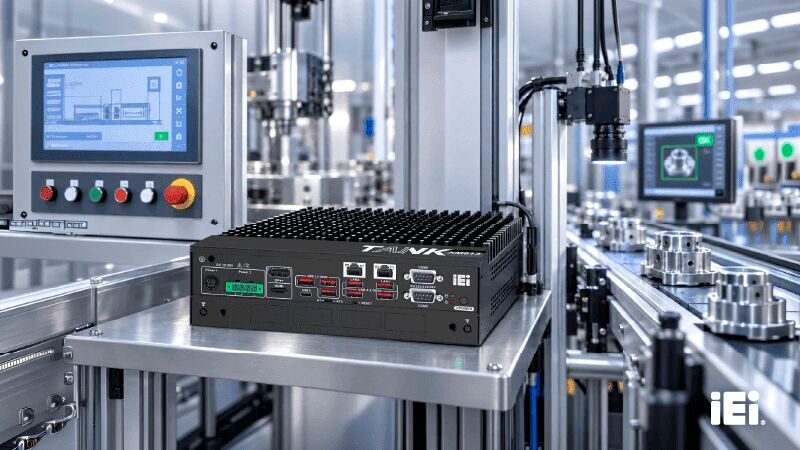
At Computex 2026, IEI demonstrated an Edge AI setup combining robotic control, local data processing and visual monitoring on an industrial platform.
(Bild: IEI)
Anyone talking about Edge AI quickly ends up talking about computing power. TOPS, GPUs, CPUs, NPUs, accelerators, platforms. For many manufacturers, the message still seems to be “bigger, faster, more powerful”. So there is a lot of talk, and a lot of promises. That is understandable, but in the end, it is only half the story. In industry, the success of an Edge AI application rarely depends on raw computing performance alone. It depends far more on whether that system fits into an environment that already exists.
And much of that environment may already be decades old.
In many factories, machines have been running for 20, 30 or 40 years, especially in Europe. The systems are paid for, productive and good enough for the job they do. What is often old is not the machine itself, but the digital environment around it. That includes operating systems, interfaces, certified software and operator interfaces. Anyone who wants to introduce Edge AI must understand why operating systems such as Windows XP or Windows 7 can remain in industrial environments long after mainstream vendor support has ended.
A Central Challenge for Digitalization
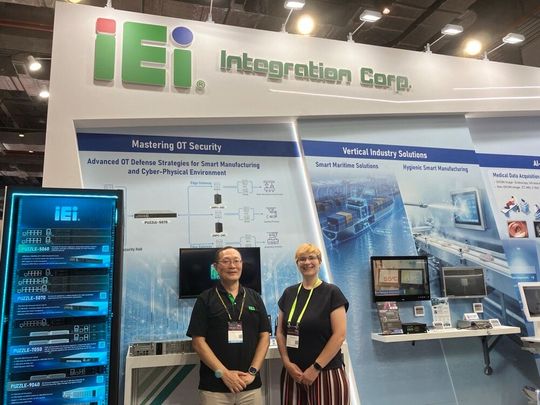
At Computex 2026 in Taipei, Y.T. Lee, Vice President Networking & Edge Computing at IEI, explains the reality that digitalization ambitions have to contend with.
(Bild: VCG/ELEKTRONIKPRAXIS)
At Computex 2026 in Taipei, Y.T. Lee, Vice President Networking & Edge Computing at IEI, described exactly this point as a central challenge for industrial digitalization. With nearly three decades of experience in embedded and advanced computing, IEI has developed a diverse portfolio spanning Edge AI, networking and medical solutions. Today, its offerings range from compact embedded products to mid- to high-performance platforms, with extensive customization capabilities for different application and deployment requirements. The portfolio extends beyond individual boards and box PCs to integrated platforms that combine computing performance, software and management capabilities to address industry-specific requirements.
This is also where customer expectations are changing. In many projects, it is no longer enough for an AI application to work in a pilot setup. Customers are looking for platforms that can be rolled out, maintained, updated and operated over many years. The proof of concept becomes a long-term operational challenge: How does the system remain available? How is it secured? How is it integrated into existing machines and plants? And who supports the customer when a demo setup turns into a productive installation?
Many providers are making promises in this direction. It becomes more interesting when Lee is not talking about future visions, but about the legacy systems that are part of industrial reality. In industry, legacy is not automatically a problem to be eliminated. Very often, it is exactly what earns a company its money.
Old Software Does Not Disappear Just Because New Hardware Arrives
Many industrial applications have been developed, adapted, validated and in some cases certified over many years. They run reliably, are deeply embedded in production processes or machine controls, and were not designed to move to a new platform every few years. That is where industry differs strongly from consumer products. A smartphone is replaced when it gets old. A machine is not.
Lee puts it very plainly in the conversation: “If you want to modify or redesign this kind of software, it is a big problem.” In the English original, he calls it a “big headache”. He is referring to applications that cannot simply be rewritten because costs, know-how, certifications and risks are attached to them.
For IEI, the virtualization of industrial software workloads and legacy operating systems is therefore an important building block. The idea is that new hardware does not replace old industrial software. Instead, existing workloads can continue to run on modern platforms. Lee describes it like this: A company can deploy a modern high-performance platform from Intel or AMD while continuing to run validated legacy applications within a virtualized environment. That may not sound particularly glamorous, but the point is industrial relevance.
Many companies are not building a completely new AI factory. They are looking for answers to questions such as: How do I bring more computing power into an existing installation? How do I keep an old application alive? How do I reduce the number of individual computers without rewriting the software? And how do I do that without turning maintenance into a computer science degree?
According to Lee, IEI addresses these requirements through virtualization and centralized management, enabling legacy and modern workloads to coexist on scalable edge platforms while keeping system resources visible and manageable. This is particularly interesting for small and medium-sized companies that do not have large IT departments. Edge AI should not become another specialist topic on top of everything else. It has to become an operable system.
Edge AI Is Not Just About Latency
Edge AI is often justified by short response times. That is true, but it does not go far enough. Machine vision, quality control or machine monitoring all benefit when decisions are made close to the machine. But for industry and medicine, there is another aspect: data cannot always go to the cloud.
Lee refers to medical applications where genetic data may not leave the country in certain markets. That is an extreme example, but it makes the basic conflict visible. Cloud AI is not automatically the right answer just because it is technically possible. Especially with sensitive industrial, medical or corporate data, the questions are control, data sovereignty and security. Edge systems can help because they process data locally and pass on only results, metadata or selected information.
For European companies, this point is especially relevant. Data protection, cybersecurity, intellectual property and critical infrastructure are not side issues. Anyone analyzing data must clarify where it is processed, who has access to it and how it is protected. Local edge processing therefore becomes a practical way to retain greater control over sensitive data and determine what information is transmitted beyond the site. That is not spectacular, but it is close to practice.
From Fixed Rules to Trainable Systems
For many industrial AI applications, the starting point was machine vision. Quality control is an obvious use case: point a camera at something, detect deviations, reduce scrap. But expectations are changing there as well. Lee says that customers used to rely mainly on rule-based systems. For optical inspection, features, tolerances and defect patterns had to be defined very precisely. Today, the focus is shifting toward training systems with good and bad examples. For selected applications, this can reduce the effort required to define every inspection rule manually.
One example from the conversation is a customer in Denmark that produces canned fish. In the past, Lee says, the company mainly looked for the cheapest hardware that could perform the specific task. With AI, this changes. The platform has to be more powerful and better suited to the application so that AI frameworks, models and analysis can work together.
This highlights a point that is often overlooked in AI discussions: Edge AI needs more than hardware. It needs an environment in which customers can actually get their application running. The platform concept is decisive here. For IEI, an Edge AI solution is not just a processor, an accelerator and a housing. It is a combination of industrial-grade hardware, virtualization, networking and security functions, framework support, central management and validation. Only this combination determines whether an application can still be operated in everyday use after the pilot project.
This is where providers such as IEI become interesting for industrial customers: not as AI magicians, but as interpreters between computing platforms and production reality. Depending on the application, the platform looks different. In manufacturing, the focus is on machine vision, quality control and machine monitoring. In medicine, local data processing and regulation move to the foreground. In transportation, energy supply, industrial networks or 5G infrastructures, availability, secure communication, network throughput and orchestration become more important. For customers, this means that adaptation, validation and integration become relevant alongside hardware selection.
From AI Vision to Real-Time Safety Response
IEI’s industrial edge platform combines AI computing, networking and system management for deployment in factory and infrastructure environments.
(Bild: IEI)
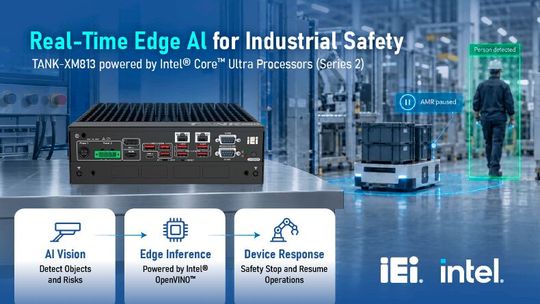
At Computex 2026, IEI demonstrated how this approach can extend beyond visual recognition. In an AMR application, a TANK-XM813 edge system combined mobile cobot management with AI-based intrusion detection through IEI’s iVEC platform. Using Intel® OpenVINO™, the system analyzed camera images locally and initiated a stop response when a person entered the operating area.
The interesting point is less the individual hardware than the connection between perception and action. AI inference and mobile cobot management were consolidated on one edge platform instead of being handled by separate systems. The demonstration therefore illustrates how Edge AI can move from identifying an event to becoming part of the operational response.
This example also highlights a point that is often overlooked in AI discussions: Edge AI needs more than hardware. It needs an environment in which customers can actually get their application running. For IEI, an Edge AI solution is not just a processor, an accelerator and a housing. It combines scalable edge computing, virtualization, networking, cybersecurity, AI framework support, centralized management and system validation, with platform options that can be tailored to different deployment requirements. Only this combination determines whether an application can still be operated in everyday use after the pilot project.
This is where providers such as IEI become interesting for industrial customers: not as AI magicians, but as interpreters between computing platforms and production reality. Depending on the application, the platform looks different. In manufacturing and Edge AI deployments, the focus is on machine vision, quality inspection, AI inference and machine monitoring. In medical applications, local data processing, reliability and regulation move to the foreground. In networking, transportation, energy and 5G infrastructure, availability, secure communication, network throughput and orchestration become more important. For customers, this means that platform flexibility, customization, validation and integration become as important as hardware selection itself.
A Challenging Market
The European market is challenging because of regulatory requirements and demanding customer expectations, but it also creates opportunities for companies such as IEI.
(Bild: IEI)
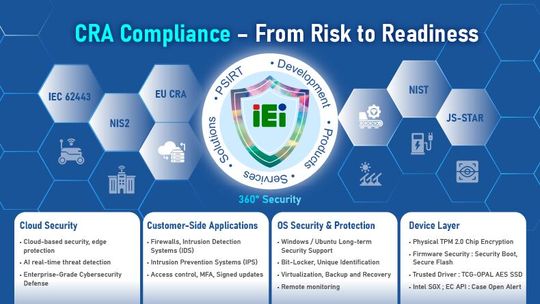
The conversation makes clear that Europe sets a high bar for deployment readiness. European customers demand stability, long-term availability, documentation, security and, increasingly, evidence of alignment with regulatory requirements. Lee mentions the Cyber Resilience Act and IEC 62443, among others. This increases the effort for manufacturers, but it can also become a competitive advantage.
Such requirements shift the benchmark. Providers that compete mainly on price come under pressure when customers ask for evidence, processes and long-term security. This is especially true in critical infrastructure, rail, marine, energy supply and industrial networks. There, it is not enough for a system to work today. It has to remain operable for years and be securely updateable.
Networking is one of IEI’s core solution areas, complementing its Edge AI and medical portfolios. Its networking and edge platforms support applications that require secure data transmission, local processing, high availability and centralized management. For Lee, Edge AI and networking are increasingly interconnected: data may need to be processed locally while systems remain securely connected, manageable and protected throughout the deployment lifecycle. Especially in Europe, he sees noticeable demand for secure network environments and local processing.
When Edge AI Has to Work Without a Large IT Team
Many companies want to digitalize, but they do not have large internal IT teams. In Germany, this does not only apply to small businesses. Many medium-sized machine builders, EMS providers and suppliers operate complex systems without having specialists for AI, IT, security and virtualization available for every edge project.
This is why Lee describes central management functions as part of IEI’s strategy. Systems should not only provide computing power, but also report their status, make resources visible and assign workloads appropriately. If Edge AI is to work on a broader scale, it must not be manageable only for companies with large IT departments.
This is exactly where many digitalization projects fail: at the transition from pilot installation to stable operation. Who maintains the system? Who updates it? Who detects failures? Who ensures that the application runs on the right hardware? IEI is trying to reduce this gap through pre-integrated systems, virtualization, central management and local support.
Supply Chain Resilience Is No Longer Just a Purchasing Issue
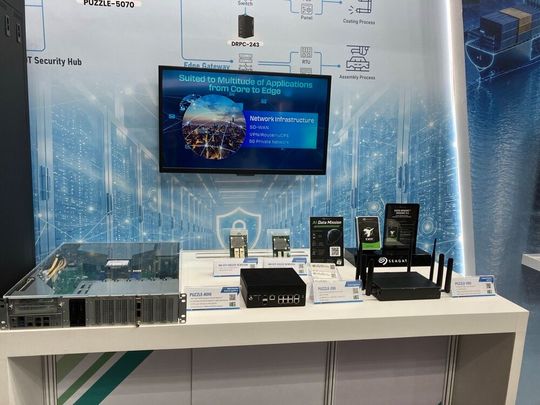
IEI offers integrated platforms for Edge AI, networking and medical applications, combining computing performance, management capabilities and customization for different deployment requirements.
(Bild: VCG/ELEKTRONIKPRAXIS)
Industrial Edge AI depends on processors, memory, SSDs, network technology, housings, cooling and energy consumption – and therefore on the same supply chains that have been causing trouble for the electronics industry for years. Lee speaks openly about shortages in memory, SSDs, flash and now also CPUs. IEI addresses these issues through close collaboration with strategic technology suppliers, together with the ability to qualify alternative components and system configurations through its own engineering and validation capabilities when necessary.
Lee also puts the old lean logic into perspective. In the past, low inventories were considered optimal. Today, he says, companies need sufficient stock again “to get through the winter”. It is a simple image, but an effective one. For customers, the decisive point is not whether a provider can absorb every price wave. What matters is whether the provider can deliver at all, and whether changes are validated before they enter an industrial system.
Energy and Temperature Become Part of the Edge Equation
One point comes up almost in passing, but it fits well with the current industrial situation: edge systems have to become more powerful, while also dealing with higher ambient temperatures and rising energy costs. Lee says that devices used to be designed for 40 or 45 °C. Today, in some cases, manufacturers have to think more in the direction of 50 or 55 °C.
Rising ambient temperatures, more densely packed control cabinets and higher computing power are increasing the demands on cooling and energy efficiency. IEI also sees this as a reason to consolidate several functions on more powerful platforms. If five individual computers can be replaced by one system, it is not only the space requirement that can fall. Maintenance, complexity and, in the best case, energy consumption can also be reduced. This is not a general rule, but it is an important starting point for industrial edge projects.
Local Presence Still Matters
For all the technology involved, one simple point remains: European customers want contacts. Not just data sheets, delivery times or a support ticket in another time zone. Especially in more complex edge and networking projects, proximity matters. IEI therefore maintains a local office in Willich, near Düsseldorf. Originally, it was focused more on logistics, but it now also handles support, training and local communication. According to Lee, product marketing and engineering teams regularly come to Europe to support internal teams, distributors and customers. Lee also talks about plans for further European markets.
This is relevant because deploying Edge AI, networking or medical platforms involves more than selecting a piece of hardware. It requires platform selection, integration, customization, validation, lifecycle management and local technical support. For European customers, local presence can therefore be important, especially when geopolitical uncertainty, supply chain problems and security requirements already add enough complexity to the project.
Edge AI Has to Fit Into Existing Industry
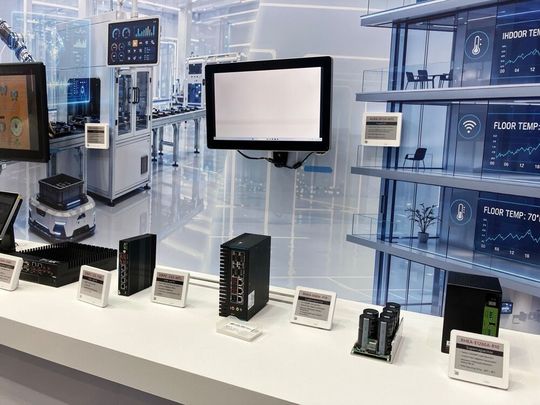
Industrial edge Al must fit into existing plants: IEl addresses industrial applications with robust edge systems, panel PCs and platforms for local data processing.
(Bild: VCG/ELEKTRONIKPRAXIS)
In the end, the conversation with Y.T. Lee leads to a simple but important conclusion: Industrial Edge AI will not succeed because it sounds modern. It will succeed when it solves existing problems. Computing power is part of that, of course. But not only that. Edge AI has to carry legacy software forward, process data locally, meet regulatory requirements and remain operable over long lifecycles – even in warm control cabinets, with scarce components and limited IT resources.
Or, to put it a little more casually: Industrial Edge AI also needs to understand Windows XP.
That is not a step backward. It is the reality in many factories. Those who ignore it may build impressive demos. Those who take it seriously have a chance to turn Edge AI into a tool that actually arrives in everyday industrial use. (sb)
Es ist für uns eine Selbstverständlichkeit, dass wir verantwortungsvoll mit Ihren personenbezogenen Daten umgehen. Sofern wir personenbezogene Daten von Ihnen erheben, verarbeiten wir diese unter Beachtung der geltenden Datenschutzvorschriften. Detaillierte Informationen finden Sie in unserer Datenschutzerklärung.
Einwilligung in die Verwendung von Daten zu Werbezwecken
Ich bin damit einverstanden, dass die Vogel Communications Group GmbH & Co. KG, Max-Planckstr. 7-9, 97082 Würzburg einschließlich aller mit ihr im Sinne der §§ 15 ff. AktG verbundenen Unternehmen (im weiteren: Vogel Communications Group) meine E-Mail-Adresse für die Zusendung von redaktionellen Newslettern nutzt. Auflistungen der jeweils zugehörigen Unternehmen können hier abgerufen werden.
Der Newsletterinhalt erstreckt sich dabei auf Produkte und Dienstleistungen aller zuvor genannten Unternehmen, darunter beispielsweise Fachzeitschriften und Fachbücher, Veranstaltungen und Messen sowie veranstaltungsbezogene Produkte und Dienstleistungen, Print- und Digital-Mediaangebote und Services wie weitere (redaktionelle) Newsletter, Gewinnspiele, Lead-Kampagnen, Marktforschung im Online- und Offline-Bereich, fachspezifische Webportale und E-Learning-Angebote. Wenn auch meine persönliche Telefonnummer erhoben wurde, darf diese für die Unterbreitung von Angeboten der vorgenannten Produkte und Dienstleistungen der vorgenannten Unternehmen und Marktforschung genutzt werden.
Meine Einwilligung umfasst zudem die Verarbeitung meiner E-Mail-Adresse und Telefonnummer für den Datenabgleich zu Marketingzwecken mit ausgewählten Werbepartnern wie z.B. LinkedIN, Google und Meta. Hierfür darf die Vogel Communications Group die genannten Daten gehasht an Werbepartner übermitteln, die diese Daten dann nutzen, um feststellen zu können, ob ich ebenfalls Mitglied auf den besagten Werbepartnerportalen bin. Die Vogel Communications Group nutzt diese Funktion zu Zwecken des Retargeting (Upselling, Crossselling und Kundenbindung), der Generierung von sog. Lookalike Audiences zur Neukundengewinnung und als Ausschlussgrundlage für laufende Werbekampagnen. Weitere Informationen kann ich dem Abschnitt „Datenabgleich zu Marketingzwecken“ in der Datenschutzerklärung entnehmen.
Falls ich im Internet auf Portalen der Vogel Communications Group einschließlich deren mit ihr im Sinne der §§ 15 ff. AktG verbundenen Unternehmen geschützte Inhalte abrufe, muss ich mich mit weiteren Daten für den Zugang zu diesen Inhalten registrieren. Im Gegenzug für diesen gebührenlosen Zugang zu redaktionellen Inhalten dürfen meine Daten im Sinne dieser Einwilligung für die hier genannten Zwecke verwendet werden. Dies gilt nicht für den Datenabgleich zu Marketingzwecken.
Recht auf Widerruf
Mir ist bewusst, dass ich diese Einwilligung jederzeit für die Zukunft widerrufen kann. Durch meinen Widerruf wird die Rechtmäßigkeit der aufgrund meiner Einwilligung bis zum Widerruf erfolgten Verarbeitung nicht berührt. Um meinen Widerruf zu erklären, kann ich als eine Möglichkeit das unter https://contact.vogel.de abrufbare Kontaktformular nutzen. Sofern ich einzelne von mir abonnierte Newsletter nicht mehr erhalten möchte, kann ich darüber hinaus auch den am Ende eines Newsletters eingebundenen Abmeldelink anklicken. Weitere Informationen zu meinem Widerrufsrecht und dessen Ausübung sowie zu den Folgen meines Widerrufs finde ich in der Datenschutzerklärung, Abschnitt Redaktionelle Newsletter.




:quality(80)/p7i.vogel.de/wcms/02/ac/02ac633824604507753bfbe704b4c9ac/0133739635v2.jpeg "Die Nobelpreisträger für Medizin 2026: Karl Deisseroth, Peter Hegemann und Georg Nagel. (Bild: Nobel Prize Outreach)")
:quality(80)/p7i.vogel.de/wcms/fd/f9/fdf9fb05837fb729c26c7e1fff63c44b/0133551695v3.jpeg "Schematische Darstellung: Ein kurzer Stromimpuls durchläuft einen Supraleiter. (Bild: Dall-E / KI-generiert)")
:quality(80)/p7i.vogel.de/wcms/38/4f/384f5a1ca48c8ca4666fd951ccab4e26/0133597121v4.jpeg "Mit rund 33 PetaFLOPS ermöglicht der neue Hochleistungsrechner Horeka 2 Berechnungen, die auf herkömmlichen Computersystemen Monate oder Jahre dauern würden. (Bild: Markus Breig, KIT)")
:quality(80)/p7i.vogel.de/wcms/0e/1a/0e1ac02c45576051e2dea7937c3f7fa9/0133943782v2.jpeg "Jack Kilby: Entwickelte den ersten integrierten Schaltkreis der Welt und legte so den Grundstein für das elektronische Zeitalter, das Texas Instruments entscheidend mitprägte. (Bild: TI)")
:quality(80)/p7i.vogel.de/wcms/ae/2f/ae2f8be6faba0eef5e1280763a1540fd/0133918510v2.jpeg "Mehrere Funkstandards auf einer Plattform: Qualcomms Dragonwing FWA Gen 6 Elite kombiniert 5G Advanced, Satellitenkommunikation und Wi-Fi 8 mit lokaler KI-Verarbeitung für die drahtlose Breitbandanbindung. (Bild: Qualcomm)")
:quality(80)/p7i.vogel.de/wcms/77/07/77076b0fe39f01b9fa2ff968697a9235/0133902131v2.jpeg "TUM-Forscher Erik Leo Haß prüft die Sensorik auf dem Fahrzeug an einer Kreuzung in Garching-Hochbrück. Aus den unterschiedlichen Echtzeit-Messungen von Kameras, Lidaren und Radaren wird ein permanent aktualisiertes Bild der Verkehrssituation erstellt. (Bild: A.Schmitz / TUM)")
:quality(80)/p7i.vogel.de/wcms/0e/b0/0eb048ece034e41de8ae33647377ff08/0133892190v2.jpeg "Von 30. November bis 04. Dezember 2026 findet der ESE-Kongress in Sindelfingen statt. Die alljährliche Entwicklerkonferenz lockt wieder zahlreiche Entwickler, Systemarchitekten, Designer und Embedded-Enthusiasten ins „Ländle“. Die Keynotes versprechen tiefe Einblicke in die aktuellen Chancen, Risiken und Herausforderungen, die der Einsatz agentischer KI mit sich bringt. (Bild: VCG / ESE Kongress)")
:quality(80)/p7i.vogel.de/wcms/ba/18/ba183500bea247c55c627d07eb4484d8/0133788141v5.jpeg "Simplicity AI SDK: Silicon Labs hat sein KI-gestütztes Entwickler-SDK in die öffentliche Beta überführt und bindet damit KI-Assistenten in den Embedded-Entwicklungsprozess ein. (Bild: Silicon Labs)")
:quality(80)/p7i.vogel.de/wcms/21/ca/21ca81e40b1764b5049d5159d95e25f0/0133748071v2.jpeg "GPT-Synopsys: ChatGPT, bekannt für das Sprachmodell ChatGPT, und EDE-Softwarespezialist Synopsys entwickeln gemeinsam eine agentische KI, die Haardwareentwickjler bei Chipdesign-Workflows tatkräftig unterstützen soll. (Bild: Synopsys)")
:quality(80)/p7i.vogel.de/wcms/2c/75/2c754216ec80a9e0543cc06fa5529ec9/0133945175v2.jpeg "Raspberry Pi Desktop: Das neue, 64-Bit-Debian-Betriebssystem ist hier installiert auf einem Dell XPS aus dem Jahr 2020. (Bild: Raspberry Pi)")
:quality(80)/p7i.vogel.de/wcms/9f/8d/9f8df4cd9cceaba8ff9e49da50b36253/0133706714v3.jpeg "Vom Sensor bis zum Server: LwM2M strukturiert Geräte- und Sensordaten über ein einheitliches Object-/Resource-Modell und ermöglicht so die standardisierte Kommunikation zwischen Embedded-Client und Cloud-Infrastruktur. (Bild: Dall-E / KI-generiert)")
:quality(80)/p7i.vogel.de/wcms/ee/6c/ee6cd73e641e91caf0a7422c4a092bb6/0133889260v2.jpeg "Bild 1:
Eine tragbare Health Sensor Plattform. (Bild: ADI)")
:quality(80)/p7i.vogel.de/wcms/a3/5e/a35ede6c3ce263b04bc05fe668c92a61/0133698752v3.jpeg "BMW baut seine Elektrofahrzeugproduktion in Bayern aus: Das neue Batteriewerk Irlbach-Straßkirchen liefert Gen6-Hochvoltbatterien nach München, wo künftig auch der erste vollelektrische M3 entstehen soll. (Bild: Fabian Kirchbauer)")
:quality(80)/p7i.vogel.de/wcms/58/e4/58e4ca0123675b5fd23a395a0a513040/0133747059v2.jpeg "Schneider Electric will PTC für rund 22,6 Mrd. US-Dollar übernehmen. Dessen CAD- und Lifecycle-Technologien sollen Engineering-, Betriebs- und Energiedaten verbinden und das Softwareangebot des Stromversorgungsspezialisten mehr in Richtung Produktentwicklung bei Kunden des Unternehmens verschieben. (Bild: PTC)")
:quality(80)/p7i.vogel.de/wcms/3d/67/3d6777d7a99bdf88f86798cd73451538/0133004756v2.jpeg "Die AGI-CPU von Arm wurde im März 2026 angekündigt. Im Rahmen der Hot Chips 2026 sind die Entwickler ins Detail gegangen. (Bild: Arm)")
:quality(80)/p7i.vogel.de/wcms/8a/2e/8a2e7d2a89ffe55c545dd6c831ed154e/0132246788v2.jpeg "Über 500 Teilnehmer, 120 Referenten: Die FPGA Conference Europe platzte in diesem Jahr aus allen Nähten – und wurde ihrem Anspruch als Leitkongress der FPGA-Welt einmal mehr gerecht. (Bild: Tobi Giessen)")
:quality(80)/p7i.vogel.de/wcms/06/a1/06a158e32b18d99fcea65547cec5d4c7/0132069489v2.jpeg "Mit direkter Integration von Speicher ins Chip-Package verspricht AMD mit dem Versal Premium Gen 2 SoC eine schnellere Datenübertragung, verringerte Latenz und einem potentiell geringere Stromverbrauch. (Bild: AMD)")
:quality(80)/p7i.vogel.de/wcms/86/2a/862afb1de8423bb7401098a2fd268281/0131792672v2.jpeg "Bild 1: Ein Spannungsversorgungskonzept für Lasten, welche eine vorgegebene Ein- und Abschaltreihenfolge (Sequencing) benötigen. (Bild: ADI)")
:quality(80)/p7i.vogel.de/wcms/31/67/3167f8f4020d83c5bbaa8d1be0ed5171/0133898582v2.jpeg "Kühlbereich im Supermarkt (Symbolbild): Hacker haben in Frankreich, Belgien und den Niederlanden Kühlschränke über ungesicherte Fernwartungs-Zugänge Kühlschränkedes Herstellers Danfoss in hunderten französischen, belgischen und niederländischen Supermärkten lahmgelegt. Der Schaden geht in Millionenhöhe. (Bild: frei lizenziert)")
:quality(80)/p7i.vogel.de/wcms/94/d7/94d79f086d3e1989167cf9782d18a13e/0133725451v2.jpeg "Festkörperbatterien: Versprechen einen massiven Reichweitesprung bei Elektroautos. Was ist dran am Versprechen und der Serienproduktion? (Bild: Dall-E / KI-generiert)")
:quality(80)/p7i.vogel.de/wcms/24/22/2422823c8106e5e0d2989446812f1166/0133923995v2.jpeg "Keysight vereinfacht gemeinsam mit Forschungsinstituten das Testen von Halbleiter-Bauelementen der nächsten Generation. (Bild: Keysight)")
:quality(80)/p7i.vogel.de/wcms/1b/ec/1becdb6cb11f50cb3b5af47fab320b1c/0133879502v2.jpeg "Das Forschungsteam bei der Installation seines Messsystems für Feldtests. Mit faseroptischen Stromsensoren lassen sich Gleichströme in einem Umspannwerk erfassen. (Bild: EMS - TU Graz)")
:quality(80)/p7i.vogel.de/wcms/09/54/0954666778f5471eaf43d45c71a714fe/0133841330v2.jpeg "Chip-on-Cell-Technik: Dukosis DK8102-Messchip erfasst Zellspannung und Temperatur direkt an der Batteriezelle und überträgt die Daten an das Batteriemanagementsystem. (Bild: Dukosi)")
:quality(80)/p7i.vogel.de/wcms/08/d3/08d30f0fe3f0cfc4ff7febcb7547eceb/0133744161v2.jpeg "Der SIS18-Tunnel am GSI Helmholtzzentrum für Schwerionenforschung in Darmstadt, Deutschland. (Bild: A. Zschau, GSI/FAIR)")
:quality(80)/p7i.vogel.de/wcms/37/2f/372f18f69870f520879a9b36ef80cccd/0133952056v2.jpeg "Multimodale Roboter-KI: Mit Neuron AI verbindet Neura Robotics Sehen, Tasten und Hören mit einem Gedächtnis, damit Roboter komplexe Aufgaben über mehrere Handlungsschritte hinweg autonom ausführen können. (Bild: Neura Robotics )")
:quality(80)/p7i.vogel.de/wcms/53/89/5389634e83d7c1f82daff9bf232f58aa/0133896104v2.jpeg "Trägheitsarme Robotik: AthenaZero kombiniert niedrig übersetzte Antriebe mit einer schnellen Regelung, um Bälle zu werfen, zu fangen und Schläge auszuführen. Die Konstruktion ermöglicht schnelle und zugleich nachgiebige Armbewegungen. (Bild: RAI (Robotics and AI Institute))")
:quality(80)/p7i.vogel.de/wcms/6d/38/6d38ad8702a1979c09e4684bf4e369dc/0133939086v2.jpeg "Die neun optischen Sensoren von Vishay kombinieren einen Infrarotemitter mit einer PIN-Fotodiode. Sie ermöglichen eine bidirektionale Datenübertragung mit bis zu 6 Mbit/s, beispielsweise im Batteriemanagement von Elektrofahrzeugen. (Bild: Vishay)")
:quality(80)/p7i.vogel.de/wcms/f8/ee/f8ee296ae7b5aba19fb551d3897677b0/0133429822v3.jpeg "Technikzentrum: Im Schwabacher Vorführbereich hält Multi Components verschiedene Anlagen für Demonstrationen, Schulungen und Prozessversuche bereit. (Bild: VCG)")
:quality(80)/p7i.vogel.de/wcms/2f/1d/2f1d9576f230695d58ec216c32db4258/0133940060v2.jpeg "Die modulare DC-Stromversorgung von Burger Engineering kombiniert bis zu acht Netzteilmodule in einem 19-Zoll-Baugruppenträger und liefert je nach Konfiguration bis zu 24 kW. (Bild: Burger Engineering)")
:quality(80)/p7i.vogel.de/wcms/4f/00/4f00b5674e5f29bee57da5b436d57eea/0133925158v2.jpeg "Schematische Darstellung der HARDSIL-Technologie: Zusätzliche Schutzstrukturen im Silizium fördern die Rekombination und Ableitung elektrischer Ladungen, die durch hochenergetische Teilchen entstehen. Dadurch sinkt das Risiko strahlungsbedingter Fehlfunktionen in CMOS-Schaltungen. (Bild: Vorago / KI-enhanced)")
:quality(80)/p7i.vogel.de/wcms/bb/e1/bbe14df33cbae5543e0b776ed4ef9943/0133913848v2.jpeg "Illustration: Bei der Direct-to-Chip-Kühlung nimmt eine Kühlplatte die Wärme direkt am Prozessor auf. Bei der Immersionskühlung werden die elektronischen Komponenten dagegen vollständig in eine elektrisch isolierende Kühlflüssigkeit eingetaucht. (Bild: Dall-E / KI-generiert)")
:quality(80)/p7i.vogel.de/wcms/71/67/7167b34cf64152af762cef864e5ff569/0133920050v2.jpeg "Globalfoundries erweitert seine Fab in Dresden im Rahmen des Projekts Sprint. Bis Ende 2028 soll die jährliche Fertigungskapazität auf mehr als eine Million 300-mm-Wafer steigen. (Bild: Globalfoundries)")
:quality(80)/p7i.vogel.de/wcms/2e/1c/2e1c64de3d6bf78e534c5123855b9b75/0133907105v4.jpeg "Jean-Marc Chery: STM hat den 66-jährigen Manager für ein weiteres Jahr als CEO bestellt. (Bild: STM)")
:quality(80)/p7i.vogel.de/wcms/6b/1d/6b1dde86fdb120b4cf9b8bc8573c415a/0133056789v3.jpeg "Wir bezahlen für Systeme, die menschliche Arbeit übernehmen, ohne bislang geklärt zu haben, wie die dadurch entstehende Wertschöpfung künftig verteilt werden soll. (Bild: frei lizenziert)")
:quality(80)/p7i.vogel.de/wcms/47/20/47201c1ce3692dbdb4e7e62709de4e16/0132649717v3.jpeg "Ingenieurberufe verändern sich: Neben der aktuellen Konjunktur treiben Digitalisierung, KI und neue Technologien den Bedarf an kontinuierlicher Qualifizierung. (Bild: frei lizenziert)")
:quality(80)/p7i.vogel.de/wcms/4e/41/4e4159d1e93e67d47bd2f51a90691b23/0131548978v2.jpeg "Transformation im Engineering: KI-gestützte Systeme generieren zunehmend selbstständig Schaltschranklayouts und entlasten Konstrukteure von zeitraubenden Routineaufgaben. (Bild: WSCAD)")
:fill(fff,0)/p7i.vogel.de/companies/69/7b/697b32013a007/v3-iei-logo.png "v3-iei-logo (IEI Integration Corp)")
:quality(80)/p7i.vogel.de/wcms/c1/e0/c1e0071872f9752bca0645cc849b527b/0133564408v2.jpeg "Advantech’s AIoT Co-Creation Campus in Linkou, Taiwan, a hub for smart manufacturing and AIoT Innovation. The company develops industrial computing platforms and customized solutions for Edge AI, medical, robotics, and other industrial applications. (Bild: Advantech)")
:quality(80)/p7i.vogel.de/wcms/08/51/0851f6318ac9121e32ff8d6eea21b93b/0133252787v2.jpeg "TXC targets high-speed optical links in AI data centers with 312.5 MHz oscillators, among other solutions. As data rates increase, requirements for jitter and frequency stability become more demanding as well. (Bild: TXC)")