Cloud AI is powerful, but it is not the right answer in every situation. For industrial, medical, and robotics applications, Advantech is focusing on local AI, customized hardware and systems that give customers greater control over data, latency, and system performance.
Advantech’s AIoT Co-Creation Campus in Linkou, Taiwan, a hub for smart manufacturing and AIoT Innovation. The company develops industrial computing platforms and customized solutions for Edge AI, medical, robotics, and other industrial applications.
(Bild: Advantech)
For a surgical robot, the latency of a cloud connection is not an abstract IT metric. If an image has to be transmitted to a remote location for processing and then sent back, latency and dependence on a stable connection can become real operational concerns. Tony Chen, Vice President and Head of Advantech’s Applied Computing Group (ACG), which provides Design and Manufacturing Services (DMS), sees this as a clear example of why the future of industrial AI will extend beyond the data center. Chen emphasizes that, in a hospital environment, latency and connectivity can become critical considerations in time-sensitive medical applications. That does not mean the cloud is going away. Large models and compute-intensive workloads will continue to have their place there. But another class of systems is growing alongside them: machines, medical devices, vehicles and robots that can run AI locally and respond to data without having to ask a data center for every decision.
Chen sees particularly strong potential for local AI adoption in Europe. Not because European developers are fundamentally opposed to the cloud, but because data protection, latency, security, and the desire to keep proprietary know-how under their own control tend to play a particularly important role in Europe. But AI adoption is not only a hardware challenge. Integrating AI into existing software environments — particularly legacy systems — can be equally complex.
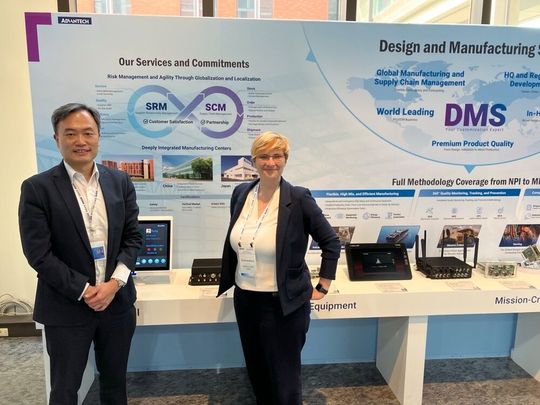
Tony Chen, VP and Head of Applied Computing Group at Advantech, with Susanne Braun.
(Bild: VCG)
Not every form of intelligence needs to live in the cloud
Advantech comes from a world in which embedded and industrial computers remain inside machines for years or even decades. The first wave of digitalization connected devices to networks, and later more and more data moved into cloud systems. With Edge AI, part of the processing is now moving back toward the device. For Chen, this is not an either-or decision. Cloud and Edge AI serve different purposes. Large models can run in the data center, while smaller or more specialized models handle tasks directly at the machine.
In a production system, that could mean making a quality decision. In a medical device, it could mean processing an image. In a robot, it could involve assessing the surrounding environment. The important point is that not every piece of information has to be transmitted before the system can react. This reduces latency while also allowing sensitive data to remain within the company’s infrastructure.
Chen observes the latter particularly often among European customers. They do not necessarily want to transfer their proprietary knowledge, algorithms, or process data to an external service. For a medical technology company, software expertise developed over many years can be a major component of the product itself. Chen puts it in a somewhat unusual way: European companies want to keep their own “personality” within their AI systems. By this, he means that their own software logic, algorithms, and know-how should remain within their system. A company that has developed its own diagnostic functions, machine control systems, or image-processing technologies may not want the associated data and algorithms to leave its own infrastructure. For Edge AI, this represents a practical way to keep proprietary intelligence and data within the company’s infrastructure.
A new processor can mean two years of software work
In theory, building an AI system sounds straightforward: choose a suitable computing platform, install the required software, and get started. In industrial applications, however, it is rarely that simple. Advantech offers a wide range of standard platforms. In parallel, Chen’s Applied Computing Group works with customers whose requirements do not fit an existing configuration. That may involve computing performance, form factor, or environmental conditions — from high or low temperatures and limited space to special interfaces or specific AI acceleration requirements.
But the more difficult adaptation is typically not the hardware. “European customers place a strong emphasis on their own software,” Chen says. Moving from one processor platform to another can create considerable additional work. If an application has been developed and validated for a particular x86 platform over many years, switching to another processor platform may sound easier than it actually is. Some customers estimate that such a migration could require as much as two years of software work. In medical technology in particular, a platform change can also trigger additional validation and testing.
A new chip is then not simply a new chip. This is also why Advantech does not see customization as merely changing a PCB. The work can just as easily involve migrating existing software to new hardware while minimizing disruption to the customer’s existing development environment.
WEDA bridges Edge AI deployment across industrial verticals
To address this challenge, Advantech provides WEDA, the WISE-Edge Developer Architecture, as a common software layer for AI and IoT applications. Advantech describes WEDA as a modular development framework intended to provide common software functions across different edge systems. Chen describes the idea behind it as a kind of “glue layer” – a layer that holds the different elements together.
The goal is to reduce the need for developers to work with completely different interfaces and software conventions across Intel- and AMD-based systems, NVIDIA platforms, or Arm-based architectures. WEDA provides development tools such as containers, APIs and SDKs, while Advantech tries to absorb some of the hardware differences underneath. Those differences do not disappear entirely, of course. An Arm-based system is still technically different from an x86 platform, and an API alone cannot automatically make every software application portable across architectures. But the migration effort can become smaller.
According to Advantech’s own evaluation, WEDA can reduce development time by around 30 percent in suitable projects, Chen says. That is a vendor figure and will depend on the individual project. For Advantech, however, there is also a simple business rationale behind it: hardware has little value if the customer cannot finish the product. “If our customer cannot deliver a product, we are in the same boat,” Chen says.
Standard hardware remains important – but not for every application
The shift toward customized systems does not, however, make standard products obsolete. For many applications, they are still the fastest route to a finished product. Advantech offers both a broad portfolio of standardized products and its Applied Computing Group (ACG), which provides Design and Manufacturing Services (DMS) for customers whose requirements go beyond standard configurations. Sometimes the necessary modification is minor. In other projects, the result is a substantially different platform.
The starting point is not necessarily a specific processor or architecture. Chen names Intel, AMD, NVIDIA and several Arm-based platforms as possible foundations. The key question is which platform best fits the application. Focusing on a single architecture can make development more efficient. At the same time, it increases dependence on that architecture remaining successful and available over the long term.
Advantech accepts the trade-off: supporting several platforms in parallel requires additional investment and engineering resources. Chen nevertheless considers this necessary to give customers greater flexibility in choosing the platform that best fits their applications.
Betting on only one ecosystem can go wrong
The distinction between x86 and Arm is becoming less clear. At the same time, AI accelerators, NPUs, and GPUs are reshaping traditional embedded architecture. No one can reliably predict which platform will dominate a particular application five or ten years from now. Advantech deliberately keeps several technology paths open. Chen puts it simply: do not put all of your eggs in one basket.
That strategy is not free. Maintaining a multi-platform strategy requires continued engineering investment, but Advantech sees this as essential to giving customers long-term flexibility and reducing dependency on any single technology architecture. This approach also allows Advantech to remain prepared as market and geopolitical conditions change.
Embedded systems add another complication: product lifecycles are much longer than the typical innovation cycle of a processor. Chen speaks of projects that run for five or ten years. Some products are still being shipped 15 years after the first delivery. Advantech aligns technology roadmaps not only with chip suppliers, but also with the long-term needs of its customers.
Just-in-Time is becoming Just-in-Case
Recent supply constraints show that this dependency is not just a hypothetical possibility. Memory prices and availability can come under pressure again as market conditions change. According to Chen, Advantech tries to identify such developments early, negotiate contracts with suppliers and qualify alternative components for customers.
The logic has changed compared with previous years. “Supply chain used to mean Just-in-Time,” Chen says. “Today, it is more like Just-in-Case.” More inventory does not solve every problem, however. An alternative memory device or processor still has to be tested and qualified in the target industrial system. Advantech qualifies multiple memory variants and configurations for selected platforms.
For an individual machine builder, the same second-source qualification work requires engineering resources that could otherwise be spent on its own product. The service may be less spectacular than an AI demonstration at a trade show. For a product that is designed to remain available for ten years, it can be more important.
Europe needs more than hardware nearby
Chen’s view of Europe is notably pragmatic. He considers the market attractive for customized systems, but it does not function as one homogeneous economic region. Germany is not France, France is not Italy, and Italy is not Scandinavia. Advantech maintains local technical and sales teams across different European regions (Advantech's Design & Manufacturing Services. Made in Europe.). For Chen, it is not enough to ship hardware from Taiwan and then try to solve every problem by email or video call.
He describes a project in Italy where a mechanical issue could not be resolved clearly despite several discussions. Only when an engineer visited the customer did it become apparent that both sides had simply been looking at the problem from different angles. “It is about people and communication,” Chen says.
That does not entirely fit the image of an increasingly autonomous AI world, and it does not have to. The more tightly hardware, software, and application are connected, the more likely problems are to emerge at the interfaces. Sometimes a local engineer can solve more than the next digital support system.
A machine does not have to be allowed to do everything it can do
In the end, the Edge AI discussion comes back to a fairly traditional embedded question: what does the system actually need to do? A medical device requires different computing performance from an autonomous vehicle. A vision-processing robot needs different accelerators from a battery-powered system where every watt matters. And not every machine needs the largest AI processor available.
Chen describes Advantech’s role as more like that of a master chef than a semiconductor manufacturer. The ingredients come from different platform suppliers. The customer defines the desired outcome. Advantech then tries to build a system that fits the application.
Edge AI does not become suitable for industrial use simply by putting as much computing power as possible into a machine. It has to work with existing software, operate under real-world environmental conditions, remain available for years and continue to be supportable even if a chip or memory component disappears from the market. For European developers, another requirement often comes on top: they want to know where their data remains and who controls the system.
The cloud can be part of the solution. It just does not automatically have to be the place where every decision is made. (sb)
Es ist für uns eine Selbstverständlichkeit, dass wir verantwortungsvoll mit Ihren personenbezogenen Daten umgehen. Sofern wir personenbezogene Daten von Ihnen erheben, verarbeiten wir diese unter Beachtung der geltenden Datenschutzvorschriften. Detaillierte Informationen finden Sie in unserer Datenschutzerklärung.
Einwilligung in die Verwendung von Daten zu Werbezwecken
Ich bin damit einverstanden, dass die Vogel Communications Group GmbH & Co. KG, Max-Planckstr. 7-9, 97082 Würzburg einschließlich aller mit ihr im Sinne der §§ 15 ff. AktG verbundenen Unternehmen (im weiteren: Vogel Communications Group) meine E-Mail-Adresse für die Zusendung von redaktionellen Newslettern nutzt. Auflistungen der jeweils zugehörigen Unternehmen können hier abgerufen werden.
Der Newsletterinhalt erstreckt sich dabei auf Produkte und Dienstleistungen aller zuvor genannten Unternehmen, darunter beispielsweise Fachzeitschriften und Fachbücher, Veranstaltungen und Messen sowie veranstaltungsbezogene Produkte und Dienstleistungen, Print- und Digital-Mediaangebote und Services wie weitere (redaktionelle) Newsletter, Gewinnspiele, Lead-Kampagnen, Marktforschung im Online- und Offline-Bereich, fachspezifische Webportale und E-Learning-Angebote. Wenn auch meine persönliche Telefonnummer erhoben wurde, darf diese für die Unterbreitung von Angeboten der vorgenannten Produkte und Dienstleistungen der vorgenannten Unternehmen und Marktforschung genutzt werden.
Meine Einwilligung umfasst zudem die Verarbeitung meiner E-Mail-Adresse und Telefonnummer für den Datenabgleich zu Marketingzwecken mit ausgewählten Werbepartnern wie z.B. LinkedIN, Google und Meta. Hierfür darf die Vogel Communications Group die genannten Daten gehasht an Werbepartner übermitteln, die diese Daten dann nutzen, um feststellen zu können, ob ich ebenfalls Mitglied auf den besagten Werbepartnerportalen bin. Die Vogel Communications Group nutzt diese Funktion zu Zwecken des Retargeting (Upselling, Crossselling und Kundenbindung), der Generierung von sog. Lookalike Audiences zur Neukundengewinnung und als Ausschlussgrundlage für laufende Werbekampagnen. Weitere Informationen kann ich dem Abschnitt „Datenabgleich zu Marketingzwecken“ in der Datenschutzerklärung entnehmen.
Falls ich im Internet auf Portalen der Vogel Communications Group einschließlich deren mit ihr im Sinne der §§ 15 ff. AktG verbundenen Unternehmen geschützte Inhalte abrufe, muss ich mich mit weiteren Daten für den Zugang zu diesen Inhalten registrieren. Im Gegenzug für diesen gebührenlosen Zugang zu redaktionellen Inhalten dürfen meine Daten im Sinne dieser Einwilligung für die hier genannten Zwecke verwendet werden. Dies gilt nicht für den Datenabgleich zu Marketingzwecken.
Recht auf Widerruf
Mir ist bewusst, dass ich diese Einwilligung jederzeit für die Zukunft widerrufen kann. Durch meinen Widerruf wird die Rechtmäßigkeit der aufgrund meiner Einwilligung bis zum Widerruf erfolgten Verarbeitung nicht berührt. Um meinen Widerruf zu erklären, kann ich als eine Möglichkeit das unter https://contact.vogel.de abrufbare Kontaktformular nutzen. Sofern ich einzelne von mir abonnierte Newsletter nicht mehr erhalten möchte, kann ich darüber hinaus auch den am Ende eines Newsletters eingebundenen Abmeldelink anklicken. Weitere Informationen zu meinem Widerrufsrecht und dessen Ausübung sowie zu den Folgen meines Widerrufs finde ich in der Datenschutzerklärung, Abschnitt Redaktionelle Newsletter.




:quality(80)/p7i.vogel.de/wcms/fd/f9/fdf9fb05837fb729c26c7e1fff63c44b/0133551695v3.jpeg "Schematische Darstellung: Ein kurzer Stromimpuls durchläuft einen Supraleiter. (Bild: Dall-E / KI-generiert)")
:quality(80)/p7i.vogel.de/wcms/38/4f/384f5a1ca48c8ca4666fd951ccab4e26/0133597121v4.jpeg "Mit rund 33 PetaFLOPS ermöglicht der neue Hochleistungsrechner Horeka 2 Berechnungen, die auf herkömmlichen Computersystemen Monate oder Jahre dauern würden. (Bild: Markus Breig, KIT)")
:quality(80)/p7i.vogel.de/wcms/b4/92/b49204e04a3873c3423b09341f49978d/0133560035v3.jpeg "Bild 1: Japans erster Full-Stack-Quantencomputer mit neutralen Atomen: „Shunkai“. (Bild: Takafumi Tomita)")
:quality(80)/p7i.vogel.de/wcms/59/e7/59e7c0aa06de56ae34c112dc699006a8/0133630806v2.jpeg "Auch wenn die Preise für DRAM- und NAND-Speicher aufgrund hoher nachfrage und geringer Kapazitäten noch hoch bleiben, scheint der Markt erste Anzeichen eines nachlassenden Booms zu zeigen. Demnach zeigen sich Anleger zunehmend skeptisch, wie viel länger der KI-Boom den anhaltenden Aufwärtstrend im Speichermarkt aufrecht erhalten kann. (Bild: Dall-E / KI-generiert)")
:quality(80)/p7i.vogel.de/wcms/c3/2e/c32e790193ba54478cfd67fcf017d5c7/0133616348v2.jpeg "Glassubstrate sollen künftig komplexere Chip-Packages mit hoher Verbindungsdichte ermöglichen: Intels neues Patent beschreibt darüber hinaus die Integration von MicroLEDs und Through-Glass Vias direkt in solche Trägerstrukturen. (Bild: Intel)")
:quality(80)/p7i.vogel.de/wcms/80/3c/803c2fa45b3bc921effa08d1434968e5/0133619268v2.jpeg "AMD-CEO Lisa Hsu (links) und World-Labs-Gründerin Dr. Fei-Fei Li (rechts) bei der Unterzeichnung der Absichtserklärung. AMD plant, das auf KI-„Weltmodelle“ spezialisierte Startup World Labs für 8,2 Mrd. US-Dollar zu übernehmen. (Bild: World Labs)")
:quality(80)/p7i.vogel.de/wcms/e0/fa/e0fa67c1612a9337dfc6d4e21e87692d/0133564427v2.jpeg "Advantechs AIoT Co-Creation Campus in Linkou, Taiwan, ist ein Zentrum für intelligente Fertigung und AIoT-Innovationen. Das Unternehmen entwickelt industrielle Computing-Plattformen sowie kundenspezifische Lösungen für Edge AI, Medizintechnik, Robotik und weitere industrielle Anwendungen. (Bild: Advantech)")
:quality(80)/p7i.vogel.de/wcms/5a/ee/5aeeda78980612ccefd3d3b7359586fd/0133584733v2.jpeg "Müssen zwingend neue Kraftwerke gebaut werden, um dem weltweiten Bedarf an KI-Rechenzentren gerecht zu werden? Eine Studie der TU Wien kommt zu der Ansicht: Meist wird das bereits existierende Netz nicht hinreichend berücksichtigt. Ein KI-Rechenzentrum dürfe nicht als ein „gewöhnlicher Verbraucher“ betrachtet werden. (Bild: frei lizenziert)")
:quality(80)/p7i.vogel.de/wcms/49/b5/49b5709c4760a7e39a77d6c33d14d383/0133615651v2.jpeg "Raspberry Pi Smart Display Module mit gestecktem Compute Module 5: Vollständig integrierte Displaylösung mit zahlreichen Anschlüssen. (Bild: Raspberry Pi Foundation)")
:quality(80)/p7i.vogel.de/wcms/79/d6/79d66dbe68a764a30256ca3019cf125d/0133536417v2.jpeg "Lässt sich ein Hardware-in-the-Loop-Testsystem in die Cloud verlagern? Das Münchner Startup OnMCU hat das getan, und dabei wertvolle Best-Practice-Erfahrungen gesammelt. (Bild: OnMCU)")
:quality(80)/p7i.vogel.de/wcms/00/97/0097c22b112065506b113f1ff07ea8ab/0133509585v2.jpeg "Ventuno Q RoadTest: soll der Element14-Community helfen, mittels Ventuno Q praktische Erkenntnisse aus realen Tests zu gewinnen. (Bild: Farnell/Element14)")
:quality(80)/p7i.vogel.de/wcms/b0/6c/b06c4f2f3742f611a51234b5662adf46/0133570286v3.jpeg "Die drei Tesvolt Forton-Batteriespeichersysteme wurden vor Beginn des Oktoberfestes geliefert. (Bild: TESVOLT)")
:quality(80)/p7i.vogel.de/wcms/0b/66/0b663c1fe794d553620f55f023dafc0c/0133561356v2.jpeg "Elektroschutz: Wegen eines Körperschlusses steht das Gehäuse des Staubsaugers unter Spannung. Bei einer Steckdose ohne Schutzkontakt kann die Sicherung nicht auslösen. Ein solcher Fehler bleibt bei einem isolierenden Untergrund, wie einem trockenen Holzboden, unbemerkt bis ein geerdetes System, in diesem Fall der Heizkörper, angefasst wird und ein lebensgefährlicher Fehlerstrom (rot) durch den Menschen fließt. (Bild: Stefan Jellinek: Elektroschutz. Wien – Leipzig 1931, mit KI erweitert)")
:quality(80)/p7i.vogel.de/wcms/3d/67/3d6777d7a99bdf88f86798cd73451538/0133004756v2.jpeg "Die AGI-CPU von Arm wurde im März 2026 angekündigt. Im Rahmen der Hot Chips 2026 sind die Entwickler ins Detail gegangen. (Bild: Arm)")
:quality(80)/p7i.vogel.de/wcms/8a/2e/8a2e7d2a89ffe55c545dd6c831ed154e/0132246788v2.jpeg "Über 500 Teilnehmer, 120 Referenten: Die FPGA Conference Europe platzte in diesem Jahr aus allen Nähten – und wurde ihrem Anspruch als Leitkongress der FPGA-Welt einmal mehr gerecht. (Bild: Tobi Giessen)")
:quality(80)/p7i.vogel.de/wcms/06/a1/06a158e32b18d99fcea65547cec5d4c7/0132069489v2.jpeg "Mit direkter Integration von Speicher ins Chip-Package verspricht AMD mit dem Versal Premium Gen 2 SoC eine schnellere Datenübertragung, verringerte Latenz und einem potentiell geringere Stromverbrauch. (Bild: AMD)")
:quality(80)/p7i.vogel.de/wcms/86/2a/862afb1de8423bb7401098a2fd268281/0131792672v2.jpeg "Bild 1: Ein Spannungsversorgungskonzept für Lasten, welche eine vorgegebene Ein- und Abschaltreihenfolge (Sequencing) benötigen. (Bild: ADI)")
:quality(80)/p7i.vogel.de/wcms/06/d1/06d1ec4b8f42ff4b3f3d31bbf3a4cd3e/0133537978v2.jpeg "IT-Security wird in OT-Umgebungen immer wichtiger: Die zunehmende Vernetzung von IT und OT schafft zusätzliche Angriffsflächen. (Bild: KI-generiert)")
:quality(80)/p7i.vogel.de/wcms/60/e7/60e71d2e90f60e5ddef056cb234724e0/0133466221v2.jpeg "Strom unter Last: Das Stromdichteprofil zeigt die Verteilung im Hochleistungs-IGBT-Modul. (Bild: Comsol)")
:quality(80)/p7i.vogel.de/wcms/31/20/3120ef4dfc9af325be75131132df2e6a/0133343322v2.jpeg "Aerodynamik-Weltrekord – Mission Efficiency setzt mit einem cW-Wert von 0,158 die neue Bestmarke aller straßenzugelassenen Autos. (Bild: Volkswagen AG)")
:quality(80)/p7i.vogel.de/wcms/a3/c5/a3c56d1f9857c9b2cd6466172d72bf11/0133565945v2.jpeg "Die um einen Spulenkörper gewickelte Glasfaser erfasst das Magnetfeld des Stromes im elektrischen Leiter. So lassen sich Schäden an Transformatoren frühzeitig verhindern. (Bild: EMS - TU Graz)")
:quality(80)/p7i.vogel.de/wcms/43/f0/43f00c25059dfc29f6424c9ba7820c62/0133597084v2.jpeg "Signalintegrität im Fokus:
Der technologische Weg von Siglent führte vom einfachen Oszilloskop hin zu High-End-Geräten für die Analyse schneller Datenübertragungen, wie diesem Vektornetzwerkanalysator mit Augendiagramm-Darstellung. (Bild: Siglent)")
:quality(80)/p7i.vogel.de/wcms/b7/48/b74826a5e7846764aab62093a5cc1cd7/0133545824v2.jpeg "Einrichten einer MIPI A-PHY-Rx-Teststation mit Testautomatisierungssoftware ValiFrame, Oszilloskop von Keysight und Arbitrary-Wave-Generator. Ein bestandener Compliance-Test ist kein Freibrief für den Feldeinsatz. (Bild: BitifEye)")
:quality(80)/p7i.vogel.de/wcms/06/f8/06f81a56e8b4dba56769b65bea11196c/0133538220v2.jpeg "Aufbau zur Messung der Wärmeleitfähigkeit bei kryogenen Temperaturen. Das Kryo-Labor ergänzt die Infrastruktur für Quantencomputing-Komponenten. (Bild: TU Chemnitz)")
:quality(80)/p7i.vogel.de/wcms/e5/ed/e5edd5ba6f7caba5f27ea5d106c8a864/0133627519v2.jpeg "Roboter-Flaute im Autobau: Deutschlands Automatisierung verliert an Tempo. Warum Experten die nächste große Wachstumschance nun im Mittelstand sehen. (Bild: © phonlamaiphoto - stock.adobe.com)")
:quality(80)/p7i.vogel.de/wcms/0d/ab/0daba984baebe0ad6a5249af120ab229/0133562669v2.jpeg "Entwickler von Embedded-Software für Medizinprodukte müssen regulatorische Anforderungen von Anfang an berücksichtigen und dürfen diese nicht erst kurz vor der CE-Zertifizierung einbeziehen. (Bild: frei lizenziert)")
:quality(80)/p7i.vogel.de/wcms/76/15/76154e7f8b7da9d44bd95bf631dcf52b/0133615834v2.jpeg "Mit neuen und umgerüsteten 300-mm-Fabs will Tower Semiconductor Japan zu seinem zentralen Produktionsstandort für Siliziumphotonik und optische Datenverbindungen ausbauen. Bis 2029 soll die Kapazität auf 45.000 300-mm-Wafer pro Monat steigen. (Bild: gemeinfrei)")
:quality(80)/p7i.vogel.de/wcms/c0/59/c059ade8345f075d770cee51b48ee68b/0133605070v2.jpeg "Führende Vertreter der Regierung von Singaput, Vanguard International Semiconductor und NXP bei der Eröffnung der im Joint Venture betriebenen VSMC-Fab in Singapur. (Bild: NXP)")
:quality(80)/p7i.vogel.de/wcms/c0/84/c08471d35631d559425a8f0266a4faf4/0133517283v2.jpeg "Robotiksoftware im Fokus: Mit der Übernahme von Picknik will Qualcomm das Open-Source-Framework MoveIt enger mit seinen Dragonwing-Plattformen und Arduino verzahnen. (Bild: Qualcomm)")
:quality(80)/p7i.vogel.de/wcms/6b/1d/6b1dde86fdb120b4cf9b8bc8573c415a/0133056789v3.jpeg "Wir bezahlen für Systeme, die menschliche Arbeit übernehmen, ohne bislang geklärt zu haben, wie die dadurch entstehende Wertschöpfung künftig verteilt werden soll. (Bild: frei lizenziert)")
:quality(80)/p7i.vogel.de/wcms/47/20/47201c1ce3692dbdb4e7e62709de4e16/0132649717v3.jpeg "Ingenieurberufe verändern sich: Neben der aktuellen Konjunktur treiben Digitalisierung, KI und neue Technologien den Bedarf an kontinuierlicher Qualifizierung. (Bild: frei lizenziert)")
:quality(80)/p7i.vogel.de/wcms/4e/41/4e4159d1e93e67d47bd2f51a90691b23/0131548978v2.jpeg "Transformation im Engineering: KI-gestützte Systeme generieren zunehmend selbstständig Schaltschranklayouts und entlasten Konstrukteure von zeitraubenden Routineaufgaben. (Bild: WSCAD)")