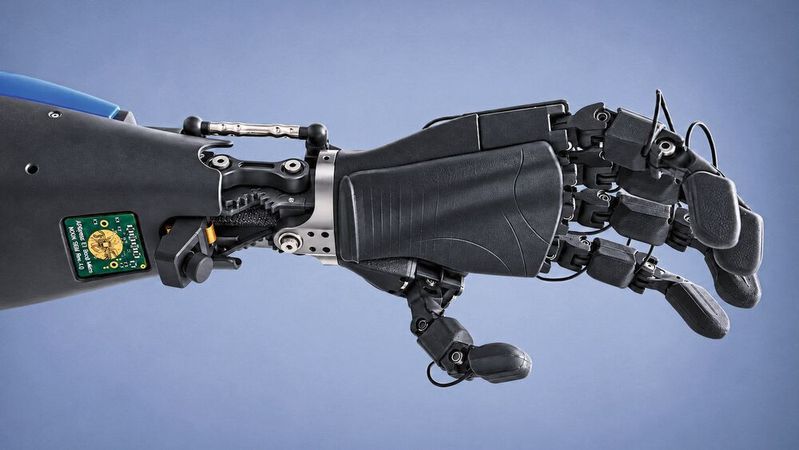
At electronica 2026, Inova and Lattice demonstrated a humanoid robotic hand control platform that synchronizes 18 motors and multiple sensors within a single 100-microsecond control cycle.. APXpress networking and Lattice Nexus-based FPGAs enable synchronized 10 kHz motion control with communication latency below 10 microseconds, supporting precise motor coordination and simplified sensor connectivity.
Precise coordination: Inova's APXpress networking and Lattice FPGAs synchronize all 18 motors of a humanoid robotic hand within a single 100-microsecond control cycle.
(Bild: Inova)
Developed in collaboration with the German Aerospace Center (DLR) Institute of Robotics and Mechatronics, the platform combines Inova Semiconductors’ APXpress high-speed networking technology with low-power Lattice CertusPro-NX and CrossLink-NX FPGAs. The architecture integrates 18 motor controllers, joint-angle sensors and a tactile array comprising 10 sensors into a single deterministic communication network. DLR contributes its expertise in robotic manipulation and field-oriented motor control, while the FPGA-based implementation provides distributed processing capabilities at individual motor nodes.
A key technical achievement is the completion of the distributed motion-control loop within one 10 kHz control period, equivalent to 100 microseconds. Communication between sensor sampling and the delivery of updated target values takes less than 10 microseconds, allowing all motor axes to respond synchronously. Conventional cyclic architectures typically introduce a delay of one or two control periods between feedback acquisition and current adjustment. By eliminating this inter-cycle delay, the demonstrated system supports faster control responses and more stable impedance regulation, particularly for robotic applications involving physical human interaction.
Field-oriented control (FOC) is implemented locally on a Lattice FPGA at each motor, operating at a frequency higher than the network's 10 kHz control rate. This distributed processing architecture enables each motor to regulate its electrical currents independently while receiving synchronized target updates through the APXpress network. Coordinating the motor axes within the same control period reduces timing differences between fingers, supporting smoother movement and more precise manipulation. The combination of local high-speed current regulation and deterministic network communication is particularly relevant for multi-axis robotic hands requiring tightly coordinated motion.
The network also accommodates joint-angle measurements and tactile feedback through a separate communication schedule designed to protect time-critical motor-control traffic. Although tactile sensing generates a substantial portion of the transmitted data, scheduled transfers prevent interference with motor commands. This separation allows the system to consolidate motion control and sensor communication onto the same physical network without compromising deterministic timing. The available APXpress bandwidth also eliminates the need for an independent sensor wiring harness, reducing system complexity while maintaining access to multiple feedback sources.
To minimize cabling, the motor controllers are arranged in a daisy-chain topology using short point-to-point connections instead of a conventional star configuration. This approach reduces the number and length of wires routed through the robotic hand, helping limit weight and mechanical restrictions around moving finger joints. The compact network arrangement also improves integration flexibility by reducing bulky cable bundles in mechanically constrained areas. Combining the motor and sensor connections into one network provides a more scalable approach to distributed electronics in articulated robotic mechanisms.
Beyond the demonstrated hand configuration, the APXpress network topology has been designed to accommodate additional data streams from cameras, radar and other perception sensors. Inova is developing silicon solutions around this modular architecture, with Lattice supporting FPGA integration and DLR providing scientific expertise in robotic control. Although the presented system remains a development demonstrator, its same-cycle control performance, distributed FOC implementation and reduced wiring requirements establish a technical foundation for more responsive, compact and highly integrated humanoid robotic systems.(sg)
Stand: 08.12.2025
Es ist für uns eine Selbstverständlichkeit, dass wir verantwortungsvoll mit Ihren personenbezogenen Daten umgehen. Sofern wir personenbezogene Daten von Ihnen erheben, verarbeiten wir diese unter Beachtung der geltenden Datenschutzvorschriften. Detaillierte Informationen finden Sie in unserer Datenschutzerklärung.
Einwilligung in die Verwendung von Daten zu Werbezwecken
Ich bin damit einverstanden, dass die Vogel Communications Group GmbH & Co. KG, Max-Planckstr. 7-9, 97082 Würzburg einschließlich aller mit ihr im Sinne der §§ 15 ff. AktG verbundenen Unternehmen (im weiteren: Vogel Communications Group) meine E-Mail-Adresse für die Zusendung von redaktionellen Newslettern nutzt. Auflistungen der jeweils zugehörigen Unternehmen können hier abgerufen werden.
Der Newsletterinhalt erstreckt sich dabei auf Produkte und Dienstleistungen aller zuvor genannten Unternehmen, darunter beispielsweise Fachzeitschriften und Fachbücher, Veranstaltungen und Messen sowie veranstaltungsbezogene Produkte und Dienstleistungen, Print- und Digital-Mediaangebote und Services wie weitere (redaktionelle) Newsletter, Gewinnspiele, Lead-Kampagnen, Marktforschung im Online- und Offline-Bereich, fachspezifische Webportale und E-Learning-Angebote. Wenn auch meine persönliche Telefonnummer erhoben wurde, darf diese für die Unterbreitung von Angeboten der vorgenannten Produkte und Dienstleistungen der vorgenannten Unternehmen und Marktforschung genutzt werden.
Meine Einwilligung umfasst zudem die Verarbeitung meiner E-Mail-Adresse und Telefonnummer für den Datenabgleich zu Marketingzwecken mit ausgewählten Werbepartnern wie z.B. LinkedIN, Google und Meta. Hierfür darf die Vogel Communications Group die genannten Daten gehasht an Werbepartner übermitteln, die diese Daten dann nutzen, um feststellen zu können, ob ich ebenfalls Mitglied auf den besagten Werbepartnerportalen bin. Die Vogel Communications Group nutzt diese Funktion zu Zwecken des Retargeting (Upselling, Crossselling und Kundenbindung), der Generierung von sog. Lookalike Audiences zur Neukundengewinnung und als Ausschlussgrundlage für laufende Werbekampagnen. Weitere Informationen kann ich dem Abschnitt „Datenabgleich zu Marketingzwecken“ in der Datenschutzerklärung entnehmen.
Falls ich im Internet auf Portalen der Vogel Communications Group einschließlich deren mit ihr im Sinne der §§ 15 ff. AktG verbundenen Unternehmen geschützte Inhalte abrufe, muss ich mich mit weiteren Daten für den Zugang zu diesen Inhalten registrieren. Im Gegenzug für diesen gebührenlosen Zugang zu redaktionellen Inhalten dürfen meine Daten im Sinne dieser Einwilligung für die hier genannten Zwecke verwendet werden. Dies gilt nicht für den Datenabgleich zu Marketingzwecken.
Recht auf Widerruf
Mir ist bewusst, dass ich diese Einwilligung jederzeit für die Zukunft widerrufen kann. Durch meinen Widerruf wird die Rechtmäßigkeit der aufgrund meiner Einwilligung bis zum Widerruf erfolgten Verarbeitung nicht berührt. Um meinen Widerruf zu erklären, kann ich als eine Möglichkeit das unter https://contact.vogel.de abrufbare Kontaktformular nutzen. Sofern ich einzelne von mir abonnierte Newsletter nicht mehr erhalten möchte, kann ich darüber hinaus auch den am Ende eines Newsletters eingebundenen Abmeldelink anklicken. Weitere Informationen zu meinem Widerrufsrecht und dessen Ausübung sowie zu den Folgen meines Widerrufs finde ich in der Datenschutzerklärung, Abschnitt Redaktionelle Newsletter.