As the number of dynamic lighting functions increases, automotive lighting is evolving into a connected system. With ISELED and ILaS, Inova offers a platform-based approach to simplify the integration of intelligent lighting, sensor, and actuator functions into zonal E/E architectures.
Driver-machine interaction: Light communicates vehicle status, and supports comfort, safety, and personalization functions.
With the development of software-defined vehicles, the role of lighting is also changing. Light no longer serves merely as a design feature or for illuminatio – it is becoming an integral part of human-machine interaction, communicates vehicle status, and supports comfort, safety, and personalization functions. As a result, the number of dynamic light points is increasing. In a modern vehicle, hundreds of LEDs must be reliably controlled, synchronized, and diagnosed. This raises the question of how light points can be integrated into and connected within the vehicle architecture. Meanwhile, E/E architectures are evolving toward centralized computing units and zonal control units. The challenge is therefore to implement more lighting functions without a proportional increase in the complexity of electronics, wiring, and software.
Modern RGB Lighting Architectures must be scalable
In traditional RGB lighting systems, functions such as control, calibration, and diagnostics are often distributed across multiple components, software layers, and suppliers. Color deviations are compensated for through binning, look-up tables, or individual corrections. Different hardware variants also increase development and tuning effort. For OEMs, data rate and component price are therefore not the only decisive factors. Other key factors include determinism, latency, addressability, diagnostic capability, cabling complexity, and the scalability of the overall system. This is precisely where the platform concept of ISELED and ILaS comes into play.
ISELED: Intelligence at the Light Point
ISELED integrates an LED driver and an RGB LED into a single digitally addressable light point. Calibration is performed by the LED manufacturer and stored directly in the chip. The control unit transmits digital color values, while color mixing and temperature compensation take place locally. This removes the need for centrally managed calibration data and additional compensation algorithms. Digital, bidirectional communication within an ISELED chain enables light points to be individually addressed, grouped, and diagnosed. The protocol supports up to 4,079 participants.
This creates a clear separation between lighting function and physical implementation. Welcome sequences, animations, or warning messages can be defined at the software level and reused across vehicle variants. The characteristics of the individual light points remain largely encapsulated within the local hardware.
ISELED 2.0 extends this approach to more demanding lighting applications. Among other features, the INLC15AQ offers higher driver currents, finer PWM resolution, and higher PWM frequencies, as well as advanced temperature compensation functions. This enables the implementation of more demanding requirements for dynamic lighting, brightness control, and temperature performance. Separate settings for day and night applications also enable dimming ratios of up to 32,000.
ILaS: From the Light Point to a Local Functional Network
ISELED provides connectivity between intelligent light points on the printed circuit board. ILaS – ISELED Light and Sensor Network – extends this principle beyond the PCB, using cable connections across vehicle zones.
In addition to intelligent LEDs, the bidirectional network also connects sensors and actuators. The ILaS transceiver INLT220Q can be used as a base chip or a repeater and supports a data rate of 2 Mbps over several meters of unshielded twisted-pair cable. Two cable interfaces and a chip-to-chip interface also support different network topologies. Sensors, push buttons, or small actuators can be connected via GPIOs.
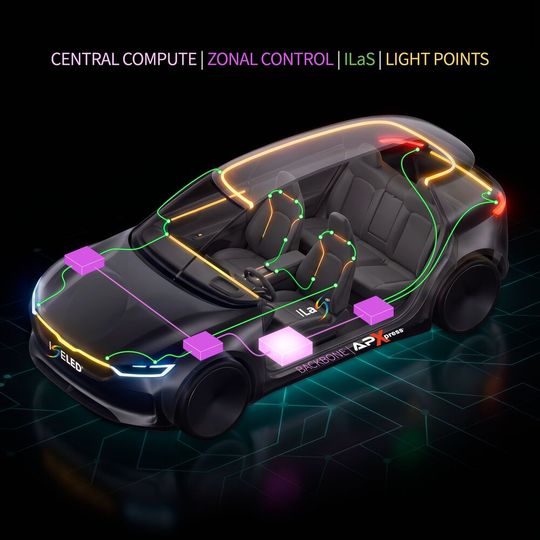
ILaS is not intended to replace the vehicle backbone. Automotive Ethernet, CAN, or other backbone technologies connect central computers and zone control units. ILaS complements this architecture at the local level between zone electronics and distributed lighting, sensor, and actuator functions (figure 1).
Stand: 08.12.2025
Es ist für uns eine Selbstverständlichkeit, dass wir verantwortungsvoll mit Ihren personenbezogenen Daten umgehen. Sofern wir personenbezogene Daten von Ihnen erheben, verarbeiten wir diese unter Beachtung der geltenden Datenschutzvorschriften. Detaillierte Informationen finden Sie in unserer Datenschutzerklärung.
Einwilligung in die Verwendung von Daten zu Werbezwecken
Ich bin damit einverstanden, dass die Vogel Communications Group GmbH & Co. KG, Max-Planckstr. 7-9, 97082 Würzburg einschließlich aller mit ihr im Sinne der §§ 15 ff. AktG verbundenen Unternehmen (im weiteren: Vogel Communications Group) meine E-Mail-Adresse für die Zusendung von redaktionellen Newslettern nutzt. Auflistungen der jeweils zugehörigen Unternehmen können hier abgerufen werden.
Der Newsletterinhalt erstreckt sich dabei auf Produkte und Dienstleistungen aller zuvor genannten Unternehmen, darunter beispielsweise Fachzeitschriften und Fachbücher, Veranstaltungen und Messen sowie veranstaltungsbezogene Produkte und Dienstleistungen, Print- und Digital-Mediaangebote und Services wie weitere (redaktionelle) Newsletter, Gewinnspiele, Lead-Kampagnen, Marktforschung im Online- und Offline-Bereich, fachspezifische Webportale und E-Learning-Angebote. Wenn auch meine persönliche Telefonnummer erhoben wurde, darf diese für die Unterbreitung von Angeboten der vorgenannten Produkte und Dienstleistungen der vorgenannten Unternehmen und Marktforschung genutzt werden.
Meine Einwilligung umfasst zudem die Verarbeitung meiner E-Mail-Adresse und Telefonnummer für den Datenabgleich zu Marketingzwecken mit ausgewählten Werbepartnern wie z.B. LinkedIN, Google und Meta. Hierfür darf die Vogel Communications Group die genannten Daten gehasht an Werbepartner übermitteln, die diese Daten dann nutzen, um feststellen zu können, ob ich ebenfalls Mitglied auf den besagten Werbepartnerportalen bin. Die Vogel Communications Group nutzt diese Funktion zu Zwecken des Retargeting (Upselling, Crossselling und Kundenbindung), der Generierung von sog. Lookalike Audiences zur Neukundengewinnung und als Ausschlussgrundlage für laufende Werbekampagnen. Weitere Informationen kann ich dem Abschnitt „Datenabgleich zu Marketingzwecken“ in der Datenschutzerklärung entnehmen.
Falls ich im Internet auf Portalen der Vogel Communications Group einschließlich deren mit ihr im Sinne der §§ 15 ff. AktG verbundenen Unternehmen geschützte Inhalte abrufe, muss ich mich mit weiteren Daten für den Zugang zu diesen Inhalten registrieren. Im Gegenzug für diesen gebührenlosen Zugang zu redaktionellen Inhalten dürfen meine Daten im Sinne dieser Einwilligung für die hier genannten Zwecke verwendet werden. Dies gilt nicht für den Datenabgleich zu Marketingzwecken.
Recht auf Widerruf
Mir ist bewusst, dass ich diese Einwilligung jederzeit für die Zukunft widerrufen kann. Durch meinen Widerruf wird die Rechtmäßigkeit der aufgrund meiner Einwilligung bis zum Widerruf erfolgten Verarbeitung nicht berührt. Um meinen Widerruf zu erklären, kann ich als eine Möglichkeit das unter https://contact.vogel.de abrufbare Kontaktformular nutzen. Sofern ich einzelne von mir abonnierte Newsletter nicht mehr erhalten möchte, kann ich darüber hinaus auch den am Ende eines Newsletters eingebundenen Abmeldelink anklicken. Weitere Informationen zu meinem Widerrufsrecht und dessen Ausübung sowie zu den Folgen meines Widerrufs finde ich in der Datenschutzerklärung, Abschnitt Redaktionelle Newsletter.
Figure 1: From central computing and the vehicle backbone to zonal control and local ILaS networking
(Bild: Inova Semiconductors)
More Distributed Intelligence, Less Local Complexity
Zonalization is changing the division of functions within the electronic architecture. Functions are increasingly being consolidated into central or zonal processing units, while intelligent endpoints are moving closer to the physical function and processing information locally.
ILaS supports this approach by connecting light, sensor, and actuator functions via a shared local communication infrastructure. This can help reduce the need for dedicated wiring and local electronics while enabling more compact designs.
The INLT301Q is a combined chip featuring an ILaS cable transceiver, smart LED driver, and DC/DC step-down converter. This allows highly integrated, networked light modules.
Software-defined vehicles are increasingly moving differentiation into software. A central processing unit can, for example, define a lighting scene, a warning function, or an HMI sequence. This information must be reliably transmitted to and implemented at the light points within the zone.
The more functions are defined by software, the more important a stable and predictable hardware foundation becomes. Color accuracy, latency, diagnostics, EMC performance, and fault responses must remain reproducible across vehicle variants. Calibrated light points and defined communication interfaces create a level of abstraction between software functionality and physical implementation.
ISELED handles key functions at the endpoint, while ILaS provides local communication within the zone. This allows higher-level software to focus more on the actual function and the user experience. At the same time, bidirectional communication makes it possible to report operating states and narrow down faults.
The Ecosystem as Part of the Platform
For production decisions, technology is only on consideration. Industrialization, component availability, supply chain options, software integration, and a reliable partner network are equally essential. The ISELED Alliance, therefore, takes an ecosystem approach: semiconductor manufacturers, LED suppliers, microcontroller manufacturers, as well as software, tool, and system partners work within a common technological framework. For OEMs and Tier 1, this creates a broader foundation for development and industrialization while also increasing supply chain resilience.
Focus on Total System Costs
When evaluating lighting architecture, simply comparing individual components is not enough. The costs of control units, circuit boards, cables, and connectors, as well as those associated with calibration, software development, software integration, diagnostics, and variant management, must also be considered. Weight, power consumption, EMC-related measures, installation, and fault handling also affect overall system costs. An optimized architectural approach can contribute to reducing these costs across the entire system. As a result, the system architecture itself is a key factor in the scalability of future lighting functions.
A Scalable Hardware Platform for Software-Defined Lighting Functions
The challenge for the next generation of vehicles is to integrate more light points and functions without proportionally increasing the effort required for wiring, electronics, and software.
To achieve this goal, ISELED and ILaS are pursuing a platform-based approach: ISELED standardizes the intelligent light point, while ILaS extends the concept into a local network for light, sensor, and actuator functions. This enables differentiation to increasingly take place through software, lighting design, and vehicle functions, while the hardware and communication architecture are built on a standardized and scalable foundation. (se)