What happens to a fuse when currents and fault energy increase, but the available space does not? Taiwanese manufacturer Conquer develops protection components for AI servers, battery systems and uninterruptible power supplies (UPS). Materials, thermal management, simulation and volume production all have to be considered together.
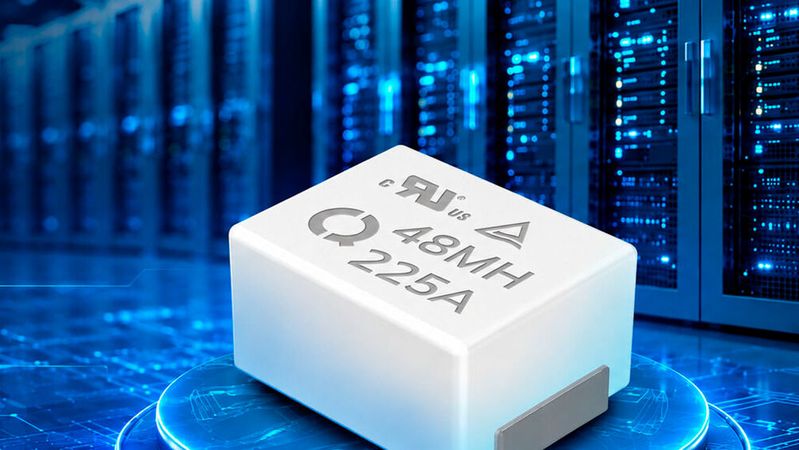
Conquer’s 48MH series SMD fuses are designed for high-current applications in AI servers and data centers. Their compact form factor supports automated assembly.
(Bild: Conquer)
Ideally, a fuse operates without attracting attention. It carries current as long as everything operates normally and disconnects the circuit when something goes wrong. That may sound like a straightforward task. In AI servers, energy storage systems and high-power UPS systems, however, it has become much more demanding. High currents and potentially high fault energy have to be managed within very limited space. At the same time, thermal loads must not endanger either the fuse itself or the overall system.
At this point, the fuse can no longer be considered as an isolated protection component.
“Fuse design today is no longer only about overcurrent protection. It is closely connected to system safety, thermal management and the overall power architecture,” says Ben Sung, Sales & Marketing Division at Conquer Electronics. A small component must be able to safely interrupt a very high fault current when necessary. This requires the interrupting rating, thermal stability, form factor, material selection and manufacturability to work together.
The path to AI servers started with home appliances
Conquer was founded in Taiwan in 1977 and is now managed by the second generation of the family. AI, of course, played no role in the company’s early business. Its first major applications were home appliances and other consumer products. Notebooks, servers and uninterruptible power supplies followed later. In recent years, the focus has shifted again, this time towards AI infrastructure, energy storage and battery systems.
That does not mean the older business is disappearing. Many customer products remain on the market for a long time and continue to require components that were originally approved for them. Some fuses have been manufactured for more than 20 years, even though volumes and margins have long since declined. Conquer continues to produce these series while also needing development and manufacturing capacity for new applications. At some point, every manufacturer has to decide which projects it can continue to support. Conquer is no exception.
The AI business shows how quickly priorities can change. Only a few years ago, it was essentially an extension of the conventional server market. According to the company, AI-related applications now account for around 20 to 30 percent of its revenue. This share has grown particularly strongly since 2025.
What customers are asking for sounds contradictory at first
Smaller, but more powerful: this summarizes many of the requests Conquer currently receives. For a fuse, this means handling higher rated currents and voltages as well as higher potential fault currents within a compact form factor. When a fault occurs, the fuse element melts and generates heat. Even high electrical ratings are of little value if the heat cannot be managed safely.
This is why the manufacturer is experimenting with geometries, materials and manufacturing processes. Silver and copper are among the materials used for the fuse element. However, the sharp rise in the price of silver is increasingly making material selection an economic consideration as well.
Conquer is therefore investigating composite solutions combining silver and copper. These could reduce the amount of expensive precious metal without compromising protection performance or reliability. For now, however, this remains development work rather than a general replacement for existing designs.
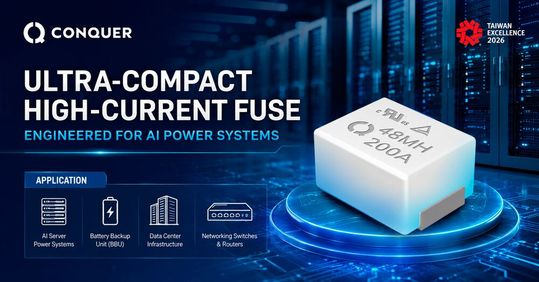
At the same time, the company is expanding its range of SMD fuses. Customers in Europe and North America in particular need components that can be integrated into automated assembly processes without requiring special production steps. With its 48MH series for AI data centers, Conquer has transferred this approach to a high-current SMD fuse. The series received the Taiwan Excellence Award 2026.
It represents a development direction that came up repeatedly during our conversation: high current capability, limited space and a package suitable for automated assembly.
Sometimes the machine has to be developed together with the component
The 48MH series from Conquer is a high-current SMD fuse for AI servers and data centers. It combines high current capability with a compact package suitable for automated assembly.
(Bild: Conquer)
“When we develop a new product, we also have to think about how we can manufacture it in high volumes,” Sung explains.
Product development and production equipment engineering therefore take place in parallel. If a new fuse requires a process that does not yet exist, the necessary equipment may also have to be developed or adapted.
The company illustrates the scale of the challenge with a simple example: in the worst case, six new products can mean six new machines. At the same time, production equipment for older product generations still has to remain in operation. New manufacturing capacity therefore cannot be added at the same pace as new requests arrive from the AI market.
According to Conquer, around 99 percent of its production is automated. This is the result of a development process that began long before the current AI boom. When Conquer became a major fuse supplier to the global notebook industry, the company invested, among other things, in 60 machines from Germany. Camera systems monitor important manufacturing characteristics and are designed to detect defects in joints and formed parts.
An electrically convincing prototype is therefore only half the job. A design only becomes suitable for high-volume production when material feeding, joining, forming, inspection and packaging can all operate reliably. Whether this is possible is not decided after development is finished, but during the development process itself.
Simulation does not replace the prototype, but it reduces development iterations
A customer request can start in very different ways. Sometimes the required current, voltage and form factor have already been defined, and only a suitable standard component is needed. In other cases, the fuse element or the time-current characteristic also has to be adapted to the power architecture. Conquer and the customer then develop the design together.
Simulation plays an important role in this process. Conquer uses Comsol Multiphysics to evaluate the electrical and thermal behavior of a design at an early stage.
“Before the customer invests larger amounts of money, we can jointly develop and simulate a design that already comes very close to the final result,” Sung explains. The company estimates that the simulated design can reach around 90 percent of the final solution.
This does not eliminate the need for physical prototypes, testing and certification. But potential problems can be identified before significant investment has already gone into tooling and manufacturing processes.
According to Conquer, it took the company two to three years to build up the necessary simulation expertise. What matters is combining the models with experience gained from different applications. An AI server has different requirements from a battery system, a UPS or a home appliance.
Not every request therefore results in a custom-designed fuse. Tooling, machine modifications and safety certifications all cost money. Co-design only makes sense if the expected production volume justifies the investment. Where this is the case, the manufacturer and the customer can jointly plan the design, the required investments and the subsequent production process.
The AI market gives suppliers little time
Rapid growth generates revenue, but it also increases the pace throughout the supply chain.
“In the past, we often had one year or more for a new design. Today, this period has sometimes been reduced to six months,” the company reports.
Another challenge is that customers themselves do not always know which solution will eventually enter volume production. In some cases, they initially provide only a current and voltage range and ask the component manufacturer to develop a suitable design. At that stage, it may still be unclear whether the associated server platform will ultimately reach high production volumes.
A successful generation of conventional servers could remain in production for three to five years. In the AI environment, power requirements and architectures change much faster.
For suppliers, this means making investments in advance. Development, validation and potentially new manufacturing equipment have to be financed before future demand is known. Not every new design can be pursued at the same time. This may sound obvious, but in a market with increasingly short product cycles, it becomes a very real limitation.
For developers, the conclusion is clear: the fuse manufacturer needs to become involved earlier in the project. If current, voltage or the cooling concept changes only shortly before the planned start of production, materials, geometry and manufacturing processes cannot simply be adapted at the same speed.
The lowest price is not always the right benchmark
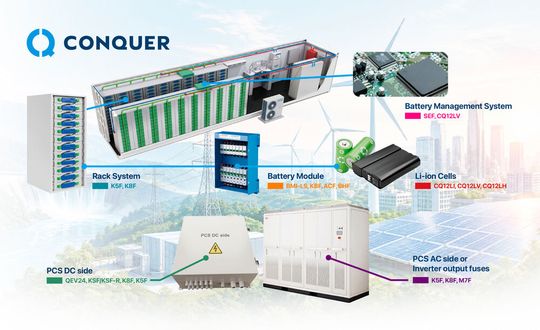
The graphic shows possible locations for Conquer fuses within a battery energy storage system, from the rack system and battery modules to Li-ion cells and the battery management system.
(Bild: Conquer)
Not every market has the same requirements. In highly price-sensitive applications, such as parts of the lighting market, there is little room for complex or customized solutions. The situation is different where safety, reliability and customization are given greater priority. These are the projects Conquer focuses on.
“For us, quality comes before cost. Our advantage is not the lowest price, but the reliability of our products,” the company summarizes its position.
Rather than offering as many different electronic components as possible, Conquer continues to deepen its expertise in fuses and transfer this knowledge to new applications.
This specialization also opens the door to OEM and private-label projects. According to Conquer, some competitors are removing product lines from their own portfolios because of rising raw material and manufacturing costs, or are looking for partners to handle volume production.
This becomes particularly interesting when a supplier is capable of developing a good product but does not want to build the required mass-production infrastructure. Translating an electrical specification into a component that can be validated is one challenge. Turning it into a stable, automated production process is another.
A sample from Taiwan should not spend weeks in transit
Even the best component is of limited use during the design phase if engineers have to wait too long for a sample. Conquer has been serving the European market for more than 20 years and works with distributors and representatives in the region. In Germany, its partner network includes Alfatec and Rutronik.
Depending on the product, available samples can therefore reach customers within 24 to 48 hours.
Regional demand still differs significantly. In North America, AI data centers are already driving strong demand for high-current and high-voltage solutions. In Europe, conventional power supplies, UPS systems, subminiature fuses and cartridge fuses are still more common.
According to Conquer, the European AI infrastructure market is still at an earlier stage, although demand is beginning to develop.
The company sees the greatest additional potential in energy storage systems, battery packs and battery modules as well as high-power UPS systems. These applications combine increasing power levels and long operating lifetimes with high safety requirements.
By contrast, Conquer explicitly does not focus its strategy on the defense market. The company intends to grow in application areas where it already has development experience and established customer relationships, including with internationally active Tier 1 customers.
Regulation is an effort – but also a quality filter
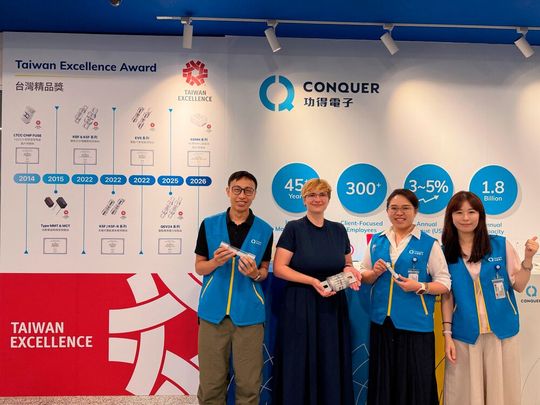
During a visit to Conquer in Taiwan: Ben Sung from the Sales & Marketing Division (left), Susanne Braun and other members of the Conquer team.
(Bild: Conquer)
RoHS, REACH and other substances, environmental and quality requirements are part of doing business in Europe. The number of requirements continues to increase and meeting them naturally requires additional effort. Conquer, however, does not see regulation as bureaucracy alone. Common rules can also build trust and make differences in quality more visible.
According to the company, Conquer has been addressing environmental and sustainability issues systematically since 2017. In manufacturing, this includes handling process water, oils and chemical liquids and preventing contamination. It also includes measures to reduce energy consumption in day-to-day operations.
The broader question, however, begins before manufacturing. How can a product later be reused or recycled? AI infrastructure and battery systems in particular are growing rapidly and require large amounts of material and energy. Anyone developing new hardware should therefore consider the end of its life cycle before the equipment is already being removed from service.
In the end, the fuse must fit the application
The fuse itself remains a small component. The task behind it has become much larger.
In modern power architecture, a fuse not only has to disconnect the right circuit at the right moment. Its thermal behavior must be manageable, it has to be compatible with automated assembly, it must be able to meet the required certifications, and it must be reproducible in high volumes.
The most difficult parts are often the transitions: between electrical specifications and materials, between simulation and physical prototypes, and between the component and the production equipment.
Conquer brings these steps together in one development process. This becomes particularly relevant when a standard fuse is no longer sufficient, but a new design still has to move into volume production quickly and reproducibly. (sb)
Es ist für uns eine Selbstverständlichkeit, dass wir verantwortungsvoll mit Ihren personenbezogenen Daten umgehen. Sofern wir personenbezogene Daten von Ihnen erheben, verarbeiten wir diese unter Beachtung der geltenden Datenschutzvorschriften. Detaillierte Informationen finden Sie in unserer Datenschutzerklärung.
Einwilligung in die Verwendung von Daten zu Werbezwecken
Ich bin damit einverstanden, dass die Vogel Communications Group GmbH & Co. KG, Max-Planckstr. 7-9, 97082 Würzburg einschließlich aller mit ihr im Sinne der §§ 15 ff. AktG verbundenen Unternehmen (im weiteren: Vogel Communications Group) meine E-Mail-Adresse für die Zusendung von redaktionellen Newslettern nutzt. Auflistungen der jeweils zugehörigen Unternehmen können hier abgerufen werden.
Der Newsletterinhalt erstreckt sich dabei auf Produkte und Dienstleistungen aller zuvor genannten Unternehmen, darunter beispielsweise Fachzeitschriften und Fachbücher, Veranstaltungen und Messen sowie veranstaltungsbezogene Produkte und Dienstleistungen, Print- und Digital-Mediaangebote und Services wie weitere (redaktionelle) Newsletter, Gewinnspiele, Lead-Kampagnen, Marktforschung im Online- und Offline-Bereich, fachspezifische Webportale und E-Learning-Angebote. Wenn auch meine persönliche Telefonnummer erhoben wurde, darf diese für die Unterbreitung von Angeboten der vorgenannten Produkte und Dienstleistungen der vorgenannten Unternehmen und Marktforschung genutzt werden.
Meine Einwilligung umfasst zudem die Verarbeitung meiner E-Mail-Adresse und Telefonnummer für den Datenabgleich zu Marketingzwecken mit ausgewählten Werbepartnern wie z.B. LinkedIN, Google und Meta. Hierfür darf die Vogel Communications Group die genannten Daten gehasht an Werbepartner übermitteln, die diese Daten dann nutzen, um feststellen zu können, ob ich ebenfalls Mitglied auf den besagten Werbepartnerportalen bin. Die Vogel Communications Group nutzt diese Funktion zu Zwecken des Retargeting (Upselling, Crossselling und Kundenbindung), der Generierung von sog. Lookalike Audiences zur Neukundengewinnung und als Ausschlussgrundlage für laufende Werbekampagnen. Weitere Informationen kann ich dem Abschnitt „Datenabgleich zu Marketingzwecken“ in der Datenschutzerklärung entnehmen.
Falls ich im Internet auf Portalen der Vogel Communications Group einschließlich deren mit ihr im Sinne der §§ 15 ff. AktG verbundenen Unternehmen geschützte Inhalte abrufe, muss ich mich mit weiteren Daten für den Zugang zu diesen Inhalten registrieren. Im Gegenzug für diesen gebührenlosen Zugang zu redaktionellen Inhalten dürfen meine Daten im Sinne dieser Einwilligung für die hier genannten Zwecke verwendet werden. Dies gilt nicht für den Datenabgleich zu Marketingzwecken.
Recht auf Widerruf
Mir ist bewusst, dass ich diese Einwilligung jederzeit für die Zukunft widerrufen kann. Durch meinen Widerruf wird die Rechtmäßigkeit der aufgrund meiner Einwilligung bis zum Widerruf erfolgten Verarbeitung nicht berührt. Um meinen Widerruf zu erklären, kann ich als eine Möglichkeit das unter https://contact.vogel.de abrufbare Kontaktformular nutzen. Sofern ich einzelne von mir abonnierte Newsletter nicht mehr erhalten möchte, kann ich darüber hinaus auch den am Ende eines Newsletters eingebundenen Abmeldelink anklicken. Weitere Informationen zu meinem Widerrufsrecht und dessen Ausübung sowie zu den Folgen meines Widerrufs finde ich in der Datenschutzerklärung, Abschnitt Redaktionelle Newsletter.




:quality(80)/p7i.vogel.de/wcms/8a/9c/8a9caa85007d3299d7c3971d7eafc942/0133479121v2.jpeg "Leonard Neuberger und Linus Rüllmann von der Weißensee Kunsthochschule Berlin haben mit ihrem Any-Projekt den nationalen James Dyson Award 2026 erhalten. (Bild: Dyson)")
:quality(80)/p7i.vogel.de/wcms/71/a8/71a84cd5963e9ac263a77c788c339dc2/0133489329v3.jpeg "Eine Sandbox begrenzt die Handlungsmöglichkeiten eines KI-Agenten, ist aber keine undurchdringliche Barriere. Erst mehrere unabhängige Schutzebenen verhindern, dass ein Ausbruch unmittelbar den Zugriff auf produktive Systeme ermöglicht. (Bild: frei lizenziert)")
:quality(80)/p7i.vogel.de/wcms/e1/dc/e1dce42a75133bb2434f7e7719c0f68e/0133441212v2.jpeg "Wukong, ein von Origin Quantum gefertigter Quantenprozessor mit 72 Qubits. (Bild: Origin Quantum)")
:quality(80)/p7i.vogel.de/wcms/de/70/de70aa086973b1d297cb520d90bf19bb/0133423537v2.jpeg "Bluetooth Channel Sounding: Wie präzise die Messung ist, hängt jedoch auch von Antenne, HF-Design, Umgebung und Auswertealgorithmus ab. (Bild: KI-generiert)")
:quality(80)/p7i.vogel.de/wcms/f8/5c/f85c5fbc8487acc36917ad430a1135d5/0133483193v2.jpeg "Der Vitalsensor goVISCAN: Mittig sitzt die Multispektralkamera mit einem 3x3-Mikrolinsenarray, das die spektralen Bänder erfasst. Kreisförmig herum sind LEDs verbaut, die die Messszene beleuchten. (Bild: Fraunhofer IOF)")
:quality(80)/p7i.vogel.de/wcms/fa/df/fadfd73dc467982f68f9bc3a842e8ad0/0133471827v2.jpeg "Photonik-SDK für C und Python: Jetzt werden Rechenoperationen als normale mathematische Funktionen abstrahiert. (Bild: Q.ANT)")
:quality(80)/p7i.vogel.de/wcms/58/93/5893d1c1946bcc25a9f8b8b939409aa2/0133444365v2.jpeg "KI trifft Lagerrobotik: Im Düsseldorfer Innovation Lab demonstriert Geekplus unter anderem humanoide Roboter, mobile Transportsysteme und das KI-Framework Gravity. (Bild: Geekplus)")
:quality(80)/p7i.vogel.de/wcms/8d/bb/8dbbf755d59174ecab99febfdd469fa3/0133422468v4.jpeg "(Bild: Spectra)")
:quality(80)/p7i.vogel.de/wcms/00/97/0097c22b112065506b113f1ff07ea8ab/0133509585v2.jpeg "Ventuno Q RoadTest: soll der Element14-Community helfen, mittels Ventuno Q praktische Erkenntnisse aus realen Tests zu gewinnen. (Bild: Farnell/Element14)")
:quality(80)/p7i.vogel.de/wcms/52/90/52907b59eca824a3d40bd58c4577e910/0133428589v2.jpeg "(Bild: Raspberry PI)")
:quality(80)/p7i.vogel.de/wcms/bd/ba/bdba9a99b0b597968222d2758dd51812/0133237118v2.jpeg "Fetek bietet Leistungs-MOSFETs in unterschiedlichen Gehäusebauformen an. Für eine geeignete Second Source reicht die mechanische und elektrische Ähnlichkeit allein allerdings nicht aus – entscheidend ist das Verhalten im konkreten Design. (Bild: Fetek)")
:quality(80)/p7i.vogel.de/wcms/da/2d/da2d155884f924e1d6ea84b77cf48d5c/0133352781v2.jpeg "Die SMD-Sicherungen der 48MH-Serie von Conquer sind für hohe Ströme ausgelegt und für den Einsatz in KI-Servern und Rechenzentren vorgesehen. Die kompakte Bauform ermöglicht eine automatisierte Bestückung. (Bild: Conquer)")
:quality(80)/p7i.vogel.de/wcms/5f/77/5f778eafd9e4415cd00274ad9a58e42a/0133462125v2.jpeg "Wandler: Integrierte GaN-Buck- und Boost-Wandler für den Mittelspannungsbereich benötigen 50 % weniger Platz als Alternativen auf Siliziumbasis, ohne dass dabei Einbußen beim Wirkungsgrad entstehen. (Bild: TI)")
:quality(80)/p7i.vogel.de/wcms/3d/67/3d6777d7a99bdf88f86798cd73451538/0133004756v2.jpeg "Die AGI-CPU von Arm wurde im März 2026 angekündigt. Im Rahmen der Hot Chips 2026 sind die Entwickler ins Detail gegangen. (Bild: Arm)")
:quality(80)/p7i.vogel.de/wcms/8a/2e/8a2e7d2a89ffe55c545dd6c831ed154e/0132246788v2.jpeg "Über 500 Teilnehmer, 120 Referenten: Die FPGA Conference Europe platzte in diesem Jahr aus allen Nähten – und wurde ihrem Anspruch als Leitkongress der FPGA-Welt einmal mehr gerecht. (Bild: Tobi Giessen)")
:quality(80)/p7i.vogel.de/wcms/06/a1/06a158e32b18d99fcea65547cec5d4c7/0132069489v2.jpeg "Mit direkter Integration von Speicher ins Chip-Package verspricht AMD mit dem Versal Premium Gen 2 SoC eine schnellere Datenübertragung, verringerte Latenz und einem potentiell geringere Stromverbrauch. (Bild: AMD)")
:quality(80)/p7i.vogel.de/wcms/86/2a/862afb1de8423bb7401098a2fd268281/0131792672v2.jpeg "Bild 1: Ein Spannungsversorgungskonzept für Lasten, welche eine vorgegebene Ein- und Abschaltreihenfolge (Sequencing) benötigen. (Bild: ADI)")
:quality(80)/p7i.vogel.de/wcms/60/e7/60e71d2e90f60e5ddef056cb234724e0/0133466221v2.jpeg "Strom unter Last: Das Stromdichteprofil zeigt die Verteilung im Hochleistungs-IGBT-Modul. (Bild: Comsol)")
:quality(80)/p7i.vogel.de/wcms/31/20/3120ef4dfc9af325be75131132df2e6a/0133343322v2.jpeg "Aerodynamik-Weltrekord – Mission Efficiency setzt mit einem cW-Wert von 0,158 die neue Bestmarke aller straßenzugelassenen Autos. (Bild: Volkswagen AG)")
:quality(80)/p7i.vogel.de/wcms/a9/3c/a93cb3af2dd2d3d5a43365ea69a3d8a1/0133339957v2.jpeg "Der am MIT entwickelte Algorithmus „Hard Flow“ verspricht, vortrainierten generativen KI-Modellen dabei zu helfen, strenge Einschränkungen einzuhalten und gleichzeitig die Lösungsqualität zu verbessern, ohne dass ein erneutes Training erforderlich ist. (Bild: Dall-E / KI-generiert)")
:quality(80)/p7i.vogel.de/wcms/1d/31/1d311b67f71d045fb28883d6b8ce6469/0133505895v2.jpeg "Das Testsystem „Iris 100“ für die hochpräzise Volumenfertigung von microLEDs nutzt ein Spektrometer und eine hochauflösende Kamera. (Bild: Teradyne)")
:quality(80)/p7i.vogel.de/wcms/6b/0c/6b0cd14955e1df9cddc90de9a6209ea6/0133376931v2.jpeg "Parallele Testabläufe: Mit dem von MCD entwickelten Software TestMate lassen sich mehrere Testsequenzen innerhalb einer Instanz parallel und asynchron ausführen. (Bild: MCD Elektronik)")
:quality(80)/p7i.vogel.de/wcms/69/20/6920b333a42be206f380befd3ae34c36/0133394583v2.jpeg "Die beiden Cäsium-Fontänenuhren der PTB liefern die gesetzliche Zeit für die gesamte Bundesrepublik. Die verwendeten Laser werden jetzt digital von einer AWG-Messkarte gesteuert. (Bild: PTB)")
:quality(80)/p7i.vogel.de/wcms/d4/ec/d4ec54071e5bf9210b9c480572802eb2/0133355445v2.jpeg "Prof. Kupsch und sein Team von der TU Bergakademie Freiberg forschen an tragbaren Ultraschallsystemen. Mit ihnen lassen sich tieferliegende Gewebestrukturen erfassen. (Bild: TU Bergakademie Freiberg)")
:quality(80)/p7i.vogel.de/wcms/95/82/95820d6085a9ad33aa27cac8ad5f5ffd/0133470449v3.jpeg "Die neue Nexora-Sensorfamilie von Teledyne e2v: Die CMOS-Bildsensoren kombinieren BSI-Technik mit Global Shutter und sind mit 12 und 16 Megapixeln erhältlich. (Bild: Teledyne)")
:quality(80)/p7i.vogel.de/wcms/47/0e/470e414076f52c39059cede15c1ea71e/0133496024v2.jpeg "Intelligente Fertigung: Daten, KI und Robotik wachsen in der SMT-Fertigung zunehmend zusammen. Vernetzte Systeme erkennen Prozessabweichungen, steuern Materialflüsse und leiten immer häufiger selbstständig Maßnahmen ein. (Bild: ASMPT SMT Solutions)")
:quality(80)/p7i.vogel.de/wcms/d4/2d/d42d81c60f05b8a27af2babe858b1c40/0133430053v2.jpeg "Bauteilkennzeichnung: Der laserbeschriftete Sensor kombiniert Data-Matrix-Code und Klarschrift für eine dauerhaft maschinen- und menschenlesbare Kennzeichnung. (Bild: FOBA Laser Marking + Engraving)")
:quality(80)/p7i.vogel.de/wcms/04/b9/04b948db62de8d70b7424a2607cb74de/0133453624v2.jpeg "Waferfertigung bei TSMC. Die Chipfertigung in den USA droht, trotz massivem Ausbau an Fertigungsstätten in einen Flaschenhals zu geraten. Nur etwa drei Prozent aller Studenten aus geigneten Fachbereichen haben laut einer Studie von McKinsey und dem Halbleiterverband SEMI vor, in die Hardware-Entwicklung zu gehen, und ziehen Bereiche wie KI oder Software Engineering vor. (Bild: TSMC)")
:quality(80)/p7i.vogel.de/wcms/e7/42/e742bcdffa80271a66641692ae305e4d/0133471495v3.jpeg "Einblick in die SMT-Fertigung von Schubert System Elektronik. (Bild: Fuji Corp.)")
:quality(80)/p7i.vogel.de/wcms/5f/36/5f36c88c8bf40c0b2f78f348343124b3/0133438438v2.jpeg "Messestand des chinesischen Speicherhestellers CXMT auf der IC China. Das Unternehmen hat nach eigenen Angaben seine fünfte DRAM-Plattform in die Serienfertigung überführt. Parallel soll der chinesische Hersteller eine NAND-Entwicklungslinie in Peking vorbereiten. (Bild: CXMT)")
:quality(80)/p7i.vogel.de/wcms/6b/1d/6b1dde86fdb120b4cf9b8bc8573c415a/0133056789v3.jpeg "Wir bezahlen für Systeme, die menschliche Arbeit übernehmen, ohne bislang geklärt zu haben, wie die dadurch entstehende Wertschöpfung künftig verteilt werden soll. (Bild: frei lizenziert)")
:quality(80)/p7i.vogel.de/wcms/47/20/47201c1ce3692dbdb4e7e62709de4e16/0132649717v3.jpeg "Ingenieurberufe verändern sich: Neben der aktuellen Konjunktur treiben Digitalisierung, KI und neue Technologien den Bedarf an kontinuierlicher Qualifizierung. (Bild: frei lizenziert)")
:quality(80)/p7i.vogel.de/wcms/4e/41/4e4159d1e93e67d47bd2f51a90691b23/0131548978v2.jpeg "Transformation im Engineering: KI-gestützte Systeme generieren zunehmend selbstständig Schaltschranklayouts und entlasten Konstrukteure von zeitraubenden Routineaufgaben. (Bild: WSCAD)")
:quality(80)/p7i.vogel.de/wcms/08/51/0851f6318ac9121e32ff8d6eea21b93b/0133252787v2.jpeg "TXC targets high-speed optical links in AI data centers with 312.5 MHz oscillators, among other solutions. As data rates increase, requirements for jitter and frequency stability become more demanding as well. (Bild: TXC)")
:quality(80)/p7i.vogel.de/wcms/ee/38/ee38fbe5d1144fa0413c3e1f0119c2f0/0133245101v2.jpeg "Hitpoint’s PT-2728FPQ is an acoustic signaling device and one of the models the company also offers as a replacement for discontinued buzzers from other manufacturers. (Bild: Hitpoint)")