Murata is discontinuing numerous buzzers and sounders. For Hitpoint, this creates an unusual opportunity: keeping legacy designs in production while at the same time moving further into automated high-volume manufacturing.
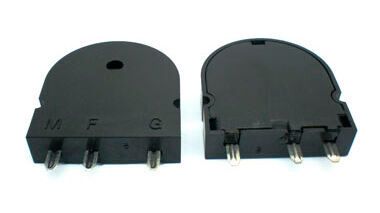
Hitpoint’s PT-2728FPQ is an acoustic signaling device and one of the models the company also offers as a replacement for discontinued buzzers from other manufacturers.
(Bild: Hitpoint)
Five cents can become very expensive. A new buzzer may cost less per unit than the model that has been used in a product for 20 or 30 years. It may be smaller, more efficient or easier to source. But Michael Tseng has made a fairly clear observation about European customers: as long as the old component still works, many of them would rather keep exactly that one.
The reason has less to do with the buzzer itself than with everything connected to replacing it. If a manufacturer changes a component in an existing product, new tests, approvals or qualification procedures may become necessary. That costs time and money. The saving on the individual component then matters very little.
“Customers in Europe in particular do not like changes,” says Tseng, Manager in Hitpoint’s Sales Department. “They want to keep using the same model.”
Over the years, this has developed into a business of its own for the Taiwanese manufacturer. When competitors discontinue older products, Hitpoint can develop a replacement that stays as close as possible to the existing component – even if the customer later needs only one or two thousand units per year.
At first, this may sound like a rather unspectacular niche business. Murata’s discontinuations are now giving it a very different scale.
Europe’s reluctance to change costs tooling – but also keeps competitors out
Hitpoint has been manufacturing acoustic components since 1983, so it is hardly a newcomer to the market. Its portfolio includes piezo and magnetic buzzers, sounders, sirens, speakers and microphones, as well as custom developments.
Over the decades, this has resulted in an unusually broad portfolio. Tseng speaks of around 3,600 different buzzer versions and a correspondingly large inventory of tooling.
Some of these tools do not exist because engineers constantly need new acoustic functions. They remain in storage because a single customer still needs an old design.
This is where the business differs from a conventional mass market. A manufacturer cannot run every variant on its own fully automated production line if annual demand is only a few thousand units. For such products, processes such as joining, gluing or welding may still involve manual work.
For Hitpoint, this is not a temporary situation. It is a consequence of the business model. Tseng describes it quite simply: if a customer still needs a particular component and cannot buy it anywhere else, continuing to manufacture the old design may make more sense than forcing the customer into a redesign.
The strategy has worked particularly well in Europe. According to Tseng, around 27 percent of Hitpoint’s business comes from the European market.
The large number of old variants creates something that few companies would normally describe as an advantage of a complicated product portfolio: a barrier to entry. A competitor that wants to take over the same customers also has to support their old applications. A few current standard products are not enough.
“If a competitor wants to enter Europe and sees our tooling warehouse with thousands of tools, that is the price,” Tseng says, describing the situation.
3,600 variants are not an ideal starting point for robotics
What protects the business from competitors also makes manufacturing more difficult.
According to Tseng, customers visiting Hitpoint’s production regularly ask about the level of automation. Where are the robotic arms? Why does the line not look like a modern, highly automated electronics factory? The answer is not particularly glamorous: with thousands of different form factors, heights and production volumes, not every process can be automated economically. “If we only had two or three products, it would be easy,” Tseng explains. With several thousand variants, the calculation looks different.
The issue is not that automation is technically impossible. It has to make economic sense. Building dedicated production equipment for a component that may only be needed in a few thousand units per year can cost more than keeping parts of the process manual. A separate robotic solution for every low-volume variant would remove the economic advantage of flexible small-series manufacturing.
At the same time, customers associate automation with consistent quality, lower cost and reproducible processes. Hitpoint is therefore caught between two expectations: old and customized products are supposed to remain available, while the factory is expected to look like a modern high-volume operation.
For a long time, that contradiction was difficult to resolve. Murata’s withdrawal is changing the calculation.
Murata’s EOL wave suddenly creates volume
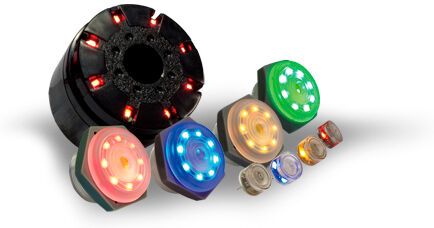
In addition to conventional buzzers, Hitpoint develops combined visual and acoustic signaling devices. Such customized variants are part of the company’s broad portfolio.
(Bild: Hitpoint)
Murata has discontinued, or announced the discontinuation of, numerous series of piezoelectric sounders and buzzers. For several product families, the company has published specific discontinuation dates, some extending into September 2027. For many of the listed products, Murata does not indicate a direct replacement.
For manufacturers such as Hitpoint, this creates a market that is much larger than the usual business of supplying a few hundred or a few thousand legacy components.
Tseng speaks openly about the opportunity. Murata operated on a very different scale from most other companies in this segment. If even part of that volume is redistributed, Hitpoint may for the first time be able to manufacture certain buzzer families in quantities that justify a more highly automated production line.
Hitpoint has already published its own Murata replacement series, matching a number of Murata part numbers with corresponding Hitpoint models.
Tseng does not want the approach to be reduced to reverse engineering, however.
According to him, Hitpoint has travelled to Japan several times over the past year and a half. The company has not only approached former Murata customers, but has also tried to establish contacts with technical personnel and explore possibilities related to manufacturing know-how and equipment.
Whether this will eventually result in actual Murata processes or machines being used at Hitpoint is still open. Tseng describes the transition as an ongoing project, and technical difficulties have already delayed the original schedule.
Hitpoint is not claiming that it can simply take over the Murata market. Tseng considers that unrealistic himself. The question is how much of the available business the company can actually win.
A replacement has to do more than fit mechanically
For existing European designs in particular, one point is likely to be important: a replacement is not automatically equivalent to the original component. Dimensions and connections can match while the acoustic or electrical behavior still differs. Frequency, sound pressure level, current consumption, drive method and installation conditions all influence how a buzzer behaves in the actual application.
There is also a reason why many European manufacturers are looking for replacements in the first place: they want to change as little as possible in an existing product. That raises the bar for the component supplier. The closer the replacement comes to the existing solution, the lower the risk that changes to mechanics, electronics or software will be required. Tseng therefore draws a clear distinction between simply recreating a component and trying to replace an existing product as completely as possible.
His wording during the conversation is unusual, but it makes the point well: there is a difference between making “a Murata replacement” and making “Murata Murata.” In other words: matching the form factor is not enough.
Murata could be the reason Hitpoint automates more
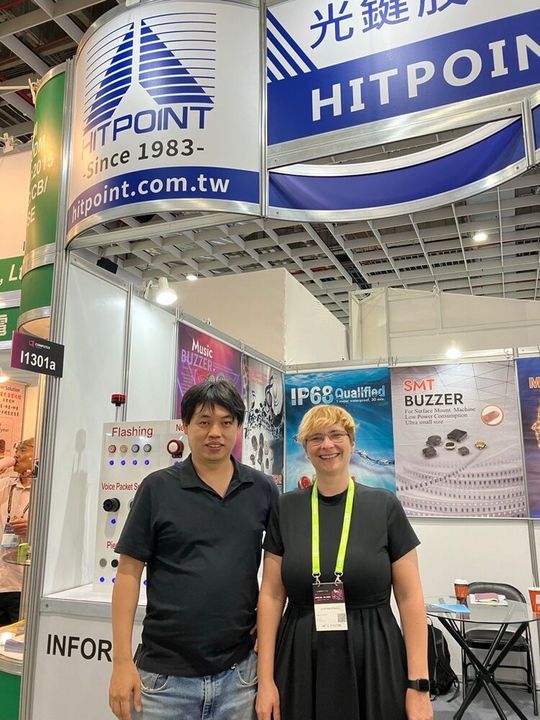
Michael Tseng, Manager in Hitpoint’s Sales Department, with Susanne Braun at the company’s trade fair booth in Taiwan.
(Bild: VCG)
The situation may also help Hitpoint solve another problem. The company has been trying for years to automate more wherever production volumes allow it. Its highly fragmented portfolio puts natural limits on that strategy. The volumes released by Murata’s withdrawal could now create products for which a fully automated line becomes economically viable.
Tseng sees several advantages. The volumes could justify the investment. Production would become more reproducible. And during factory visits, Hitpoint could show customers that the company does operate automated processes. Tseng talks about this last point with a certain amount of humor. For some visitors, a robotic arm almost seems to function as visible proof of quality – regardless of whether their own low-volume product is actually produced on that line.
The calculation is not quite that simple, of course. An automated line only earns its money if the expected orders really arrive. That has been the risk in the past. Hitpoint had already considered investing in production equipment for high-volume products, Tseng says. Without the corresponding orders, however, the machines would have been poorly utilized.
Small-volume production is supposed to stay
Hitpoint does not intend to abandon its existing business simply to chase Murata volumes. Around 35 percent of its buzzer designs are customized, according to Tseng. These projects vary widely. Some customers need a special function, a different sound or, for example, a combination of visual and acoustic signaling. Other custom projects are effectively legacy projects: an old component has been discontinued, and Hitpoint produces a suitable version for only one or a small number of customers.
The company wants to keep this business. It is not only about customer loyalty. It also protects Hitpoint to some extent from pure price competition. In highly standardized buzzers produced in very large volumes, the manufacturer competes with Chinese suppliers that operate on a very different scale. Tseng makes no attempt to hide the difficulty of that competition. On price alone, Hitpoint sees little advantage.
Small-volume and customized production works differently. Here, what matters is whether a manufacturer is willing to keep a tool in storage, continue an older design or build a special solution for a relatively small project. Automated high-volume production and flexible small-series manufacturing are therefore expected to continue side by side.
An old component can suddenly become strategicn
At first glance, the two approaches seem contradictory. On one side, the electronics industry is investing in new manufacturing technologies, automation and increasingly efficient components. On the other, Hitpoint builds new tooling so that a customer can continue using a buzzer whose design may be decades old.
Both can make economic sense. Murata’s discontinuations are making this logic particularly visible. For Hitpoint, they create an opportunity to connect two business models that have so far been quite different. Whether that will work is not yet decided. Tseng speaks openly about technical problems, delays and competitors that have identified the same opportunity.
A buzzer may cost only a few cents. The tooling, qualification and know-how required to keep producing it almost unchanged after many years cost considerably more. For European engineers who need exactly that old component, it may still be the cheaper solution. (sb)
Es ist für uns eine Selbstverständlichkeit, dass wir verantwortungsvoll mit Ihren personenbezogenen Daten umgehen. Sofern wir personenbezogene Daten von Ihnen erheben, verarbeiten wir diese unter Beachtung der geltenden Datenschutzvorschriften. Detaillierte Informationen finden Sie in unserer Datenschutzerklärung.
Einwilligung in die Verwendung von Daten zu Werbezwecken
Ich bin damit einverstanden, dass die Vogel Communications Group GmbH & Co. KG, Max-Planckstr. 7-9, 97082 Würzburg einschließlich aller mit ihr im Sinne der §§ 15 ff. AktG verbundenen Unternehmen (im weiteren: Vogel Communications Group) meine E-Mail-Adresse für die Zusendung von redaktionellen Newslettern nutzt. Auflistungen der jeweils zugehörigen Unternehmen können hier abgerufen werden.
Der Newsletterinhalt erstreckt sich dabei auf Produkte und Dienstleistungen aller zuvor genannten Unternehmen, darunter beispielsweise Fachzeitschriften und Fachbücher, Veranstaltungen und Messen sowie veranstaltungsbezogene Produkte und Dienstleistungen, Print- und Digital-Mediaangebote und Services wie weitere (redaktionelle) Newsletter, Gewinnspiele, Lead-Kampagnen, Marktforschung im Online- und Offline-Bereich, fachspezifische Webportale und E-Learning-Angebote. Wenn auch meine persönliche Telefonnummer erhoben wurde, darf diese für die Unterbreitung von Angeboten der vorgenannten Produkte und Dienstleistungen der vorgenannten Unternehmen und Marktforschung genutzt werden.
Meine Einwilligung umfasst zudem die Verarbeitung meiner E-Mail-Adresse und Telefonnummer für den Datenabgleich zu Marketingzwecken mit ausgewählten Werbepartnern wie z.B. LinkedIN, Google und Meta. Hierfür darf die Vogel Communications Group die genannten Daten gehasht an Werbepartner übermitteln, die diese Daten dann nutzen, um feststellen zu können, ob ich ebenfalls Mitglied auf den besagten Werbepartnerportalen bin. Die Vogel Communications Group nutzt diese Funktion zu Zwecken des Retargeting (Upselling, Crossselling und Kundenbindung), der Generierung von sog. Lookalike Audiences zur Neukundengewinnung und als Ausschlussgrundlage für laufende Werbekampagnen. Weitere Informationen kann ich dem Abschnitt „Datenabgleich zu Marketingzwecken“ in der Datenschutzerklärung entnehmen.
Falls ich im Internet auf Portalen der Vogel Communications Group einschließlich deren mit ihr im Sinne der §§ 15 ff. AktG verbundenen Unternehmen geschützte Inhalte abrufe, muss ich mich mit weiteren Daten für den Zugang zu diesen Inhalten registrieren. Im Gegenzug für diesen gebührenlosen Zugang zu redaktionellen Inhalten dürfen meine Daten im Sinne dieser Einwilligung für die hier genannten Zwecke verwendet werden. Dies gilt nicht für den Datenabgleich zu Marketingzwecken.
Recht auf Widerruf
Mir ist bewusst, dass ich diese Einwilligung jederzeit für die Zukunft widerrufen kann. Durch meinen Widerruf wird die Rechtmäßigkeit der aufgrund meiner Einwilligung bis zum Widerruf erfolgten Verarbeitung nicht berührt. Um meinen Widerruf zu erklären, kann ich als eine Möglichkeit das unter https://contact.vogel.de abrufbare Kontaktformular nutzen. Sofern ich einzelne von mir abonnierte Newsletter nicht mehr erhalten möchte, kann ich darüber hinaus auch den am Ende eines Newsletters eingebundenen Abmeldelink anklicken. Weitere Informationen zu meinem Widerrufsrecht und dessen Ausübung sowie zu den Folgen meines Widerrufs finde ich in der Datenschutzerklärung, Abschnitt Redaktionelle Newsletter.




:quality(80)/p7i.vogel.de/wcms/e1/dc/e1dce42a75133bb2434f7e7719c0f68e/0133441212v2.jpeg "Wukong, ein von Origin Quantum gefertigter Quantenprozessor mit 72 Qubits. (Bild: Origin Quantum)")
:quality(80)/p7i.vogel.de/wcms/8f/fe/8ffe634655ffed16bffa710b20ed464e/0133391553v2.jpeg "Bild 1: TDSEM- und TEM-Aufnahme eines Josephson-Kontakts aus 2ML
αSi-NbTiN.
(Bild: imec)")
:quality(80)/p7i.vogel.de/wcms/81/b3/81b3110e8d075932ad1749f336c6fead/0133385629v2.jpeg "High End Performance Packaging: Auf der Demo Street der FIRST können Besucher Technologien und konkrete Anwendungen aus den Bereichen Power, Advanced Packaging, Radio Frequency, MEMS, Sensorik und Photonics erleben und mit den Experten vor Ort ins Gespräch kommen. (Bild: ©Fraunhofer IZM)")
:quality(80)/p7i.vogel.de/wcms/1c/87/1c87856de82abcd4354cbcf5e64947c5/0133464246v2.jpeg "Immer mehr Daten müssen moduliert auf Lichtwellen durch das globale Glasfasernetz geschleust werden. Japanische Forscher reizen die Physik der Leitung nun weiter aus. (Bild: frei lizenziert)")
:quality(80)/p7i.vogel.de/wcms/c7/32/c732c5ab94c63acae1328a9dd7f17e58/0133457447v2.jpeg "Die MIPI Alliance will ein Standardformat für den Austausch von kinematischen Sensordaten erarbeiten. Dafür hat die Branchenorganisation die „Kinematics Working Group“ ins Leben gerufen. Die Arbeitsgruppe wird zunächst ein einheitliches Kinematic Streaming Format (KSF) entwickeln, das die Datenübertragung bei Radar- und Lidar-Anwendungen in Automobilindustrie, Robotik und anderen kinematischen Bereichen optimiert. (Bild: © Akarat Phasura - stock.adobe.com)")
:quality(80)/p7i.vogel.de/wcms/5f/77/5f778eafd9e4415cd00274ad9a58e42a/0133462125v2.jpeg "Wandler: Integrierte GaN-Buck- und Boost-Wandler für den Mittelspannungsbereich benötigen 50 % weniger Platz als Alternativen auf Siliziumbasis, ohne dass dabei Einbußen beim Wirkungsgrad entstehen. (Bild: TI)")
:quality(80)/p7i.vogel.de/wcms/58/93/5893d1c1946bcc25a9f8b8b939409aa2/0133444365v2.jpeg "KI trifft Lagerrobotik: Im Düsseldorfer Innovation Lab demonstriert Geekplus unter anderem humanoide Roboter, mobile Transportsysteme und das KI-Framework Gravity. (Bild: Geekplus)")
:quality(80)/p7i.vogel.de/wcms/8d/bb/8dbbf755d59174ecab99febfdd469fa3/0133422468v4.jpeg "(Bild: Spectra)")
:quality(80)/p7i.vogel.de/wcms/c8/d9/c8d986c4eabbb4762b6693effd77d766/0133405602v2.jpeg "In einer Produktionsanlage von P&G nutzen Bediener das KI-basierte Visual Inspection Cockpit auf Siemens Industrial Edge, um die Qualität in Echtzeit über Konsumgüterlinien mit hoher Produktvarianz hinweg zu überwachen. (Bild: Siemens)")
:quality(80)/p7i.vogel.de/wcms/03/4b/034b4121617aed9487cab28144fcd6f3/0133442063v2.jpeg "Linux-Trainer und Best-Speaker-Preisträger: Mit didaktischem Geschick, großer Leidenschaft und unverwechselbarem Akzent „brennt“ der Ur-Bayer die Basics und Feinheiten von Linux in die Köpfe der Entwickler. (Bild: VCG)")
:quality(80)/p7i.vogel.de/wcms/dc/c9/dcc98be982eb6457f4e2b627fadaac98/0133177388v2.jpeg "Evolution des Codings: Einst wurden Programme von Hand geschrieben und mittels Karten und Schaltern in den Rechner gespeist. Heute, im Zeitalter des „Vibe Codings“, können Computer sich weitgehend selbst programmieren. (Bild: Dall-E / KI-generiert)")
:quality(80)/p7i.vogel.de/wcms/da/2d/da2d155884f924e1d6ea84b77cf48d5c/0133352781v2.jpeg "Die SMD-Sicherungen der 48MH-Serie von Conquer sind für hohe Ströme ausgelegt und für den Einsatz in KI-Servern und Rechenzentren vorgesehen. Die kompakte Bauform ermöglicht eine automatisierte Bestückung. (Bild: Conquer)")
:quality(80)/p7i.vogel.de/wcms/5f/e9/5fe9934927f84248f3a43f7c73b5e7ad/0133276869v2.jpeg "Ein Planartransformator von Elytone für kompakte Stromversorgungen mit hoher Leistungsdichte. Die flache Bauform ermöglicht geringe Bauhöhen und lässt sich an hohe Schaltfrequenzen anpassen. (Bild: Elytone)")
:quality(80)/p7i.vogel.de/wcms/3d/67/3d6777d7a99bdf88f86798cd73451538/0133004756v2.jpeg "Die AGI-CPU von Arm wurde im März 2026 angekündigt. Im Rahmen der Hot Chips 2026 sind die Entwickler ins Detail gegangen. (Bild: Arm)")
:quality(80)/p7i.vogel.de/wcms/8a/2e/8a2e7d2a89ffe55c545dd6c831ed154e/0132246788v2.jpeg "Über 500 Teilnehmer, 120 Referenten: Die FPGA Conference Europe platzte in diesem Jahr aus allen Nähten – und wurde ihrem Anspruch als Leitkongress der FPGA-Welt einmal mehr gerecht. (Bild: Tobi Giessen)")
:quality(80)/p7i.vogel.de/wcms/06/a1/06a158e32b18d99fcea65547cec5d4c7/0132069489v2.jpeg "Mit direkter Integration von Speicher ins Chip-Package verspricht AMD mit dem Versal Premium Gen 2 SoC eine schnellere Datenübertragung, verringerte Latenz und einem potentiell geringere Stromverbrauch. (Bild: AMD)")
:quality(80)/p7i.vogel.de/wcms/86/2a/862afb1de8423bb7401098a2fd268281/0131792672v2.jpeg "Bild 1: Ein Spannungsversorgungskonzept für Lasten, welche eine vorgegebene Ein- und Abschaltreihenfolge (Sequencing) benötigen. (Bild: ADI)")
:quality(80)/p7i.vogel.de/wcms/60/e7/60e71d2e90f60e5ddef056cb234724e0/0133466221v2.jpeg "Strom unter Last: Das Stromdichteprofil zeigt die Verteilung im Hochleistungs-IGBT-Modul. (Bild: Comsol)")
:quality(80)/p7i.vogel.de/wcms/31/20/3120ef4dfc9af325be75131132df2e6a/0133343322v2.jpeg "Aerodynamik-Weltrekord – Mission Efficiency setzt mit einem cW-Wert von 0,158 die neue Bestmarke aller straßenzugelassenen Autos. (Bild: Volkswagen AG)")
:quality(80)/p7i.vogel.de/wcms/a9/3c/a93cb3af2dd2d3d5a43365ea69a3d8a1/0133339957v2.jpeg "Der am MIT entwickelte Algorithmus „Hard Flow“ verspricht, vortrainierten generativen KI-Modellen dabei zu helfen, strenge Einschränkungen einzuhalten und gleichzeitig die Lösungsqualität zu verbessern, ohne dass ein erneutes Training erforderlich ist. (Bild: Dall-E / KI-generiert)")
:quality(80)/p7i.vogel.de/wcms/6b/0c/6b0cd14955e1df9cddc90de9a6209ea6/0133376931v2.jpeg "Parallele Testabläufe: Mit dem von MCD entwickelten Software TestMate lassen sich mehrere Testsequenzen innerhalb einer Instanz parallel und asynchron ausführen. (Bild: MCD Elektronik)")
:quality(80)/p7i.vogel.de/wcms/69/20/6920b333a42be206f380befd3ae34c36/0133394583v2.jpeg "Die beiden Cäsium-Fontänenuhren der PTB liefern die gesetzliche Zeit für die gesamte Bundesrepublik. Die verwendeten Laser werden jetzt digital von einer AWG-Messkarte gesteuert. (Bild: PTB)")
:quality(80)/p7i.vogel.de/wcms/d4/ec/d4ec54071e5bf9210b9c480572802eb2/0133355445v2.jpeg "Prof. Kupsch und sein Team von der TU Bergakademie Freiberg forschen an tragbaren Ultraschallsystemen. Mit ihnen lassen sich tieferliegende Gewebestrukturen erfassen. (Bild: TU Bergakademie Freiberg)")
:quality(80)/p7i.vogel.de/wcms/70/14/70143317b1e90d5d9bde780df4a2a3c2/0133325724v2.jpeg "Im Mittelpunkt der European Microwave Week 2026 steht die Funktechnik. Rohde & Schwarz präsentiert dort Messtechnik für HF- und Mikrowellensysteme, Radar, Satellitenkommunikation und 6G-Anwendungen (Symbolbild). (Bild: frei lizenziert)")
:quality(80)/p7i.vogel.de/wcms/fe/eb/feeb305af5bd017f5ce5af3783d4e0dc/0133463991v2.jpeg "Robotik:
Bei AMR muss die Verbindungstechnik trotz Vibration und Stoßbelastungen Leistung, Signale sowie Daten zuverlässig übertragen – auf engstem Raum und zugänglich für regelmäßige Wartung. (Bild: Hyperever)")
:quality(80)/p7i.vogel.de/wcms/6d/f3/6df31cca3705133f5953424b893fabe8/0133414574v2.jpeg "Roboter bauen Roboter: In der neuen Ubtech-Fabrik übernehmen automatisierte Systeme selbst Teile der Materialversorgung und Logistik für die Produktion humanoider Roboter. (Bild: Ubtech)")
:quality(80)/p7i.vogel.de/wcms/d4/2d/d42d81c60f05b8a27af2babe858b1c40/0133430053v2.jpeg "Bauteilkennzeichnung: Der laserbeschriftete Sensor kombiniert Data-Matrix-Code und Klarschrift für eine dauerhaft maschinen- und menschenlesbare Kennzeichnung. (Bild: FOBA Laser Marking + Engraving)")
:quality(80)/p7i.vogel.de/wcms/04/b9/04b948db62de8d70b7424a2607cb74de/0133453624v2.jpeg "Waferfertigung bei TSMC. Die Chipfertigung in den USA droht, trotz massivem Ausbau an Fertigungsstätten in einen Flaschenhals zu geraten. Nur etwa drei Prozent aller Studenten aus geigneten Fachbereichen haben laut einer Studie von McKinsey und dem Halbleiterverband SEMI vor, in die Hardware-Entwicklung zu gehen, und ziehen Bereiche wie KI oder Software Engineering vor. (Bild: TSMC)")
:quality(80)/p7i.vogel.de/wcms/e7/42/e742bcdffa80271a66641692ae305e4d/0133471495v3.jpeg "Einblick in die SMT-Fertigung von Schubert System Elektronik. (Bild: Fuji Corp.)")
:quality(80)/p7i.vogel.de/wcms/5f/36/5f36c88c8bf40c0b2f78f348343124b3/0133438438v2.jpeg "Messestand des chinesischen Speicherhestellers CXMT auf der IC China. Das Unternehmen hat nach eigenen Angaben seine fünfte DRAM-Plattform in die Serienfertigung überführt. Parallel soll der chinesische Hersteller eine NAND-Entwicklungslinie in Peking vorbereiten. (Bild: CXMT)")
:quality(80)/p7i.vogel.de/wcms/6b/1d/6b1dde86fdb120b4cf9b8bc8573c415a/0133056789v3.jpeg "Wir bezahlen für Systeme, die menschliche Arbeit übernehmen, ohne bislang geklärt zu haben, wie die dadurch entstehende Wertschöpfung künftig verteilt werden soll. (Bild: frei lizenziert)")
:quality(80)/p7i.vogel.de/wcms/47/20/47201c1ce3692dbdb4e7e62709de4e16/0132649717v3.jpeg "Ingenieurberufe verändern sich: Neben der aktuellen Konjunktur treiben Digitalisierung, KI und neue Technologien den Bedarf an kontinuierlicher Qualifizierung. (Bild: frei lizenziert)")
:quality(80)/p7i.vogel.de/wcms/4e/41/4e4159d1e93e67d47bd2f51a90691b23/0131548978v2.jpeg "Transformation im Engineering: KI-gestützte Systeme generieren zunehmend selbstständig Schaltschranklayouts und entlasten Konstrukteure von zeitraubenden Routineaufgaben. (Bild: WSCAD)")
:quality(80)/p7i.vogel.de/wcms/08/51/0851f6318ac9121e32ff8d6eea21b93b/0133252787v2.jpeg "TXC targets high-speed optical links in AI data centers with 312.5 MHz oscillators, among other solutions. As data rates increase, requirements for jitter and frequency stability become more demanding as well. (Bild: TXC)")
:quality(80)/p7i.vogel.de/wcms/3e/52/3e52caf04ffc0446ac34990ea5fa95b6/0133240185v2.jpeg "Surge-fester MELF-Widerstand aus der SRM-Serie von Firstohm. Die Baureihe ist für Anwendungen ausgelegt, in denen kurzzeitig hohe Energien und wiederholte Entladeimpulse auftreten können. (Bild: Firstohm)")