Higher switching frequencies make magnetic components smaller, but they also increase the demands on losses, thermal management and EMC. Elytone addresses these requirements with proven product designs and custom engineering for power supplies, e-mobility, energy storage and AI infrastructure.
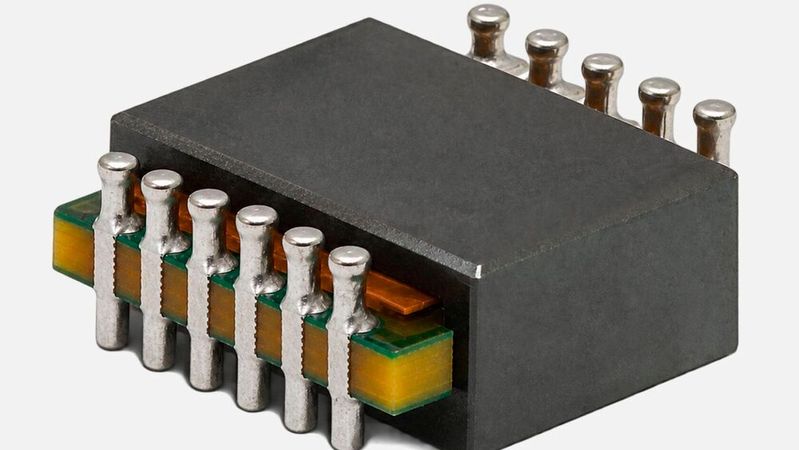
A planar transformer from Elytone for compact power supplies with high power density. Its flat design enables low-profile construction and can be adapted to high switching frequencies.
(Bild: Elytone)
More power, less space: This requirement now runs through almost every area of power electronics. Space is limited in a server power supply, just as it is in a DC/DC converter in a vehicle or a compact industrial drive. At the same time, systems are expected to become more efficient, generate less heat and meet stricter electromagnetic compatibility requirements.
Higher switching frequencies are therefore an important part of the answer. They allow magnetic components to become smaller and increase power density. But this reduction in size does not come for free. What may initially look like a smaller transformer on the data sheet can quickly affect the entire power design.
This is exactly the area Elytone works in. The Taiwanese company has been developing and manufacturing electronic components for more than 45 years and focuses particularly on magnetic components for power electronics. These include transformers, inductors, chokes and other components for power conversion and EMC.
Alongside proven product designs, Elytone offers custom development and engineering support for applications where standard solutions are not sufficient.
Higher frequency saves space, but also increases losses
When the operating frequency of a converter increases, its magnetic components can become smaller. This is one reason why the development of SiC and GaN power semiconductors is also changing magnetics. Faster-switching power devices allow higher frequencies – and therefore more compact passive components.
Elytone sees a clear trend toward high-frequency designs and planar transformers. Conventional wire-wound transformers reach their limits especially where low profiles and high power density are required. Planar structures and PCB windings can reduce volume and allow the geometry to fit the available space more closely.
But that does not solve the whole problem. Core and copper losses still have to be controlled, while skin and proximity effects increasingly influence the windings. Simply scaling down an existing transformer is therefore not enough. Core material, geometry, conductor layout and operating frequency have to work together.
At that point, a component issue becomes a system issue. A transformer may work electrically at the required frequency and still reach its thermal limits under real operating conditions. Losses that were relatively easy to remove from a larger component are now concentrated in a much smaller volume.
More power in less space makes heat part of the design
AI servers, charging infrastructure, battery systems and industrial power supplies are expected to handle more power without becoming proportionally larger. For magnetics, this increases more than just the electrical load. The path by which heat leaves the component also becomes part of the design.
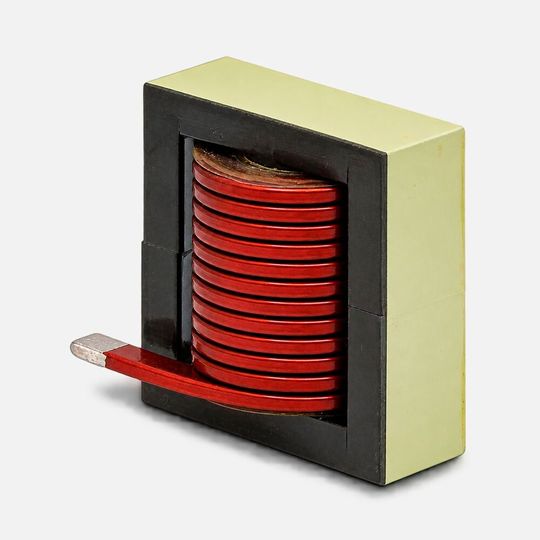
Elytone’s ETF-4901 high-current inductor is designed for applications with high current levels and correspondingly low conduction losses.
(Bild: Elytone)
Elytone refers to thermal paths that have to be considered during development. Depending on the application, this can include integration with heat sinks, potting materials or the customer’s cooling system.
That means looking beyond the transformer itself. How the component is mounted on the PCB, which materials surround it and where the heat can actually go all affect the thermal balance. Even relatively small additional losses can matter in a compact converter – and in a data center, the same effect is multiplied across a large number of power supplies.
Faster switching also makes EMC more difficult
Another challenge is electromagnetic compatibility. As devices become more compact, power and signal paths move closer together. At the same time, higher frequencies place greater demands on EMC design.
Custom chokes and filters are therefore another part of Elytone’s development work alongside transformers. Common-mode chokes face much the same challenge as other components: they have to become smaller while still providing sufficient noise suppression.
According to Elytone, European customers in particular place high demands on EMC, efficiency, thermal stability and long-term reliability.
These targets cannot be optimized independently. A winding design that reduces losses can also change parasitic characteristics; a smaller component may save space while making heat removal more difficult. In the end, the converter as a whole has to work – electrically, thermally, in terms of EMC and at a cost that fits the application.
Standard parts are not always enough for production-ready designs
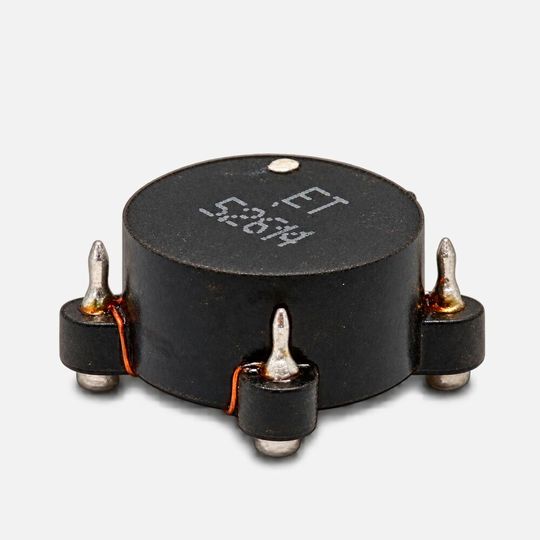
Elytone’s ET-52600 is a compact SMD common-mode choke. Components of this type are used to suppress common-mode interference in power supplies and power electronics.
(Bild: Elytone)
Elytone therefore works with two approaches. For applications whose requirements can be met with existing and proven designs, the company can draw on established product platforms. Where space constraints, switching frequency, thermal budgets or EMC requirements go beyond those designs, custom engineering comes into play.
Depending on the project, cooperation can range from adapting an existing design to developing a completely new solution. Elytone aims to become involved as early as possible, from the initial concept and electrical and mechanical design through to prototypes and later volume production.
This does not mean that every power supply needs a completely new transformer. If an existing design meets the requirements, there is little technical or economic reason to develop a custom version. The tighter the design constraints become, however, the more difficult that choice becomes.
Custom magnetics then often does not start with a part number. First come the operating conditions of the converter: input and output, power level, topology, switching frequency, insulation requirements, height, temperature and acceptable losses. The final component design follows from these requirements.
AI servers and e-mobility share the same basic requirement
Elytone currently sees switching power supplies and DC/DC converters as important growth areas. Demand for high-frequency transformers is growing particularly strongly, according to the company.
The applications behind this could hardly be more different. On one side are AI servers, data centers and energy storage systems. On the other are e-mobility and charging infrastructure. Industrial drives, automation and other power supply applications add to the list.
From a technical point of view, however, many of them come down to the same requirement: more power in less volume, preferably without additional losses or thermal problems.
Elytone is therefore already working with architectures around 800 V HVDC power distribution for AI data centers. At the same time, the company is following developments in solid-state transformers and higher voltage levels in e-mobility.
SiC and GaN also change the components around the switch
For the coming years, Elytone sees three closely connected directions: higher frequencies, higher power levels and greater use of planar magnetic components.
One important driver is the growing adoption of SiC and GaN. Wide-bandgap semiconductors enable higher switching frequencies. The magnetics have to be able to follow.
Otherwise, the problem simply moves somewhere else.
Transformers, inductors and EMC components also have to be adapted. For Elytone, this mainly means development work on core materials, winding structures and geometries. AC losses have to be reduced, while higher power levels also increase the demands on insulation and thermal management.
A faster switch alone does not make a more compact converter. Only when the other components can handle the new operating conditions can the potential increase in power density actually be transferred to the system.
European customers bring their own set of requirements
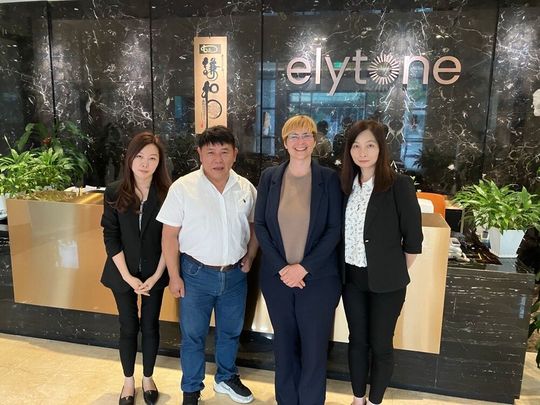
During a visit to Elytone in Taiwan: Santa Hsieh, R&D Director of the Magnetics BU, with Susanne Braun, Flora Lee and Iris Tang, both Sales Directors of the Magnetics BU.
(Bild: VCG)
Europe is not a new market for Elytone. The company wants to become involved earlier in development projects, particularly in e-mobility, industrial automation, renewable energy and energy storage.
European customers, Elytone says, often combine high technical requirements with strong cost pressure. Efficiency, thermal performance, EMC and long-term reliability have to be right, while the product still has to make economic sense. That is another reason not to leave magnetics until late in a project: if a design turns out to be too hot, too expensive or problematic in EMC testing, changes become more difficult once topology and components are fixed.
Elytone does not see growing demand for energy storage as a European issue alone. As renewable energy expands and the power requirements of data centers increase, so does the need for systems that store, convert and distribute energy.
In the end, the transformer does not just get smaller
The development of modern power electronics can easily be told as a story of smaller and smaller components. Higher switching frequencies allow smaller transformers, planar designs reduce height, and better semiconductors reduce losses.
The design does not become simpler because of that.
As frequency and power density increase, the individual design decisions become more closely connected. Core material and winding design affect losses. Losses determine the thermal design. Geometry and switching behavior affect EMC. And in the end, all of this has to become a component that can be manufactured reliably.
The magnetic component gets smaller. Its role in the design decisions does not.
This is why magnetics in many modern power architectures can no longer be treated as something that is simply selected near the end of the design process. (sb)
Es ist für uns eine Selbstverständlichkeit, dass wir verantwortungsvoll mit Ihren personenbezogenen Daten umgehen. Sofern wir personenbezogene Daten von Ihnen erheben, verarbeiten wir diese unter Beachtung der geltenden Datenschutzvorschriften. Detaillierte Informationen finden Sie in unserer Datenschutzerklärung.
Einwilligung in die Verwendung von Daten zu Werbezwecken
Ich bin damit einverstanden, dass die Vogel Communications Group GmbH & Co. KG, Max-Planckstr. 7-9, 97082 Würzburg einschließlich aller mit ihr im Sinne der §§ 15 ff. AktG verbundenen Unternehmen (im weiteren: Vogel Communications Group) meine E-Mail-Adresse für die Zusendung von redaktionellen Newslettern nutzt. Auflistungen der jeweils zugehörigen Unternehmen können hier abgerufen werden.
Der Newsletterinhalt erstreckt sich dabei auf Produkte und Dienstleistungen aller zuvor genannten Unternehmen, darunter beispielsweise Fachzeitschriften und Fachbücher, Veranstaltungen und Messen sowie veranstaltungsbezogene Produkte und Dienstleistungen, Print- und Digital-Mediaangebote und Services wie weitere (redaktionelle) Newsletter, Gewinnspiele, Lead-Kampagnen, Marktforschung im Online- und Offline-Bereich, fachspezifische Webportale und E-Learning-Angebote. Wenn auch meine persönliche Telefonnummer erhoben wurde, darf diese für die Unterbreitung von Angeboten der vorgenannten Produkte und Dienstleistungen der vorgenannten Unternehmen und Marktforschung genutzt werden.
Meine Einwilligung umfasst zudem die Verarbeitung meiner E-Mail-Adresse und Telefonnummer für den Datenabgleich zu Marketingzwecken mit ausgewählten Werbepartnern wie z.B. LinkedIN, Google und Meta. Hierfür darf die Vogel Communications Group die genannten Daten gehasht an Werbepartner übermitteln, die diese Daten dann nutzen, um feststellen zu können, ob ich ebenfalls Mitglied auf den besagten Werbepartnerportalen bin. Die Vogel Communications Group nutzt diese Funktion zu Zwecken des Retargeting (Upselling, Crossselling und Kundenbindung), der Generierung von sog. Lookalike Audiences zur Neukundengewinnung und als Ausschlussgrundlage für laufende Werbekampagnen. Weitere Informationen kann ich dem Abschnitt „Datenabgleich zu Marketingzwecken“ in der Datenschutzerklärung entnehmen.
Falls ich im Internet auf Portalen der Vogel Communications Group einschließlich deren mit ihr im Sinne der §§ 15 ff. AktG verbundenen Unternehmen geschützte Inhalte abrufe, muss ich mich mit weiteren Daten für den Zugang zu diesen Inhalten registrieren. Im Gegenzug für diesen gebührenlosen Zugang zu redaktionellen Inhalten dürfen meine Daten im Sinne dieser Einwilligung für die hier genannten Zwecke verwendet werden. Dies gilt nicht für den Datenabgleich zu Marketingzwecken.
Recht auf Widerruf
Mir ist bewusst, dass ich diese Einwilligung jederzeit für die Zukunft widerrufen kann. Durch meinen Widerruf wird die Rechtmäßigkeit der aufgrund meiner Einwilligung bis zum Widerruf erfolgten Verarbeitung nicht berührt. Um meinen Widerruf zu erklären, kann ich als eine Möglichkeit das unter https://contact.vogel.de abrufbare Kontaktformular nutzen. Sofern ich einzelne von mir abonnierte Newsletter nicht mehr erhalten möchte, kann ich darüber hinaus auch den am Ende eines Newsletters eingebundenen Abmeldelink anklicken. Weitere Informationen zu meinem Widerrufsrecht und dessen Ausübung sowie zu den Folgen meines Widerrufs finde ich in der Datenschutzerklärung, Abschnitt Redaktionelle Newsletter.




:quality(80)/p7i.vogel.de/wcms/e1/dc/e1dce42a75133bb2434f7e7719c0f68e/0133441212v2.jpeg "Wukong, ein von Origin Quantum gefertigter Quantenprozessor mit 72 Qubits. (Bild: Origin Quantum)")
:quality(80)/p7i.vogel.de/wcms/8f/fe/8ffe634655ffed16bffa710b20ed464e/0133391553v2.jpeg "Bild 1: TDSEM- und TEM-Aufnahme eines Josephson-Kontakts aus 2ML
αSi-NbTiN.
(Bild: imec)")
:quality(80)/p7i.vogel.de/wcms/81/b3/81b3110e8d075932ad1749f336c6fead/0133385629v2.jpeg "High End Performance Packaging: Auf der Demo Street der FIRST können Besucher Technologien und konkrete Anwendungen aus den Bereichen Power, Advanced Packaging, Radio Frequency, MEMS, Sensorik und Photonics erleben und mit den Experten vor Ort ins Gespräch kommen. (Bild: ©Fraunhofer IZM)")
:quality(80)/p7i.vogel.de/wcms/1c/87/1c87856de82abcd4354cbcf5e64947c5/0133464246v2.jpeg "Immer mehr Daten müssen moduliert auf Lichtwellen durch das globale Glasfasernetz geschleust werden. Japanische Forscher reizen die Physik der Leitung nun weiter aus. (Bild: frei lizenziert)")
:quality(80)/p7i.vogel.de/wcms/c7/32/c732c5ab94c63acae1328a9dd7f17e58/0133457447v2.jpeg "Die MIPI Alliance will ein Standardformat für den Austausch von kinematischen Sensordaten erarbeiten. Dafür hat die Branchenorganisation die „Kinematics Working Group“ ins Leben gerufen. Die Arbeitsgruppe wird zunächst ein einheitliches Kinematic Streaming Format (KSF) entwickeln, das die Datenübertragung bei Radar- und Lidar-Anwendungen in Automobilindustrie, Robotik und anderen kinematischen Bereichen optimiert. (Bild: © Akarat Phasura - stock.adobe.com)")
:quality(80)/p7i.vogel.de/wcms/5f/77/5f778eafd9e4415cd00274ad9a58e42a/0133462125v2.jpeg "Wandler: Integrierte GaN-Buck- und Boost-Wandler für den Mittelspannungsbereich benötigen 50 % weniger Platz als Alternativen auf Siliziumbasis, ohne dass dabei Einbußen beim Wirkungsgrad entstehen. (Bild: TI)")
:quality(80)/p7i.vogel.de/wcms/58/93/5893d1c1946bcc25a9f8b8b939409aa2/0133444365v2.jpeg "KI trifft Lagerrobotik: Im Düsseldorfer Innovation Lab demonstriert Geekplus unter anderem humanoide Roboter, mobile Transportsysteme und das KI-Framework Gravity. (Bild: Geekplus)")
:quality(80)/p7i.vogel.de/wcms/8d/bb/8dbbf755d59174ecab99febfdd469fa3/0133422468v4.jpeg "(Bild: Spectra)")
:quality(80)/p7i.vogel.de/wcms/c8/d9/c8d986c4eabbb4762b6693effd77d766/0133405602v2.jpeg "In einer Produktionsanlage von P&G nutzen Bediener das KI-basierte Visual Inspection Cockpit auf Siemens Industrial Edge, um die Qualität in Echtzeit über Konsumgüterlinien mit hoher Produktvarianz hinweg zu überwachen. (Bild: Siemens)")
:quality(80)/p7i.vogel.de/wcms/03/4b/034b4121617aed9487cab28144fcd6f3/0133442063v2.jpeg "Linux-Trainer und Best-Speaker-Preisträger: Mit didaktischem Geschick, großer Leidenschaft und unverwechselbarem Akzent „brennt“ der Ur-Bayer die Basics und Feinheiten von Linux in die Köpfe der Entwickler. (Bild: VCG)")
:quality(80)/p7i.vogel.de/wcms/dc/c9/dcc98be982eb6457f4e2b627fadaac98/0133177388v2.jpeg "Evolution des Codings: Einst wurden Programme von Hand geschrieben und mittels Karten und Schaltern in den Rechner gespeist. Heute, im Zeitalter des „Vibe Codings“, können Computer sich weitgehend selbst programmieren. (Bild: Dall-E / KI-generiert)")
:quality(80)/p7i.vogel.de/wcms/da/2d/da2d155884f924e1d6ea84b77cf48d5c/0133352781v2.jpeg "Die SMD-Sicherungen der 48MH-Serie von Conquer sind für hohe Ströme ausgelegt und für den Einsatz in KI-Servern und Rechenzentren vorgesehen. Die kompakte Bauform ermöglicht eine automatisierte Bestückung. (Bild: Conquer)")
:quality(80)/p7i.vogel.de/wcms/5f/e9/5fe9934927f84248f3a43f7c73b5e7ad/0133276869v2.jpeg "Ein Planartransformator von Elytone für kompakte Stromversorgungen mit hoher Leistungsdichte. Die flache Bauform ermöglicht geringe Bauhöhen und lässt sich an hohe Schaltfrequenzen anpassen. (Bild: Elytone)")
:quality(80)/p7i.vogel.de/wcms/3d/67/3d6777d7a99bdf88f86798cd73451538/0133004756v2.jpeg "Die AGI-CPU von Arm wurde im März 2026 angekündigt. Im Rahmen der Hot Chips 2026 sind die Entwickler ins Detail gegangen. (Bild: Arm)")
:quality(80)/p7i.vogel.de/wcms/8a/2e/8a2e7d2a89ffe55c545dd6c831ed154e/0132246788v2.jpeg "Über 500 Teilnehmer, 120 Referenten: Die FPGA Conference Europe platzte in diesem Jahr aus allen Nähten – und wurde ihrem Anspruch als Leitkongress der FPGA-Welt einmal mehr gerecht. (Bild: Tobi Giessen)")
:quality(80)/p7i.vogel.de/wcms/06/a1/06a158e32b18d99fcea65547cec5d4c7/0132069489v2.jpeg "Mit direkter Integration von Speicher ins Chip-Package verspricht AMD mit dem Versal Premium Gen 2 SoC eine schnellere Datenübertragung, verringerte Latenz und einem potentiell geringere Stromverbrauch. (Bild: AMD)")
:quality(80)/p7i.vogel.de/wcms/86/2a/862afb1de8423bb7401098a2fd268281/0131792672v2.jpeg "Bild 1: Ein Spannungsversorgungskonzept für Lasten, welche eine vorgegebene Ein- und Abschaltreihenfolge (Sequencing) benötigen. (Bild: ADI)")
:quality(80)/p7i.vogel.de/wcms/60/e7/60e71d2e90f60e5ddef056cb234724e0/0133466221v2.jpeg "Strom unter Last: Das Stromdichteprofil zeigt die Verteilung im Hochleistungs-IGBT-Modul. (Bild: Comsol)")
:quality(80)/p7i.vogel.de/wcms/31/20/3120ef4dfc9af325be75131132df2e6a/0133343322v2.jpeg "Aerodynamik-Weltrekord – Mission Efficiency setzt mit einem cW-Wert von 0,158 die neue Bestmarke aller straßenzugelassenen Autos. (Bild: Volkswagen AG)")
:quality(80)/p7i.vogel.de/wcms/a9/3c/a93cb3af2dd2d3d5a43365ea69a3d8a1/0133339957v2.jpeg "Der am MIT entwickelte Algorithmus „Hard Flow“ verspricht, vortrainierten generativen KI-Modellen dabei zu helfen, strenge Einschränkungen einzuhalten und gleichzeitig die Lösungsqualität zu verbessern, ohne dass ein erneutes Training erforderlich ist. (Bild: Dall-E / KI-generiert)")
:quality(80)/p7i.vogel.de/wcms/6b/0c/6b0cd14955e1df9cddc90de9a6209ea6/0133376931v2.jpeg "Parallele Testabläufe: Mit dem von MCD entwickelten Software TestMate lassen sich mehrere Testsequenzen innerhalb einer Instanz parallel und asynchron ausführen. (Bild: MCD Elektronik)")
:quality(80)/p7i.vogel.de/wcms/69/20/6920b333a42be206f380befd3ae34c36/0133394583v2.jpeg "Die beiden Cäsium-Fontänenuhren der PTB liefern die gesetzliche Zeit für die gesamte Bundesrepublik. Die verwendeten Laser werden jetzt digital von einer AWG-Messkarte gesteuert. (Bild: PTB)")
:quality(80)/p7i.vogel.de/wcms/d4/ec/d4ec54071e5bf9210b9c480572802eb2/0133355445v2.jpeg "Prof. Kupsch und sein Team von der TU Bergakademie Freiberg forschen an tragbaren Ultraschallsystemen. Mit ihnen lassen sich tieferliegende Gewebestrukturen erfassen. (Bild: TU Bergakademie Freiberg)")
:quality(80)/p7i.vogel.de/wcms/70/14/70143317b1e90d5d9bde780df4a2a3c2/0133325724v2.jpeg "Im Mittelpunkt der European Microwave Week 2026 steht die Funktechnik. Rohde & Schwarz präsentiert dort Messtechnik für HF- und Mikrowellensysteme, Radar, Satellitenkommunikation und 6G-Anwendungen (Symbolbild). (Bild: frei lizenziert)")
:quality(80)/p7i.vogel.de/wcms/fe/eb/feeb305af5bd017f5ce5af3783d4e0dc/0133463991v2.jpeg "Robotik:
Bei AMR muss die Verbindungstechnik trotz Vibration und Stoßbelastungen Leistung, Signale sowie Daten zuverlässig übertragen – auf engstem Raum und zugänglich für regelmäßige Wartung. (Bild: Hyperever)")
:quality(80)/p7i.vogel.de/wcms/6d/f3/6df31cca3705133f5953424b893fabe8/0133414574v2.jpeg "Roboter bauen Roboter: In der neuen Ubtech-Fabrik übernehmen automatisierte Systeme selbst Teile der Materialversorgung und Logistik für die Produktion humanoider Roboter. (Bild: Ubtech)")
:quality(80)/p7i.vogel.de/wcms/d4/2d/d42d81c60f05b8a27af2babe858b1c40/0133430053v2.jpeg "Bauteilkennzeichnung: Der laserbeschriftete Sensor kombiniert Data-Matrix-Code und Klarschrift für eine dauerhaft maschinen- und menschenlesbare Kennzeichnung. (Bild: FOBA Laser Marking + Engraving)")
:quality(80)/p7i.vogel.de/wcms/04/b9/04b948db62de8d70b7424a2607cb74de/0133453624v2.jpeg "Waferfertigung bei TSMC. Die Chipfertigung in den USA droht, trotz massivem Ausbau an Fertigungsstätten in einen Flaschenhals zu geraten. Nur etwa drei Prozent aller Studenten aus geigneten Fachbereichen haben laut einer Studie von McKinsey und dem Halbleiterverband SEMI vor, in die Hardware-Entwicklung zu gehen, und ziehen Bereiche wie KI oder Software Engineering vor. (Bild: TSMC)")
:quality(80)/p7i.vogel.de/wcms/e7/42/e742bcdffa80271a66641692ae305e4d/0133471495v3.jpeg "Einblick in die SMT-Fertigung von Schubert System Elektronik. (Bild: Fuji Corp.)")
:quality(80)/p7i.vogel.de/wcms/5f/36/5f36c88c8bf40c0b2f78f348343124b3/0133438438v2.jpeg "Messestand des chinesischen Speicherhestellers CXMT auf der IC China. Das Unternehmen hat nach eigenen Angaben seine fünfte DRAM-Plattform in die Serienfertigung überführt. Parallel soll der chinesische Hersteller eine NAND-Entwicklungslinie in Peking vorbereiten. (Bild: CXMT)")
:quality(80)/p7i.vogel.de/wcms/6b/1d/6b1dde86fdb120b4cf9b8bc8573c415a/0133056789v3.jpeg "Wir bezahlen für Systeme, die menschliche Arbeit übernehmen, ohne bislang geklärt zu haben, wie die dadurch entstehende Wertschöpfung künftig verteilt werden soll. (Bild: frei lizenziert)")
:quality(80)/p7i.vogel.de/wcms/47/20/47201c1ce3692dbdb4e7e62709de4e16/0132649717v3.jpeg "Ingenieurberufe verändern sich: Neben der aktuellen Konjunktur treiben Digitalisierung, KI und neue Technologien den Bedarf an kontinuierlicher Qualifizierung. (Bild: frei lizenziert)")
:quality(80)/p7i.vogel.de/wcms/4e/41/4e4159d1e93e67d47bd2f51a90691b23/0131548978v2.jpeg "Transformation im Engineering: KI-gestützte Systeme generieren zunehmend selbstständig Schaltschranklayouts und entlasten Konstrukteure von zeitraubenden Routineaufgaben. (Bild: WSCAD)")
:quality(80)/p7i.vogel.de/wcms/3e/52/3e52caf04ffc0446ac34990ea5fa95b6/0133240185v2.jpeg "Surge-fester MELF-Widerstand aus der SRM-Serie von Firstohm. Die Baureihe ist für Anwendungen ausgelegt, in denen kurzzeitig hohe Energien und wiederholte Entladeimpulse auftreten können. (Bild: Firstohm)")
:quality(80)/p7i.vogel.de/wcms/08/51/0851f6318ac9121e32ff8d6eea21b93b/0133252787v2.jpeg "TXC targets high-speed optical links in AI data centers with 312.5 MHz oscillators, among other solutions. As data rates increase, requirements for jitter and frequency stability become more demanding as well. (Bild: TXC)")