As AI data centres become more efficient, it becomes harder to verify efficiency gains. The right measurement setup reveals where losses occur and whether improvements are real.
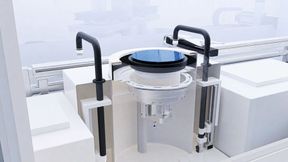
A substation is one link in the power chain supplying data centers — a chain whose efficiency must be measured from the grid to the chip.
(Source: AI-generated)
As AI workloads push data centers toward ever higher power densities, the engineering challenge is no longer limited to converting and distributing energy efficiently. It is increasingly about proving, with sufficient accuracy, where losses occur and whether claimed improvements are real. In modern facilities, fractional gains in efficiency can translate into major savings in operating cost, cooling demand and carbon footprint. Yet those gains often lie within the uncertainty limits of conventional test setups. For engineers working on infrastructure power trains, server supplies and board-level converters, measurement itself is becoming a critical design parameter.
Build a measurement chain, not just a test setup
Use a precision power analyzer for traceable steady-state power and energy measurements.
Use an oscilloscope to investigate switching behavior, load transients, and root causes.
Match probes, current sensors, bandwidth, and channel deskew to the measurement task.
Document calibration, correction factors, and uncertainty so that small efficiency gains can be reproduced and defended.
Efficiency Gains That Are Smaller Than the Measurement Error
Data centers are under simultaneous pressure from rising compute demand, stricter sustainability targets and industry benchmarks such as PUE for facilities, 80 PLUS for power supplies and SPEC SERT for server active-state efficiency. The result is a broad effort to optimize every conversion stage along the grid-to-chip path, from transformers and UPS systems to rack-level buses, server PSUs and point-of-load regulators on AI accelerator boards.
At these efficiency levels, however, the remaining losses are often extremely small. A new topology, a wide-bandgap semiconductor or an updated control loop may improve performance by only a few tenths of a percent. If the measurement chain cannot resolve that difference reliably, optimization becomes guesswork and certification becomes difficult to defend. This is especially problematic in data center environments, where real operating conditions include partial-load operation, harmonic-rich waveforms and rapid load transients rather than steady full-load behavior.
The measurement requirements also vary significantly across the power chain. Medium-voltage and low-voltage transformers, for example, demand accurate no-load and short-circuit testing under IEC 60076 conditions. In no-load testing, very low power factors can make phase accuracy the dominant source of error, so even small timing mismatches between voltage and current channels can distort the calculated iron losses. At the other end of the chain, server PSUs, 48 V rack architectures and high-current accelerator boards require a different combination of bandwidth, current handling, dynamic range and long-term stability to characterize efficiency, ripple and transient response under realistic workloads.
From Transformer Losses to GPU Rails
Emerging architectures are adding further complexity. HVDC distribution and solid-state transformers introduce multiple conversion stages, bidirectional energy flow and dynamic mode changes that must be analyzed both from the grid side and within the DC distribution network. In such systems, engineers need to understand not only average efficiency but also harmonic behavior, switching effects, ride-through performance and control-loop interactions.
That creates a measurement problem spanning several orders of magnitude. One application may involve kilovolt-level infrastructure measurements with wideband harmonics, while another focuses on millivolt ripple and fast current excursions on processor supply rails. In AI-oriented systems, where loads can change abruptly as accelerators ramp between idle and compute-intensive states, partial-load and transient behavior become more relevant than nameplate efficiency figures. A power conversion stage rated at very high efficiency at full load may spend much of its operating life in a lower-load region where the cumulative energy loss is actually greater.
Point-of-load regulators on GPU and AI accelerator boards push this still further: supply voltages drop toward the sub-1 V range while currents climb into the hundreds of amperes, with microsecond-scale load steps. Electrical efficiency measurement must therefore separate stage-by-stage energy accounting from board-level switching and transient analysis. Where electrical difference methods approach their practical resolution limit, calorimetric loss measurement remains a useful cross-check for absolute loss figures, while precision electrical analysis remains the tool of choice for comparing topologies, operating points and multi-stage chains under controlled conditions.
Stand: 08.12.2025
Es ist für uns eine Selbstverständlichkeit, dass wir verantwortungsvoll mit Ihren personenbezogenen Daten umgehen. Sofern wir personenbezogene Daten von Ihnen erheben, verarbeiten wir diese unter Beachtung der geltenden Datenschutzvorschriften. Detaillierte Informationen finden Sie in unserer Datenschutzerklärung.
Einwilligung in die Verwendung von Daten zu Werbezwecken
Ich bin damit einverstanden, dass die Vogel Communications Group GmbH & Co. KG, Max-Planckstr. 7-9, 97082 Würzburg einschließlich aller mit ihr im Sinne der §§ 15 ff. AktG verbundenen Unternehmen (im weiteren: Vogel Communications Group) meine E-Mail-Adresse für die Zusendung von redaktionellen Newslettern nutzt. Auflistungen der jeweils zugehörigen Unternehmen können hier abgerufen werden.
Der Newsletterinhalt erstreckt sich dabei auf Produkte und Dienstleistungen aller zuvor genannten Unternehmen, darunter beispielsweise Fachzeitschriften und Fachbücher, Veranstaltungen und Messen sowie veranstaltungsbezogene Produkte und Dienstleistungen, Print- und Digital-Mediaangebote und Services wie weitere (redaktionelle) Newsletter, Gewinnspiele, Lead-Kampagnen, Marktforschung im Online- und Offline-Bereich, fachspezifische Webportale und E-Learning-Angebote. Wenn auch meine persönliche Telefonnummer erhoben wurde, darf diese für die Unterbreitung von Angeboten der vorgenannten Produkte und Dienstleistungen der vorgenannten Unternehmen und Marktforschung genutzt werden.
Meine Einwilligung umfasst zudem die Verarbeitung meiner E-Mail-Adresse und Telefonnummer für den Datenabgleich zu Marketingzwecken mit ausgewählten Werbepartnern wie z.B. LinkedIN, Google und Meta. Hierfür darf die Vogel Communications Group die genannten Daten gehasht an Werbepartner übermitteln, die diese Daten dann nutzen, um feststellen zu können, ob ich ebenfalls Mitglied auf den besagten Werbepartnerportalen bin. Die Vogel Communications Group nutzt diese Funktion zu Zwecken des Retargeting (Upselling, Crossselling und Kundenbindung), der Generierung von sog. Lookalike Audiences zur Neukundengewinnung und als Ausschlussgrundlage für laufende Werbekampagnen. Weitere Informationen kann ich dem Abschnitt „Datenabgleich zu Marketingzwecken“ in der Datenschutzerklärung entnehmen.
Falls ich im Internet auf Portalen der Vogel Communications Group einschließlich deren mit ihr im Sinne der §§ 15 ff. AktG verbundenen Unternehmen geschützte Inhalte abrufe, muss ich mich mit weiteren Daten für den Zugang zu diesen Inhalten registrieren. Im Gegenzug für diesen gebührenlosen Zugang zu redaktionellen Inhalten dürfen meine Daten im Sinne dieser Einwilligung für die hier genannten Zwecke verwendet werden. Dies gilt nicht für den Datenabgleich zu Marketingzwecken.
Recht auf Widerruf
Mir ist bewusst, dass ich diese Einwilligung jederzeit für die Zukunft widerrufen kann. Durch meinen Widerruf wird die Rechtmäßigkeit der aufgrund meiner Einwilligung bis zum Widerruf erfolgten Verarbeitung nicht berührt. Um meinen Widerruf zu erklären, kann ich als eine Möglichkeit das unter https://contact.vogel.de abrufbare Kontaktformular nutzen. Sofern ich einzelne von mir abonnierte Newsletter nicht mehr erhalten möchte, kann ich darüber hinaus auch den am Ende eines Newsletters eingebundenen Abmeldelink anklicken. Weitere Informationen zu meinem Widerrufsrecht und dessen Ausübung sowie zu den Folgen meines Widerrufs finde ich in der Datenschutzerklärung, Abschnitt Redaktionelle Newsletter.
Complementary Instrumentation Rather Than a Single Tool
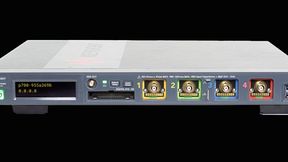
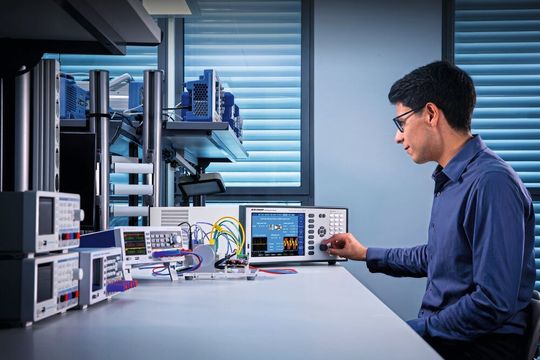
Figure 1. LMG600 precision power analyzer on a test bench.
(Source: Rohde & Schwarz)
Addressing these challenges requires a combination of instruments with clearly defined roles. Oscilloscopes are indispensable for observing switching waveforms, timing relationships, inrush currents, control-loop behavior and transient events. In power electronics development, instruments such as the MXO oscilloscope series can be used to calculate instantaneous power, switching losses, harmonic content and efficiency-related parameters at converter and device level. Their strength lies in time-domain visibility and root-cause analysis.
For steady-state power, long-term energy measurement and high-confidence determination of real, reactive and apparent power, a precision power analyzer is typically the more appropriate instrument. Industry benchmarks and qualification workflows depend on that confidence: whether the task is transformer verification under IEC 60076, UPS and multi-stage efficiency analysis, or supporting server efficiency assessments linked to SPEC SERT, synchronized multi-channel analyzers such as the LMG600 precision power analyzer family (Figure 1) provide the channel-to-channel timing consistency and AC/DC accuracy needed to resolve small loss differences across several stages simultaneously. In practice, this allows engineers to treat the analyzer as the reference instrument for traceable power figures, while using the oscilloscope to explain why those figures change under dynamic conditions.
Programmable DC supplies are also part of this measurement ecosystem rather than merely acting as utility sources. When testing 48 V building blocks, converters or selected accelerator-board rails, the quality of the source directly affects the credibility of the result. A programmable supply with accurate readback, controlled dynamics and reproducible sequencing can emulate realistic buses and load steps without introducing avoidable artifacts into the setup. Instruments such as the R&S NGT3600 series DC power supplies are relevant here because they allow engineers to apply clean, configurable supply conditions up to 80 V and 50 A per channel and to separate DUT behavior from source-induced effects. This is especially important when validating protection functions, startup behavior and control stability.
Traceability, Synchronization and Uncertainty in Development and Qualification
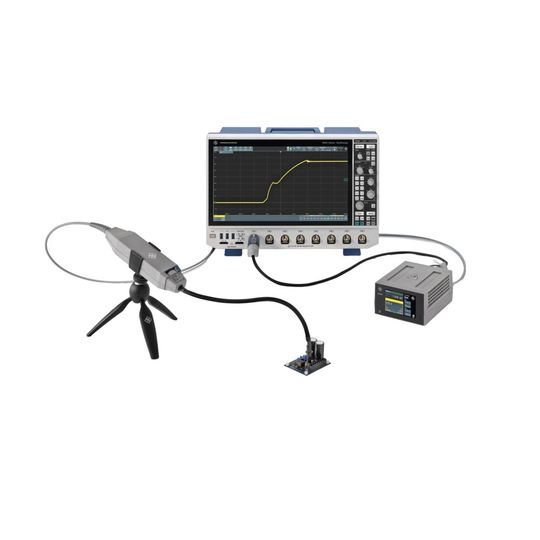
Figure 2. R&S RT-ZISO isolated probing system with MXO 5 oscilloscope.
(Source: Rohde & Schwarz)
A recurring issue in power testing is the assumption that the instrument simply observes the system without influencing the result. In reality, the measurement outcome depends on sensor choice, wiring, filtering, channel synchronization and calibration. Legacy power meters designed around sinusoidal assumptions may produce misleading results in environments dominated by harmonics and non-linear loads. Likewise, high-level KPIs such as PUE or benchmark scores are of limited value if the underlying measurements are not supported by a coherent uncertainty budget. Probing is often the decisive link in that chain.
At converter and device level, floating measurements on wide-bandgap switches, gate drives and shunt currents require high common-mode rejection and minimal ground-loop paths; optically isolated probes such as the R&S RT-ZISO (Figure 2) illustrate how bandwidth and isolation must be matched to the switching environment before waveform-based loss calculations can be trusted. On the analyzer side, current transducers, deskew between voltage and current channels, and documented correction factors determine whether a few tenths of a percent of efficiency improvement are real or merely an artifact of the setup.
For that reason, traceability is becoming central to both development and qualification. Whether the task is transformer verification, PSU certification or server efficiency benchmarking, the results must be reproducible and technically defensible. That calls for calibrated instruments, documented procedures, stable timing relationships between channels and transparent handling of correction factors and post-processing. A workflow that combines application-focused analysis with scripting and automation can reduce both effort and risk, especially when multiple instrument classes are integrated into the same test strategy.
Measuring What Matters From the Grid to the GPU
The evolution of AI-driven data centers is blurring the traditional boundaries between grid infrastructure, facility power systems and IT hardware. As a result, engineers need a coherent measurement chain that extends from transformer inputs to board-level converter outputs and GPU rails. The decisive question is not which single instrument is used, but how roles are assigned along that chain: a precision power analyzer for traceable multi-stage efficiency and energy figures, an oscilloscope for switching behavior and load transients, suitable probes for floating and high-bandwidth access, and a programmable DC supply for clean, reproducible excitation of converters and board-level rails.
Instruments such as the LMG600 power analyzer, MXO oscilloscope series, R&S RT-ZISO probe system and R&S NGT3600 power supply illustrate those complementary roles. The more efficient the power chain becomes, the more decisive measurement quality will be in determining what engineers can genuinely improve. (heh)
* Dr. Philipp Weigell is Vice President Market Segment Industry, Components, Research & Universities at Rohde & Schwarz.