What does it take to step directly from an 800 V server bus to 12.5 V at 6 kW? By splitting the conversion across eight GaN-based modules, the design simplifies transformer design and reaches 97 % efficiency in a prototype.
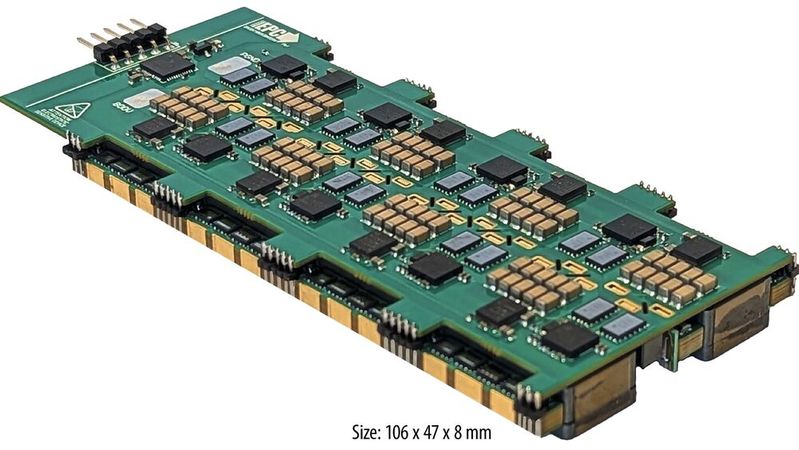
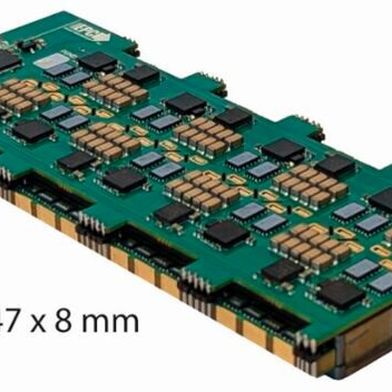
Figure 1. 800 V to 12.5 V 6kW ISOP board (106 mm × 47 mm × 8 mm).
(Bild: Efficient Power Conversion (EPC))
The adoption of 800VDC power distribution in AI and high-performance computing servers reduces distribution losses by delivering the high-voltage bus directly to the server board. Converting 800 V directly to 12.5 V for the multiphase voltage regulators eliminates the intermediate 800-V-to-48-V conversion stage, improving overall system efficiency while reducing system complexity. However, the high step-down conversion ratio presents significant challenges in achieving high efficiency and power density, particularly in the design of the planar transformer. This paper presents the design considerations for a 6 kW isolated 800-V-to-12.5-V DC-DC converter module targeting 97 % full-load efficiency. Key design aspects, including converter topology selection, planar transformer optimization, and power device selection, are analyzed to minimize losses while satisfying thermal and power density requirements. Experimental results from a hardware prototype demonstrate 97 % efficiency at full load and a peak efficiency of 98 %, validating the proposed design methodology.
ISOP CONVERTER ARCHITECTURE
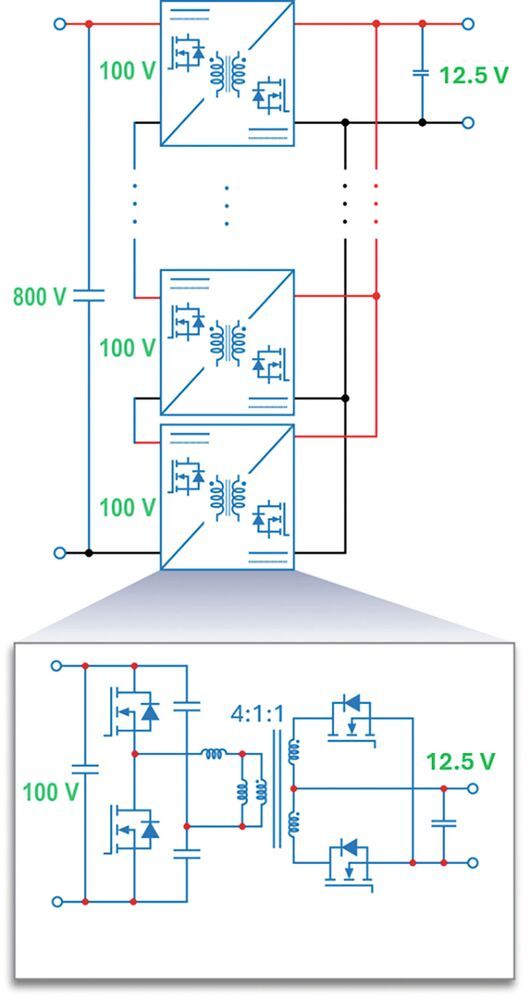
The Input-Series-Output-Parallel (ISOP) architecture has emerged as a promising solution for high-ratio 800-V-to-low-voltage DC-DC conversion in next-generation AI server power systems [1]. By connecting the inputs of multiple identical isolated converter modules in series and their outputs in parallel, the ISOP architecture distributes the input voltage and output power among the modules, reducing device voltage stress while enabling scalable high-current operation. When implemented with LLC resonant converter modules, the architecture provides inherent voltage balancing and current sharing through proper resonant tank design, eliminating the need for complex balancing control. In addition, phase interleaving among the modules significantly reduces output current ripple and output capacitance requirements, improving both power density and efficiency. More importantly, as shown in Figure 2, an eight-module ISOP architecture reduces the transformer turns ratio to 4:1 for each LLC module, greatly simplifying planar transformer winding design, reducing leakage inductance and winding resistance. These advantages make the ISOP architecture well suited for direct 800-V-to-12.5-V conversion and provide a scalable path toward future 800-V-to-6-V power delivery architectures.
Figure 2. Eight stacked ISOP converter.
(Source: Efficient Power Conversion (EPC))
TRANSFORMER DESIGN
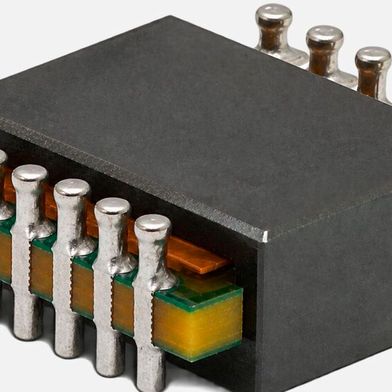
Beyond improving switch efficiency, the ISOP architecture simplifies magnetic and thermal design. A conventional 800-V-to-12.5-V converter requires a transformer turns ratio of 16:1, whereas an eight-module ISOP implementation reduces the ratio to 4:1. This enables compact PCB-integrated planar transformers with lower leakage inductance and higher power density.
The modular architecture also distributes power losses across the board, reducing thermal hotspots and enabling effective top-side cooling. In addition, interleaving the eight modules significantly reduces output current ripple, lowering output capacitance requirements and further improving power density.
GAN ADVANTAGES
A key advantage of the ISOP architecture is its ability to utilize mid-voltage GaN devices. Conventional converters operating from an 800 V bus typically require 1.2 kV SiC MOSFETs or 650 V GaN devices. In contrast, an eight-module ISOP architecture reduces the nominal input voltage of each module to approximately 100 V, enabling the use of 150 V GaN FETs.
Low-voltage GaN devices, such as the EPC2305, offer low gate charge, output charge, and on-resistance, enabling efficient operation near 1MHz. For the 6 kW converter, the eight-module GaN ISOP implementation achieves primary-side switch loss of 6.8 W, compared with 15.9 W using 1.2 kV SiC MOSFETs, a 57 % reduction. The switch footprint is also reduced from 630mm2 to 240mm2. The device level advantages enable higher efficiency, switching frequency, and power density.
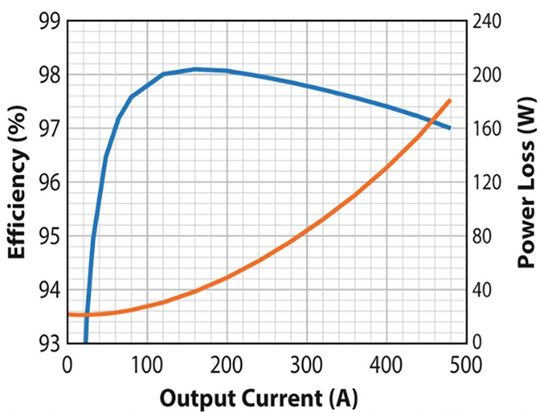
Figure 3. 800 V to 12.5 V 6 kW ISOP efficiency.
(Source: Efficient Power Conversion (EPC))
HARDWARE RESULTS
A 6 kW prototype module has been built with dimensions of 106mm × 47mm × 8mm, demonstrating high power density. The measured efficiency reaches 97 % at full load with a peak efficiency of 98 %, as shown in Figure 1. The measured switching waveforms at 1MHz demonstrate stable resonant operation and validate the proposed design, as shown in Figure 3.
Stand: 08.12.2025
Es ist für uns eine Selbstverständlichkeit, dass wir verantwortungsvoll mit Ihren personenbezogenen Daten umgehen. Sofern wir personenbezogene Daten von Ihnen erheben, verarbeiten wir diese unter Beachtung der geltenden Datenschutzvorschriften. Detaillierte Informationen finden Sie in unserer Datenschutzerklärung.
Einwilligung in die Verwendung von Daten zu Werbezwecken
Ich bin damit einverstanden, dass die Vogel Communications Group GmbH & Co. KG, Max-Planckstr. 7-9, 97082 Würzburg einschließlich aller mit ihr im Sinne der §§ 15 ff. AktG verbundenen Unternehmen (im weiteren: Vogel Communications Group) meine E-Mail-Adresse für die Zusendung von redaktionellen Newslettern nutzt. Auflistungen der jeweils zugehörigen Unternehmen können hier abgerufen werden.
Der Newsletterinhalt erstreckt sich dabei auf Produkte und Dienstleistungen aller zuvor genannten Unternehmen, darunter beispielsweise Fachzeitschriften und Fachbücher, Veranstaltungen und Messen sowie veranstaltungsbezogene Produkte und Dienstleistungen, Print- und Digital-Mediaangebote und Services wie weitere (redaktionelle) Newsletter, Gewinnspiele, Lead-Kampagnen, Marktforschung im Online- und Offline-Bereich, fachspezifische Webportale und E-Learning-Angebote. Wenn auch meine persönliche Telefonnummer erhoben wurde, darf diese für die Unterbreitung von Angeboten der vorgenannten Produkte und Dienstleistungen der vorgenannten Unternehmen und Marktforschung genutzt werden.
Meine Einwilligung umfasst zudem die Verarbeitung meiner E-Mail-Adresse und Telefonnummer für den Datenabgleich zu Marketingzwecken mit ausgewählten Werbepartnern wie z.B. LinkedIN, Google und Meta. Hierfür darf die Vogel Communications Group die genannten Daten gehasht an Werbepartner übermitteln, die diese Daten dann nutzen, um feststellen zu können, ob ich ebenfalls Mitglied auf den besagten Werbepartnerportalen bin. Die Vogel Communications Group nutzt diese Funktion zu Zwecken des Retargeting (Upselling, Crossselling und Kundenbindung), der Generierung von sog. Lookalike Audiences zur Neukundengewinnung und als Ausschlussgrundlage für laufende Werbekampagnen. Weitere Informationen kann ich dem Abschnitt „Datenabgleich zu Marketingzwecken“ in der Datenschutzerklärung entnehmen.
Falls ich im Internet auf Portalen der Vogel Communications Group einschließlich deren mit ihr im Sinne der §§ 15 ff. AktG verbundenen Unternehmen geschützte Inhalte abrufe, muss ich mich mit weiteren Daten für den Zugang zu diesen Inhalten registrieren. Im Gegenzug für diesen gebührenlosen Zugang zu redaktionellen Inhalten dürfen meine Daten im Sinne dieser Einwilligung für die hier genannten Zwecke verwendet werden. Dies gilt nicht für den Datenabgleich zu Marketingzwecken.
Recht auf Widerruf
Mir ist bewusst, dass ich diese Einwilligung jederzeit für die Zukunft widerrufen kann. Durch meinen Widerruf wird die Rechtmäßigkeit der aufgrund meiner Einwilligung bis zum Widerruf erfolgten Verarbeitung nicht berührt. Um meinen Widerruf zu erklären, kann ich als eine Möglichkeit das unter https://contact.vogel.de abrufbare Kontaktformular nutzen. Sofern ich einzelne von mir abonnierte Newsletter nicht mehr erhalten möchte, kann ich darüber hinaus auch den am Ende eines Newsletters eingebundenen Abmeldelink anklicken. Weitere Informationen zu meinem Widerrufsrecht und dessen Ausübung sowie zu den Folgen meines Widerrufs finde ich in der Datenschutzerklärung, Abschnitt Redaktionelle Newsletter.
CONCLUSIONS
Driven by increasing demand for data center efficiency, single-stage 800-V-to-12.5-V conversion provides an attractive approach for next-generation AI power delivery. For such a high step-down ratio, ISOP architecture offers significant advantages in both transformer design and power device optimization. The reduced voltage stress enables the use of mid-voltage GaN devices operating near 1MHz, improving both efficiency and power density. As intermediate bus voltages continue to decrease toward 6 V, the conversion ratio will become even more challenging, making the ISOP architecture increasingly compelling for future AI server power systems. (mr)
[1] A. Pozo and M. de Rooij, “Using Low-Voltage GaN in ISOP Converters for AI Servers with 800 V Architecture,” Bodo’s Power Systems, Mar. 2026.
[2] A. Lidow, M. de Rooij, J. Glaser, A. Pozo, S. Zhang, M. Palma, D. Reusch, and J. Strydom, GaN Transistors for Efficient Power Conversion, 4th ed. Hoboken, NJ, USA: John Wiley & Sons, 2025.
* Alejandro Pozo is Director of Applications at Efficient Power Conversion (EPC).