From detailed multiphysics simulation to AI-assisted system modeling: New approaches help engineers better understand the interactions between electronic components and automate development workflows.
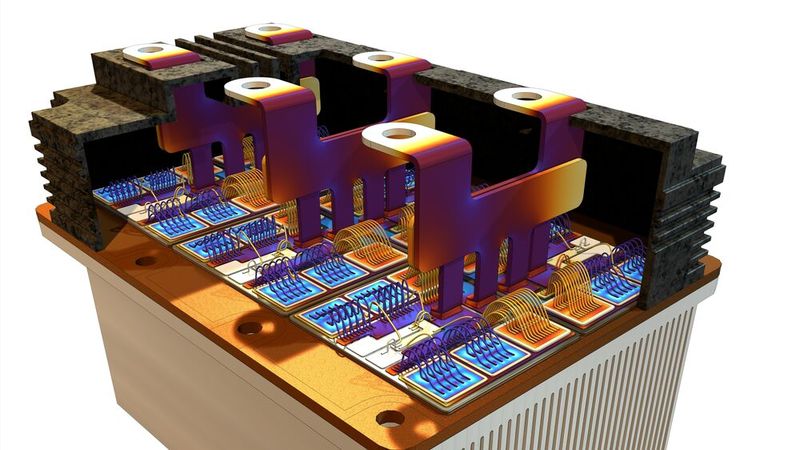
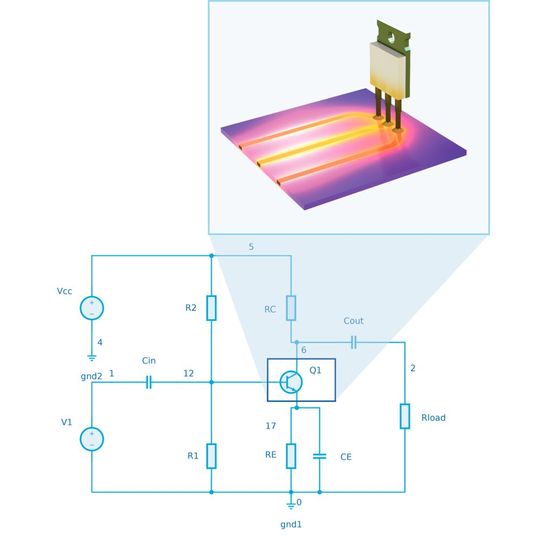
Figure 1: Simulating a power electronics assembly makes it possible to investigate the interactions between electrical and thermal effects. For example, power losses and critical temperature regions can be analyzed early in the development process.
(Source: Comsol)
A power semiconductor heats up during operation. As its temperature rises, its electrical behavior changes, affecting the losses and, in turn, the amount of heat generated. At the same time, the stresses it experiences depend on how it is integrated into the circuit and the operating conditions of the overall system. What initially appears to be a thermal problem is actually the result of interactions between different physical phenomena and electrical system characteristics. Such interactions are common in electronics development. Whether in power electronics, electric drives, sensors, or highly integrated assemblies, demands for higher power density, efficiency, and reliability continue to grow. Meeting these demands often requires looking beyond individual components and considering how they behave as part of a larger system.
Numerical simulation helps engineers investigate these relationships early in the development process. There are, however, two different approaches to consider. On the one hand, physical phenomena within individual components can be modeled in great detail. On the other hand, engineers need models that allow them to efficiently analyze the behavior of an entire system. Both approaches have their strengths. New modeling capabilities bring them closer together, while artificial intelligence offers additional ways to automate simulation tasks.
The Limits of Simplified Models
In electronics development, systems are often represented using equivalent circuits, characteristic curves, and lumped parameters. These models make it possible to investigate many engineering questions quickly and efficiently. However, they have limitations when spatial distributions or interactions between different physical phenomena become important.
Consider the heating of electronic components. Thermal resistances can be used to estimate temperatures, but investigating localized hot spots, complex cooling structures, or temperature-dependent material properties requires spatially resolved models. This is where multiphysics simulation comes into play. It enables engineers to calculate, for example, electric currents and heat transfer together. This makes it possible to investigate how electrical losses cause heating and how the resulting temperature changes, in turn, affect electrical behavior. Modeling every detail of an entire system would, however, often be too computationally demanding. A more practical approach is to combine simplified system models with detailed multiphysics models wherever a closer look at the underlying physics is needed.
Two Modeling Approaches, One System
This is where the coupling of system-level and multiphysics simulations becomes particularly useful. Instead of calculating the behavior of individual components independently of the overall system, the two modeling levels are connected. COMSOL Multiphysics® version 2027 introduces COMSOL Systems, a new modeling environment designed for this purpose. It enables engineers to create electrical circuit diagrams, process flow diagrams, and custom equation-based system models. A library of nearly 5,000 predefined components helps users get started.
These building blocks can represent electrical circuit elements, technical components, or entire subsystems. When a simplified description of a component is insufficient, it can be coupled directly to a detailed 1D, 2D, or 3D multiphysics model. The physics-based model receives its operating conditions from the overall system and, in turn, provides calculated quantities that influence the system's behavior. A circuit containing thermally sensitive components provides an example of how this works in practice. The system model describes the electrical operating conditions and the interactions between circuit elements. For a selected component, an additional 3D model calculates how heat is distributed within the device. This allows electrical and thermal effects to be investigated in detail exactly where they matter for the overall system. The approach is particularly useful when operating conditions change. After all, the stresses experienced by a component depend not only on its own properties but also on what happens elsewhere in the system.
Stand: 08.12.2025
Es ist für uns eine Selbstverständlichkeit, dass wir verantwortungsvoll mit Ihren personenbezogenen Daten umgehen. Sofern wir personenbezogene Daten von Ihnen erheben, verarbeiten wir diese unter Beachtung der geltenden Datenschutzvorschriften. Detaillierte Informationen finden Sie in unserer Datenschutzerklärung.
Einwilligung in die Verwendung von Daten zu Werbezwecken
Ich bin damit einverstanden, dass die Vogel Communications Group GmbH & Co. KG, Max-Planckstr. 7-9, 97082 Würzburg einschließlich aller mit ihr im Sinne der §§ 15 ff. AktG verbundenen Unternehmen (im weiteren: Vogel Communications Group) meine E-Mail-Adresse für die Zusendung von redaktionellen Newslettern nutzt. Auflistungen der jeweils zugehörigen Unternehmen können hier abgerufen werden.
Der Newsletterinhalt erstreckt sich dabei auf Produkte und Dienstleistungen aller zuvor genannten Unternehmen, darunter beispielsweise Fachzeitschriften und Fachbücher, Veranstaltungen und Messen sowie veranstaltungsbezogene Produkte und Dienstleistungen, Print- und Digital-Mediaangebote und Services wie weitere (redaktionelle) Newsletter, Gewinnspiele, Lead-Kampagnen, Marktforschung im Online- und Offline-Bereich, fachspezifische Webportale und E-Learning-Angebote. Wenn auch meine persönliche Telefonnummer erhoben wurde, darf diese für die Unterbreitung von Angeboten der vorgenannten Produkte und Dienstleistungen der vorgenannten Unternehmen und Marktforschung genutzt werden.
Meine Einwilligung umfasst zudem die Verarbeitung meiner E-Mail-Adresse und Telefonnummer für den Datenabgleich zu Marketingzwecken mit ausgewählten Werbepartnern wie z.B. LinkedIN, Google und Meta. Hierfür darf die Vogel Communications Group die genannten Daten gehasht an Werbepartner übermitteln, die diese Daten dann nutzen, um feststellen zu können, ob ich ebenfalls Mitglied auf den besagten Werbepartnerportalen bin. Die Vogel Communications Group nutzt diese Funktion zu Zwecken des Retargeting (Upselling, Crossselling und Kundenbindung), der Generierung von sog. Lookalike Audiences zur Neukundengewinnung und als Ausschlussgrundlage für laufende Werbekampagnen. Weitere Informationen kann ich dem Abschnitt „Datenabgleich zu Marketingzwecken“ in der Datenschutzerklärung entnehmen.
Falls ich im Internet auf Portalen der Vogel Communications Group einschließlich deren mit ihr im Sinne der §§ 15 ff. AktG verbundenen Unternehmen geschützte Inhalte abrufe, muss ich mich mit weiteren Daten für den Zugang zu diesen Inhalten registrieren. Im Gegenzug für diesen gebührenlosen Zugang zu redaktionellen Inhalten dürfen meine Daten im Sinne dieser Einwilligung für die hier genannten Zwecke verwendet werden. Dies gilt nicht für den Datenabgleich zu Marketingzwecken.
Recht auf Widerruf
Mir ist bewusst, dass ich diese Einwilligung jederzeit für die Zukunft widerrufen kann. Durch meinen Widerruf wird die Rechtmäßigkeit der aufgrund meiner Einwilligung bis zum Widerruf erfolgten Verarbeitung nicht berührt. Um meinen Widerruf zu erklären, kann ich als eine Möglichkeit das unter https://contact.vogel.de abrufbare Kontaktformular nutzen. Sofern ich einzelne von mir abonnierte Newsletter nicht mehr erhalten möchte, kann ich darüber hinaus auch den am Ende eines Newsletters eingebundenen Abmeldelink anklicken. Weitere Informationen zu meinem Widerrufsrecht und dessen Ausübung sowie zu den Folgen meines Widerrufs finde ich in der Datenschutzerklärung, Abschnitt Redaktionelle Newsletter.
When AI Takes On Simulation Tasks
Figure 2: Comsol Systems enables electrical circuit models to be coupled with detailed 3D multiphysics models of individual components. In this example, the thermal behavior of a transistor is analyzed in the context of the electrical circuit.
(Source: Comsol)
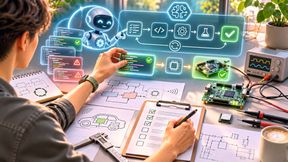
Alongside these new system modeling capabilities, the way engineers interact with simulation software is also changing. AI can now do more than answer questions or suggest code. AI agents can independently access tools, carry out tasks, and use the results to determine which steps to take next. COMSOL Multiphysics® version 2027 introduces the COMSOL MCP Server to support such workflows. Through this interface, external AI agents can access functionality provided by the COMSOL API. For example, they can create or modify models, adjust parameters, run simulations, and evaluate results.
What could this mean for electronics development? Consider an engineer investigating how different cooling structures affect the maximum temperature of an electronic assembly. Traditionally, the engineer would need to prepare, simulate, and compare the different designs manually or write a script to automate the process. With a properly configured AI agent, part of this work could be automated. The agent could first modify selected model parameters, run the simulations, and compare the calculated temperatures. Based on the results, it could select additional design variants and perform further calculations. Design constraints or specified limits could also be incorporated into such a workflow. Importantly, the physical results would still come from the simulation model. AI does not replace the underlying physics. Instead, it primarily coordinates the individual steps and assists with evaluating the results.
This does not mean that such workflows can operate without engineering oversight. Automated simulations can only produce reliable results if the models, material properties, boundary conditions, and numerical settings are appropriate. Engineers must still assess the results and be able to intervene when necessary. Changes made and simulations performed by the agent can therefore also be reviewed and adjusted in the COMSOL Desktop® environment.
More Freedom to Make Engineering Decisions
System modeling and agentic AI address different challenges, but they complement each other well. One connects detailed physics-based models with the behavior of the overall system. The other helps automate repetitive tasks and carry out simulation studies more efficiently. Both are relevant to electronics development. As products become more complex, it becomes increasingly difficult to account for all the interactions and operating conditions involved. By connecting different modeling levels and automating simulation workflows, engineers can explore more design alternatives without a corresponding increase in manual effort.
This allows simulation to play a greater role early in the development process — not just when a finished design needs to be verified, but when engineers are still deciding how individual components should be designed to ensure that the entire system performs reliably. (sb)
* Dr. Phillip Oberdorfer is Technology Communication Officer at COMSOL