Even in highly automated electronics manufacturing, many tasks still require manual work. DELTEC GROUP is addressing this with two approaches: a digital operator assistance system for manual assembly and a robot-assisted test cell.
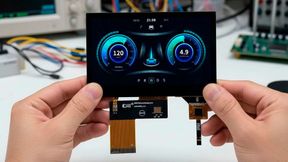
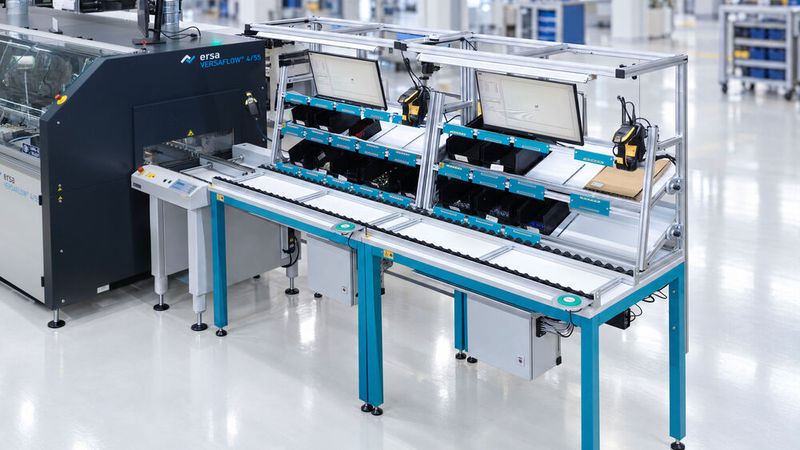
Digital support where manual work remains: The DGMA workstation guides operators through assembly steps and integrates material handling, process data, and quality checks.
(Source: Deltec Group)
On SMT lines, component placement is largely automated. But manual through-hole assembly, PCB assembly, and electrical testing often tell a different story. Components still have to be inserted by hand, boards placed in test fixtures, and individual operations checked. This takes time, ties up skilled personnel, and creates opportunities for errors, particularly when products change frequently.
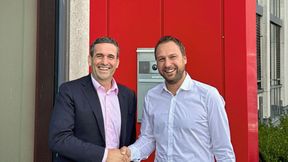
DELTEC GROUP, based in Furth im Wald, Germany, is tackling two of these areas. A digital operator assistance system is designed to support employees during assembly, while two collaborative robots handle electronic assemblies in a newly developed test cell. The EMS provider is bringing both solutions to electronica 2026 in Munich, where they will be demonstrated live to a broad international audience for the first time.
Digital Guidance Without Added Complexity
Developed jointly with B4C Solutions, DGMA (DELTEC Guided Manual Assembly) is intended for operations where full automation is difficult or economically impractical. The workstation guides employees through the individual steps of manual component insertion and assembly while supporting quality assurance.
At its core is operator guidance software that divides the assembly process into defined steps. A screen provides the information needed for each task, including images and videos. During material picking, a pick-by-light system indicates the correct bin. Light curtains at the other bins are intended to prevent operators from taking the wrong components.
The setup procedure is another distinctive feature: material bins do not have to be arranged in a fixed order. Instead, they can be positioned flexibly during setup. This can simplify workstation preparation, especially when products change frequently.
A camera mounted above the work surface tracks assembly progress. According to the developers, visual quality control combines conventional inspection algorithms with AI-based image processing. The aim is to detect deviations during assembly rather than at a later inspection stage.
Operator guidance goes beyond component picking. Additional devices such as torque screwdrivers, sensors, cameras, and test systems can be integrated into process control, allowing DGMA to support other manual assembly tasks as well.
Connecting Operator Assistance to the MES
Integration into existing manufacturing IT is central to the concept. DELTEC GROUP does not intend DGMA to operate as an isolated workstation. Instead, the data collected is made available for materials management, process monitoring, and traceability. Consumed materials are reported to the materials management system in real time. Product definitions are managed centrally in the manufacturing execution system (MES), which also receives process data recorded during assembly.
Traceability can extend across multiple production steps. When assemblies are handled on carriers, each can be linked to a carrier ID. This association can be maintained through subsequent processes, such as selective soldering or automated optical inspection (AOI).
Cost is another consideration. According to the company, the goal is to limit investment per DGMA workstation to no more than one-third of the cost of comparable solutions on the market. Development with its technology partner should also make it possible to continuously adapt functions to production requirements.
Two Cobots Take Over Handling
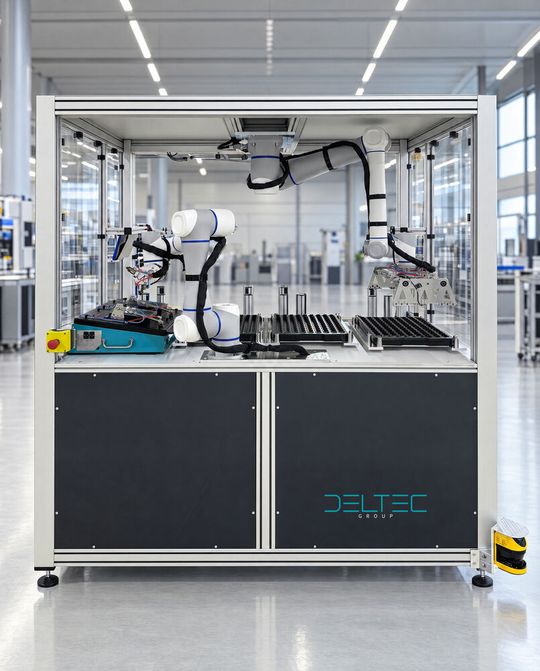
Two cobots handle assemblies and thermoformed trays in the automated test cell, taking over repetitive tasks that were previously performed manually.
(Source: Deltec Group)
While DGMA supports employees performing manual tasks, the second project takes a different approach: robots are intended to take over handling operations previously carried out by hand. Production volumes help explain the need. According to the company, up to 350,000 assemblies pass through DELTEC GROUP's ten SMT lines each week. Some must then undergo electrical testing, including in-circuit testing (ICT) or functional testing (FCT).
Although the tests themselves are largely automated, loading and unloading test systems often require manual intervention. Employees remove assemblies from thermoformed trays, place them in test fixtures, and take them out again after testing. A robotic cell developed by the team is designed to handle these steps. It uses two cobots working on separate tasks in parallel.
Stand: 08.12.2025
Es ist für uns eine Selbstverständlichkeit, dass wir verantwortungsvoll mit Ihren personenbezogenen Daten umgehen. Sofern wir personenbezogene Daten von Ihnen erheben, verarbeiten wir diese unter Beachtung der geltenden Datenschutzvorschriften. Detaillierte Informationen finden Sie in unserer Datenschutzerklärung.
Einwilligung in die Verwendung von Daten zu Werbezwecken
Ich bin damit einverstanden, dass die Vogel Communications Group GmbH & Co. KG, Max-Planckstr. 7-9, 97082 Würzburg einschließlich aller mit ihr im Sinne der §§ 15 ff. AktG verbundenen Unternehmen (im weiteren: Vogel Communications Group) meine E-Mail-Adresse für die Zusendung von redaktionellen Newslettern nutzt. Auflistungen der jeweils zugehörigen Unternehmen können hier abgerufen werden.
Der Newsletterinhalt erstreckt sich dabei auf Produkte und Dienstleistungen aller zuvor genannten Unternehmen, darunter beispielsweise Fachzeitschriften und Fachbücher, Veranstaltungen und Messen sowie veranstaltungsbezogene Produkte und Dienstleistungen, Print- und Digital-Mediaangebote und Services wie weitere (redaktionelle) Newsletter, Gewinnspiele, Lead-Kampagnen, Marktforschung im Online- und Offline-Bereich, fachspezifische Webportale und E-Learning-Angebote. Wenn auch meine persönliche Telefonnummer erhoben wurde, darf diese für die Unterbreitung von Angeboten der vorgenannten Produkte und Dienstleistungen der vorgenannten Unternehmen und Marktforschung genutzt werden.
Meine Einwilligung umfasst zudem die Verarbeitung meiner E-Mail-Adresse und Telefonnummer für den Datenabgleich zu Marketingzwecken mit ausgewählten Werbepartnern wie z.B. LinkedIN, Google und Meta. Hierfür darf die Vogel Communications Group die genannten Daten gehasht an Werbepartner übermitteln, die diese Daten dann nutzen, um feststellen zu können, ob ich ebenfalls Mitglied auf den besagten Werbepartnerportalen bin. Die Vogel Communications Group nutzt diese Funktion zu Zwecken des Retargeting (Upselling, Crossselling und Kundenbindung), der Generierung von sog. Lookalike Audiences zur Neukundengewinnung und als Ausschlussgrundlage für laufende Werbekampagnen. Weitere Informationen kann ich dem Abschnitt „Datenabgleich zu Marketingzwecken“ in der Datenschutzerklärung entnehmen.
Falls ich im Internet auf Portalen der Vogel Communications Group einschließlich deren mit ihr im Sinne der §§ 15 ff. AktG verbundenen Unternehmen geschützte Inhalte abrufe, muss ich mich mit weiteren Daten für den Zugang zu diesen Inhalten registrieren. Im Gegenzug für diesen gebührenlosen Zugang zu redaktionellen Inhalten dürfen meine Daten im Sinne dieser Einwilligung für die hier genannten Zwecke verwendet werden. Dies gilt nicht für den Datenabgleich zu Marketingzwecken.
Recht auf Widerruf
Mir ist bewusst, dass ich diese Einwilligung jederzeit für die Zukunft widerrufen kann. Durch meinen Widerruf wird die Rechtmäßigkeit der aufgrund meiner Einwilligung bis zum Widerruf erfolgten Verarbeitung nicht berührt. Um meinen Widerruf zu erklären, kann ich als eine Möglichkeit das unter https://contact.vogel.de abrufbare Kontaktformular nutzen. Sofern ich einzelne von mir abonnierte Newsletter nicht mehr erhalten möchte, kann ich darüber hinaus auch den am Ende eines Newsletters eingebundenen Abmeldelink anklicken. Weitere Informationen zu meinem Widerrufsrecht und dessen Ausübung sowie zu den Folgen meines Widerrufs finde ich in der Datenschutzerklärung, Abschnitt Redaktionelle Newsletter.
The first robot handles the trays, positioning them for assemblies to be picked up or deposited. The second loads and unloads the connected test system, which is also an in-house development by DELTEC GROUP. This division of labor is deliberate. The greater challenge is not placing an assembly precisely in the test fixture, but reliably handling the trays. Splitting the tasks allows both robots to work at the same time.
The cobots offer repeatability of 0.03 mm and a payload capacity of up to 10 kg. The company expects the automation to reduce the manual workload and pay for itself in less than a year. This estimate is based on projected efficiency gains.
Automation Must Fit the Production Process
For EMS providers, the objective is not simply to automate as many steps as possible. Solutions also have to accommodate changing assemblies, production volumes, and customer requirements. DGMA and the robot-assisted test cell take different approaches: one supports employees in their work, while the other automates repetitive handling tasks.
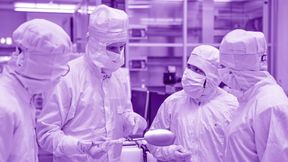
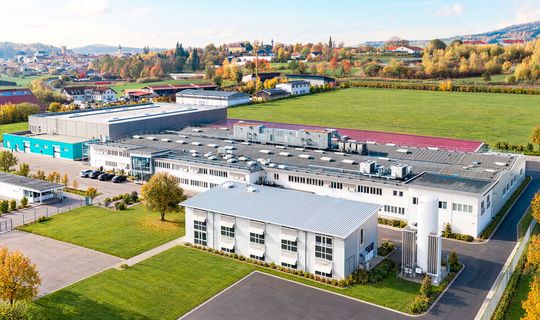
The Furth im Wald site combines electronics manufacturing with the development of automated and digitally supported production processes.
(Source: Deltec Group)
“Automation and digitalization go hand in hand at DELTEC GROUP. That is also essential to secure Germany’s manufacturing base over the medium and long term. At DELTEC GROUP, we have a clear strategy and the capabilities to continue moving in this direction,” says Thomas Fischer, Technical Director.
For Carsten Ellermeier, owner of DELTEC GROUP, these projects are also about positioning the company. At electronica, he wants to showcase more than manufacturing capacity and modern equipment. He wants visitors to see the process expertise within the company. DGMA and the automated test cell give him two concrete examples to demonstrate it. (sb)