There’s no shortage of ideas for next-generation vehicles. The question is how quickly those ideas reach customers, and how they improve over time. That comes down to something too often overlooked: architecture.
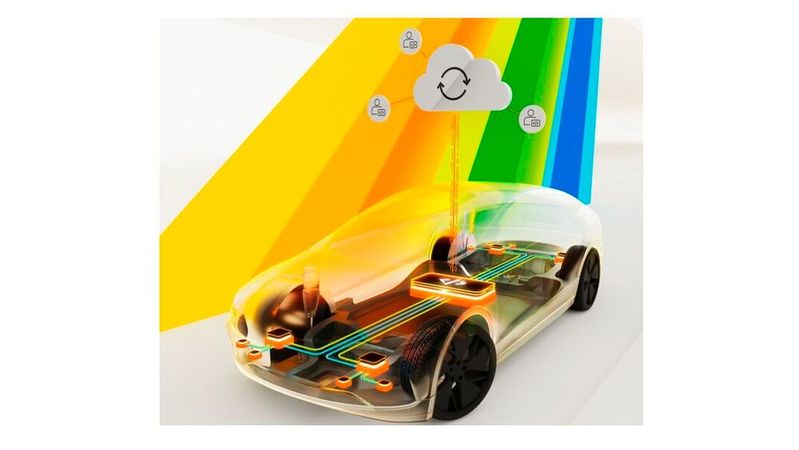
Software-defined vehicle: Value is no longer determined by traditional mechanical engineering factors such as horsepower or displacement, but rather by software, computing power, and digital services.
(Bild: NXP Semiconductors)
Over the last decade, ADAS, electrification and the connected cabin pulled software to the center of the vehicle. Features have been racing ahead ever since. Architectures, in many cases, have not. That gap now shows up as program drag, cost growth and integration risk.
Why the “add another ECU” Model breaks under SDV Pressure
For years, adding capability meant adding another ECU, often with different silicon, software and integration models. Across a vehicle, that creates validation overhead, unpredictable updates and more interface stitching than new value. What once worked now becomes the bottleneck when customers expect frequent over-the-air improvements.
The fix is not “more boxes.” It’s decoupling software from hardware and running on a unified foundation that delivers consistent behavior across the vehicle. Just as data centers tamed runaway complexity by standardizing compute and orchestrating systems together, automotive must now shift from hardware sprawl to a unified architecture designed for predictable behavior at scale.
What a Unified Vehicle-core Architecture Looks like—and why it Works
A vehicle-core architecture coordinates how the car behaves: motion, energy and thermal management, body systems, in-vehicle networking and security. Around that core, automakers still keep tight loops at the edge and organize I/O in zones, but the system is logically unified and architecturally disciplined:
Central domain: where real‑time, safety‑critical coordination lives and timing must be deterministic.
Zonal layer: where functions and I/O are grouped physically, simplifying wiring and enabling orderly data and energy distribution.
Edge nodes: where low‑latency control stays close to sensors and actuators without fragmenting overall behavior.
Domains such as infotainment and automated‑driving feature stacks evolve at “consumer speed”. They operate outside the vehicle‑core architecture and interface through well‑defined boundaries. That separation protects real‑time, safety‑critical systems while letting fast‑moving domains innovate freely.
It is also important to consider how AI fits into this architecture. AI delivers most value where data and computing are consistent. A unified vehicle-core architecture provides both, with computing placed at the edge, in zones or at the core based on latency and safety needs.
This is also what allows AI to move beyond isolated features. With consistent data, deterministic timing, and controlled deployment, AI can improve vehicle behavior at a system level—compounding benefits across the fleet over time.
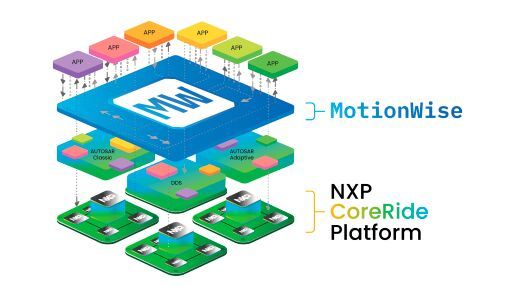
Figure 1: Following the acquisition of TTTech Auto, now Trustmotion, NXP has Motionwise, a middleware solution designed to integrate software and hardware in complex vehicle architectures.
(Bild: NXP Semiconductors)
Software and Middleware: the Difference between Components and a System
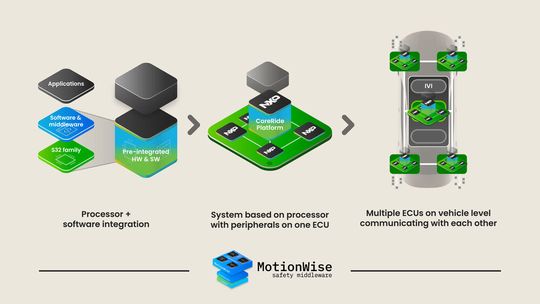
Middleware is what makes SDVs work (Figure 1). A modern vehicle needs a consistent software base and a deterministic middleware layer that handles safe scheduling, mixed criticality orchestration, communication discipline, isolation and well-defined service interfaces (Figure 2).
Figure 2: A modern vehicle needs a consistent software base and a deterministic middleware layer that handles safe scheduling, mixed criticality orchestration, communication discipline, isolation and well-defined service interfaces.
(Bild: NXP Semiconductors)
Instead of repeating the ECU by ECU integration cycle, car manufacturers are now looking at architectures where the core hardware, networking, energy management and middleware already behave as one.
Once the architecture is in place, continuous integration, testing and deployment (CI/CT/CD) accelerate progress only when a consistent execution environment ensures results remain repeatable and reliable.
Build versus Buy: where to Invest Scarce Engineering Time
There is pride in building from scratch, but there is also a cost. Recreating timing models, safety scaffolding, OTA pathways and integration layers pull attention away from work customers notice. A more pragmatic pattern is to start with a proven foundation and focus internal teams on experiences and data-driven features.
To operationalize this shift, the industry is moving toward system‑ready SDV foundations—architectural baselines that remove the need to rebuild infrastructure program by program.
For automakers, this directly lowers total cost of ownership by reducing redundant integration work, shortening validation cycles, and enabling software reuse across vehicle lines and generations. By freeing teams from foundational integration work, these approaches let engineering effort concentrate on differentiation customers actually experience: features, services, and intelligence delivered over the vehicle’s lifetime. That’s important because customers do not ask for an SDV. They ask for range, safety, comfort, personalization and a car that is better next year than it is today.
Stand: 08.12.2025
Es ist für uns eine Selbstverständlichkeit, dass wir verantwortungsvoll mit Ihren personenbezogenen Daten umgehen. Sofern wir personenbezogene Daten von Ihnen erheben, verarbeiten wir diese unter Beachtung der geltenden Datenschutzvorschriften. Detaillierte Informationen finden Sie in unserer Datenschutzerklärung.
Einwilligung in die Verwendung von Daten zu Werbezwecken
Ich bin damit einverstanden, dass die Vogel Communications Group GmbH & Co. KG, Max-Planckstr. 7-9, 97082 Würzburg einschließlich aller mit ihr im Sinne der §§ 15 ff. AktG verbundenen Unternehmen (im weiteren: Vogel Communications Group) meine E-Mail-Adresse für die Zusendung von redaktionellen Newslettern nutzt. Auflistungen der jeweils zugehörigen Unternehmen können hier abgerufen werden.
Der Newsletterinhalt erstreckt sich dabei auf Produkte und Dienstleistungen aller zuvor genannten Unternehmen, darunter beispielsweise Fachzeitschriften und Fachbücher, Veranstaltungen und Messen sowie veranstaltungsbezogene Produkte und Dienstleistungen, Print- und Digital-Mediaangebote und Services wie weitere (redaktionelle) Newsletter, Gewinnspiele, Lead-Kampagnen, Marktforschung im Online- und Offline-Bereich, fachspezifische Webportale und E-Learning-Angebote. Wenn auch meine persönliche Telefonnummer erhoben wurde, darf diese für die Unterbreitung von Angeboten der vorgenannten Produkte und Dienstleistungen der vorgenannten Unternehmen und Marktforschung genutzt werden.
Meine Einwilligung umfasst zudem die Verarbeitung meiner E-Mail-Adresse und Telefonnummer für den Datenabgleich zu Marketingzwecken mit ausgewählten Werbepartnern wie z.B. LinkedIN, Google und Meta. Hierfür darf die Vogel Communications Group die genannten Daten gehasht an Werbepartner übermitteln, die diese Daten dann nutzen, um feststellen zu können, ob ich ebenfalls Mitglied auf den besagten Werbepartnerportalen bin. Die Vogel Communications Group nutzt diese Funktion zu Zwecken des Retargeting (Upselling, Crossselling und Kundenbindung), der Generierung von sog. Lookalike Audiences zur Neukundengewinnung und als Ausschlussgrundlage für laufende Werbekampagnen. Weitere Informationen kann ich dem Abschnitt „Datenabgleich zu Marketingzwecken“ in der Datenschutzerklärung entnehmen.
Falls ich im Internet auf Portalen der Vogel Communications Group einschließlich deren mit ihr im Sinne der §§ 15 ff. AktG verbundenen Unternehmen geschützte Inhalte abrufe, muss ich mich mit weiteren Daten für den Zugang zu diesen Inhalten registrieren. Im Gegenzug für diesen gebührenlosen Zugang zu redaktionellen Inhalten dürfen meine Daten im Sinne dieser Einwilligung für die hier genannten Zwecke verwendet werden. Dies gilt nicht für den Datenabgleich zu Marketingzwecken.
Recht auf Widerruf
Mir ist bewusst, dass ich diese Einwilligung jederzeit für die Zukunft widerrufen kann. Durch meinen Widerruf wird die Rechtmäßigkeit der aufgrund meiner Einwilligung bis zum Widerruf erfolgten Verarbeitung nicht berührt. Um meinen Widerruf zu erklären, kann ich als eine Möglichkeit das unter https://contact.vogel.de abrufbare Kontaktformular nutzen. Sofern ich einzelne von mir abonnierte Newsletter nicht mehr erhalten möchte, kann ich darüber hinaus auch den am Ende eines Newsletters eingebundenen Abmeldelink anklicken. Weitere Informationen zu meinem Widerrufsrecht und dessen Ausübung sowie zu den Folgen meines Widerrufs finde ich in der Datenschutzerklärung, Abschnitt Redaktionelle Newsletter.
The Bottom Line
The industry has reached the point where adding features without architectural discipline only increases cost and risk. The winners will build on a deterministic vehicle-core foundation, standardize middleware and run a delivery model – spanning deployment, validation, and updates — that allows AI-driven improvements to be introduced safely and continuously over the vehicle’s lifetime.
That is how software, hardware and operations align so intelligence can spread across the vehicle predictably and at scale. Build on that foundation, then the experience – services, personalization, efficiency – stops being aspiration and starts being standard practice.
(se)
* Jan-Philipp Gehrmann, VP of Marketing & Strategy, Automotive at NXP