AI accelerators are now exceeding the 1 kW-per-GPU threshold, while server racks are approaching the megawatt level. An examination of the Power Distribution Network (PDN) of modern AI servers reveals why multilayer ceramic capacitors (MLCCs) are becoming increasingly important.
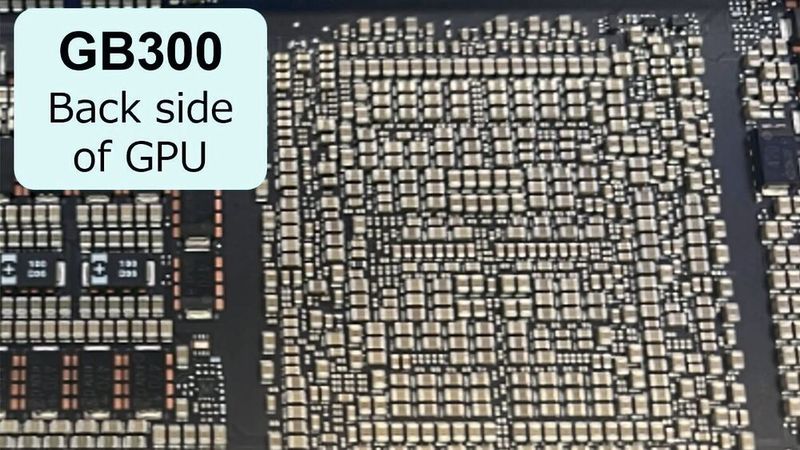
AI chip size is increasing, requiring a larger power circuit area while keeping the overall board size as small as possible.
(Bild: TAIYO YUDEN)
It is no longer sufficient to simply provide enough electrical power. Instead, this energy must be delivered to the processor with the lowest possible losses while simultaneously coping with extremely fast load transients. Every unnecessary watt of power loss not only increases the energy consumption of the data center but also makes cooling significantly more challenging.
At the center of this development is the Power Distribution Network (PDN)—the complete power delivery chain from the power supply through the voltage regulators to the processor itself. Power supplies and DC/DC converters tend to dominate the conversation, yet passive components are gaining ground in importance. Multilayer ceramic capacitors (MLCCs) are a case in point: by stabilizing supply voltage even under highly dynamic load transients, they allow modern AI processors to consistently reach their maximum computing performance.
For manufacturers of passive components, this trend represents a fundamental technological shift. The market demands MLCCs with significantly higher capacitance, lower parasitic inductance, and increasingly compact form factors. At the same time, new integration concepts are becoming more important to utilize the limited space available on the PCB and within semiconductor packages as efficiently as possible. These requirements form the basis of TAIYO YUDEN's current development strategy.
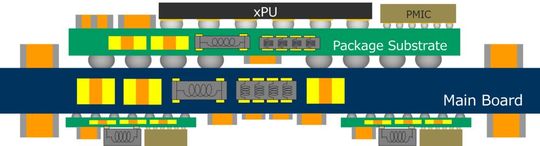
Maximize space utilization to position the last-stage VR as close to the load as possible, using small, high-performance and/or embedded components.
(Bild: TAIYO YUDEN)
Power Delivery Moves Closer to the Processor
For many years, supply voltages were generated by high-performance voltage regulators located on the motherboard and then routed to the processor through PCB traces. As long as processors consumed only a few hundred watts, this architecture posed few challenges.
The conditions for AI accelerators, however, look very different. Their core supply voltage typically ranges between 0.7 V and 0.9 V, while power levels exceeding 1 kW push currents well past 1,000 A. Under these conditions, even minimal trace resistance produces measurable voltage drops and substantial power losses.
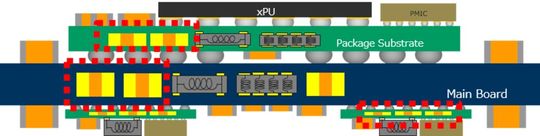
As power demands increase and vertical power delivery is adopted, MLCC placement space is becoming limited, driving increased interest in embedded MLCCs.
(Bild: TAIYO YUDEN)
Another phenomenon further complicates power delivery. AI processors can change their power consumption within just a few nanoseconds. As neural networks execute different computational workloads or multiple compute units become active simultaneously, extremely fast load transients occur. The power delivery system must respond virtually instantaneously. Otherwise, the supply voltage temporarily drops below its target level, negatively affecting both system stability and computing performance.
For this reason, the architecture of modern server power delivery is undergoing a fundamental transformation. The final stage of voltage regulation is moving progressively closer to the processor.
TAIYO YUDEN describes this evolution in three stages:
Motherboard Voltage Regulator (MBVR): Voltage regulation is located entirely on the motherboard.
Vertical Power Delivery (VPD): The power delivery circuitry moves closer to the processor, shortening current paths and reducing losses.
Integrated Voltage Regulator (IVR): The final voltage conversion stage is integrated directly into the processor package or its immediate vicinity.
The shorter the current path between the voltage regulator and the processor, the lower the resistive losses become. At the same time, transient response improves dramatically because energy reaches the processor much faster. This evolution is now considered one of the key enabling technologies for future AI server architectures.
However, this progress introduces a new challenge. As power delivery moves closer to the processor, the available installation space becomes increasingly limited. Consequently, smaller components become the only viable solution.
Why MLCCs Are Essential for AI Servers
From the outside, multilayer ceramic capacitors appear to be among the smallest components on a printed circuit board. Their importance for modern AI servers, however, is enormous.
While voltage regulators generate the required supply voltage, MLCCs temporarily store electrical energy directly adjacent to the processor and can release it again within just a few nanoseconds whenever required.
This behavior can be compared to a small local energy reservoir. If the supply voltage temporarily drops because of a sudden increase in current demand, the MLCCs located immediately next to the processor instantly release their stored charge. This keeps the supply voltage within acceptable limits until the voltage regulator has had sufficient time to adjust its output accordingly.
How Modern MLCCs Achieve Higher Capacitance
A capacitor consists of two conductive electrodes separated by an insulating layer, the dielectric. When voltage is applied, opposite charges build up on the electrodes, and the resulting electric field stores energy. The moment the supply voltage briefly dips, this stored energy discharges again within just a few nanoseconds — fast enough to buffer even the rapid load transients of AI accelerators.
This is precisely what makes MLCCs indispensable for modern processors. Voltage regulators handle the average supply voltage, but it's the MLCCs that deliver the energy needed to keep pace with the extremely fast load transients constantly occurring in AI accelerators. In effect, they act as local, high-speed energy reservoirs.
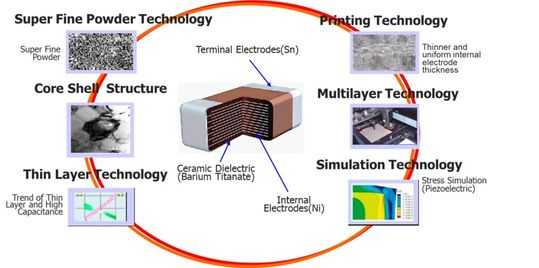
The MLCC Key technology.
(Bild: TAIYO YUDEN)
A single capacitor would not be sufficient for this purpose. Instead, an MLCC consists of numerous stacked layers of ceramic dielectric material and nickel electrodes. The ceramic, typically barium titanate (BaTiO₃), forms the dielectric, while the nickel layers serve as electrodes. Each individual layer functions as a small capacitor. By stacking hundreds or even thousands of these layers, manufacturers achieve very high capacitance within an extremely compact component.
The achievable capacitance is primarily determined by four factors: the electrode area, the number of active layers, the dielectric constant of the ceramic material, and the thickness of the dielectric layer.
Since increasing the package size is generally not an option, current development focuses on realizing increasingly finer structures within the same footprint. Thinner ceramic layers combined with a greater number of active layers enable substantially higher capacitance without increasing component dimensions.
High-Density MLCCs Meet Increasing Power Density Requirements
The power consumption of modern AI processors continues to rise, while their supply voltages are simultaneously decreasing to well below one volt. For system designers, this creates a significant challenge: ever-higher currents must be delivered within an increasingly confined space, while sufficient local energy storage must still be maintained.
To address these demands, TAIYO YUDEN has developed a dedicated roadmap for AI server applications. Its portfolio includes High-Density MLCCs from the X6 and X7 series, optimized for the various voltage rails found in modern server architectures. These products range from high-capacitance output capacitors for supply voltages between 0.6 V and 1.2 V to MLCCs designed for intermediate bus voltages and higher-voltage input filtering.
The objective is to provide sufficient capacitance despite the severe space constraints of next-generation AI platforms while ensuring the stability of the entire Power Distribution Network.
Embedded MLCCs Create New Opportunities for System Design
As power delivery circuitry moves closer to the processor, the available space inside the package substrate becomes increasingly limited. At the same time, PCB real estate is becoming more valuable than ever.
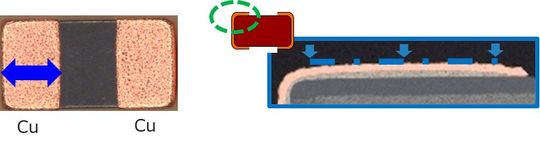
One way to resolve this conflict is to integrate capacitors directly into the package. Embedded MLCCs relocate capacitance from the PCB surface into the package substrate itself. This frees valuable board space for additional components while simultaneously reducing the electrical distance between the processor and the capacitor. Shorter current paths further improve power delivery performance and reduce parasitic resistance.
The larger, flat Cu electrode of TAIYO YUDEN's embedded MLCC makes it easy to increase the number of vias, minimizing parasitic resistance, while also ensuring secure fixation of the MLCC and reducing the risk of movement during resin molding.
(Bild: TAIYO YUDEN)
TAIYO YUDEN has pursued this concept for many years. Its embedded MLCCs feature flat copper electrodes, which improve manufacturing yield during substrate fabrication. Wide electrode structures also allow multiple vias to be used simultaneously, further reducing parasitic resistance.
Another advantage is the secure mechanical fixation of the components during resin encapsulation, increasing process reliability during manufacturing. Today, the company has accumulated more than ten years of experience in the mass production of embedded capacitor solutions.
Besides high capacitance, low parasitic inductance has become equally important.
The faster a processor changes its current consumption, the more its performance depends on the effective inductance of the decoupling capacitors. Excessive inductance limits the capacitor's ability to supply current during extremely fast transient events. For this reason, TAIYO YUDEN complements its High-Density MLCC portfolio with Low-ESL solutions based on three-terminal technology.
Their special terminal geometry significantly reduces parasitic inductance while simultaneously lowering impedance, particularly at high frequencies. As a result, extremely fast load transients can be compensated even more effectively.
A Portfolio for the Next Generation of AI Servers
As data centers increasingly rely on more powerful AI accelerators, higher current densities, and more compact server architectures, TAIYO YUDEN approaches these challenges from a system perspective rather than focusing on individual components.
The portfolio includes high-density MLCCs for a wide range of supply voltages, embedded MLCCs for advanced package architectures, and low-ESL capacitor solutions designed for highly dynamic load conditions.
The portfolio is complemented by high-performance inductors that work together with the capacitors to enable compact and highly efficient power delivery systems.
The focus is therefore not simply on increasing the capacitance of individual components. Rather, success depends on the interaction of every element within the Power Distribution Network.
Only when voltage regulators, inductors, and MLCCs are carefully optimized as an integrated system can the extremely dynamic load profiles of modern AI accelerators be managed reliably.
MLCCs at the Heart of Modern Power Delivery
The power requirements of today's AI processors continue to grow at an extraordinary pace. At the same time, demands for higher energy efficiency, greater power density, and faster transient response are increasing. As a result, the Power Distribution Network is becoming a key differentiating factor for next-generation AI computing platforms.
In addition to MLCCs designed for embedded substrate applications, TAIYO YUDEN offers a lineup of cutting-edge X6S components, which includes 0402-inch (22µF, 47µF), 0603-inch (22µF, 47µF, 100µF), and 0805-inch (47µF, 100µF, 220µF) MLCCs.
Multilayer ceramic capacitors store energy directly adjacent to the processor, stabilize the supply voltage during extremely fast load transients, and thereby enable the performance levels required by modern AI accelerators.
With its High-Density MLCCs, Embedded MLCCs, and Low-ESL technologies, TAIYO YUDEN directly addresses these challenges. By combining advanced material science, precision manufacturing, and decades of expertise in passive components, the company has developed a portfolio specifically designed for the power delivery requirements of future AI data centers.
TAIYO YUDEN therefore positions itself not merely as a component supplier, but as a technology partner for engineers developing the next generation of AI server power architectures.
(ID:50925536)
Stand: 08.12.2025
Es ist für uns eine Selbstverständlichkeit, dass wir verantwortungsvoll mit Ihren personenbezogenen Daten umgehen. Sofern wir personenbezogene Daten von Ihnen erheben, verarbeiten wir diese unter Beachtung der geltenden Datenschutzvorschriften. Detaillierte Informationen finden Sie in unserer Datenschutzerklärung.
Einwilligung in die Verwendung von Daten zu Werbezwecken
Ich bin damit einverstanden, dass die Vogel Communications Group GmbH & Co. KG, Max-Planckstr. 7-9, 97082 Würzburg einschließlich aller mit ihr im Sinne der §§ 15 ff. AktG verbundenen Unternehmen (im weiteren: Vogel Communications Group) meine E-Mail-Adresse für die Zusendung von redaktionellen Newslettern nutzt. Auflistungen der jeweils zugehörigen Unternehmen können hier abgerufen werden.
Der Newsletterinhalt erstreckt sich dabei auf Produkte und Dienstleistungen aller zuvor genannten Unternehmen, darunter beispielsweise Fachzeitschriften und Fachbücher, Veranstaltungen und Messen sowie veranstaltungsbezogene Produkte und Dienstleistungen, Print- und Digital-Mediaangebote und Services wie weitere (redaktionelle) Newsletter, Gewinnspiele, Lead-Kampagnen, Marktforschung im Online- und Offline-Bereich, fachspezifische Webportale und E-Learning-Angebote. Wenn auch meine persönliche Telefonnummer erhoben wurde, darf diese für die Unterbreitung von Angeboten der vorgenannten Produkte und Dienstleistungen der vorgenannten Unternehmen und Marktforschung genutzt werden.
Meine Einwilligung umfasst zudem die Verarbeitung meiner E-Mail-Adresse und Telefonnummer für den Datenabgleich zu Marketingzwecken mit ausgewählten Werbepartnern wie z.B. LinkedIN, Google und Meta. Hierfür darf die Vogel Communications Group die genannten Daten gehasht an Werbepartner übermitteln, die diese Daten dann nutzen, um feststellen zu können, ob ich ebenfalls Mitglied auf den besagten Werbepartnerportalen bin. Die Vogel Communications Group nutzt diese Funktion zu Zwecken des Retargeting (Upselling, Crossselling und Kundenbindung), der Generierung von sog. Lookalike Audiences zur Neukundengewinnung und als Ausschlussgrundlage für laufende Werbekampagnen. Weitere Informationen kann ich dem Abschnitt „Datenabgleich zu Marketingzwecken“ in der Datenschutzerklärung entnehmen.
Falls ich im Internet auf Portalen der Vogel Communications Group einschließlich deren mit ihr im Sinne der §§ 15 ff. AktG verbundenen Unternehmen geschützte Inhalte abrufe, muss ich mich mit weiteren Daten für den Zugang zu diesen Inhalten registrieren. Im Gegenzug für diesen gebührenlosen Zugang zu redaktionellen Inhalten dürfen meine Daten im Sinne dieser Einwilligung für die hier genannten Zwecke verwendet werden. Dies gilt nicht für den Datenabgleich zu Marketingzwecken.
Recht auf Widerruf
Mir ist bewusst, dass ich diese Einwilligung jederzeit für die Zukunft widerrufen kann. Durch meinen Widerruf wird die Rechtmäßigkeit der aufgrund meiner Einwilligung bis zum Widerruf erfolgten Verarbeitung nicht berührt. Um meinen Widerruf zu erklären, kann ich als eine Möglichkeit das unter https://contact.vogel.de abrufbare Kontaktformular nutzen. Sofern ich einzelne von mir abonnierte Newsletter nicht mehr erhalten möchte, kann ich darüber hinaus auch den am Ende eines Newsletters eingebundenen Abmeldelink anklicken. Weitere Informationen zu meinem Widerrufsrecht und dessen Ausübung sowie zu den Folgen meines Widerrufs finde ich in der Datenschutzerklärung, Abschnitt Redaktionelle Newsletter.




:quality(80)/p7i.vogel.de/wcms/bf/be/bfbee7b65baec3e1ba081a443808cc84/0132746071v5.jpeg "Heinz Arnold: Kann China eine Alternative zu den EUV-Anlagen von ASML bieten? (Bild: Dall-E / KI-generiert)")
:quality(80)/p7i.vogel.de/wcms/3a/01/3a010ed10c644b1804a101d5afbe595c/0132672260v2.jpeg "Nach dem Moore'schen Gesetz: Packaging entwickelt sich zum wichtigsten Motor für die Halbleitertechnik. (Bild: © Svitlana - stock.adobe.com)")
:quality(80)/p7i.vogel.de/wcms/89/f1/89f1a6c36c4397be6939b00570d2bc5f/0132677340v2.jpeg "Das Kühlsystem eines Quantencomputers hält die Quantenchips bei Temperaturen nahe dem absoluten Nullpunkt. Erst unter diesen Bedingungen können sie ihre besonderen Quanteneigenschaften entfalten (künstlerische Darstellung). (Bild: B. Schröder/HZDR)")
:quality(80)/p7i.vogel.de/wcms/f1/99/f199b1d3f45c30bd4fa65956d8386471/0132763535v2.jpeg "Für 2027 planen zwei Unternehmen erstmals eine optische Laserkommunikation, die direkt zwischen einem Satelliten in einer erdnahen Umlaufbahn (LEO) und einem wiedereintretenden Raumfahrzeug etabliert werden soll. (Bild: ATMOS Space Cargo)")
:quality(80)/p7i.vogel.de/wcms/72/45/7245dc0f6ac41ac6bcf86d8e5d761c15/0132780694v3.jpeg "AI chip size is increasing, requiring a larger power circuit area while keeping the overall board size as small as possible. (Bild: TAIYO YUDEN)")
:quality(80)/p7i.vogel.de/wcms/9f/c5/9fc50e7e7566118efc8c01fcd36c3504/0132712014v2.jpeg "High Bandwidth Flash: Mit fortschrittlicher Verpackungstechnologie lassen sich herkömmliche Flash-Speicherchips stapeln, wodurch sich die Lesegeschwindigkeiten drastisch verbessern. (Bild: Sandisk)")
:quality(80)/p7i.vogel.de/wcms/8e/90/8e903462cf20021b3e01aef22728c51d/0132671545v2.jpeg "Die EU-Kommission hat eine Großinitiative zur Förderung von Künstlicher Intelligenz im EU-Raum gestartet. Ziel ist, 10 Milliarden Euro an öffentlichen Geldern bereitzustellen, um Europa bei der künstlichen Intelligenz durch mehrere neue KI-Gigafactories besser voranzubringen. Weitere 20 Milliarden sollen durch Investitionen aus der Wirtschaft zusammenkommen. (Bild: J. Stone)")
:quality(80)/p7i.vogel.de/wcms/e9/35/e935a9603233958e3e88e4d4d8d7fc10/0132623730v2.jpeg "Falsch gesetzte Prioritäten und unzureichende Limits beim Einsatz KI-gestützter Coding-Agenten haben bei Amazon in diversen Softwareprojekten Mehrkosten in Millionenhöhe verursacht – darunter ironischerweise auch ein Projekt für ein internes Finanzprüfungssystem. (Bild: Dall-E / KI-generiert)")
:quality(80)/p7i.vogel.de/wcms/38/e8/38e8a3195479448383fdc90ca8bdd73f/0132661451v2.jpeg "Zentrale Geräteverwaltung: Skalierbare Architekturkonzepte gewährleisten sichere OTA-Updates und einen hochverfügbaren Betrieb von Embedded-Systemen. (Bild: Gemini / KI-generiert)")
:quality(80)/p7i.vogel.de/wcms/8a/94/8a948c57a2a7bef7f0164d0c3c00436e/0132488005v2.jpeg "Die drei neuen Touch Display 2 der Raspberry Pi Foundation in 10, 7 und 5 Zoll. (Bild: Raspberry Pi Foundation)")
:quality(80)/p7i.vogel.de/wcms/36/b5/36b58409246b5bc604a633c7120995a5/0132716726v2.jpeg "ompakte Absicherung für die Industrie: Die neue Gleichstrom-USV Duramax von Weidmüller schützt 24-Volt-Anlagen vor unerwarteten Spannungsschwankungen. (Bild: Weidmüller)")
:quality(80)/p7i.vogel.de/wcms/91/fd/91fd1376557777ed8f96c74ad4bb67ce/0132682351v2.jpeg "Wide-Bandgap-Materialien: Sind aus SiC und GaN und finden auf Leiterplatten in der Leistungselektronik Einsatz. Zum Testen sind spezielle Plattformen notwendig, die elektrische Parameter und thermisches Verhalten unter Realbedingungen validieren können. (Bild: Heraeus)")
:quality(80)/p7i.vogel.de/wcms/c2/18/c218bc61b5e21196efa51014171d035e/0132679076v3.jpeg "Mit 2.200 V erweitert Power Integrations den Spannungsbereich seiner PowiGaN-Technologie. Ziel sind Hochspannungsanwendungen, in denen hohe Schaltfrequenzen kompaktere Stromversorgungen ermöglichen sollen. (Bild: Power Integrations)")
:quality(80)/p7i.vogel.de/wcms/8a/2e/8a2e7d2a89ffe55c545dd6c831ed154e/0132246788v2.jpeg "Über 500 Teilnehmer, 120 Referenten: Die FPGA Conference Europe platzte in diesem Jahr aus allen Nähten – und wurde ihrem Anspruch als Leitkongress der FPGA-Welt einmal mehr gerecht. (Bild: Tobi Giessen)")
:quality(80)/p7i.vogel.de/wcms/06/a1/06a158e32b18d99fcea65547cec5d4c7/0132069489v2.jpeg "Mit direkter Integration von Speicher ins Chip-Package verspricht AMD mit dem Versal Premium Gen 2 SoC eine schnellere Datenübertragung, verringerte Latenz und einem potentiell geringere Stromverbrauch. (Bild: AMD)")
:quality(80)/p7i.vogel.de/wcms/86/2a/862afb1de8423bb7401098a2fd268281/0131792672v2.jpeg "Bild 1: Ein Spannungsversorgungskonzept für Lasten, welche eine vorgegebene Ein- und Abschaltreihenfolge (Sequencing) benötigen. (Bild: ADI)")
:quality(80)/p7i.vogel.de/wcms/14/d7/14d7cb77132e76f852e71edf06cc94fb/0131803730v2.jpeg "Tom Trill, CEO von Qualinx, und Dr. Manfred Horstmann, Senior Vice President und General Manager bei GlobalFoundries (Bild: Globalfoundries)")
:quality(80)/p7i.vogel.de/wcms/c1/c1/c1c1c1400ca9ed92b11d2c9744570fc5/0132605401v1.jpeg "Bewährte Security Design Principles zeigen, wie sich Embedded-Systeme von Beginn an resilienter, modularer und wirksam gegen Cyberangriffe absichern lassen. (Bild: Dall-E / KI-generiert)")
:quality(80)/p7i.vogel.de/wcms/31/e1/31e19bb8d1057f4dfbdc5cb36f465bc1/0132596426v4.jpeg "Magnetfusion: Querschnitt eines künftigen Fusionskraftwerks mit dem mehr als 100 Mio. °C heißem Plasma. (Bild: ITER)")
:quality(80)/p7i.vogel.de/wcms/f7/9a/f79a88746d596c9bb948de48f9d988a7/0132575777v2.jpeg "Auch Synopsys zeichnet für EDA eine Zukunft mit autonom agierenden KI-Agenten. (Bild: Synopsys)")
:quality(80)/p7i.vogel.de/wcms/86/0c/860cfa420ab1db3479ff1540a05c484d/header-960x540pxv1.png "Schaltkomponenten für das Batteriemanagement (Bild: Shutterstock)")
:quality(80)/p7i.vogel.de/wcms/ef/fb/effb7f5920275c64f26ad86475b4a26b/0132661518v2.jpeg "Exakter Wirkungsgrad: Für hochpräzise Wirkungsgrad- und Verlustanalysen an Frequenzumrichtern ist eine exakte zeit- und amplitudengenaue Leistungsmessung unerlässlich. (Bild: LEM)")
:quality(80)/p7i.vogel.de/wcms/79/f5/79f5c6a1d253a9df4e9e8cb1ce409494/0132631726v2.jpeg "Herzstück der Optimierung: Die Integration von Göpel-Hardware wie dem „SCANBOOSTER II“ und entsprechenden TEM-Modulen ermöglichte das schnelle Flashen via SPI-Interface. (Bild: Göpel electronic)")
:quality(80)/p7i.vogel.de/wcms/49/fb/49fb55dd77c9a79e4c18353cf095eee1/0132724876v2.jpeg "Die Pioniere der digitalen Relaislogik: Das Entwicklerteam um Richard „Dick“ Morley (im Bild ganz links) mit einem frühen Modell der Modicon 084. Ihre Entscheidung für den visuellen Kontaktplan sicherte der neuen Technologie die Akzeptanz in den Werkhallen. (Bild: Schneider Electric)")
:quality(80)/p7i.vogel.de/wcms/8a/25/8a25a67197150178ae57bfff7a4d9067/0132741917v2.jpeg "Technicoll 9464 für chemisch und thermisch belastete Strukturklebungen von Ruderer ist ein 2-K-Epoxidharzklebstoff für Transport, Fahrzeugbau, Luftfahrt, Elektronik und Composite-Anwendungen.
(Bild: Ruderer)")
:quality(80)/p7i.vogel.de/wcms/3e/dc/3edcb987bc4e960088fe92111d3b95b3/0132741806v2.jpeg "Rollender Humanoid bei Siemens: Im Praxistest bewegte der Roboter 60 Behälter pro Stunde aufs Förderband. (Bild: Siemens)")
:quality(80)/p7i.vogel.de/wcms/a4/94/a494432e87a6c58687cc27b2b7774fd8/0132764492v2.jpeg "Precoplat fertigt die eigenen Leiterplatten ausschließlich in Deutschland und gibt Ratschläge, woran sich Platinen \"Made in Germany\" erkennen lassen. (Bild: Precoplat)")
:quality(80)/p7i.vogel.de/wcms/0d/54/0d5433187cf8600cfb7f1755dfc6c3f4/0132761112v2.jpeg "Halbleiterskalierung: TSMCs Roadmap zeigt einen grundlegenden Wandel. Nicht allein die Transistordichte bestimmt die Entwicklungen, sondern die Skalierung verschiebt sich vom einzelnen Chip auf die Systemebene. (Bild: TSMC)")
:quality(80)/p7i.vogel.de/wcms/1e/db/1edb2d67c5ab06033f59ee71e27aeb22/0132682714v2.jpeg "Symbolbild: Neue US-Regeln könnten den Marktzugang ausländischer Anbieter mobiler Roboter und vernetzter Wechselrichter erschweren. (Bild: Dall-E / KI-generiert)")
:quality(80)/p7i.vogel.de/wcms/66/75/66750595ac91a276db7fdb39edc4de80/0132680361v2.jpeg "Symbolbild: Rechenzentren, Chips und Leiterplatten stehen für die reale KI-Infrastruktur – die fragile Blase für die hohen Erwartungen an ihr weiteres Wachstum. (Bild: Dall-E / KI-generiert)")
:quality(80)/p7i.vogel.de/wcms/47/20/47201c1ce3692dbdb4e7e62709de4e16/0132649717v3.jpeg "Ingenieurberufe verändern sich: Neben der aktuellen Konjunktur treiben Digitalisierung, KI und neue Technologien den Bedarf an kontinuierlicher Qualifizierung. (Bild: frei lizenziert)")
:quality(80)/p7i.vogel.de/wcms/4e/41/4e4159d1e93e67d47bd2f51a90691b23/0131548978v2.jpeg "Transformation im Engineering: KI-gestützte Systeme generieren zunehmend selbstständig Schaltschranklayouts und entlasten Konstrukteure von zeitraubenden Routineaufgaben. (Bild: WSCAD)")
:quality(80)/p7i.vogel.de/wcms/d6/ea/d6eac438c362c545cab42ef0f30bcfc0/0130136975v2.jpeg "Die Bewerbungsphase für den James Dyson Award 2026 ist gestartet. (Bild: Dyson)")
:fill(fff,0)/p7i.vogel.de/companies/67/48/674821efc7bba/images.png "images (TAIYO YUDEN)")