As power electronics, high-speed links, and AI workloads converge, testing subsystems in isolation may overlook critical interactions. Philip Diegmann explains why correlated measurements are essential for everything from SiC and GaN designs to AI data centers and AI-assisted test workflows.
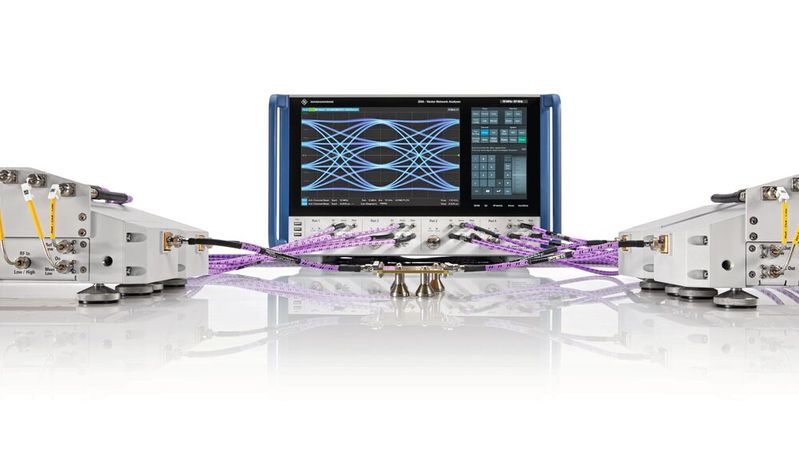
The R&S ZNA vector network analyser from Rohde & Schwarz can characterise high-speed interconnects. In the interview, Philip Diegmann explains why correlated measurements are essential.
(Source: Rohde & Schwarz)
Is it becoming increasingly difficult to prove that modern electronic systems work under all conditions?
Philip Diegmann: Yes, and convergence is the main reason. Power electronics, high-speed digital design, RF connectivity and EMC used to be separate. Today, they meet in one product, often on one board.
The electrical power in these systems keeps rising, in a smaller space. Next to the power stage, CPUs, GPUs and accelerators move data at high speed. A fast-switching converter is a noise source and a high-speed link is a receiver. These interactions do not show up if each subsystem is verified in isolation. On top of that, the systems must operate in a complex environment with varying temperatures, crowded wireless spectrum and functional and regulatory requirements such as EMC.
Robotics is a good example. A modern robot processes camera, radar and force sensor data in real time while converting considerable power for its actuators. If a motor inverter couples interference into a sensor interface, the result is a robot that behaves unpredictably. Robustness therefore requires correlated measurements across domains. Rohde & Schwarz offers solutions for all of these areas.
Where do developers most often reach their limits today when measuring SiC and GaN systems?
Philip Diegmann is the vice president of digital and power test solutions at Rohde & Schwarz.
(source: Paul Hiller)
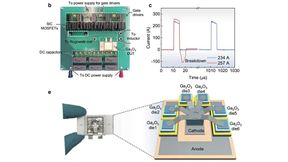
SiC and GaN switch much faster than silicon, with voltage slopes that can exceed 100 V/ns in GaN designs. Engineers need oscilloscopes and, above all, probes with significantly higher bandwidth. If the measurement chain is too slow, switching losses are underestimated and overshoot remains invisible.
The biggest limit, however, is usually the connection to the device. The high-side switch and gate driver sit on a node that swings by hundreds of volts within nanoseconds. Even a few nanohenries of loop inductance in the probe connection produce ringing that belongs to the setup, not to the circuit. Conventional differential probes also lose common-mode rejection at high frequencies, exactly where these transients occur. Optically isolated probes such as the R&S RT-ZISO solve this problem: they maintain high common-mode rejection across their full bandwidth and make reliable floating measurements on the high-side gate and switch node possible.
The second major challenge is efficiency measurement. SiC and GaN converters already operate at very high efficiency levels, and a new topology or optimized gate drive may improve performance by only a few tenths of a percent. Such gains often lie within the uncertainty limits of conventional test setups. Engineers therefore need precision power analyzers such as the LMG600 family, with high AC/DC accuracy and consistent timing between voltage and current channels. Only then can they tell whether an improvement is real or merely an artifact of the setup.
My most important recommendation is to treat measurability as a design requirement. Plan defined test points with short, low-inductance connections into the layout from the start.
What challenges test and measurement more in AI data centers: data rates or power density?
Both are essential, and together they largely determine how fast AI can continue to develop. More importantly, they cannot be separated.
On the data side, AI clusters only scale if accelerators exchange data fast enough. Electrical links are moving to 224 Gbit/s per lane, and 448 Gbit/s is already under development. At these data rates, the interconnect itself becomes the bottleneck: every cable, connector and PCB trace adds loss, reflections and crosstalk. Vector network analyzers such as the R&S ZNA are the key instruments for characterizing these interconnects. They measure insertion loss, return loss and crosstalk over a very wide frequency range.
On the power side, the demand for electrical energy will continue to rise. Rack power already exceeds 100 kW, and accelerator core rails operate below 1 V at currents of around 1,000 A and above, with load steps in the microsecond range. Verifying ripple and transient response on such rails requires low-noise power rail probes. Proving efficiency from the grid to the chip calls for precision power analyzers, oscilloscopes, suitable probes and programmable power supplies, each with a clearly defined role.
Stand: 08.12.2025
Es ist für uns eine Selbstverständlichkeit, dass wir verantwortungsvoll mit Ihren personenbezogenen Daten umgehen. Sofern wir personenbezogene Daten von Ihnen erheben, verarbeiten wir diese unter Beachtung der geltenden Datenschutzvorschriften. Detaillierte Informationen finden Sie in unserer Datenschutzerklärung.
Einwilligung in die Verwendung von Daten zu Werbezwecken
Ich bin damit einverstanden, dass die Vogel Communications Group GmbH & Co. KG, Max-Planckstr. 7-9, 97082 Würzburg einschließlich aller mit ihr im Sinne der §§ 15 ff. AktG verbundenen Unternehmen (im weiteren: Vogel Communications Group) meine E-Mail-Adresse für die Zusendung von redaktionellen Newslettern nutzt. Auflistungen der jeweils zugehörigen Unternehmen können hier abgerufen werden.
Der Newsletterinhalt erstreckt sich dabei auf Produkte und Dienstleistungen aller zuvor genannten Unternehmen, darunter beispielsweise Fachzeitschriften und Fachbücher, Veranstaltungen und Messen sowie veranstaltungsbezogene Produkte und Dienstleistungen, Print- und Digital-Mediaangebote und Services wie weitere (redaktionelle) Newsletter, Gewinnspiele, Lead-Kampagnen, Marktforschung im Online- und Offline-Bereich, fachspezifische Webportale und E-Learning-Angebote. Wenn auch meine persönliche Telefonnummer erhoben wurde, darf diese für die Unterbreitung von Angeboten der vorgenannten Produkte und Dienstleistungen der vorgenannten Unternehmen und Marktforschung genutzt werden.
Meine Einwilligung umfasst zudem die Verarbeitung meiner E-Mail-Adresse und Telefonnummer für den Datenabgleich zu Marketingzwecken mit ausgewählten Werbepartnern wie z.B. LinkedIN, Google und Meta. Hierfür darf die Vogel Communications Group die genannten Daten gehasht an Werbepartner übermitteln, die diese Daten dann nutzen, um feststellen zu können, ob ich ebenfalls Mitglied auf den besagten Werbepartnerportalen bin. Die Vogel Communications Group nutzt diese Funktion zu Zwecken des Retargeting (Upselling, Crossselling und Kundenbindung), der Generierung von sog. Lookalike Audiences zur Neukundengewinnung und als Ausschlussgrundlage für laufende Werbekampagnen. Weitere Informationen kann ich dem Abschnitt „Datenabgleich zu Marketingzwecken“ in der Datenschutzerklärung entnehmen.
Falls ich im Internet auf Portalen der Vogel Communications Group einschließlich deren mit ihr im Sinne der §§ 15 ff. AktG verbundenen Unternehmen geschützte Inhalte abrufe, muss ich mich mit weiteren Daten für den Zugang zu diesen Inhalten registrieren. Im Gegenzug für diesen gebührenlosen Zugang zu redaktionellen Inhalten dürfen meine Daten im Sinne dieser Einwilligung für die hier genannten Zwecke verwendet werden. Dies gilt nicht für den Datenabgleich zu Marketingzwecken.
Recht auf Widerruf
Mir ist bewusst, dass ich diese Einwilligung jederzeit für die Zukunft widerrufen kann. Durch meinen Widerruf wird die Rechtmäßigkeit der aufgrund meiner Einwilligung bis zum Widerruf erfolgten Verarbeitung nicht berührt. Um meinen Widerruf zu erklären, kann ich als eine Möglichkeit das unter https://contact.vogel.de abrufbare Kontaktformular nutzen. Sofern ich einzelne von mir abonnierte Newsletter nicht mehr erhalten möchte, kann ich darüber hinaus auch den am Ende eines Newsletters eingebundenen Abmeldelink anklicken. Weitere Informationen zu meinem Widerrufsrecht und dessen Ausübung sowie zu den Folgen meines Widerrufs finde ich in der Datenschutzerklärung, Abschnitt Redaktionelle Newsletter.
The two topics meet on the board. Supply noise on an accelerator rail turns into jitter on a high-speed link. Power integrity and signal integrity therefore have to be analyzed together.
Where can AI already take over test and measurement tasks in a meaningful way today?
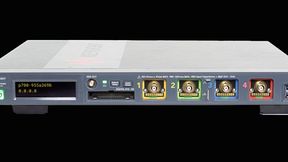
The most practical use today is in the interaction between the engineer and the measurement setup. Configuring instruments, writing automation scripts and evaluating measurement data take up a large part of the working day in the lab. A promising approach is to connect instruments to agentic AI frameworks. The engineer describes the measurement task, and the AI agent configures the instrument, runs the acquisition and summarizes the results. We recently introduced MXO AI Connect for exactly this purpose. It uses a Model Context Protocol (MCP) server to connect R&S MXO oscilloscopes to agent frameworks.
MXO AI Connect also makes it much easier to create automation solutions. Engineers can, for example, ask the AI agent to write a Python script for a recurring measurement task. The agent tests the script directly on the instrument and refines it step by step. The result is a reusable script that runs independently of the AI agent, for example in a regression test or on a production test system.
The roles must remain clear, however. The instrument measures, and the AI orchestrates and assists. A measured value must remain deterministic, traceable and reproducible. The engineer stays responsible for the test strategy and for interpreting the results. AI does not replace measurement expertise; it makes that expertise available more efficiently.
Is physical measurement becoming even more important despite ever better simulation?
Yes, although its role is changing. Early simulation makes a key contribution to reducing the number of hardware respins. A simulation, however, is only as good as its models, and accurate models require extensive measurement of the essential parameters. A SiC or GaN transistor model needs measured switching behavior and parasitics, typically from double-pulse tests. A high-speed channel model needs measured S-parameters, and a power delivery network model needs measured impedance over frequency. Simulation and measurement therefore form a closed loop: measured data feeds the models, and measurements on the first hardware verify and refine them.
Some effects also remain difficult to simulate in full, such as the EMI behavior of a complete system or the variation across production lots. Compliance and certification are always based on measured evidence.
So measurement is shifting. It moves forward into precise component characterization, and it remains the final proof at system level. Precision and traceability matter more than ever, because the measured values become the foundation for everything that follows. (heh)