Despite discontinued components, fragile supply chains, and geopolitical risks, many companies still underestimate the importance of obsolescence management. A COGD panel discussion highlighted why this needs to change and why it must become a top priority.
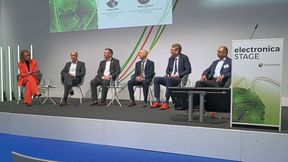
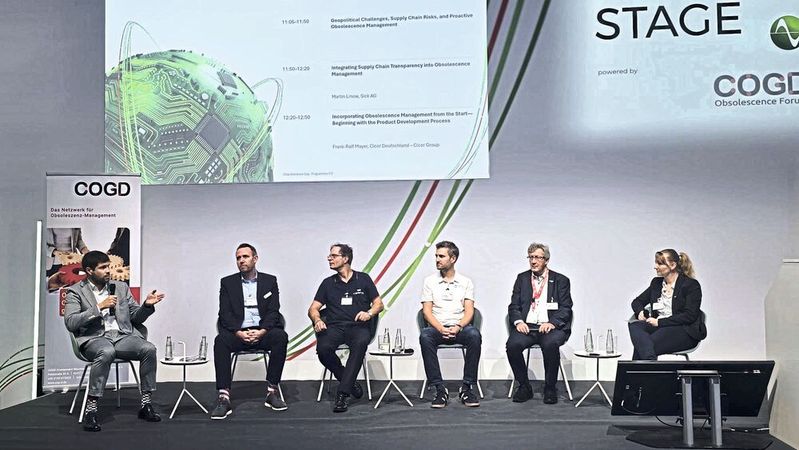
COGD panel discussion at electronica 2026 (from left to right): Martin Linow (Sick), Björn Bartels (Amsys), COGD Chairman Axel Wagner (Asteelflash), Lars Kiera (RTS Electronic), Wolfgang Heinbach (Syliom), and moderator Stefanie Kölbl (TQ Systems).
(Source: COGD)
Shutdowns during the COVID-19 pandemic, natural disasters, regulatory and compliance requirements, geopolitical tensions, and the AI boom have caused—and continue to cause—major supply chain disruptions. In addition, manufacturers have streamlined their product portfolios through numerous mergers and acquisitions. As a result, more and more components have been discontinued, while lead times have become so long that they amount to de facto obsolescence.
Effective obsolescence management should therefore be high on every company's priority list. After all, companies caught off guard by obsolescence that cannot source a missing component through distributors or brokers often have no choice but to redesign their products. This ties up resources, takes time, and distracts developers from essential new projects. The consequences can range from reputational damage and substantial costs to threats to a company's very survival.
However, Lars Kiera, CEO of RTS Electronic, sees little evidence that obsolescence management is actually a top priority: “Many companies are carrying on exactly as they did before 2020, using the same slow processes. They are simply reacting rather than developing a strategy for the future.”
Why is this the case? This question was also at the heart of the COGD panel discussion on the first day of electronica 2026. Even experts are surprised that obsolescence management is apparently still being neglected. “By now, everyone should realize that supply chain disruptions are not a temporary phenomenon but are becoming the new normal,” says Björn Bartels, CEO of Amsys.
“So what are the barriers? Why are relatively few manufacturers embracing professional obsolescence management (OM)?” asked Stefanie Kölbl, moderator of the discussion, Director of TQ Embedded, and Head of Obsolescence at TQ Systems. One major obstacle is that, in larger companies, the costs of obsolescence management—and the savings it generates—are often unclear. “OM has a huge impact on a company's business performance, but management is often reluctant to embrace it because executives see it as an engineering problem,” explains Wolfgang Heinbach, Partner at Syliom. “OM must be translated into the language of money —the language management understands. When executives see firsthand how much money is lost due to obsolescence, they pay attention.”
Without management support, an effective obsolescence management system is unlikely to succeed. “If there is no direct connection to management and no commitment from the top, there will ultimately be no sustainable strategic decisions, regardless of how effective the OM tools are,” warns Bartels.
But isn't spending money on obsolescence management an investment in risks that may never materialize? Heinbach disagrees: “Supply chains are highly fragile and will certainly remain so.” Given the known risks, Kiera is equally clear: “Allocations will continue to occur, so the money spent on obsolescence management is by no means wasted. It's money well spent.”
However, implementing obsolescence management can also waste money, particularly if the process is only partially implemented. OM cannot be the responsibility of a single department because it affects virtually every area of a business. Communication and coordination across departments are therefore essential. “If that works, great. If it doesn't, it may make more sense to centralize obsolescence management in a dedicated department,” explains Martin Limow, Resilience Part Manager at Sick.
The panelists also agreed that having the right tools alone does not guarantee effective obsolescence management. “OM is a process that ultimately involves people who have to make decisions,” says Wolfgang Heinbach. “Data is a prerequisite, but it must be translated into decisions.”
To achieve this, Bartels recommended presenting the results of complex data analyses as simply as possible, using a red-amber-green traffic light system. “Everyone in the company understands this, across all departments and right up to senior management.” Every identified issue must also have an assigned owner responsible for resolving it. Otherwise, important information gets lost and all the groundwork goes to waste.
Stand: 08.12.2025
Es ist für uns eine Selbstverständlichkeit, dass wir verantwortungsvoll mit Ihren personenbezogenen Daten umgehen. Sofern wir personenbezogene Daten von Ihnen erheben, verarbeiten wir diese unter Beachtung der geltenden Datenschutzvorschriften. Detaillierte Informationen finden Sie in unserer Datenschutzerklärung.
Einwilligung in die Verwendung von Daten zu Werbezwecken
Ich bin damit einverstanden, dass die Vogel Communications Group GmbH & Co. KG, Max-Planckstr. 7-9, 97082 Würzburg einschließlich aller mit ihr im Sinne der §§ 15 ff. AktG verbundenen Unternehmen (im weiteren: Vogel Communications Group) meine E-Mail-Adresse für die Zusendung von redaktionellen Newslettern nutzt. Auflistungen der jeweils zugehörigen Unternehmen können hier abgerufen werden.
Der Newsletterinhalt erstreckt sich dabei auf Produkte und Dienstleistungen aller zuvor genannten Unternehmen, darunter beispielsweise Fachzeitschriften und Fachbücher, Veranstaltungen und Messen sowie veranstaltungsbezogene Produkte und Dienstleistungen, Print- und Digital-Mediaangebote und Services wie weitere (redaktionelle) Newsletter, Gewinnspiele, Lead-Kampagnen, Marktforschung im Online- und Offline-Bereich, fachspezifische Webportale und E-Learning-Angebote. Wenn auch meine persönliche Telefonnummer erhoben wurde, darf diese für die Unterbreitung von Angeboten der vorgenannten Produkte und Dienstleistungen der vorgenannten Unternehmen und Marktforschung genutzt werden.
Meine Einwilligung umfasst zudem die Verarbeitung meiner E-Mail-Adresse und Telefonnummer für den Datenabgleich zu Marketingzwecken mit ausgewählten Werbepartnern wie z.B. LinkedIN, Google und Meta. Hierfür darf die Vogel Communications Group die genannten Daten gehasht an Werbepartner übermitteln, die diese Daten dann nutzen, um feststellen zu können, ob ich ebenfalls Mitglied auf den besagten Werbepartnerportalen bin. Die Vogel Communications Group nutzt diese Funktion zu Zwecken des Retargeting (Upselling, Crossselling und Kundenbindung), der Generierung von sog. Lookalike Audiences zur Neukundengewinnung und als Ausschlussgrundlage für laufende Werbekampagnen. Weitere Informationen kann ich dem Abschnitt „Datenabgleich zu Marketingzwecken“ in der Datenschutzerklärung entnehmen.
Falls ich im Internet auf Portalen der Vogel Communications Group einschließlich deren mit ihr im Sinne der §§ 15 ff. AktG verbundenen Unternehmen geschützte Inhalte abrufe, muss ich mich mit weiteren Daten für den Zugang zu diesen Inhalten registrieren. Im Gegenzug für diesen gebührenlosen Zugang zu redaktionellen Inhalten dürfen meine Daten im Sinne dieser Einwilligung für die hier genannten Zwecke verwendet werden. Dies gilt nicht für den Datenabgleich zu Marketingzwecken.
Recht auf Widerruf
Mir ist bewusst, dass ich diese Einwilligung jederzeit für die Zukunft widerrufen kann. Durch meinen Widerruf wird die Rechtmäßigkeit der aufgrund meiner Einwilligung bis zum Widerruf erfolgten Verarbeitung nicht berührt. Um meinen Widerruf zu erklären, kann ich als eine Möglichkeit das unter https://contact.vogel.de abrufbare Kontaktformular nutzen. Sofern ich einzelne von mir abonnierte Newsletter nicht mehr erhalten möchte, kann ich darüber hinaus auch den am Ende eines Newsletters eingebundenen Abmeldelink anklicken. Weitere Informationen zu meinem Widerrufsrecht und dessen Ausübung sowie zu den Folgen meines Widerrufs finde ich in der Datenschutzerklärung, Abschnitt Redaktionelle Newsletter.
Proactive obsolescence management is essential. “If obsolescence management is integrated into product development from the outset, many potential risks can be identified early and subsequent negative consequences avoided,” explains Axel Wagner, legal adviser at Asteelflash and Chairman of the COGD. When this works, “we, as obsolescence managers, have done our job well. Management doesn't notice a thing because everything runs as it should,” says Limow.
Unavoidable obsolescence, on the other hand, must be mitigated through appropriate action plans. Those responsible for addressing such cases are often seen as the bearers of bad news. “But we don't create the problems—we solve them. We urgently need to shake off this negative image!” says Kiera.
The same applies to obsolescence management as a whole. Companies that shy away from implementing it because of the associated costs and effort may soon face a harsh reality. Or, as Linow puts it: “Companies that think they can manage without OM in this day and age will cease to exist in the foreseeable future.” (kr)