EMS providers need flexible automation for high-volume production, frequent product changes, and small batches. The right mix of robots, cobots, and manual processes depends on throughput, material flow, and integration effort.
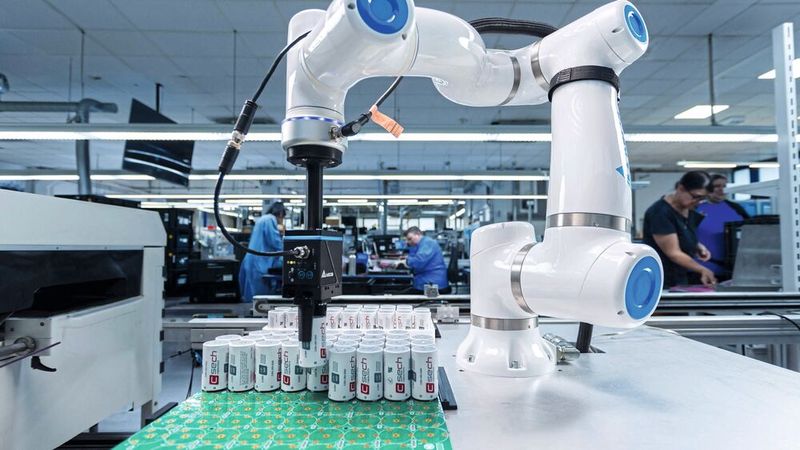
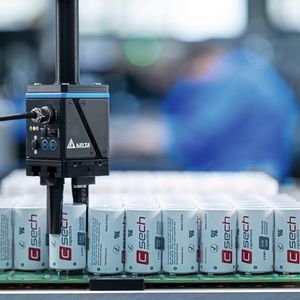
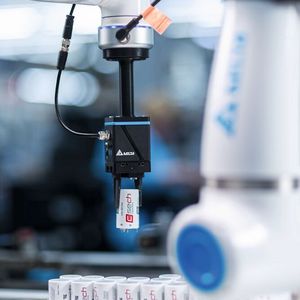
Partial automation in EMS practice: The D-Bot was designed to populate PCBs with 68 large-format capacitors outside regular staff working hours.
(Source: Delta Electronics / Elektron)
Electronics manufacturing combines highly standardized processes with areas that demand a great deal of flexibility. SMT assembly, reflow soldering, and automated optical inspection typically follow clearly defined sequences. Before and after these core processes, however, production requirements can vary considerably.
High product variety, small batch sizes, and special components often require frequent changeovers. At the same time, any investment in automation has to pay off within relatively short production runs while also helping manufacturers make better use of limited skilled labor. The challenge is therefore to find the right balance between performance, flexibility, and cost.
Bildergalerie
Some tasks may be easy to automate from a technical standpoint but occur too infrequently to justify a dedicated system. Others may seem insignificant on their own but consume substantial capacity when repeated across multiple products or shifts. The starting point should therefore always be the task itself and the conditions under which it is performed.
Conventional Robotics Excels in High-Speed Processes
Industrial robots are particularly effective in highly repetitive processes with short cycle times and workpieces presented in clearly defined positions. They can load and unload machines, handle printed circuit boards, or carry out standardized inspection and packaging tasks. In high-volume production, their speed, reach, and payload can provide significant advantages.
To achieve this level of performance, however, the process needs to be stable. Materials must arrive reliably in defined positions, and unplanned operator intervention should be kept to a minimum. Variations in component position or geometry may require additional sensors, machine vision, and additional programming.
Conventional industrial robots also typically operate within safeguarded areas, where they can run at high speeds and achieve maximum throughput. These safety measures require additional floor space and may affect the surrounding material flow. In an existing production environment, integrating the system can therefore be more complex than the robot task itself.
The robot is only one part of the overall solution. Controllers, grippers, feeding systems, safety equipment, and interfaces to upstream and downstream processes all need to work together reliably.
Cobots Bring Flexibility to Changing Processes
As product variety increases, flexibility becomes more important. Frequent changeovers, limited floor space, and regular interaction with operators can make traditional automation less attractive. In these environments, cobots can provide a flexible alternative between fixed automation and fully manual production. Typical applications are often found outside the highly automated core of the production line. These can include placing special components, loading standalone inspection stations, sorting, dispensing, packaging, or handling printed circuit boards between individual process steps. By taking over repetitive tasks, cobots can also free skilled employees to focus on work that requires more experience or technical expertise.
Application-specific programs, grippers, and fixtures make it possible to use the same robot for different products or assemblies. Ideally, this flexibility is built into the automation concept from the outset, with future product variants considered during the design phase. This helps keep changeover times and production interruptions to a minimum. User-friendly interfaces and guided software functions can make setup and reconfiguration easier as well. This allows production teams to adapt processes to new tasks without requiring extensive programming expertise.
Stand: 08.12.2025
Es ist für uns eine Selbstverständlichkeit, dass wir verantwortungsvoll mit Ihren personenbezogenen Daten umgehen. Sofern wir personenbezogene Daten von Ihnen erheben, verarbeiten wir diese unter Beachtung der geltenden Datenschutzvorschriften. Detaillierte Informationen finden Sie in unserer Datenschutzerklärung.
Einwilligung in die Verwendung von Daten zu Werbezwecken
Ich bin damit einverstanden, dass die Vogel Communications Group GmbH & Co. KG, Max-Planckstr. 7-9, 97082 Würzburg einschließlich aller mit ihr im Sinne der §§ 15 ff. AktG verbundenen Unternehmen (im weiteren: Vogel Communications Group) meine E-Mail-Adresse für die Zusendung von redaktionellen Newslettern nutzt. Auflistungen der jeweils zugehörigen Unternehmen können hier abgerufen werden.
Der Newsletterinhalt erstreckt sich dabei auf Produkte und Dienstleistungen aller zuvor genannten Unternehmen, darunter beispielsweise Fachzeitschriften und Fachbücher, Veranstaltungen und Messen sowie veranstaltungsbezogene Produkte und Dienstleistungen, Print- und Digital-Mediaangebote und Services wie weitere (redaktionelle) Newsletter, Gewinnspiele, Lead-Kampagnen, Marktforschung im Online- und Offline-Bereich, fachspezifische Webportale und E-Learning-Angebote. Wenn auch meine persönliche Telefonnummer erhoben wurde, darf diese für die Unterbreitung von Angeboten der vorgenannten Produkte und Dienstleistungen der vorgenannten Unternehmen und Marktforschung genutzt werden.
Meine Einwilligung umfasst zudem die Verarbeitung meiner E-Mail-Adresse und Telefonnummer für den Datenabgleich zu Marketingzwecken mit ausgewählten Werbepartnern wie z.B. LinkedIN, Google und Meta. Hierfür darf die Vogel Communications Group die genannten Daten gehasht an Werbepartner übermitteln, die diese Daten dann nutzen, um feststellen zu können, ob ich ebenfalls Mitglied auf den besagten Werbepartnerportalen bin. Die Vogel Communications Group nutzt diese Funktion zu Zwecken des Retargeting (Upselling, Crossselling und Kundenbindung), der Generierung von sog. Lookalike Audiences zur Neukundengewinnung und als Ausschlussgrundlage für laufende Werbekampagnen. Weitere Informationen kann ich dem Abschnitt „Datenabgleich zu Marketingzwecken“ in der Datenschutzerklärung entnehmen.
Falls ich im Internet auf Portalen der Vogel Communications Group einschließlich deren mit ihr im Sinne der §§ 15 ff. AktG verbundenen Unternehmen geschützte Inhalte abrufe, muss ich mich mit weiteren Daten für den Zugang zu diesen Inhalten registrieren. Im Gegenzug für diesen gebührenlosen Zugang zu redaktionellen Inhalten dürfen meine Daten im Sinne dieser Einwilligung für die hier genannten Zwecke verwendet werden. Dies gilt nicht für den Datenabgleich zu Marketingzwecken.
Recht auf Widerruf
Mir ist bewusst, dass ich diese Einwilligung jederzeit für die Zukunft widerrufen kann. Durch meinen Widerruf wird die Rechtmäßigkeit der aufgrund meiner Einwilligung bis zum Widerruf erfolgten Verarbeitung nicht berührt. Um meinen Widerruf zu erklären, kann ich als eine Möglichkeit das unter https://contact.vogel.de abrufbare Kontaktformular nutzen. Sofern ich einzelne von mir abonnierte Newsletter nicht mehr erhalten möchte, kann ich darüber hinaus auch den am Ende eines Newsletters eingebundenen Abmeldelink anklicken. Weitere Informationen zu meinem Widerrufsrecht und dessen Ausübung sowie zu den Folgen meines Widerrufs finde ich in der Datenschutzerklärung, Abschnitt Redaktionelle Newsletter.
Safety remains a key consideration. Depending on the application and the results of the risk assessment, integrated safety functions can allow cobots to operate close to people without a conventional safety cage. Delta Electronics’ D-Bot, for example, uses sensor-based collision detection to register contact. Its “Reflex Safety” function then stops the robot and reverses the movement. The safety assessment, however, must always consider the complete application rather than the robot alone. Tooling, workpieces, operating speeds, forces, and the surrounding process all influence the safeguarding measures required.
Peripherals and Material Flow Set Practical Limits
Planning the movement of the robot itself is usually only part of the task. In practice, reliable gripping, consistent material feeding, and accurate positioning often determine whether an application works reliably.
Loose components, unstable trays, or inconsistent part orientation can quickly increase system complexity. Vision systems can compensate for some of these variations, but they bring additional requirements in terms of lighting, hardware, programming, and commissioning. Every additional component also adds cost and increases the maintenance burden. The most effective automation solution is therefore not necessarily the most sophisticated one. It is the one that achieves the required level of reliability with the least unnecessary complexity.
The required level of autonomy also plays an important role. A system that is expected to run unattended for several hours needs sufficient material supplies, clearly defined locations for completed parts, and reliable status and error reporting. Faults need to be identified quickly so that the time saved through automation is not lost to extended downtime. If achieving the desired level of autonomy requires disproportionate technical effort, keeping the process manual may ultimately be the more economical choice.
Partial Automation in Practice
A project at Elektron Systeme und Komponenten shows how targeted automation can help address a very specific staffing challenge. One production order would have required three employees to work a night shift. Given the limited availability of skilled workers, Elektron looked for an alternative and worked with Delta to assess whether the relevant process step could be automated.
The D-Bot was configured to place 68 large capacitors on each printed circuit board outside regular working hours. The following morning, employees could inspect the completed boards and continue with the remaining production steps. The trial showed how Elektron could add production capacity without having to change the existing SMT lines or downstream inspection processes. Automation was focused specifically on the repetitive component-placement task that had created the staffing bottleneck. This is also an example of why automation does not always need to cover an entire process. Automating the right individual step can be enough to remove a bottleneck and make better use of the workforce already available.
The Business Case Depends on the Entire Application
The robot itself is only one part of the investment. Grippers, fixtures, feeding systems, controllers, safety equipment, programming, and commissioning all contribute to the overall cost. A meaningful business case therefore has to consider the complete automation system over its expected operating life.
These costs need to be weighed against the benefits: fewer manual labor hours, more consistent cycle times, improved shift planning, and greater process consistency. The ability to reuse the system for other products or applications can further improve utilization and shorten the payback period.
Jan Zuse, Business Development Manager Robotics at Delta Electronics EMEA, offers a practical benchmark: “Partial automation of 50 to 80 percent is often sufficient to achieve an attractive return on investment.”
In practice, this could mean that employees continue to supply materials and deal with exceptional cases while the cobot handles the repetitive and time-consuming part of the process. Not every application benefits from automation. Tasks that occur only occasionally involve highly variable movements, require frequent changeovers, or involve parts that are difficult to grip may still be better handled manually.
Flexibility Becomes a Strategic Benchmark
Future-proof production is not about automating every manual task. It is about applying automation where it creates a clear operational benefit. Production volume, product variety, order duration, available floor space, and workforce availability all influence which approach is most suitable. Special-purpose machinery, industrial robots, cobots, and manual processes each have a role to play. The right choice depends on the production environment and the task at hand.
For EMS providers, this means looking beyond cycle time alone. The question is increasingly how existing resources can be used where they add the most value. Companies that examine their processes carefully and automate selectively can address two challenges at once: maintaining production capacity in the face of skilled labor shortages while retaining the flexibility needed to respond to changing customer requirements. (sb)
* Jan Zuse is Business Development Manager Robotics at Delta Electronics EMEA