



:quality(80)/p7i.vogel.de/wcms/8a/9c/8a9caa85007d3299d7c3971d7eafc942/0133479121v2.jpeg "Leonard Neuberger und Linus Rüllmann von der Weißensee Kunsthochschule Berlin haben mit ihrem Any-Projekt den nationalen James Dyson Award 2026 erhalten. (Bild: Dyson)")
:quality(80)/p7i.vogel.de/wcms/71/a8/71a84cd5963e9ac263a77c788c339dc2/0133489329v3.jpeg "Eine Sandbox begrenzt die Handlungsmöglichkeiten eines KI-Agenten, ist aber keine undurchdringliche Barriere. Erst mehrere unabhängige Schutzebenen verhindern, dass ein Ausbruch unmittelbar den Zugriff auf produktive Systeme ermöglicht. (Bild: frei lizenziert)")
:quality(80)/p7i.vogel.de/wcms/e1/dc/e1dce42a75133bb2434f7e7719c0f68e/0133441212v2.jpeg "Wukong, ein von Origin Quantum gefertigter Quantenprozessor mit 72 Qubits. (Bild: Origin Quantum)")
:quality(80)/p7i.vogel.de/wcms/de/70/de70aa086973b1d297cb520d90bf19bb/0133423537v2.jpeg "Bluetooth Channel Sounding: Wie präzise die Messung ist, hängt jedoch auch von Antenne, HF-Design, Umgebung und Auswertealgorithmus ab. (Bild: KI-generiert)")
:quality(80)/p7i.vogel.de/wcms/f8/5c/f85c5fbc8487acc36917ad430a1135d5/0133483193v2.jpeg "Der Vitalsensor goVISCAN: Mittig sitzt die Multispektralkamera mit einem 3x3-Mikrolinsenarray, das die spektralen Bänder erfasst. Kreisförmig herum sind LEDs verbaut, die die Messszene beleuchten. (Bild: Fraunhofer IOF)")
:quality(80)/p7i.vogel.de/wcms/fa/df/fadfd73dc467982f68f9bc3a842e8ad0/0133471827v2.jpeg "Photonik-SDK für C und Python: Jetzt werden Rechenoperationen als normale mathematische Funktionen abstrahiert. (Bild: Q.ANT)")
:quality(80)/p7i.vogel.de/wcms/58/93/5893d1c1946bcc25a9f8b8b939409aa2/0133444365v2.jpeg "KI trifft Lagerrobotik: Im Düsseldorfer Innovation Lab demonstriert Geekplus unter anderem humanoide Roboter, mobile Transportsysteme und das KI-Framework Gravity. (Bild: Geekplus)")
:quality(80)/p7i.vogel.de/wcms/8d/bb/8dbbf755d59174ecab99febfdd469fa3/0133422468v4.jpeg "(Bild: Spectra)")
:quality(80)/p7i.vogel.de/wcms/00/97/0097c22b112065506b113f1ff07ea8ab/0133509585v2.jpeg "Ventuno Q RoadTest: soll der Element14-Community helfen, mittels Ventuno Q praktische Erkenntnisse aus realen Tests zu gewinnen. (Bild: Farnell/Element14)")
:quality(80)/p7i.vogel.de/wcms/52/90/52907b59eca824a3d40bd58c4577e910/0133428589v2.jpeg "(Bild: Raspberry PI)")
:quality(80)/p7i.vogel.de/wcms/bd/ba/bdba9a99b0b597968222d2758dd51812/0133237118v2.jpeg "Fetek bietet Leistungs-MOSFETs in unterschiedlichen Gehäusebauformen an. Für eine geeignete Second Source reicht die mechanische und elektrische Ähnlichkeit allein allerdings nicht aus – entscheidend ist das Verhalten im konkreten Design. (Bild: Fetek)")
:quality(80)/p7i.vogel.de/wcms/da/2d/da2d155884f924e1d6ea84b77cf48d5c/0133352781v2.jpeg "Die SMD-Sicherungen der 48MH-Serie von Conquer sind für hohe Ströme ausgelegt und für den Einsatz in KI-Servern und Rechenzentren vorgesehen. Die kompakte Bauform ermöglicht eine automatisierte Bestückung. (Bild: Conquer)")
:quality(80)/p7i.vogel.de/wcms/5f/77/5f778eafd9e4415cd00274ad9a58e42a/0133462125v2.jpeg "Wandler: Integrierte GaN-Buck- und Boost-Wandler für den Mittelspannungsbereich benötigen 50 % weniger Platz als Alternativen auf Siliziumbasis, ohne dass dabei Einbußen beim Wirkungsgrad entstehen. (Bild: TI)")
:quality(80)/p7i.vogel.de/wcms/3d/67/3d6777d7a99bdf88f86798cd73451538/0133004756v2.jpeg "Die AGI-CPU von Arm wurde im März 2026 angekündigt. Im Rahmen der Hot Chips 2026 sind die Entwickler ins Detail gegangen. (Bild: Arm)")
:quality(80)/p7i.vogel.de/wcms/8a/2e/8a2e7d2a89ffe55c545dd6c831ed154e/0132246788v2.jpeg "Über 500 Teilnehmer, 120 Referenten: Die FPGA Conference Europe platzte in diesem Jahr aus allen Nähten – und wurde ihrem Anspruch als Leitkongress der FPGA-Welt einmal mehr gerecht. (Bild: Tobi Giessen)")
:quality(80)/p7i.vogel.de/wcms/06/a1/06a158e32b18d99fcea65547cec5d4c7/0132069489v2.jpeg "Mit direkter Integration von Speicher ins Chip-Package verspricht AMD mit dem Versal Premium Gen 2 SoC eine schnellere Datenübertragung, verringerte Latenz und einem potentiell geringere Stromverbrauch. (Bild: AMD)")
:quality(80)/p7i.vogel.de/wcms/86/2a/862afb1de8423bb7401098a2fd268281/0131792672v2.jpeg "Bild 1: Ein Spannungsversorgungskonzept für Lasten, welche eine vorgegebene Ein- und Abschaltreihenfolge (Sequencing) benötigen. (Bild: ADI)")
:quality(80)/p7i.vogel.de/wcms/60/e7/60e71d2e90f60e5ddef056cb234724e0/0133466221v2.jpeg "Strom unter Last: Das Stromdichteprofil zeigt die Verteilung im Hochleistungs-IGBT-Modul. (Bild: Comsol)")
:quality(80)/p7i.vogel.de/wcms/31/20/3120ef4dfc9af325be75131132df2e6a/0133343322v2.jpeg "Aerodynamik-Weltrekord – Mission Efficiency setzt mit einem cW-Wert von 0,158 die neue Bestmarke aller straßenzugelassenen Autos. (Bild: Volkswagen AG)")
:quality(80)/p7i.vogel.de/wcms/a9/3c/a93cb3af2dd2d3d5a43365ea69a3d8a1/0133339957v2.jpeg "Der am MIT entwickelte Algorithmus „Hard Flow“ verspricht, vortrainierten generativen KI-Modellen dabei zu helfen, strenge Einschränkungen einzuhalten und gleichzeitig die Lösungsqualität zu verbessern, ohne dass ein erneutes Training erforderlich ist. (Bild: Dall-E / KI-generiert)")
:quality(80)/p7i.vogel.de/wcms/1d/31/1d311b67f71d045fb28883d6b8ce6469/0133505895v2.jpeg "Das Testsystem „Iris 100“ für die hochpräzise Volumenfertigung von microLEDs nutzt ein Spektrometer und eine hochauflösende Kamera. (Bild: Teradyne)")
:quality(80)/p7i.vogel.de/wcms/6b/0c/6b0cd14955e1df9cddc90de9a6209ea6/0133376931v2.jpeg "Parallele Testabläufe: Mit dem von MCD entwickelten Software TestMate lassen sich mehrere Testsequenzen innerhalb einer Instanz parallel und asynchron ausführen. (Bild: MCD Elektronik)")
:quality(80)/p7i.vogel.de/wcms/69/20/6920b333a42be206f380befd3ae34c36/0133394583v2.jpeg "Die beiden Cäsium-Fontänenuhren der PTB liefern die gesetzliche Zeit für die gesamte Bundesrepublik. Die verwendeten Laser werden jetzt digital von einer AWG-Messkarte gesteuert. (Bild: PTB)")
:quality(80)/p7i.vogel.de/wcms/d4/ec/d4ec54071e5bf9210b9c480572802eb2/0133355445v2.jpeg "Prof. Kupsch und sein Team von der TU Bergakademie Freiberg forschen an tragbaren Ultraschallsystemen. Mit ihnen lassen sich tieferliegende Gewebestrukturen erfassen. (Bild: TU Bergakademie Freiberg)")
:quality(80)/p7i.vogel.de/wcms/95/82/95820d6085a9ad33aa27cac8ad5f5ffd/0133470449v3.jpeg "Die neue Nexora-Sensorfamilie von Teledyne e2v: Die CMOS-Bildsensoren kombinieren BSI-Technik mit Global Shutter und sind mit 12 und 16 Megapixeln erhältlich. (Bild: Teledyne)")
:quality(80)/p7i.vogel.de/wcms/47/0e/470e414076f52c39059cede15c1ea71e/0133496024v2.jpeg "Intelligente Fertigung: Daten, KI und Robotik wachsen in der SMT-Fertigung zunehmend zusammen. Vernetzte Systeme erkennen Prozessabweichungen, steuern Materialflüsse und leiten immer häufiger selbstständig Maßnahmen ein. (Bild: ASMPT SMT Solutions)")
:quality(80)/p7i.vogel.de/wcms/d4/2d/d42d81c60f05b8a27af2babe858b1c40/0133430053v2.jpeg "Bauteilkennzeichnung: Der laserbeschriftete Sensor kombiniert Data-Matrix-Code und Klarschrift für eine dauerhaft maschinen- und menschenlesbare Kennzeichnung. (Bild: FOBA Laser Marking + Engraving)")
:quality(80)/p7i.vogel.de/wcms/04/b9/04b948db62de8d70b7424a2607cb74de/0133453624v2.jpeg "Waferfertigung bei TSMC. Die Chipfertigung in den USA droht, trotz massivem Ausbau an Fertigungsstätten in einen Flaschenhals zu geraten. Nur etwa drei Prozent aller Studenten aus geigneten Fachbereichen haben laut einer Studie von McKinsey und dem Halbleiterverband SEMI vor, in die Hardware-Entwicklung zu gehen, und ziehen Bereiche wie KI oder Software Engineering vor. (Bild: TSMC)")
:quality(80)/p7i.vogel.de/wcms/e7/42/e742bcdffa80271a66641692ae305e4d/0133471495v3.jpeg "Einblick in die SMT-Fertigung von Schubert System Elektronik. (Bild: Fuji Corp.)")
:quality(80)/p7i.vogel.de/wcms/5f/36/5f36c88c8bf40c0b2f78f348343124b3/0133438438v2.jpeg "Messestand des chinesischen Speicherhestellers CXMT auf der IC China. Das Unternehmen hat nach eigenen Angaben seine fünfte DRAM-Plattform in die Serienfertigung überführt. Parallel soll der chinesische Hersteller eine NAND-Entwicklungslinie in Peking vorbereiten. (Bild: CXMT)")
:quality(80)/p7i.vogel.de/wcms/6b/1d/6b1dde86fdb120b4cf9b8bc8573c415a/0133056789v3.jpeg "Wir bezahlen für Systeme, die menschliche Arbeit übernehmen, ohne bislang geklärt zu haben, wie die dadurch entstehende Wertschöpfung künftig verteilt werden soll. (Bild: frei lizenziert)")
:quality(80)/p7i.vogel.de/wcms/47/20/47201c1ce3692dbdb4e7e62709de4e16/0132649717v3.jpeg "Ingenieurberufe verändern sich: Neben der aktuellen Konjunktur treiben Digitalisierung, KI und neue Technologien den Bedarf an kontinuierlicher Qualifizierung. (Bild: frei lizenziert)")
:quality(80)/p7i.vogel.de/wcms/4e/41/4e4159d1e93e67d47bd2f51a90691b23/0131548978v2.jpeg "Transformation im Engineering: KI-gestützte Systeme generieren zunehmend selbstständig Schaltschranklayouts und entlasten Konstrukteure von zeitraubenden Routineaufgaben. (Bild: WSCAD)")
Anbieter zum Thema
:fill(fff,0)/images.vogel.de/vogelonline/companyimg/76800/76895/65.jpg "FAULHABER_120mm.jpg ()")
:fill(fff,0)/p7i.vogel.de/companies/67/8a/678a0c5c3e273/logo-caltest-instruments-signet.png "logo-caltest-instruments-signet (Caltest Instruments GmbH)")
Secure supply through efficient smoothing
C2 is is responsible for smoothing the output voltage. As this is a one-pulse reactance, the entire output current of C2 must be made available during the negative half-wavelength. The necessary capacitance of this depends on the permissible ripple of the output voltage. For the circuit in the example, a maximum value of 1 V is required. At the maximum load current consumption of 15 mA at 9 V, a load resistance of 600 Ω is produced. With a line frequency of 50 Hz (10 ms per half-wavelength) the minimum capacitance of C2 can thus be determined:
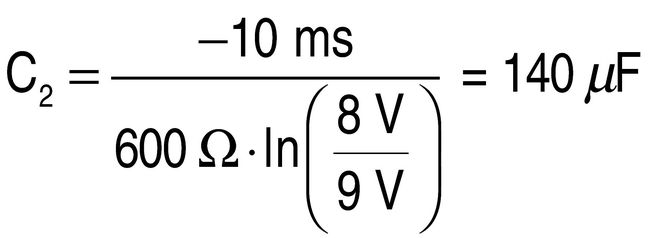
A single-ended aluminum electrolyte capacitor is selected with a capacitance of 150 µF and a permissible voltage of 25 VDC. In order to achieve the longest possible life, this capacitor should be designed for a temperature of at least 105 °C.
Optionally, a ceramic capacitor (C3) can additionally be connected in parallel with C2. This is used for noise suppression and for blocking voltage peaks. For example, a TDK MLCC with a capacitance of 0.1 µF can be considered for this purpose. The type C1608X7R1E104K080AA was selected with a nominal voltage of 25 VDC with size 1608 (IEC) and X7R temperature characteristic (–55 to 125 ºC, ±15%).
Circuit protection is essential
In a worst-case scenario it may happen that, when switching off without load, C1 remains charged with the peak voltage of 325 V. It is then the task of R2 to discharge the capacitor as quickly as possible. When setting the resistance value, a compromise must be made between power dissipation and discharge time constant. In this case the value of 470 kΩ was selected. A power dissipation of approx. 0.1 W occurs here and the discharge time to a maximum permissible touch voltage of 50 V takes around 0.5 s. If the power supply is continuously connected to the grid, however, there is no need for this resistor.
The overvoltage protection at the line input (RV1) is also important, of course. For this purpose, TDK offers various series of EPCOS varistors. The types from the EPCOS standard series are suitable for the stated circuit, as these cover a wide range of voltages from 11 VRMS to 1100 VRMS. These protection components are available with disk diameters of between 5 mm and 20 mm, corresponding to the required surge current capability and energy absorption. In this case, for example, the compact type B72205S0231K101 with a disk diameter of 5 mm is suitable, which features a surge current capability of 400 A at a pulse of 8/20 µs.
In addition, the output of the circuit can also be protected against overvoltage (RV2), for example, using the EPCOS SMT CeraDiode B72590D0150A060, which has a DC voltage of 15 V.
Finally, an EPCOS PTC B59873C0120A570 (RT1), which is designed for a maximum load current of 90 mA at 25 °C, ensures the current limitation at the power input. If a fault should occur in the circuit that results in an increased current flow, the PTC heats up, causing its resistance to rise sharply and thus limit the current to non-critical values.
* Christoph Jehle is Manager Product Communications at TDK in Munich.
(ID:43634765)
:quality(80)/p7i.vogel.de/wcms/3e/52/3e52caf04ffc0446ac34990ea5fa95b6/0133240185v2.jpeg "Surge-fester MELF-Widerstand aus der SRM-Serie von Firstohm. Die Baureihe ist für Anwendungen ausgelegt, in denen kurzzeitig hohe Energien und wiederholte Entladeimpulse auftreten können. (Bild: Firstohm)")
:quality(80)/p7i.vogel.de/wcms/2f/0c/2f0cdaf3c1041b3592bd71e44edd4aea/0133352797v2.jpeg "Conquer’s 48MH series SMD fuses are designed for high-current applications in AI servers and data centers. Their compact form factor supports automated assembly. (Bild: Conquer)")