LED technology for automotive has developed strongly in recent years. Among other things, the aim has been to meet the demands of headlight manufacturers for smaller components with a high brightness.
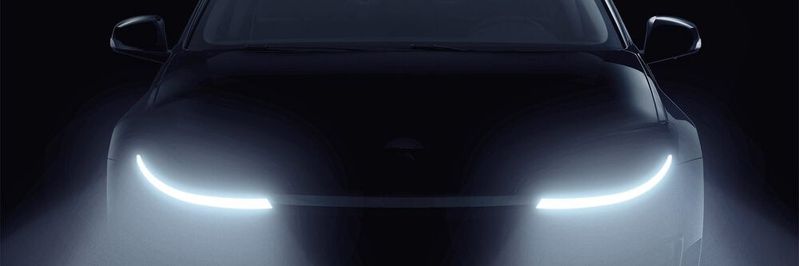
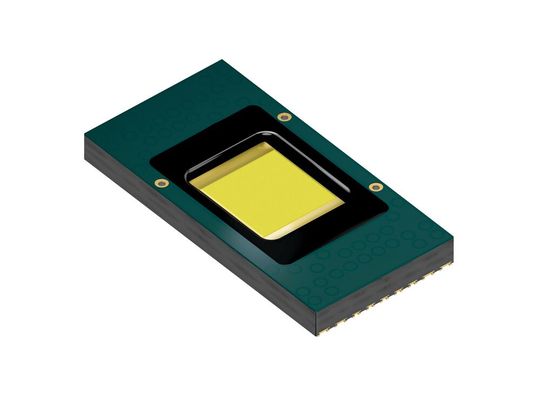
Automotive Lighting: Thanks to extremely space-saving and at the same time very bright LEDs such as the Oslon Boost from Osram, particularly slim headlight designs are possible.
(source: Osram Opto Semiconductors)
The greater the variety of applications in automotive lighting, the more diversified the portfolios of LED manufacturers has become. Osram Opto Semiconductors has been the market leader for automotive LEDs for many years and has played a leading role in shaping key development trends. Solutions with several thousand light pixels promise completely new possibilities for headlight manufacturers and OEMs – even beyond classic lighting.
Energy Efficiency and Design Freedom in Modern Cars
Automotive lighting has always been an essential safety component – both to see and to be seen. As automobiles have evolved, vehicle lighting has also undergone various stages of change. The faster the cars became, the more important it is to see as far as possible in the dark. In today's cars, factors such as energy efficiency and design freedom are just as important as brightness. LEDs offer a number of advantages over halogen solutions that are still frequently used today. In addition to the purely functional aspects, LED technology is pushing the limits of what is feasible further and further in many respects. For example, manufacturers are increasingly focusing on topics such as communication using light via headlights and rear lights.
Increased Brightness and Better Energy Efficiency
Many of today's vehicle models use conventional lighting technologies such as halogen or xenon. However, the constant technological improvements of LED technology ensure that this balance of power is shifting more and more clearly in the direction of LEDs - and will continue to do so in the coming years. The reasons for this are manifold. With LEDs, the right light wavelength can be easily generated. They require little energy and installation space and have a much longer lifetime than previously used lighting technologies.
With the Oslon Black Flat and Oslon Compact LED series, Osram Opto Semiconductors has launched two product families whose design is trimmed to achieve the best possible ratio of energy efficiency and brightness. The second generation of the Oslon Compact PL has several variants – with one four LED chips. A special electrically insulated pad ensures significantly simplified heat dissipation from the ceramic components.
As a result, the LEDs can be driven at a higher current, resulting in an outstanding brightness value of 395 lumens at 1 A for the 1-chip variant. The dimensions of 1.9 mm x 1.5 mm x 0.73 mm also enable space-saving system designs, which are important for Adaptive Driving Beam systems, for example. Thanks to the once again significantly improved efficiency values within the Oslon Black Flat S family with 130 lm/W at 1 A, the replacement of any halogen solutions previously used is now even more attractive. These improvements also contribute to the fact that the required heat sink can be considerably smaller – with correspondingly positive effects on the overall costs of the system. And, in the future, even LED solutions can be realized without their own heat sink.
More Freedom in Lighting-Design
One of the central arguments for LED-based headlights is the compact dimensions of the diodes. The exceptional light output with extremely small space requirements offers significantly more design freedom than conventional system approaches. This makes the latest trend with LED technology easy to achieve.
The "face" of the latest vehicle generations has changed more and more over the past years. Especially in the premium segment, there is a clear trend towards ever slimmer headlamp designs. This requires not only particularly compact LEDs, but also a high light output. Osram has therefore created the Oslon Boost family. This family is measuring 1.9 mm x 1.5 mm x 0.73 mm, the ceramic-based SMD component is not only extremely small, but also boasts an outstanding luminance of 255 cd/mm². The first LED-based solutions for adaptive front lighting with mechanical dimming were implemented several years ago. This allows individually switchable areas of the high beam to be dimmed or switched off. This prevents oncoming drivers from being dazzled.
Adaptive Front Lighting Demands for Higher Resolution
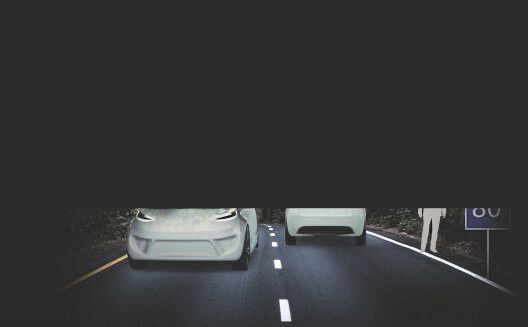
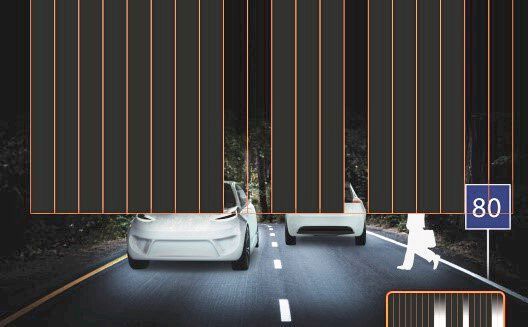
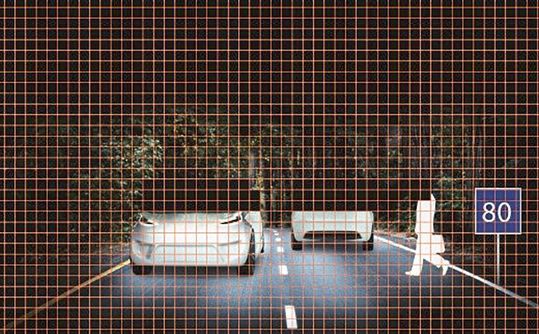
From blurry to clear – with the help of pixelated LEDs (right image), different areas of the field of view can be illuminated, faded out or dimmed very precisely.
(Sources: Osram Opto Semiconductors)
(Bild: Osram Opto Semiconductors)
(Bild: Osram Opto Semiconductors)
The combination of high-performance LEDs with intelligent functions will make an additional contribution to significantly improved road safety in the future. Solutions with individually controllable LED pixels are a big step forward. Here, individual, wide segments of the field of view and significantly smaller and more precisely defined areas, such as the windshield of an oncoming car, can be selectively faded out, and at the same time details, such as approaching cyclists on the road, can be illuminated.
Stand: 08.12.2025
Es ist für uns eine Selbstverständlichkeit, dass wir verantwortungsvoll mit Ihren personenbezogenen Daten umgehen. Sofern wir personenbezogene Daten von Ihnen erheben, verarbeiten wir diese unter Beachtung der geltenden Datenschutzvorschriften. Detaillierte Informationen finden Sie in unserer Datenschutzerklärung.
Einwilligung in die Verwendung von Daten zu Werbezwecken
Ich bin damit einverstanden, dass die Vogel Communications Group GmbH & Co. KG, Max-Planckstr. 7-9, 97082 Würzburg einschließlich aller mit ihr im Sinne der §§ 15 ff. AktG verbundenen Unternehmen (im weiteren: Vogel Communications Group) meine E-Mail-Adresse für die Zusendung von redaktionellen Newslettern nutzt. Auflistungen der jeweils zugehörigen Unternehmen können hier abgerufen werden.
Der Newsletterinhalt erstreckt sich dabei auf Produkte und Dienstleistungen aller zuvor genannten Unternehmen, darunter beispielsweise Fachzeitschriften und Fachbücher, Veranstaltungen und Messen sowie veranstaltungsbezogene Produkte und Dienstleistungen, Print- und Digital-Mediaangebote und Services wie weitere (redaktionelle) Newsletter, Gewinnspiele, Lead-Kampagnen, Marktforschung im Online- und Offline-Bereich, fachspezifische Webportale und E-Learning-Angebote. Wenn auch meine persönliche Telefonnummer erhoben wurde, darf diese für die Unterbreitung von Angeboten der vorgenannten Produkte und Dienstleistungen der vorgenannten Unternehmen und Marktforschung genutzt werden.
Meine Einwilligung umfasst zudem die Verarbeitung meiner E-Mail-Adresse und Telefonnummer für den Datenabgleich zu Marketingzwecken mit ausgewählten Werbepartnern wie z.B. LinkedIN, Google und Meta. Hierfür darf die Vogel Communications Group die genannten Daten gehasht an Werbepartner übermitteln, die diese Daten dann nutzen, um feststellen zu können, ob ich ebenfalls Mitglied auf den besagten Werbepartnerportalen bin. Die Vogel Communications Group nutzt diese Funktion zu Zwecken des Retargeting (Upselling, Crossselling und Kundenbindung), der Generierung von sog. Lookalike Audiences zur Neukundengewinnung und als Ausschlussgrundlage für laufende Werbekampagnen. Weitere Informationen kann ich dem Abschnitt „Datenabgleich zu Marketingzwecken“ in der Datenschutzerklärung entnehmen.
Falls ich im Internet auf Portalen der Vogel Communications Group einschließlich deren mit ihr im Sinne der §§ 15 ff. AktG verbundenen Unternehmen geschützte Inhalte abrufe, muss ich mich mit weiteren Daten für den Zugang zu diesen Inhalten registrieren. Im Gegenzug für diesen gebührenlosen Zugang zu redaktionellen Inhalten dürfen meine Daten im Sinne dieser Einwilligung für die hier genannten Zwecke verwendet werden. Dies gilt nicht für den Datenabgleich zu Marketingzwecken.
Recht auf Widerruf
Mir ist bewusst, dass ich diese Einwilligung jederzeit für die Zukunft widerrufen kann. Durch meinen Widerruf wird die Rechtmäßigkeit der aufgrund meiner Einwilligung bis zum Widerruf erfolgten Verarbeitung nicht berührt. Um meinen Widerruf zu erklären, kann ich als eine Möglichkeit das unter https://contact.vogel.de abrufbare Kontaktformular nutzen. Sofern ich einzelne von mir abonnierte Newsletter nicht mehr erhalten möchte, kann ich darüber hinaus auch den am Ende eines Newsletters eingebundenen Abmeldelink anklicken. Weitere Informationen zu meinem Widerrufsrecht und dessen Ausübung sowie zu den Folgen meines Widerrufs finde ich in der Datenschutzerklärung, Abschnitt Redaktionelle Newsletter.
A 2D matrix involves elements with less than 0.5° – a significant leap compared to fade-out with LED segments, which are typically about 1 to 2 degrees wide. Active LED pixel arrays are to be highlighted as the best energy-optimized approach for adaptive front lighting systems to date. In current solutions several discrete LEDs, such as Osram's Oslon Compact CM, are used.
Each LED acts as a single "pixel". A special primary optics stretches the upper and lower pixel rows vertically by several degrees. The horizontal resolution can thus be left at about 1.2°. This not only reduces the number of required LEDs, but also allows the use of conventional methods of integrating electronics.
1,024 Led Pixels Can Be Controlled Individually
The first generation of hybrid LED Eviyos from Osram.
(Source: Osram Opto Semiconductors)
If a significantly higher number of active pixels is the goal, the integration of the driver electronics and the active LED is already necessary at semiconductor level. This was done in the world's first hybrid LED "Eviyos" from Osram. Eviyos stands for Efficient, Versatile, Intelligent, µ-structured LED chip from Osram Opto Semiconductors. An LED pixel array chip is directly connected to an active silicon IC and controls the individual light pixels. This allows the use of a unit that combines a common power supply with a digital serial interface. Until now, each LED pixel had to be connected to an external power source via two contacts. In the first product generation of the Eviyos, 1,024 pixels are accommodated on approx. 4 mm x 4 mm.
Eviyos technology enables an especially fine LED pixel resolution in the full illumination range without increasing energy consumption. For more frequent distributions without high beam, further energy is saved by switching off the LED pixels. With previous adaptive approaches, the overall solution is always operated at full brightness and unneeded light is manually faded out and thus wasted.
A High Resolution for Automotive Lighting
High-resolution visualization of information using the headlight - the 25,600 pixels of the second Eviyos generation from Osram will make this possible in the future.
(Source: Osram Opto Semiconductors)
Around two years after announcing the first hybrid LED, Osram is opening a new chapter in multi-pixel solutions for car headlights with the second generation of Eviyos: more than 25,000 individually controllable pixels can be featured in just 40 mm². The light points move closer together down to a pixel pitch of only 40 µm, enabling particularly space-saving system designs. The second generation of Eviyos is currently still in development and is scheduled to be launched in the year 2023.
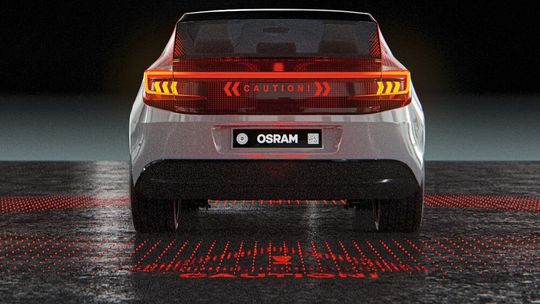
Warning via communication with light.
(Source: Osram Opto Semiconductors)
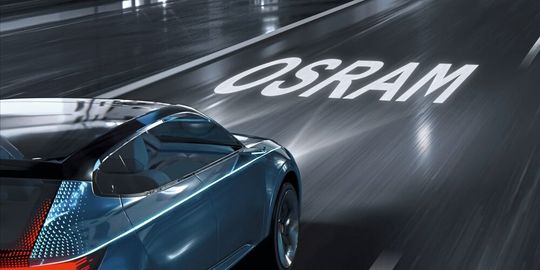
With products like Eviyos, applications beyond the classic lighting in cars such as high-resolution projections on the road will also be possible in the future. This form of visualization using light is included in Car-To-X communication. In addition to the projection of information into the driver's field of vision, cars in the future will increasingly communicate with other road users. Thus, rear combination lamps consisting of several LED pixels can function as classic rear lighting in normal operation and, if the situation demands it, only switch on the pixels that form the word "Caution!" to warn the following driver that he is driving too close to the vehicle, for example.
Automotive Lighting Will Change in the Coming Years
A short outlook: The latest advances in development already show how automotive lighting will change in the coming years. The change from halogen to LED-based headlamps will continue to accelerate and penetrate other vehicle classes. Similarly, headlights and taillights will not only illuminate or fade out individual areas with unimagined precision, but also open up new fields of application beyond classic lighting. The new generation of hybrid LEDs heralded by Eviyos enables some additional benefits in car lighting such as lower system costs, and module sizes, lower thermal losses, even higher reliability and better color accuracy. At the same time, the integration of electronics in LED components leads to additional functions.
Osram is clearly showing where the technological journey for vehicle lighting will take us in the coming next years: multifunctional, intelligently controllable headlights that can do much more than just illuminate the road.
* Florian Fink is Marketing Manager for Automotive Exterior at Osram Opto Semiconductors in Regensburg.





:quality(80)/p7i.vogel.de/wcms/e9/ce/e9ce137e87eccac328ec5504c586c477/0129711019v3.jpeg "Im Rahmen eines Entwicklungsprojekts wurden verschiedene bleireduzierte und bleifreie Kupfer-Beryllium-basierte Legierungskonzepte untersucht, die die Anforderungen an hohe Festigkeiten als auch eine hohe elektrische Leitfähigkeit erfüllen. (Bild: Materion)")
:quality(80)/p7i.vogel.de/wcms/68/46/684697b6eb687384e0d8c6803450401a/0130056395v2.jpeg "Das TUM RoboGym (powered by Neura) in der Planungsphase (Grafik). Die TU München und das Robotik Startup Neura Robotics planen, gemeinsam am Campus der TU München das weltgrößte Robotik-Trainingszentrum einzurichten. (Bild: Neura Robotics)")
:quality(80)/p7i.vogel.de/wcms/0f/c0/0fc0d93c99a5d9066e58c39f41fb1b10/0130046764v2.jpeg "Sicherheit im Schienenverkehr: Dank 5G-Funkverbindung wird eine stabile Übertragung unter schwankenden Netzbedingungen garantiert. (Bild: Smart Rail Connectivity Campus (SRCC))")
:quality(80)/p7i.vogel.de/wcms/1d/d8/1dd8627e2323721d4ee5436f9401911e/0130147601v2.jpeg "Der kompakte Modulator ermöglicht eine schnelle und energieeffiziente Datenübertragung und lässt sich kostengünstig herstellen. (Bild: Hugo Larocque, EPFL)")
:quality(80)/p7i.vogel.de/wcms/8e/d4/8ed4a2aa0bf362584aa1284f0adb2fdf/0130156040v2.jpeg "Kioxia-Werk in Kitakami: Auch der japanische Speicherspezialist hat nun in einer Notiz an Investoren darauf hingeweisen, aus dem Legacy-Geschäft mit Multi-Layer-Cell-Speichern aussteigen zu wollen. Die letzten Lieferungen an Bestandskunden sollen im März 2027 erfolgen. (Bild: Kioxia)")
:quality(80)/p7i.vogel.de/wcms/65/f4/65f404dc6d19d4f1628ad7e49f6a22cf/0130136276v2.jpeg "Bild 1: Blockschaltbild eines E-Bike-Systems auf Basis des Gate-Treibers DRV8363-Q1. (Bild: TI)")
:quality(80)/p7i.vogel.de/wcms/fb/d3/fbd33264fcdf128866667be0a0a6b657/0130137877v2.jpeg "Openclaw begeistert KI-Communitys. (Bild: Openclaw.ai)")
:quality(80)/p7i.vogel.de/wcms/a5/5e/a55ec741a9c17cb890b2cb5bcb919477/0130162776v2.jpeg "Von der vernetzten Kamera über den Saugroboter und den Industrieroboter bis hin zu Drohne und Humanoiden wandert KI entlang der Entwicklung von „Basic Intelligence“ zur „Multi-Purpose Intelligence“ immer näher an Sensoren und Aktoren, während softwaredefinierte Architekturen langfristige Systeme flexibel für neue Funktionen und KI-Modelle aufrüstbar machen. (Bild: Globalfoundries)")
:quality(80)/p7i.vogel.de/wcms/fa/8d/fa8dedee195f29c33c89d86311c258ee/0130104146v2.jpeg "Kompakte KI-Power: Die Smart-Module SIM8668 und SIM8666 von Simcom vereinen auf kleinstem Raum eine Quad-Core-CPU samt integrierter NPU für ressourcenschonende Industrie- und Robotikanwendungen. (Bild: Chip: Simcom/Hintergrund: KI-generiert)")
:quality(80)/p7i.vogel.de/wcms/cc/13/cc1378375499a26b5ddbb309d2155acb/0130085649v2.jpeg "Vom Hardware-Produzenten zum Software-Anbieter: Neocortec lizenziert seinen NeoMesh-Protokoll-Stack zunehmend direkt an OEMs und Dritthersteller, anstatt ausschließlich auf den Verkauf eigener Funkmodule zu setzen. (Bild: mc/VCG)")
:quality(80)/p7i.vogel.de/wcms/24/58/2458f1cae3100e375fbb8124f02c54af/0130111244v3.jpeg "Stromsparer für das IoT: Der Npzero-Baustein übernimmt die Sensorüberwachung und schickt den Hauptprozessor in den Tiefschlaf. (Bild: Manuel Christa)")
:quality(80)/p7i.vogel.de/wcms/fa/fc/fafc300481de3fd4d7f34400327d0d01/0130127049v2.jpeg "Lenovo hat in Zusammenarbeit mit der Shanghai Jiao Tong University eine Silizium-Anoden-Batterie unter dem Namen „ED1000\" als Proof of Concept für mobile Workstations vorgestellt. (Bild: Lenovo)")
:quality(80)/p7i.vogel.de/wcms/d2/cd/d2cd33084ab732ff8a600bc55ade1f47/0130096831v1.jpeg "Die WE-MPSB-Familie. (Bild: Würth Elektronik eiSos)")
:quality(80)/p7i.vogel.de/wcms/10/45/1045969e69a1db4aaa73d0f74f55cc02/0129962687v2.jpeg "Bosch Rexroth und AMD arbeiten gemeinsam an Software-Defined Automation: ctrlX OS unterstützt nun auch auf AMD Embedded x86-CPUs und adaptive SoCs und verspricht so noch größere Hardware-DesignFlexibilität, nahtlose Skalierbarkeit und eine sichere, modulare Betriebssystem-Grundlage. (Bild: Bosch Rexroth AG)")
:quality(80)/p7i.vogel.de/wcms/cd/32/cd3243e4a9a6476265ef6ea9463dfbd8/0129852659v2.jpeg "Die PIC64-Serie an Multicore-Mikroprozessoren setzt auf RISC-V-Kerne und eignen sich speziell für Anwendungen mit asynchronem Multipricessing (AMP) in intelligenten Embedded-Edge-Anwendungen. (Bild: Microchip)")
:quality(80)/p7i.vogel.de/wcms/c7/f6/c7f61d0437c7f8fca3c6ff947ba2ad62/0129322490v2.jpeg "AMD hat die zweite Generation der Kintex UltraScale+ Gen 2 FPGA-Familie vorgestellt, die mit PCIe Gen4 den 4K-AV-over-IP-Betrieb für 4K/8K-Medienanwendungen unterstützt. (Bild: AMD)")
:quality(80)/p7i.vogel.de/wcms/66/0c/660c31afa35398bac9be42f2be73fdc4/0129073529v2.jpeg "FPGAs lösen Performance-Engpässe, gelten aber in der Programmierung als schwer zugänglich. Die universelle Programmiersprache Livt soll die Hürde senken – korrekt, deterministisch und HDL-kompatibel. (Bild: Toby Giessen / VCG)")
:quality(80)/p7i.vogel.de/wcms/35/af/35af7dd326d198475d06fbb69aa600b5/0130175971v2.jpeg "Diff GT kann in einer kostenlosen Probeversion ausprobiert werden. (Bild: CSci)")
:quality(80)/p7i.vogel.de/wcms/c0/2e/c02e7bf72bfc434888c37100e2511681/0130127767v3.jpeg "„Wegen seiner kompakten Bauweise, des modularen Aufbaus und der hohen Effizienz ist der Axialflussmotor eine attraktive Alternative zur etablierten Radialflussmotor-Topologie“, PEM-Leiter Professor Achim Kampker (Bild: RWTH Aachen University)")
:quality(80)/p7i.vogel.de/wcms/95/a1/95a197490145b7afcfd4dc176a1b5ef9/0130096114v2.jpeg "Der Einsatz amorpher Stähle im Stator ermöglicht eine deutliche Reduktion von Verlusten und steigert die Effizienz moderner Elektromotoren im Fahrzeugantrieb. (Bild: Horse Powertrain)")
:quality(80)/p7i.vogel.de/wcms/bf/82/bf82f81061b759c454e15ec4c2e7560b/0130110139v2.jpeg "48 Volt im Fahrzeug: Ziel ist eine effiziente Energienutzung, einfache Integration sowie eine zuverlässige Leistung. Doch mit den Möglichkeiten kommen auch Probleme. (Bild: Leoni)")
:quality(80)/p7i.vogel.de/wcms/74/96/74964a7715c738a9e8b17681445ceed3/0130103633v2.jpeg "Zusammen mit dem Vektor-Netzwerkanalysator PNA/PNA-X kann der Lightwave Component Analyzer N4378A von Keysight optische Transceiver-Komponenten mit 1,6 T und darüber hinaus charakterisieren. (Bild: Keysight)")
:quality(80)/p7i.vogel.de/wcms/0d/18/0d183ecb569b03285578762658d2def6/0130061201v2.jpeg "Rahman Jamal war 30 Jahre bei National Instruments und damit ein Teil der Messtechnik-Branche. Den VIP-Anwenderkongress hat er mit aus der Taufe gehoben. (Bild: ELEKTRONIKPRAXIS/privat)")
:quality(80)/p7i.vogel.de/wcms/72/19/7219e53d462877119eaf0bd98783a46d/0129953146v2.jpeg "Das GCAR 6283 unterstützt bei Test, Simulation und Analyse moderner Steuergeräte. (Bild: Göpel electronic)")
:quality(80)/p7i.vogel.de/wcms/6a/93/6a93991941467231d8798c8577882dfd/0130071573v2.jpeg "(Bild: Vision & Control GmbH)")
:quality(80)/p7i.vogel.de/wcms/d3/76/d3760874d137b2f4bae5954b46dd5900/0130101582v3.jpeg "Hardware hautnah: Ein Development-Board mit dem neuen SoC nRF54LM20, der dank integrierter NPU speziell für extrem stromsparende Edge-KI-Anwendungen entwickelt wurde. (Bild: mc/VCG)")
:quality(80)/p7i.vogel.de/wcms/42/de/42de87134adee379a83e5d633ba48c95/0130176499v2.jpeg "Zur LOPEC 2026 kamen nahezu 160 Aussteller und 2.400 Teilnehmer nach München, um sich über gedruckte Elektronik zu informieren. (Bild: Messe München GmbH)")
:quality(80)/p7i.vogel.de/wcms/90/0c/900ca1b73852ed45bd7e42a6119192dd/0130174841v2.jpeg "Simulation kann dabei helfen, Materialflüsse in der Produktion zu optimieren. (Bild: frei lizenziert)")
:quality(80)/p7i.vogel.de/wcms/5e/ed/5eed37b21283f8f364a37d025d53fa48/0130167146v2.jpeg "ProteQ Viso: Digitales Stereomikroskop für echte brillenlose 3D- Bildbetrachtung auf dem Flachbildschirm. (Bild: Vision Engineering)")
:quality(80)/p7i.vogel.de/wcms/bb/2a/bb2ac8404ae7b3f08a5c01d1ca0615a7/0130182922v2.jpeg "Steht ein Verkauf von Elmos im Raum? Medienberichten zufolge planen die Gründer des Unternehmens, die weiterhin mehrheitlich Anteile am Dortmunder Automotive-Spezialisten halten, den Ausstieg aus dem Chipunternehmen. (Bild: Elmos)")
:quality(80)/p7i.vogel.de/wcms/ef/9d/ef9dc7f8402f3f4ff42268e573921bc4/0130129635v2.jpeg "Mit Verträgen über bis zu fünf Jahre möchte Samsung-Co-CEO Jun Young-hyun auf den KI-getriebenen Nachfrageboom im Speichermarkt reagieren. Das soll für mehr Planungssicherheit im traditionell volatilen Speichergeschäft sorgen. Gleichzeitig dürfte dies aber für Kunden den Druck erhöhen, Bedarfe, Preise und Lieferketten langfristig präzise abzusichern. (Bild: Samsung)")
:quality(80)/p7i.vogel.de/wcms/d6/ea/d6eac438c362c545cab42ef0f30bcfc0/0130136975v2.jpeg "Die Bewerbungsphase für den James Dyson Award 2026 ist gestartet. (Bild: Dyson)")
:quality(80)/p7i.vogel.de/wcms/e5/6c/e56ceb935ba09cb66a4fd0f961b2d3e9/0129642888v2.jpeg "(Bild: Vogel Professional Education)")
:quality(80)/p7i.vogel.de/wcms/69/1f/691f39ba12be3cad90eb88bdabc456a6/0127321404v2.jpeg "Das Kreativteam Christian Göller, GreatScott! und Christopher Becht (v. l. n. r.): erfolgreiches Creator-Marketing im B2B-Sektor (Bild: Würth Elektronik)")
:fill(fff,0)/images.vogel.de/vogelonline/companyimg/9600/9682/65.jpg "cbm_v_color.JPG ()")
:fill(fff,0)/images.vogel.de/vogelonline/companyimg/130400/130457/65.jpg "mev_logo-RGB-L.jpg ()")
:quality(80)/p7i.vogel.de/wcms/ab/73/ab73d241611c109a242a4e5f1b50d01e/0128483827v4.jpeg "Filter elements in various SMD designs. (Bild: TAIYO YUDEN)")
:quality(80)/p7i.vogel.de/wcms/da/e4/dae45caa7f4fa7125e17b07d9da016bb/0125786170v2.jpeg "Soft termination prevents cracks by absorbing mechanical stress through a resin layer. (Bild: TAIYO YUDEN CO., LTD.)")