



:quality(80)/p7i.vogel.de/wcms/37/ec/37ece4c276f37114e8f40696ff5dcd66/0130537789v2.jpeg "Um die Entwicklung von High-TRL-Halbleiter-Qubits zu beschleunigen und damit in Europa produzierte Quantensysteme in größerem Maßstab zu ermöglichen wurde die vom belgischen Forschungsinstitut IMEC koordinierte Quanten-Pilotlinie SPINS ins Leben gerufen. (Bild: Imec)")
:quality(80)/p7i.vogel.de/wcms/46/7c/467c0afffbfd10c3553c2888a4a6289f/0130479810v3.jpeg "Spezielle Elektroden, die Forscher am Fraunhofer IFAM entwickeln, entfernen wertvolle Rohstoffe wie Lithium und Kobalt beim Recyceln von Batterien aus dem Prozesswasser. (Bild: Fraunhofer IFAM)")
:quality(80)/p7i.vogel.de/wcms/12/3d/123d9eb2c2e4ce13296371a2ad3718a4/0130412664v2.jpeg "In seiner PCIe-5.0-SSD „BM9K1“ setzt Samsung erstmals statt ARM auf RISC-V-Kerne für den Festplattencontroller. (Bild: Samsung / finance.biggo.jp)")
:quality(80)/p7i.vogel.de/wcms/b6/e7/b6e755d9e704319c0bb59dc1ac2d67e8/0130537290v2.jpeg "Menschliches Wissen, künstliche Intelligenz: Intelligente Datenverarbeitung direkt am Einsatzort verlangt nach dem Zusammenspiel von KI, Hardware-Know-how und konkreter Anwendungserfahrung. (Bild: Dall-E / KI-generiert)")
:quality(80)/p7i.vogel.de/wcms/8b/10/8b10d1edceb749de99c1df3ad97be01e/0130564619v2.jpeg "Infrastruktur für KI-Agenten: Intel und Sambanova teilen Rechenlast auf drei Prozessortypen auf (Bild: Gemini / KI-generiert)")
:quality(80)/p7i.vogel.de/wcms/ac/da/acda3bafe46d3bf8e104a2a7bc2ac557/0130535476v2.jpeg "Geschätzter Ansprechpartner für Journalisten: Alfred Eiblmayr koordiniert seit vielen Jahren beim Halbleiterhersteller STMicroelectronics die Presse- und Öffentlichkeitsarbeit. Als ehemaliger Redakteur weiß er, worauf es ankommt. (Bild: Alfred Eiblmayr)")
:quality(80)/p7i.vogel.de/wcms/ca/9b/ca9b681785123f9700518a46897f9779/0130428786v1.jpeg "Biometrische Systeme mit künstlicher Intelligenz sind darauf ausgelegt, Personen anhand ihrer physischen oder verhaltensbezogenen Merkmale zu erkennen. (Bild: © AlinStock - stock.adobe.com)")
:quality(80)/p7i.vogel.de/wcms/38/cb/38cbe19e814dd30b94780bc3946547ab/0130446533v2.jpeg "Zur Absicherung seines KI-Ökosystems geht Nvidia eine Strategische Partnerschaft mit Marvell ein und investiert hierfür 2 Mrd. US-$ in den ASIC-Spezialisten. Im Fokus stehen NVLink Fusion, optische Interconnects und Silicium Photonics. (Bild: Marvell)")
:quality(80)/p7i.vogel.de/wcms/c2/88/c28805ea7b2261235475146a5b0c61f8/0130313028v2.jpeg "x86 trifft adaptive Logik: Auf der Messe demonstriert AMD die industrielle Vernetzung eines Node-RED-Gateways (links) mit Zynq-UltraScale+-Controllern (Mitte) und einer Soft-SPS auf Basis der Ryzen AI P100 Serie (rechts). (Bild: Manuel Christa)")
:quality(80)/p7i.vogel.de/wcms/fa/8d/fa8dedee195f29c33c89d86311c258ee/0130104146v2.jpeg "Kompakte KI-Power: Die Smart-Module SIM8668 und SIM8666 von Simcom vereinen auf kleinstem Raum eine Quad-Core-CPU samt integrierter NPU für ressourcenschonende Industrie- und Robotikanwendungen. (Bild: Chip: Simcom/Hintergrund: KI-generiert)")
:quality(80)/p7i.vogel.de/wcms/69/7a/697a270ed7538378d1fbc0f0b240ed25/0130534691v3.jpeg "Die Wago Stromversorgung Pro 2 ist eine intelligente und zuverlässige Stromversorgung mit integrierter Redundanz und MOSFET-Technologie und gewährleisten dadurch eine höhere Zuverlässigkeit der Anwendung. (Bild: WAGO GmbH & Co. KG)")
:quality(80)/p7i.vogel.de/wcms/e7/a4/e7a4e048491e60cb30e22a860f5d68bc/0130519425v4.jpeg "Dynamisch:
Die Zuverlässigkeit der Stromversorgung hängt von mechanischen und thermischen Faktoren sowie zeitlichen Abfolgen ab. (Bild: inpotron Schaltnetzteile GmbH)")
:quality(80)/p7i.vogel.de/wcms/1b/f0/1bf02d41e3eac721823841a4c1228753/0130519149v2.jpeg "Der Wandler GQA2W024A050V-007-R ist in mehreren Gehäusekonfigurationen erhältlich, um Entwicklern maximale Flexibilität für ihr Gesamtgehäusedesign und die Kühlung des Wandlers zu bieten. (Bild: TDK-Lambda)")
:quality(80)/p7i.vogel.de/wcms/1a/53/1a539631c940d184689460600bd2b395/0130410666v2.jpeg "Das iG-G74M von iWave Global ist das erste erhältliche System-on-Module, das den neuen FPGA-Modulstandard oHFM.c der SGeT erfüllt. (Bild: iWave Global)")
:quality(80)/p7i.vogel.de/wcms/10/45/1045969e69a1db4aaa73d0f74f55cc02/0129962687v2.jpeg "Bosch Rexroth und AMD arbeiten gemeinsam an Software-Defined Automation: ctrlX OS unterstützt nun auch auf AMD Embedded x86-CPUs und adaptive SoCs und verspricht so noch größere Hardware-DesignFlexibilität, nahtlose Skalierbarkeit und eine sichere, modulare Betriebssystem-Grundlage. (Bild: Bosch Rexroth AG)")
:quality(80)/p7i.vogel.de/wcms/cd/32/cd3243e4a9a6476265ef6ea9463dfbd8/0129852659v2.jpeg "Die PIC64-Serie an Multicore-Mikroprozessoren setzt auf RISC-V-Kerne und eignen sich speziell für Anwendungen mit asynchronem Multipricessing (AMP) in intelligenten Embedded-Edge-Anwendungen. (Bild: Microchip)")
:quality(80)/p7i.vogel.de/wcms/ba/e4/bae4e54395e5a53088060531ef99b814/0130359274v2.jpeg "Mit dem Fuse EDA AI Agent verfolgt Siemens EDA ein umfassendes Programm, alle Aspekte des Chipdesigns mit KI-Coworkern zu erleichtern, auch in Questa One. (Bild: Siemens EDA)")
:quality(80)/p7i.vogel.de/wcms/35/af/35af7dd326d198475d06fbb69aa600b5/0130175971v2.jpeg "Diff GT kann in einer kostenlosen Probeversion ausprobiert werden. (Bild: CSci)")
:quality(80)/p7i.vogel.de/wcms/c0/2e/c02e7bf72bfc434888c37100e2511681/0130127767v3.jpeg "„Wegen seiner kompakten Bauweise, des modularen Aufbaus und der hohen Effizienz ist der Axialflussmotor eine attraktive Alternative zur etablierten Radialflussmotor-Topologie“, PEM-Leiter Professor Achim Kampker (Bild: RWTH Aachen University)")
:quality(80)/p7i.vogel.de/wcms/e1/0b/e10bc04827e33786548587e32bbae422/0130438700v2.jpeg "Optische Datenkommunikation: Um Bauteile auf Basis optischer Datenkommunikation umfassend testen zu können, sind neue Testfähigkeiten erforderlich. (Bild: © kudzik - stock.adobe.com / KI-generiert)")
:quality(80)/p7i.vogel.de/wcms/35/06/3506f2a8d33a696aaef12a30771bd8d8/0130496747v2.jpeg "Ein von Keysight entwickelter Empfänger-Test für 10BASE-T1S fördert den Test von funktionskritischen Empfängern, um die Zuverlässigkeit und Sicherheit künftiger Bordnetzwerke zu gewährleisten. (Bild: Keysight)")
:quality(80)/p7i.vogel.de/wcms/e5/ed/e5ed08c670c44565a9130e95a760dddc/0130494578v2.jpeg "PV-Anlage auf dem Dach der Elbfabrik, einer Forschungsfabrik des Fraunhofer IFF. Mit einem Sensorsystem lassen sich Fehler in PV-Großanlagen frühzeitig erkennen. (Bild: Fraunhofer IFF/Anne Bornkessel)")
:quality(80)/p7i.vogel.de/wcms/ce/33/ce336bc438b912829effe8d4704dc159/0130480307v2.jpeg "Die VNA-Plattform von Siglent unterstützen vollständige Zweitor-S-Parameter-Messungen von 9 kHz bis 3 GHz. (Bild: Siglent)")
:quality(80)/p7i.vogel.de/wcms/3a/72/3a722ed2ad6ac4894c352e6ce87b6560/0130567207v2.jpeg "Mit Seamless Automation macht Festo die Automatisierungstechnik so einfach, dass Technik ein Erlebnis wird. Das Konzept baut Komplexität ab und schafft Klarheit für intuitive Lösungen – zu erleben auf dem Festo Stand in Halle 13 auf der Hannover Messe 2026. (Bild: Festo)")
:quality(80)/p7i.vogel.de/wcms/e4/d1/e4d122a8ecce14b98c8298c1cc130194/0130561462v2.jpeg "(Bild: Spectra AG)")
:quality(80)/p7i.vogel.de/wcms/3c/55/3c5505dd3ca3971cddd09c583a4c907d/0130458429v2.jpeg "Fit für Extrembedingungen: Diese Illustration zeigt einen photonischen Chip, dessen Komponenten mit der neuen Verbindungstechnik hochstabil gebondet wurden. (Bild: NIST)")
:quality(80)/p7i.vogel.de/wcms/47/ce/47ce64bad7990f276f68cbb24505f6dd/0130472850v2.jpeg "Data Modul fokussiert sich auf die Integration kompletter Display-Systeme. (Bild: Data Modul)")
:quality(80)/p7i.vogel.de/wcms/2e/95/2e9597b5dc1873771c7fe9c32ac41e82/0130549010v2.jpeg "Deepsleep: 13 Stunden lang war Deepseek nicht verfügbar. Nutzer spürten die Auswirkungen teils deutlich. (Bild: Dall-E / KI-generiert)")
:quality(80)/p7i.vogel.de/wcms/15/56/15564dea31861c376a385658c3b961a3/0130465243v2.jpeg "Luftaufnahme von Intels Fab 34 in Leixlip, Irland, aus dem Jahr 2024. In dem Werk werden Chips nach den hauseigenen Verfahren Intel 3 und Intel 4 gefertigt. (Bild: Intel)")
:quality(80)/p7i.vogel.de/wcms/bf/2a/bf2aad428ab1a80e6738fdbdc2efeb7e/0130453420v2.jpeg "Unter Dach und Fach: Nach Freigabe aller zuständigen Behörden das das amerikanische Unternehmen Molex den britischen Verbindungstechnik-Anbieter Smiths Interconect übernommen. (Bild: Molex / Smiths Interconect)")
:quality(80)/p7i.vogel.de/wcms/d6/ea/d6eac438c362c545cab42ef0f30bcfc0/0130136975v2.jpeg "Die Bewerbungsphase für den James Dyson Award 2026 ist gestartet. (Bild: Dyson)")
:quality(80)/p7i.vogel.de/wcms/e5/6c/e56ceb935ba09cb66a4fd0f961b2d3e9/0129642888v2.jpeg "(Bild: Vogel Professional Education)")
:quality(80)/p7i.vogel.de/wcms/69/1f/691f39ba12be3cad90eb88bdabc456a6/0127321404v2.jpeg "Das Kreativteam Christian Göller, GreatScott! und Christopher Becht (v. l. n. r.): erfolgreiches Creator-Marketing im B2B-Sektor (Bild: Würth Elektronik)")
Software Virtualization Not All Virtualization Approaches are Suitable for Embedded Systems
Multi-core processors and virtualization bring major opportunities to system developers to cut costs and improve performance by consolidating multi-platform embedded systems onto a single computer platform running multiple operating systems. However, not all virtualization approaches are satisfactory for all applications.
Anbieter zum Thema
:fill(fff,0)/p7i.vogel.de/companies/61/a8/61a8d8e6ca4c2/glyn-logo-profilbild.jpeg "glyn-logo-profilbild (GLYN)")
:fill(fff,0)/p7i.vogel.de/companies/66/f6/66f673630a98a/logo-mc-rgb-300x300.png "logo-mc-rgb-300x300 (MicroConsult)")
:fill(fff,0)/p7i.vogel.de/companies/5f/f7/5ff7108437e0a/logo-20190211-02.jpg "LOGO_20190211-02.jpg (http://www.apacereu.com/Downloads/ApacerLOGO.jpg)")
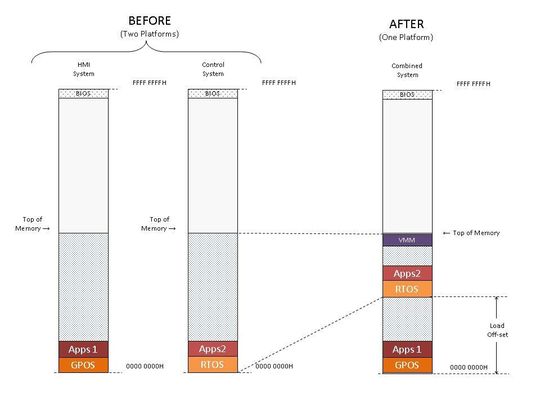
The secret to getting multiple operating systems to run on the same platform is to use virtualization techniques, whereby a hypervisor or virtual machine manager presents each operating system with its own separate version of the underlying machine’s software architecture.
Virtualization is implemented in different ways, and not all virtualization approaches are satisfactory for all applications. For example, some hypervisors virtualize the entire underlying machine, including its I/O, for each guest operating system. This approach may work for servers, where there is no real-time constraints that communications from an I/O device be handled by a within a set time interval, but it causes serious performance limitations in embedded applications that have real-time constraints.
Another difference between virtualization in the server environment and embedded virtualization is the need for embedded virtualization to combine operating systems of different types on the same system. As explained above, high performance embedded systems typically involve multiple processor platforms, each running an operating system that is tailored for the tasks it performs.
Embedded virtualization with RTOS and GPOS
Normally, there will be a real-time operating system (RTOS) running a control application on one platform alongside a general purpose operating system (GPOS) that’s implementing an advanced human-machine interface (HMI) and/or data processing software on another platform.
GPOS schedulers tend to prioritize tasks on a first come, first served basis while RTOS schedulers are event-prioritized. RTOS schedulers handle new interrupts immediately (unless they are masked), regardless of what other tasks are running. Therefore when a sensor or another data capturing device generates an interrupt, it is serviced at the speed that the CPU can service the interrupt every time, resulting in predictable and deterministic response time.
As mentioned above, combining a GPOS and RTOS on the same system can eliminate the cost of separate real-time computer modules, allowing the consolidation of “two-box” systems to one for some OEMs. Embedded virtualization has also opened the door to other OEMs who want to improve the usability of their control application by adding an advanced HMI without requiring an expensive two-box solution.
How embedded virtualization is implemented
Software environments that support embedded virtualization are not new, but hardware features implemented on microprocessors that make it easier to implement embedded virtualization are new. Without special hardware “hooks” that support the relocation of memory and I/O address spaces, the ability to run multiple OSes on a system requires a technique called paravirtualization.
Using paravirtualization techniques
Paravirtualization techniques refer to the use of software to translate memory addresses, I/O addresses, and interrupt vectors used by the virtualized OSes and applications in order for these to run on the same system. In effect, each OS’s environment needs to be moved “out of each other’s way.” Typically, paravirtualization requires that some modifications be made to code that is imported from the systems being combined, and hence its implementation is usually specific to the environment (OS, platform and application).
For example, to run two OSes on the same platform, one or both of the OSes and its associated application software are relocated in memory. The Figure shows the combination of the HMI (GPOS) and control system (RTOS). Loading the guest OS (RTOS) and associated application(s) is done by the virtual machine manager at system start-up. From that point onwards any memory address generated by the RTOS and the applications running on it must be adjusted by the memory load offset. This is done with paravirtualization techniques that edit memory tables and other memory vectors within the RTOS.
Artikelfiles und Artikellinks
(ID:23993490)
:quality(80)/p7i.vogel.de/wcms/7a/c2/7ac26212e809e0aa7aca38d7b6b9bd45/0129606884v2.jpeg "Avnet Silica at embedded world 2026 (Bild: Gerd Altmann)")
:quality(80)/p7i.vogel.de/wcms/ab/73/ab73d241611c109a242a4e5f1b50d01e/0128483827v4.jpeg "Filter elements in various SMD designs. (Bild: TAIYO YUDEN)")