Water quality is a critical global concern, influencing everything from ecosystem health to human well-being. Traditional water analysis methods, however, often fall short in providing real-time, comprehensive data.
Quality monitoring: UV spectroscopy can be used to quickly and reliably determine the quality of drinking water.
(Source: Hamamatsu)
As global concerns surrounding water quality intensify, safeguarding this indispensable resource becomes increasingly imperative. The impact of water quality affects many aspects of our lives, including our food systems, environment, and personal health. Factors such as the increasing population, intensified farming practices and industrial waste have all taken a toll on the purity of our water sources [2]. To tackle these challenges, Hamamatsu Photonics has developed an advanced UV spectrometer, offering innovative solutions for water quality management, particularly key in monitoring the environment and our drinking water. When human activities cause bodies of water to become rich in nutrients, it leads to a reduction in oxygen levels, resulting in the death of aquatic life. Monitoring wastewater quality helps detect pollution events and ensures compliance at treatment facilities[7]. For instance, hospitals and pharmaceutical plants generate concentrated antibiotic wastewater that requires treatment and analysis before release into the environment[1,14].
Water Quality and Concentional Methods for Water Analysis
Water utilities are committed to meeting the drinking-water standards set by the World Health Organization. To ensure safe and reliable drinking water, they employ rigorous water quality monitoring and treatment systems that detect and prevent potential hazards that could render drinking water unsafe [3]. Water quality monitoring usually requires sampling and shipping the samples to a laboratory. This only partially explains water quality over time and may not capture short-term fluctuations.
Delayed feedback from the laboratory also makes it difficult to respond quickly to water incidents [4]. Water quality is assessed by using chemical, biological, and physical methods. Chemical methods such as titration and electrochemical analysis determine pollutant concentrations in a lab. However, these methods require expensive equipment and many reagents and can cause secondary pollution. Biological methods involve enrichment analysis and biosensor technology but suffer from lower accuracy and sensitivity compared to other methods. The results from the chemical and biological methods are also generally not provided in real time [6].
Physical methods consist of spectral remote sensing technology in the UV and visible wavelengths. The principle of UV-Vis spectrophotometry relies on the correlation between the absorption of specific light wavelengths by a substance and its concentration [8]. Thanks to software particle compensation, spectrophotometry generally does not require sample filtrations; it is reagent-free and allows fast measurements of water quality in real time. This method has been increasingly utilized in the realm of rapid water quality assessment in recent years [6]. Among the parameters that can be measured using UV-Vis spectrophotometers are commonly color, nitrate, Depleted Oxygen Content (DOC), Total Oxygen Content (TOC), and the spectral absorption coefficient SAC254. Recently, additional parameters have been included in water quality monitoring using online UV-Vis spectrophotometers [8], such as measurements of dissolved organic matter [9], chemical oxygen demand (COD) in water bodies [10], and disinfectant in drinking water [11].
Single-Wavelength and Multiwavelength Detectors
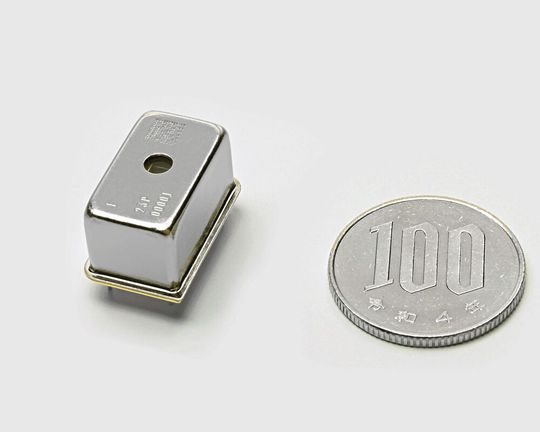
The C16767MA is a highly sensitive, ultra-compact (fingertip size) spectrometer head. The C16767MA supports the ultraviolet range (190 to 440 nm). This product is suitable for integration into a variety of compact instruments.
(Source: Hamamatsu)
There are two types of spectral sensors used in water analysis: single wavelength (SW) sensors and spectrophotometers. Online SW UV-Vis instruments determine concentrations of a specific water parameter measuring the absorbance of a selected single wavelength [12]. UV-Vis spectrophotometers measure the absorbance in a certain wavelength range and produce spectral fingerprints used to determine water quality concentrations of several parameters[13]. SW sensors may not compensate for particle effects accurately, while spectrophotometers provide better particle compensation and can be calibrated with higher accuracy, ideal for precise applications, such as real-time water and treatment process monitoring [13].
Hamamatsu’s innovative UV-VIS spectrometer is designed to meet the demands of modern water quality monitoring. This cutting-edge solution seamlessly blends advanced technology and practicality, ensuring accurate and efficient real-time analysis. The C16767MA mini-spectrometer head model [15] presents the most compact yet powerful solutions for situations requiring portability and efficiency. Ideal for direct installation into water pipelines or complex monitoring configurations, its streamlined design encapsulates advanced functionality within a diminutive form factor.
The UV-VIS spectrometer exhibits exceptional sensitivity across a wavelength range spanning from 190 to 400 nm. This allows for precise measurement of critical water quality parameters, thereby enabling comprehensive insight into water composition. The distinctive compact form of our spectral sensor facilitates seamless integration into miniature and handheld instruments. These sensors can be effortlessly incorporated directly within water pipelines, underscoring their adaptability and ease of deployment.
Stand: 08.12.2025
Es ist für uns eine Selbstverständlichkeit, dass wir verantwortungsvoll mit Ihren personenbezogenen Daten umgehen. Sofern wir personenbezogene Daten von Ihnen erheben, verarbeiten wir diese unter Beachtung der geltenden Datenschutzvorschriften. Detaillierte Informationen finden Sie in unserer Datenschutzerklärung.
Einwilligung in die Verwendung von Daten zu Werbezwecken
Ich bin damit einverstanden, dass die Vogel Communications Group GmbH & Co. KG, Max-Planckstr. 7-9, 97082 Würzburg einschließlich aller mit ihr im Sinne der §§ 15 ff. AktG verbundenen Unternehmen (im weiteren: Vogel Communications Group) meine E-Mail-Adresse für die Zusendung von redaktionellen Newslettern nutzt. Auflistungen der jeweils zugehörigen Unternehmen können hier abgerufen werden.
Der Newsletterinhalt erstreckt sich dabei auf Produkte und Dienstleistungen aller zuvor genannten Unternehmen, darunter beispielsweise Fachzeitschriften und Fachbücher, Veranstaltungen und Messen sowie veranstaltungsbezogene Produkte und Dienstleistungen, Print- und Digital-Mediaangebote und Services wie weitere (redaktionelle) Newsletter, Gewinnspiele, Lead-Kampagnen, Marktforschung im Online- und Offline-Bereich, fachspezifische Webportale und E-Learning-Angebote. Wenn auch meine persönliche Telefonnummer erhoben wurde, darf diese für die Unterbreitung von Angeboten der vorgenannten Produkte und Dienstleistungen der vorgenannten Unternehmen und Marktforschung genutzt werden.
Meine Einwilligung umfasst zudem die Verarbeitung meiner E-Mail-Adresse und Telefonnummer für den Datenabgleich zu Marketingzwecken mit ausgewählten Werbepartnern wie z.B. LinkedIN, Google und Meta. Hierfür darf die Vogel Communications Group die genannten Daten gehasht an Werbepartner übermitteln, die diese Daten dann nutzen, um feststellen zu können, ob ich ebenfalls Mitglied auf den besagten Werbepartnerportalen bin. Die Vogel Communications Group nutzt diese Funktion zu Zwecken des Retargeting (Upselling, Crossselling und Kundenbindung), der Generierung von sog. Lookalike Audiences zur Neukundengewinnung und als Ausschlussgrundlage für laufende Werbekampagnen. Weitere Informationen kann ich dem Abschnitt „Datenabgleich zu Marketingzwecken“ in der Datenschutzerklärung entnehmen.
Falls ich im Internet auf Portalen der Vogel Communications Group einschließlich deren mit ihr im Sinne der §§ 15 ff. AktG verbundenen Unternehmen geschützte Inhalte abrufe, muss ich mich mit weiteren Daten für den Zugang zu diesen Inhalten registrieren. Im Gegenzug für diesen gebührenlosen Zugang zu redaktionellen Inhalten dürfen meine Daten im Sinne dieser Einwilligung für die hier genannten Zwecke verwendet werden. Dies gilt nicht für den Datenabgleich zu Marketingzwecken.
Recht auf Widerruf
Mir ist bewusst, dass ich diese Einwilligung jederzeit für die Zukunft widerrufen kann. Durch meinen Widerruf wird die Rechtmäßigkeit der aufgrund meiner Einwilligung bis zum Widerruf erfolgten Verarbeitung nicht berührt. Um meinen Widerruf zu erklären, kann ich als eine Möglichkeit das unter https://contact.vogel.de abrufbare Kontaktformular nutzen. Sofern ich einzelne von mir abonnierte Newsletter nicht mehr erhalten möchte, kann ich darüber hinaus auch den am Ende eines Newsletters eingebundenen Abmeldelink anklicken. Weitere Informationen zu meinem Widerrufsrecht und dessen Ausübung sowie zu den Folgen meines Widerrufs finde ich in der Datenschutzerklärung, Abschnitt Redaktionelle Newsletter.
Hamamatsu's UV spectrometer boasts an unparalleled dynamic range, ensuring dependable measurements amidst dynamic environmental conditions. This makes them ideal for dependable operation in outdoor settings, where fluctuations are inherent. Our new UV spectrometers achieve a high Signal-to-Noise Ratio (SNR) enabling the early detection of even the most subtle fluctuations in water quality, facilitating preemptive alarms and swift corrective actions. By curbing crosstalk among different wavelength readings, the accuracy of Hamamatsu's UV spectrometer is significantly enhanced. This design detail ensures the production of reliable and consistent measurements, critical for meaningful analysis.
Navigating the Future of Water Quality With UV Technology
Hamamatsu's cutting-edge UV spectrometer offers a vital solution to the escalating global water quality challenges. From addressing nutrient imbalances jeopardizing aquatic ecosystems and food supplies to ensuring stringent drinking water standards, these spectrometers cater to diverse concerns. The future of water quality management lies in innovation. By continuing to refine and expand these technologies, we can better protect our most valuable natural resources. Water is life, and through continuous advancements in real-time monitoring, we are safeguarding it for future generations. With tools like Hamamatsu’s compact UV spectrometers, the path toward a more sustainable and healthier planet is clearer than ever. (heh)
References
[1] F. S. Chapin III, P. A. Matson, and P. M. Vitousek, Principles of Terrestrial Ecosystem Ecology, 2nd ed., Springer, 2011.
[2] H.I. Chaminé, "Water resources meet sustainability: new trends in environmental hydrogeology and groundwater engineering," Environ Earth Sci, vol. 73, pp. 2513-2520, 2015. doi: 10.1007/s12665-014-3986-y.
[3] Z. Shi, C.W.K. Chow, R. Fabris, J. Liu, and B. Jin, "Applications of Online UV-Vis Spectrophotometer for Drinking Water Quality Monitoring and Process Control: A Review," Sensors, vol. 22, no. 8, article 2987, 2022. doi: 10.3390/s22082987.
[4] M.H. Banna, S. Imran, A. Francisque, H. Najjaran, R. Sadiq, M. Rodriguez, and M. Hoorfar, "Online Drinking Water Quality Monitoring: Review on Available and Emerging Technologies," Critical Reviews in Environmental Science and Technology, vol. 44, no. 12, pp. 1370-1421, 2014. doi: 10.1080/10643389.2013.781936.
[5] A.-E. Briciu, A. Graur, and D. I. Oprea, “Water Quality Index of Suceava River in Suceava City Metropolitan Area,” Water, vol. 12, no. 8, p. 2111, Jul. 2020, doi: 10.3390/w12082111.
[6] G.V. Pashkova and A.G. Revenko, "A Review of Application of Total Reflection X-ray Fluorescence Spectrometry to Water Analysis," Applied Spectroscopy Reviews, vol. 50, no. 6, pp. 443-472, 2015. doi: 10.1080/05704928.2015.1010205.
[7] E.M. Carstea, J. Bridgeman, A. Baker, and D.M. Reynolds, "Fluorescence spectroscopy for wastewater monitoring: A review," Water Research, vol. 95, pp. 205-219, 2016. doi: 10.1016/j.watres.2016.03.021.
[8] Y. Guo, C. Liu, R. Ye, and Q. Duan, "Advances on Water Quality Detection by UV-Vis Spectroscopy," Appl. Sci., vol. 10, p. 6874, 2020. doi: 10.3390/app10196874.
[9] P. Li and J. Hur, "Utilization of UV-Vis spectroscopy and related data analyses for dissolved organic matter (DOM) studies: A review," Crit. Rev. Environ. Sci. Technol., vol. 47, pp. 131-154, 2017. doi: 10.1080/10643389.2016.1224573.
[10] F. Liu, P. Zheng, B. Huang, X. Zhao, L. Jiao, and D. Dong, "A review on optical measurement method of chemical oxygen demand in water bodies," in Proceedings of the International Conference on Computer and Computing Technologies in Agriculture, Beijing, China, 27-30 September 2015, pp. 619-636.
[11] S. Hossain, C. W. Chow, G. A. Hewa, D. Cook, and M. Harris, "Spectrophotometric online detection of drinking water disinfectant: A machine learning approach," Sensors, vol. 20, p. 6671, 2020.
[12] J. van den Broeke, G. Langergraber, and A. Weingartner, "On-line and in-situ UV/vis spectroscopy for multiparameter measurements: a brief review," Spectroscopy Europe, vol. 18, no. 4, pp. 15-18, 2006.
[13] Z. Shi, C.W. Chow, R. Fabris, J. Liu, and B. Jin, "Alternative particle compensation techniques for online water quality monitoring using UV–Vis spectrophotometer," Chemometrics and Intelligent Laboratory Systems, vol. 204, p. 104074, 2020.
[14] Li F., Wang X., Yang M., Zhu M., Chen W., Li Q., Sun D., Bi X., Maletskyi Z., Ratnaweera H. "Detection Limits of Antibiotics in Wastewater by Real-Time UV–VIS Spectrometry at Different Optical Path Length." Processes, vol. 10, no. 12, p. 2614, 2022. [Online]. Available: https://doi.org/10.3390/pr10122614





:quality(80)/p7i.vogel.de/wcms/e9/ce/e9ce137e87eccac328ec5504c586c477/0129711019v3.jpeg "Im Rahmen eines Entwicklungsprojekts wurden verschiedene bleireduzierte und bleifreie Kupfer-Beryllium-basierte Legierungskonzepte untersucht, die die Anforderungen an hohe Festigkeiten als auch eine hohe elektrische Leitfähigkeit erfüllen. (Bild: Materion)")
:quality(80)/p7i.vogel.de/wcms/68/46/684697b6eb687384e0d8c6803450401a/0130056395v2.jpeg "Das TUM RoboGym (powered by Neura) in der Planungsphase (Grafik). Die TU München und das Robotik Startup Neura Robotics planen, gemeinsam am Campus der TU München das weltgrößte Robotik-Trainingszentrum einzurichten. (Bild: Neura Robotics)")
:quality(80)/p7i.vogel.de/wcms/0f/c0/0fc0d93c99a5d9066e58c39f41fb1b10/0130046764v2.jpeg "Sicherheit im Schienenverkehr: Dank 5G-Funkverbindung wird eine stabile Übertragung unter schwankenden Netzbedingungen garantiert. (Bild: Smart Rail Connectivity Campus (SRCC))")
:quality(80)/p7i.vogel.de/wcms/1d/d8/1dd8627e2323721d4ee5436f9401911e/0130147601v2.jpeg "Der kompakte Modulator ermöglicht eine schnelle und energieeffiziente Datenübertragung und lässt sich kostengünstig herstellen. (Bild: Hugo Larocque, EPFL)")
:quality(80)/p7i.vogel.de/wcms/8e/d4/8ed4a2aa0bf362584aa1284f0adb2fdf/0130156040v2.jpeg "Kioxia-Werk in Kitakami: Auch der japanische Speicherspezialist hat nun in einer Notiz an Investoren darauf hingeweisen, aus dem Legacy-Geschäft mit Multi-Layer-Cell-Speichern aussteigen zu wollen. Die letzten Lieferungen an Bestandskunden sollen im März 2027 erfolgen. (Bild: Kioxia)")
:quality(80)/p7i.vogel.de/wcms/65/f4/65f404dc6d19d4f1628ad7e49f6a22cf/0130136276v2.jpeg "Bild 1: Blockschaltbild eines E-Bike-Systems auf Basis des Gate-Treibers DRV8363-Q1. (Bild: TI)")
:quality(80)/p7i.vogel.de/wcms/fb/d3/fbd33264fcdf128866667be0a0a6b657/0130137877v2.jpeg "Openclaw begeistert KI-Communitys. (Bild: Openclaw.ai)")
:quality(80)/p7i.vogel.de/wcms/a5/5e/a55ec741a9c17cb890b2cb5bcb919477/0130162776v2.jpeg "Von der vernetzten Kamera über den Saugroboter und den Industrieroboter bis hin zu Drohne und Humanoiden wandert KI entlang der Entwicklung von „Basic Intelligence“ zur „Multi-Purpose Intelligence“ immer näher an Sensoren und Aktoren, während softwaredefinierte Architekturen langfristige Systeme flexibel für neue Funktionen und KI-Modelle aufrüstbar machen. (Bild: Globalfoundries)")
:quality(80)/p7i.vogel.de/wcms/fa/8d/fa8dedee195f29c33c89d86311c258ee/0130104146v2.jpeg "Kompakte KI-Power: Die Smart-Module SIM8668 und SIM8666 von Simcom vereinen auf kleinstem Raum eine Quad-Core-CPU samt integrierter NPU für ressourcenschonende Industrie- und Robotikanwendungen. (Bild: Chip: Simcom/Hintergrund: KI-generiert)")
:quality(80)/p7i.vogel.de/wcms/cc/13/cc1378375499a26b5ddbb309d2155acb/0130085649v2.jpeg "Vom Hardware-Produzenten zum Software-Anbieter: Neocortec lizenziert seinen NeoMesh-Protokoll-Stack zunehmend direkt an OEMs und Dritthersteller, anstatt ausschließlich auf den Verkauf eigener Funkmodule zu setzen. (Bild: mc/VCG)")
:quality(80)/p7i.vogel.de/wcms/24/58/2458f1cae3100e375fbb8124f02c54af/0130111244v3.jpeg "Stromsparer für das IoT: Der Npzero-Baustein übernimmt die Sensorüberwachung und schickt den Hauptprozessor in den Tiefschlaf. (Bild: Manuel Christa)")
:quality(80)/p7i.vogel.de/wcms/fa/fc/fafc300481de3fd4d7f34400327d0d01/0130127049v2.jpeg "Lenovo hat in Zusammenarbeit mit der Shanghai Jiao Tong University eine Silizium-Anoden-Batterie unter dem Namen „ED1000\" als Proof of Concept für mobile Workstations vorgestellt. (Bild: Lenovo)")
:quality(80)/p7i.vogel.de/wcms/d2/cd/d2cd33084ab732ff8a600bc55ade1f47/0130096831v1.jpeg "Die WE-MPSB-Familie. (Bild: Würth Elektronik eiSos)")
:quality(80)/p7i.vogel.de/wcms/10/45/1045969e69a1db4aaa73d0f74f55cc02/0129962687v2.jpeg "Bosch Rexroth und AMD arbeiten gemeinsam an Software-Defined Automation: ctrlX OS unterstützt nun auch auf AMD Embedded x86-CPUs und adaptive SoCs und verspricht so noch größere Hardware-DesignFlexibilität, nahtlose Skalierbarkeit und eine sichere, modulare Betriebssystem-Grundlage. (Bild: Bosch Rexroth AG)")
:quality(80)/p7i.vogel.de/wcms/cd/32/cd3243e4a9a6476265ef6ea9463dfbd8/0129852659v2.jpeg "Die PIC64-Serie an Multicore-Mikroprozessoren setzt auf RISC-V-Kerne und eignen sich speziell für Anwendungen mit asynchronem Multipricessing (AMP) in intelligenten Embedded-Edge-Anwendungen. (Bild: Microchip)")
:quality(80)/p7i.vogel.de/wcms/c7/f6/c7f61d0437c7f8fca3c6ff947ba2ad62/0129322490v2.jpeg "AMD hat die zweite Generation der Kintex UltraScale+ Gen 2 FPGA-Familie vorgestellt, die mit PCIe Gen4 den 4K-AV-over-IP-Betrieb für 4K/8K-Medienanwendungen unterstützt. (Bild: AMD)")
:quality(80)/p7i.vogel.de/wcms/66/0c/660c31afa35398bac9be42f2be73fdc4/0129073529v2.jpeg "FPGAs lösen Performance-Engpässe, gelten aber in der Programmierung als schwer zugänglich. Die universelle Programmiersprache Livt soll die Hürde senken – korrekt, deterministisch und HDL-kompatibel. (Bild: Toby Giessen / VCG)")
:quality(80)/p7i.vogel.de/wcms/35/af/35af7dd326d198475d06fbb69aa600b5/0130175971v2.jpeg "Diff GT kann in einer kostenlosen Probeversion ausprobiert werden. (Bild: CSci)")
:quality(80)/p7i.vogel.de/wcms/c0/2e/c02e7bf72bfc434888c37100e2511681/0130127767v3.jpeg "„Wegen seiner kompakten Bauweise, des modularen Aufbaus und der hohen Effizienz ist der Axialflussmotor eine attraktive Alternative zur etablierten Radialflussmotor-Topologie“, PEM-Leiter Professor Achim Kampker (Bild: RWTH Aachen University)")
:quality(80)/p7i.vogel.de/wcms/95/a1/95a197490145b7afcfd4dc176a1b5ef9/0130096114v2.jpeg "Der Einsatz amorpher Stähle im Stator ermöglicht eine deutliche Reduktion von Verlusten und steigert die Effizienz moderner Elektromotoren im Fahrzeugantrieb. (Bild: Horse Powertrain)")
:quality(80)/p7i.vogel.de/wcms/bf/82/bf82f81061b759c454e15ec4c2e7560b/0130110139v2.jpeg "48 Volt im Fahrzeug: Ziel ist eine effiziente Energienutzung, einfache Integration sowie eine zuverlässige Leistung. Doch mit den Möglichkeiten kommen auch Probleme. (Bild: Leoni)")
:quality(80)/p7i.vogel.de/wcms/74/96/74964a7715c738a9e8b17681445ceed3/0130103633v2.jpeg "Zusammen mit dem Vektor-Netzwerkanalysator PNA/PNA-X kann der Lightwave Component Analyzer N4378A von Keysight optische Transceiver-Komponenten mit 1,6 T und darüber hinaus charakterisieren. (Bild: Keysight)")
:quality(80)/p7i.vogel.de/wcms/0d/18/0d183ecb569b03285578762658d2def6/0130061201v2.jpeg "Rahman Jamal war 30 Jahre bei National Instruments und damit ein Teil der Messtechnik-Branche. Den VIP-Anwenderkongress hat er mit aus der Taufe gehoben. (Bild: ELEKTRONIKPRAXIS/privat)")
:quality(80)/p7i.vogel.de/wcms/72/19/7219e53d462877119eaf0bd98783a46d/0129953146v2.jpeg "Das GCAR 6283 unterstützt bei Test, Simulation und Analyse moderner Steuergeräte. (Bild: Göpel electronic)")
:quality(80)/p7i.vogel.de/wcms/6a/93/6a93991941467231d8798c8577882dfd/0130071573v2.jpeg "(Bild: Vision & Control GmbH)")
:quality(80)/p7i.vogel.de/wcms/d3/76/d3760874d137b2f4bae5954b46dd5900/0130101582v3.jpeg "Hardware hautnah: Ein Development-Board mit dem neuen SoC nRF54LM20, der dank integrierter NPU speziell für extrem stromsparende Edge-KI-Anwendungen entwickelt wurde. (Bild: mc/VCG)")
:quality(80)/p7i.vogel.de/wcms/42/de/42de87134adee379a83e5d633ba48c95/0130176499v2.jpeg "Zur LOPEC 2026 kamen nahezu 160 Aussteller und 2.400 Teilnehmer nach München, um sich über gedruckte Elektronik zu informieren. (Bild: Messe München GmbH)")
:quality(80)/p7i.vogel.de/wcms/90/0c/900ca1b73852ed45bd7e42a6119192dd/0130174841v2.jpeg "Simulation kann dabei helfen, Materialflüsse in der Produktion zu optimieren. (Bild: frei lizenziert)")
:quality(80)/p7i.vogel.de/wcms/5e/ed/5eed37b21283f8f364a37d025d53fa48/0130167146v2.jpeg "ProteQ Viso: Digitales Stereomikroskop für echte brillenlose 3D- Bildbetrachtung auf dem Flachbildschirm. (Bild: Vision Engineering)")
:quality(80)/p7i.vogel.de/wcms/bb/2a/bb2ac8404ae7b3f08a5c01d1ca0615a7/0130182922v2.jpeg "Steht ein Verkauf von Elmos im Raum? Medienberichten zufolge planen die Gründer des Unternehmens, die weiterhin mehrheitlich Anteile am Dortmunder Automotive-Spezialisten halten, den Ausstieg aus dem Chipunternehmen. (Bild: Elmos)")
:quality(80)/p7i.vogel.de/wcms/ef/9d/ef9dc7f8402f3f4ff42268e573921bc4/0130129635v2.jpeg "Mit Verträgen über bis zu fünf Jahre möchte Samsung-Co-CEO Jun Young-hyun auf den KI-getriebenen Nachfrageboom im Speichermarkt reagieren. Das soll für mehr Planungssicherheit im traditionell volatilen Speichergeschäft sorgen. Gleichzeitig dürfte dies aber für Kunden den Druck erhöhen, Bedarfe, Preise und Lieferketten langfristig präzise abzusichern. (Bild: Samsung)")
:quality(80)/p7i.vogel.de/wcms/d6/ea/d6eac438c362c545cab42ef0f30bcfc0/0130136975v2.jpeg "Die Bewerbungsphase für den James Dyson Award 2026 ist gestartet. (Bild: Dyson)")
:quality(80)/p7i.vogel.de/wcms/e5/6c/e56ceb935ba09cb66a4fd0f961b2d3e9/0129642888v2.jpeg "(Bild: Vogel Professional Education)")
:quality(80)/p7i.vogel.de/wcms/69/1f/691f39ba12be3cad90eb88bdabc456a6/0127321404v2.jpeg "Das Kreativteam Christian Göller, GreatScott! und Christopher Becht (v. l. n. r.): erfolgreiches Creator-Marketing im B2B-Sektor (Bild: Würth Elektronik)")

:quality(80)/p7i.vogel.de/wcms/da/e4/dae45caa7f4fa7125e17b07d9da016bb/0125786170v2.jpeg "Soft termination prevents cracks by absorbing mechanical stress through a resin layer. (Bild: TAIYO YUDEN CO., LTD.)")
:quality(80)/p7i.vogel.de/wcms/ab/73/ab73d241611c109a242a4e5f1b50d01e/0128483827v4.jpeg "Filter elements in various SMD designs. (Bild: TAIYO YUDEN)")