For automotive designers, TCAN340x-Q1 EMC-certified 3.3V CAN transceiver represents a compelling alternative to standard 5V CAN transceivers. The TCAN340x-Q1 marks the beginning of a new era in 3.3V CAN FD transceivers, helping to remove the 5V supply rail that applications traditionally needed only for the 5V CAN transceiver.
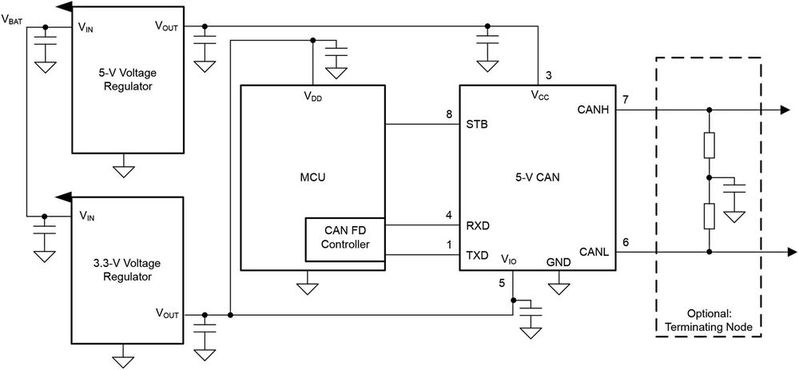
Figure 1: Application schematic of a 5V CAN transceiver.
(Source: TI)
With the electrification of vehicles happening at a rapid pace, multiple ECUs are deployed all through the vehicle. These subsystems talk to each other through a CAN network, with each CAN node consisting of at least three components: a CAN transceiver, a microcontroller (MCU) or microprocessor (MPU), with an embedded CAN protocol controller and a power device (a DC/DC converter or linear regulator) that converts the automotive battery voltage to 5V. Additionally, in case the MCU or MPU’s input/output (I/O) voltage is 3.3V, a separate 3.3V power device is used on the ECU’s printed circuit board (PCB). Figure 1 shows a simplified schematic.
CAN bus signals typically consist of dominant and recessive phases. A CAN driver produces a differential signal of at least 1.5V across a 60Ω load during the dominant phase, whereas the driver weakly biases the bus to a common-mode 2.5V level during the recessive phase. This signaling is designed for bitwise arbitration, and the device with the highest priority ID (the CAN frame identification field with the most dominant bits) takes control of the bus, since the dominant (strong) drive is able to overcome recessive (weak) biasing.
The receiving nodes monitor CAN high and CAN low differential signals and can decode the CAN message as long as the signal is above 900mV (the dominant threshold) or below 500mV (the recessive threshold). See Figure 2 (VD = VCANH – VCANL; For driver: VOD(DOM) ≥ 1.5V @ 60 Ω load; For receiver: VID(DOM) ≥ 900mV, VID(rec) ≤ 500mV).
A CAN wiring harness extends throughout the vehicle. Any common-mode disturbance generated by the CAN transceiver can result in emissions that can potentially impact the functionality of other automotive subsystems. Similarly, the harness is susceptible to electromagnetic interference emerging from other modules. Thus, electromagnetic compliance (EMC) is an important requirement for any automotive CAN transceiver. Different subsystems can have CAN transceivers from different semiconductor vendors; thus, interoperability is another requirement for any CAN transceiver to be used in a mainstream vehicle network.
5V CAN Transceiver
The CAN bus transceiver may be the only 5V component in the subsystem. With the modern MCU’s I/O supply going down to 3.3V, it is possible to eliminate the 5V rail altogether, resulting in power-stage simplification and cost savings by reducing the bill of materials and PCB space. A highly bus-fault-tolerant CAN bus transceiver that is footprint-compatible to standard 5V CAN transceivers and operates from a single 3.3V supply, can help simplify designs and reduce cost by eliminating the need for a dedicated 5V supply.
TI has released two automotive-qualified, EMC-certified 3.3V CAN FD transceivers (TCAN3403-Q1 and TCAN3404-Q1 CAN FD). The two transceivers differ at pin 5: Ultra-low power shutdown mode rsp. low voltage I/O support.
Even at a minimum supply voltage of 3V (since the 3.3V main supply can vary by ±10%), the devices are designed for a minimum differential output voltage of 1.5V with a 50Ω bus load. This maintains compliance to the VOD specification included in the ISO 11898-2(2024) standard. Receiver thresholds are the same as in standard 5V CAN transceivers, maintaining compliance to ISO11898-2 (2024).
Driver transistors must be sized so that the drop across the high and low sides combined is a maximum of 1.5V at an operating bus supply voltage of 3V. This reduction in the minimum operating supply voltage mandates device recessive biasing to be positioned at 1.9V, as opposed to 2.5V for standard 5V CAN transceivers. Because CAN is a differential interface, single-ended voltages in the dominant and recessive states are not crucial for proper operation or communication. This means that the devices are compatible with ISO 11898-2 (2024).
Figure 3 shows an application diagram with the TCAN3404-Q1 and a single 3.3V supply regulator for the MCU and the CAN transceiver.
Figure 4 compares single device level waveforms from the TCAN340x-Q1 and a standard 5V CAN transceiver.
When combining the TCAN3403-Q1 and TCAN3404-Q1 with 5V CAN transceivers on the same bus, a slight recessive bias mismatch can have an impact on emissions. However, proprietary design techniques implemented in both devices maintain EMC compliance per IEC 62228-3 in both homogeneous (both nodes in network, as in the TCAN340x-Q1) and heterogeneous (one node is the TCAN340x-Q1, the other node is standard 5V CAN) network conditions.
Stand: 08.12.2025
Es ist für uns eine Selbstverständlichkeit, dass wir verantwortungsvoll mit Ihren personenbezogenen Daten umgehen. Sofern wir personenbezogene Daten von Ihnen erheben, verarbeiten wir diese unter Beachtung der geltenden Datenschutzvorschriften. Detaillierte Informationen finden Sie in unserer Datenschutzerklärung.
Einwilligung in die Verwendung von Daten zu Werbezwecken
Ich bin damit einverstanden, dass die Vogel Communications Group GmbH & Co. KG, Max-Planckstr. 7-9, 97082 Würzburg einschließlich aller mit ihr im Sinne der §§ 15 ff. AktG verbundenen Unternehmen (im weiteren: Vogel Communications Group) meine E-Mail-Adresse für die Zusendung von redaktionellen Newslettern nutzt. Auflistungen der jeweils zugehörigen Unternehmen können hier abgerufen werden.
Der Newsletterinhalt erstreckt sich dabei auf Produkte und Dienstleistungen aller zuvor genannten Unternehmen, darunter beispielsweise Fachzeitschriften und Fachbücher, Veranstaltungen und Messen sowie veranstaltungsbezogene Produkte und Dienstleistungen, Print- und Digital-Mediaangebote und Services wie weitere (redaktionelle) Newsletter, Gewinnspiele, Lead-Kampagnen, Marktforschung im Online- und Offline-Bereich, fachspezifische Webportale und E-Learning-Angebote. Wenn auch meine persönliche Telefonnummer erhoben wurde, darf diese für die Unterbreitung von Angeboten der vorgenannten Produkte und Dienstleistungen der vorgenannten Unternehmen und Marktforschung genutzt werden.
Meine Einwilligung umfasst zudem die Verarbeitung meiner E-Mail-Adresse und Telefonnummer für den Datenabgleich zu Marketingzwecken mit ausgewählten Werbepartnern wie z.B. LinkedIN, Google und Meta. Hierfür darf die Vogel Communications Group die genannten Daten gehasht an Werbepartner übermitteln, die diese Daten dann nutzen, um feststellen zu können, ob ich ebenfalls Mitglied auf den besagten Werbepartnerportalen bin. Die Vogel Communications Group nutzt diese Funktion zu Zwecken des Retargeting (Upselling, Crossselling und Kundenbindung), der Generierung von sog. Lookalike Audiences zur Neukundengewinnung und als Ausschlussgrundlage für laufende Werbekampagnen. Weitere Informationen kann ich dem Abschnitt „Datenabgleich zu Marketingzwecken“ in der Datenschutzerklärung entnehmen.
Falls ich im Internet auf Portalen der Vogel Communications Group einschließlich deren mit ihr im Sinne der §§ 15 ff. AktG verbundenen Unternehmen geschützte Inhalte abrufe, muss ich mich mit weiteren Daten für den Zugang zu diesen Inhalten registrieren. Im Gegenzug für diesen gebührenlosen Zugang zu redaktionellen Inhalten dürfen meine Daten im Sinne dieser Einwilligung für die hier genannten Zwecke verwendet werden. Dies gilt nicht für den Datenabgleich zu Marketingzwecken.
Recht auf Widerruf
Mir ist bewusst, dass ich diese Einwilligung jederzeit für die Zukunft widerrufen kann. Durch meinen Widerruf wird die Rechtmäßigkeit der aufgrund meiner Einwilligung bis zum Widerruf erfolgten Verarbeitung nicht berührt. Um meinen Widerruf zu erklären, kann ich als eine Möglichkeit das unter https://contact.vogel.de abrufbare Kontaktformular nutzen. Sofern ich einzelne von mir abonnierte Newsletter nicht mehr erhalten möchte, kann ich darüber hinaus auch den am Ende eines Newsletters eingebundenen Abmeldelink anklicken. Weitere Informationen zu meinem Widerrufsrecht und dessen Ausübung sowie zu den Folgen meines Widerrufs finde ich in der Datenschutzerklärung, Abschnitt Redaktionelle Newsletter.
Other features of the TCAN3403-Q1 and TCAN3404-Q1 include:
A high bus-fault tolerance up to ±58V prevents device damage in the event of miswiring faults in 12V and 24V battery applications.
An extended common-mode operating voltage range of ±30V ensures that the receiver continues to receive data without disruption, even in the presence of a large ground potential difference or voltage interference.
Footprint compatibility with standard 5V CAN transceivers and a shutdown feature that reduces the supply current to <5µA for seamless upgradability.
Package options offered in leaded small-outline integrated circuit (SOIC)-8, leadless very small-outline no-lead (VSON)-8 with wettable flanks, and ultrasmall leaded small-outline transistor (SOT)-23.
Many 3.3V CAN transceivers were already available in the market, but none of them meets the requirements for automotive qualification and EMC certification. Thus, the TCAN340x-Q1 is an option for automotive designers looking for a fully interoperable 3.3V CAN transceiver that overcomes EMC challenges in heterogeneous networks.
Interoperability
To verify its interoperability, the TCAN340x-Q1 was tested in a 16-node linear homogenous network with all nodes at 2Mbps and and in an 8-node homogeneous linear network at 5Mbps. Additionally, it was tested with a 16-node 2Mbps network under heterogeneous conditions (with four nodes being TCAN340x-Q1 and 12 nodes being golden reference 5V CAN transceivers). Similarly, an 8-node 5Mbps network was tested under heterogeneous conditions (two nodes being TCAN340x-Q1 and 6 nodes as golden reference 5V CAN transceivers).
Under all network conditions, failures such as CAN bus short to GND, CAN short to battery, ground shift between nodes and disconnection of nodes were intentionally introduced in the network at startup. Subsequently, the fault was removed and communication integrity was checked.
Additionally, TI performed internal testing for various networks (multi-node complex star topologies) with and without arbitration, and the TCAN340x-Q1 passed the interoperability tests under all network conditions. Below are two waveforms during arbitration for homogeneous (all 5V nodes) and heterogeneous (three TCAN340x-Q1 and 8 standard 5V CAN nodes) 11-node complex triple star networks tested at a data rate of 2Mbps (with 500kbps arbitration).
The waveforms clearly demonstrated error-free reception. Even though a shift of the bus common-mode voltage (VCM) movement occurred during the frame under heterogeneous conditions, the differential bus and RXD waveforms remained undisturbed and comparable to all 5V homogeneous network conditions.
EMC Performance of the TCAN340x-Q1
As stated in the previous sections, meeting the component-level EMC regulations is a strict requirement to get CAN transceivers qualified by major car makers. One standard that is used to test and qualify CAN transceivers for EMC is IEC62228-3:2019. This standard tests CAN transceivers for conducted emissions and conducted immunity in a two-node setup, and for ISO10605 ESD and pulse transients.
As CAN is a differential interface, electromagnetic energy due to differential signals largely gets cancelled out, but any common-mode mismatch can show up on cable harnesses, resulting in significant system-level emissions. To meet the EMC regulations, significant design effort has been put into the TCAN340x-Q1 in order to maintain switching symmetry between CANH and CANL during rising and falling bus transitions.
Additionally, proprietary design techniques are implemented in the TCAN340x-Q1 to dynamically adjust the bus common mode while driving and receiving CAN data to meet emission regulations, specifically in heterogeneous networks. Emissions in homogeneous networks (where all nodes on CAN bus are 3.3V) are easier to meet compared to the stricter heterogeneous network (mix of 3.3V and 5V CAN node on same bus) because of the common-mode shift under recessive conditions.
TCAN340x-Q1 meets strict EMC requirements per IEC 62228-3:2019 under both homogeneous and heterogeneous network conditions. Relevant reports are available upon request.
Conclusion
For automotive designers, TI’s TCAN340x-Q1 EMC-certified 3.3V CAN transceiver represents a compelling alternative to standard 5V CAN transceivers. It is footprint compatible and fully interoperable with 5V CAN transceivers while being compatible with the ISO11898-2:2024 physical-layer specifications. The TCAN340x-Q1 helps reduce CAN solution costs by 25% (by eliminating an automotive 5V LDO) and PCB space by 70%. Thus, the TCAN340x-Q1 marks the beginning of a new era in 3.3V CAN FD transceivers, helping to remove the 5V supply rail that applications traditionally needed only for the 5V CAN transceiver, thereby reducing both BOM cost and PCB size. (kr)





:quality(80)/p7i.vogel.de/wcms/e9/ce/e9ce137e87eccac328ec5504c586c477/0129711019v3.jpeg "Im Rahmen eines Entwicklungsprojekts wurden verschiedene bleireduzierte und bleifreie Kupfer-Beryllium-basierte Legierungskonzepte untersucht, die die Anforderungen an hohe Festigkeiten als auch eine hohe elektrische Leitfähigkeit erfüllen. (Bild: Materion)")
:quality(80)/p7i.vogel.de/wcms/68/46/684697b6eb687384e0d8c6803450401a/0130056395v2.jpeg "Das TUM RoboGym (powered by Neura) in der Planungsphase (Grafik). Die TU München und das Robotik Startup Neura Robotics planen, gemeinsam am Campus der TU München das weltgrößte Robotik-Trainingszentrum einzurichten. (Bild: Neura Robotics)")
:quality(80)/p7i.vogel.de/wcms/0f/c0/0fc0d93c99a5d9066e58c39f41fb1b10/0130046764v2.jpeg "Sicherheit im Schienenverkehr: Dank 5G-Funkverbindung wird eine stabile Übertragung unter schwankenden Netzbedingungen garantiert. (Bild: Smart Rail Connectivity Campus (SRCC))")
:quality(80)/p7i.vogel.de/wcms/1d/d8/1dd8627e2323721d4ee5436f9401911e/0130147601v2.jpeg "Der kompakte Modulator ermöglicht eine schnelle und energieeffiziente Datenübertragung und lässt sich kostengünstig herstellen. (Bild: Hugo Larocque, EPFL)")
:quality(80)/p7i.vogel.de/wcms/8e/d4/8ed4a2aa0bf362584aa1284f0adb2fdf/0130156040v2.jpeg "Kioxia-Werk in Kitakami: Auch der japanische Speicherspezialist hat nun in einer Notiz an Investoren darauf hingeweisen, aus dem Legacy-Geschäft mit Multi-Layer-Cell-Speichern aussteigen zu wollen. Die letzten Lieferungen an Bestandskunden sollen im März 2027 erfolgen. (Bild: Kioxia)")
:quality(80)/p7i.vogel.de/wcms/65/f4/65f404dc6d19d4f1628ad7e49f6a22cf/0130136276v2.jpeg "Bild 1: Blockschaltbild eines E-Bike-Systems auf Basis des Gate-Treibers DRV8363-Q1. (Bild: TI)")
:quality(80)/p7i.vogel.de/wcms/fb/d3/fbd33264fcdf128866667be0a0a6b657/0130137877v2.jpeg "Openclaw begeistert KI-Communitys. (Bild: Openclaw.ai)")
:quality(80)/p7i.vogel.de/wcms/a5/5e/a55ec741a9c17cb890b2cb5bcb919477/0130162776v2.jpeg "Von der vernetzten Kamera über den Saugroboter und den Industrieroboter bis hin zu Drohne und Humanoiden wandert KI entlang der Entwicklung von „Basic Intelligence“ zur „Multi-Purpose Intelligence“ immer näher an Sensoren und Aktoren, während softwaredefinierte Architekturen langfristige Systeme flexibel für neue Funktionen und KI-Modelle aufrüstbar machen. (Bild: Globalfoundries)")
:quality(80)/p7i.vogel.de/wcms/fa/8d/fa8dedee195f29c33c89d86311c258ee/0130104146v2.jpeg "Kompakte KI-Power: Die Smart-Module SIM8668 und SIM8666 von Simcom vereinen auf kleinstem Raum eine Quad-Core-CPU samt integrierter NPU für ressourcenschonende Industrie- und Robotikanwendungen. (Bild: Chip: Simcom/Hintergrund: KI-generiert)")
:quality(80)/p7i.vogel.de/wcms/cc/13/cc1378375499a26b5ddbb309d2155acb/0130085649v2.jpeg "Vom Hardware-Produzenten zum Software-Anbieter: Neocortec lizenziert seinen NeoMesh-Protokoll-Stack zunehmend direkt an OEMs und Dritthersteller, anstatt ausschließlich auf den Verkauf eigener Funkmodule zu setzen. (Bild: mc/VCG)")
:quality(80)/p7i.vogel.de/wcms/24/58/2458f1cae3100e375fbb8124f02c54af/0130111244v3.jpeg "Stromsparer für das IoT: Der Npzero-Baustein übernimmt die Sensorüberwachung und schickt den Hauptprozessor in den Tiefschlaf. (Bild: Manuel Christa)")
:quality(80)/p7i.vogel.de/wcms/fa/fc/fafc300481de3fd4d7f34400327d0d01/0130127049v2.jpeg "Lenovo hat in Zusammenarbeit mit der Shanghai Jiao Tong University eine Silizium-Anoden-Batterie unter dem Namen „ED1000\" als Proof of Concept für mobile Workstations vorgestellt. (Bild: Lenovo)")
:quality(80)/p7i.vogel.de/wcms/d2/cd/d2cd33084ab732ff8a600bc55ade1f47/0130096831v1.jpeg "Die WE-MPSB-Familie. (Bild: Würth Elektronik eiSos)")
:quality(80)/p7i.vogel.de/wcms/10/45/1045969e69a1db4aaa73d0f74f55cc02/0129962687v2.jpeg "Bosch Rexroth und AMD arbeiten gemeinsam an Software-Defined Automation: ctrlX OS unterstützt nun auch auf AMD Embedded x86-CPUs und adaptive SoCs und verspricht so noch größere Hardware-DesignFlexibilität, nahtlose Skalierbarkeit und eine sichere, modulare Betriebssystem-Grundlage. (Bild: Bosch Rexroth AG)")
:quality(80)/p7i.vogel.de/wcms/cd/32/cd3243e4a9a6476265ef6ea9463dfbd8/0129852659v2.jpeg "Die PIC64-Serie an Multicore-Mikroprozessoren setzt auf RISC-V-Kerne und eignen sich speziell für Anwendungen mit asynchronem Multipricessing (AMP) in intelligenten Embedded-Edge-Anwendungen. (Bild: Microchip)")
:quality(80)/p7i.vogel.de/wcms/c7/f6/c7f61d0437c7f8fca3c6ff947ba2ad62/0129322490v2.jpeg "AMD hat die zweite Generation der Kintex UltraScale+ Gen 2 FPGA-Familie vorgestellt, die mit PCIe Gen4 den 4K-AV-over-IP-Betrieb für 4K/8K-Medienanwendungen unterstützt. (Bild: AMD)")
:quality(80)/p7i.vogel.de/wcms/66/0c/660c31afa35398bac9be42f2be73fdc4/0129073529v2.jpeg "FPGAs lösen Performance-Engpässe, gelten aber in der Programmierung als schwer zugänglich. Die universelle Programmiersprache Livt soll die Hürde senken – korrekt, deterministisch und HDL-kompatibel. (Bild: Toby Giessen / VCG)")
:quality(80)/p7i.vogel.de/wcms/35/af/35af7dd326d198475d06fbb69aa600b5/0130175971v2.jpeg "Diff GT kann in einer kostenlosen Probeversion ausprobiert werden. (Bild: CSci)")
:quality(80)/p7i.vogel.de/wcms/c0/2e/c02e7bf72bfc434888c37100e2511681/0130127767v3.jpeg "„Wegen seiner kompakten Bauweise, des modularen Aufbaus und der hohen Effizienz ist der Axialflussmotor eine attraktive Alternative zur etablierten Radialflussmotor-Topologie“, PEM-Leiter Professor Achim Kampker (Bild: RWTH Aachen University)")
:quality(80)/p7i.vogel.de/wcms/95/a1/95a197490145b7afcfd4dc176a1b5ef9/0130096114v2.jpeg "Der Einsatz amorpher Stähle im Stator ermöglicht eine deutliche Reduktion von Verlusten und steigert die Effizienz moderner Elektromotoren im Fahrzeugantrieb. (Bild: Horse Powertrain)")
:quality(80)/p7i.vogel.de/wcms/bf/82/bf82f81061b759c454e15ec4c2e7560b/0130110139v2.jpeg "48 Volt im Fahrzeug: Ziel ist eine effiziente Energienutzung, einfache Integration sowie eine zuverlässige Leistung. Doch mit den Möglichkeiten kommen auch Probleme. (Bild: Leoni)")
:quality(80)/p7i.vogel.de/wcms/74/96/74964a7715c738a9e8b17681445ceed3/0130103633v2.jpeg "Zusammen mit dem Vektor-Netzwerkanalysator PNA/PNA-X kann der Lightwave Component Analyzer N4378A von Keysight optische Transceiver-Komponenten mit 1,6 T und darüber hinaus charakterisieren. (Bild: Keysight)")
:quality(80)/p7i.vogel.de/wcms/0d/18/0d183ecb569b03285578762658d2def6/0130061201v2.jpeg "Rahman Jamal war 30 Jahre bei National Instruments und damit ein Teil der Messtechnik-Branche. Den VIP-Anwenderkongress hat er mit aus der Taufe gehoben. (Bild: ELEKTRONIKPRAXIS/privat)")
:quality(80)/p7i.vogel.de/wcms/72/19/7219e53d462877119eaf0bd98783a46d/0129953146v2.jpeg "Das GCAR 6283 unterstützt bei Test, Simulation und Analyse moderner Steuergeräte. (Bild: Göpel electronic)")
:quality(80)/p7i.vogel.de/wcms/6a/93/6a93991941467231d8798c8577882dfd/0130071573v2.jpeg "(Bild: Vision & Control GmbH)")
:quality(80)/p7i.vogel.de/wcms/d3/76/d3760874d137b2f4bae5954b46dd5900/0130101582v3.jpeg "Hardware hautnah: Ein Development-Board mit dem neuen SoC nRF54LM20, der dank integrierter NPU speziell für extrem stromsparende Edge-KI-Anwendungen entwickelt wurde. (Bild: mc/VCG)")
:quality(80)/p7i.vogel.de/wcms/42/de/42de87134adee379a83e5d633ba48c95/0130176499v2.jpeg "Zur LOPEC 2026 kamen nahezu 160 Aussteller und 2.400 Teilnehmer nach München, um sich über gedruckte Elektronik zu informieren. (Bild: Messe München GmbH)")
:quality(80)/p7i.vogel.de/wcms/90/0c/900ca1b73852ed45bd7e42a6119192dd/0130174841v2.jpeg "Simulation kann dabei helfen, Materialflüsse in der Produktion zu optimieren. (Bild: frei lizenziert)")
:quality(80)/p7i.vogel.de/wcms/5e/ed/5eed37b21283f8f364a37d025d53fa48/0130167146v2.jpeg "ProteQ Viso: Digitales Stereomikroskop für echte brillenlose 3D- Bildbetrachtung auf dem Flachbildschirm. (Bild: Vision Engineering)")
:quality(80)/p7i.vogel.de/wcms/bb/2a/bb2ac8404ae7b3f08a5c01d1ca0615a7/0130182922v2.jpeg "Steht ein Verkauf von Elmos im Raum? Medienberichten zufolge planen die Gründer des Unternehmens, die weiterhin mehrheitlich Anteile am Dortmunder Automotive-Spezialisten halten, den Ausstieg aus dem Chipunternehmen. (Bild: Elmos)")
:quality(80)/p7i.vogel.de/wcms/ef/9d/ef9dc7f8402f3f4ff42268e573921bc4/0130129635v2.jpeg "Mit Verträgen über bis zu fünf Jahre möchte Samsung-Co-CEO Jun Young-hyun auf den KI-getriebenen Nachfrageboom im Speichermarkt reagieren. Das soll für mehr Planungssicherheit im traditionell volatilen Speichergeschäft sorgen. Gleichzeitig dürfte dies aber für Kunden den Druck erhöhen, Bedarfe, Preise und Lieferketten langfristig präzise abzusichern. (Bild: Samsung)")
:quality(80)/p7i.vogel.de/wcms/d6/ea/d6eac438c362c545cab42ef0f30bcfc0/0130136975v2.jpeg "Die Bewerbungsphase für den James Dyson Award 2026 ist gestartet. (Bild: Dyson)")
:quality(80)/p7i.vogel.de/wcms/e5/6c/e56ceb935ba09cb66a4fd0f961b2d3e9/0129642888v2.jpeg "(Bild: Vogel Professional Education)")
:quality(80)/p7i.vogel.de/wcms/69/1f/691f39ba12be3cad90eb88bdabc456a6/0127321404v2.jpeg "Das Kreativteam Christian Göller, GreatScott! und Christopher Becht (v. l. n. r.): erfolgreiches Creator-Marketing im B2B-Sektor (Bild: Würth Elektronik)")
:quality(80)/p7i.vogel.de/wcms/99/14/9914f418d52001e63622b0428e2b0ad5/0121336407v3.jpeg "Figure 2:
CAN signaling, driver and receiver representation.(Source: TI)")
:quality(80)/p7i.vogel.de/wcms/68/83/688303199e4c74102ae05b2830cea08d/0121336410v3.jpeg "Figure 3:
Application schematic of a 3.3V CAN transceiver.(Source: TI)")
:quality(80)/p7i.vogel.de/wcms/13/2d/132d0fcb3c74fb20039cb18084f1179e/0121333690v2.jpeg "Figure 4:
Waveform comparison of a 5V CAN and 3.3V CAN transceiver.(Source: TI)")
:quality(80)/p7i.vogel.de/wcms/50/0a/500a29c039ce566a4e22ffe0c9ac669d/0121333695v2.jpeg "Figure 5: 5V homogeneous network CAN FD frame waveform.(Source: TI)")
:quality(80)/p7i.vogel.de/wcms/3f/45/3f45b76aef06121a2016dd70cbecd5f3/0127037255v2.jpeg "Piezoelectric actuators turn flat car displays into responsive surfaces, providing tactile and acoustic feedback for safer, more intuitive interaction. (Bild: TAIYO YUDEN CO., LTD.)")
:quality(80)/p7i.vogel.de/wcms/da/e4/dae45caa7f4fa7125e17b07d9da016bb/0125786170v2.jpeg "Soft termination prevents cracks by absorbing mechanical stress through a resin layer. (Bild: TAIYO YUDEN CO., LTD.)")