



:quality(80)/p7i.vogel.de/wcms/fd/f9/fdf9fb05837fb729c26c7e1fff63c44b/0133551695v3.jpeg "Schematische Darstellung: Ein kurzer Stromimpuls durchläuft einen Supraleiter. (Bild: Dall-E / KI-generiert)")
:quality(80)/p7i.vogel.de/wcms/38/4f/384f5a1ca48c8ca4666fd951ccab4e26/0133597121v4.jpeg "Mit rund 33 PetaFLOPS ermöglicht der neue Hochleistungsrechner Horeka 2 Berechnungen, die auf herkömmlichen Computersystemen Monate oder Jahre dauern würden. (Bild: Markus Breig, KIT)")
:quality(80)/p7i.vogel.de/wcms/b4/92/b49204e04a3873c3423b09341f49978d/0133560035v3.jpeg "Bild 1: Japans erster Full-Stack-Quantencomputer mit neutralen Atomen: „Shunkai“. (Bild: Takafumi Tomita)")
:quality(80)/p7i.vogel.de/wcms/ec/a8/eca8ddea5472433e249bbbebc55f9359/0133690858v2.jpeg "MLCCs und Induktivitäten stabilisieren die Stromversorgung und unterdrücken Störungen in KI-Systemen. Ihre Weiterentwicklung soll im Mittelpunkt der möglichen Allianz von TDK und Taiyo Yuden stehen. (Bild: frei lizenziert)")
:quality(80)/p7i.vogel.de/wcms/f1/13/f113267b7c5f916aeae4c36b6a4a1063/0133573592v2.jpeg "R290 gehört zu den Optionen für ein alternatives Kältemittel etwa in Automobilanwendungen, weil es weder ein fluoriertes Treibhausgas noch ein PFAS ist. Mit dem neuen P+T-Sensor versucht Sensata, genau diese Umstellung auf der Sensorseite zu unterstützen. (Bild: Sensata)")
:quality(80)/p7i.vogel.de/wcms/e7/1b/e71b1ff11962d58738df22efac1ef3d1/0133675895v2.jpeg "RCA 808 Elektronenröhre von 1941: Gerade aus der Sende- und Rundfunktechnik, aber auch in der Frühzeit der Großrechner waren Elektronenröhre jahrzehntelang nicht wegzudenken. (Bild: frei lizenziert)")
:quality(80)/p7i.vogel.de/wcms/8a/c4/8ac4ba1e62296ec1d5a22142acf2106c/0133668420v2.jpeg "Open-Source-Tools für KI: DeepSeek und Huawei öffnen Programmierwerkzeuge für Ascend-Prozessoren und wollen damit Entwicklung, Chip-Kommunikation und KI-Berechnungen auf Huaweis Hardware vereinfachen - und eine stärkere Konkurrenz zu Nvidia eröffnen. (Bild: Dall-E / KI-generiert)")
:quality(80)/p7i.vogel.de/wcms/7b/50/7b5059b0061406008acc1c8f33f5a1be/0133652823v2.jpeg "(Bild: Innodisk)")
:quality(80)/p7i.vogel.de/wcms/f0/30/f030a5822f6133736a9b04c234a7aa2f/0133646232v2.jpeg "Die Eclipse Foundation hat zusammen mit 16 weiteren Organisationen und Unternehmen die Sovereign AI Foundation gegründet. Die Initative hat sich der Entwicklung und Bereitstellung von KI-Technologien verschrieben, die unter Open-Source-Lizenzen zugänglich sein sollen. (Bild: Sovereign AI Foundation)")
:quality(80)/p7i.vogel.de/wcms/49/92/4992ea53c28bcc76a9324cd492f1efa5/0133642704v2.jpeg "AMD Ross verspricht, Werkzeuge, Wissen und Workflows über den Entwicklungszyklus und mehrere Ebenen der Embedded-Entwicklung hinweg zu verbinden. (Bild: von EP basierend auf Material von AMD / KI-generiert)")
:quality(80)/p7i.vogel.de/wcms/49/b5/49b5709c4760a7e39a77d6c33d14d383/0133615651v2.jpeg "Raspberry Pi Smart Display Module mit gestecktem Compute Module 5: Vollständig integrierte Displaylösung mit zahlreichen Anschlüssen. (Bild: Raspberry Pi Foundation)")
:quality(80)/p7i.vogel.de/wcms/79/d6/79d66dbe68a764a30256ca3019cf125d/0133536417v2.jpeg "Lässt sich ein Hardware-in-the-Loop-Testsystem in die Cloud verlagern? Das Münchner Startup OnMCU hat das getan, und dabei wertvolle Best-Practice-Erfahrungen gesammelt. (Bild: OnMCU)")
:quality(80)/p7i.vogel.de/wcms/42/37/423717dce326230d3b83f10bebb4422c/0133693515v2.jpeg "Der 650-V-GaN-FET von Renesas sitzt in einem 8 mm × 8 mm großen PQFN-Gehäuse und kann seine Verlustwärme über Ober- und Unterseite abführen. (Bild: Renesas)")
:quality(80)/p7i.vogel.de/wcms/b0/6c/b06c4f2f3742f611a51234b5662adf46/0133570286v3.jpeg "Die drei Tesvolt Forton-Batteriespeichersysteme wurden vor Beginn des Oktoberfestes geliefert. (Bild: TESVOLT)")
:quality(80)/p7i.vogel.de/wcms/5a/ee/5aeeda78980612ccefd3d3b7359586fd/0133584733v2.jpeg "Müssen zwingend neue Kraftwerke gebaut werden, um dem weltweiten Bedarf an KI-Rechenzentren gerecht zu werden? Eine Studie der TU Wien kommt zu der Ansicht: Meist wird das bereits existierende Netz nicht hinreichend berücksichtigt. Ein KI-Rechenzentrum dürfe nicht als ein „gewöhnlicher Verbraucher“ betrachtet werden. (Bild: frei lizenziert)")
:quality(80)/p7i.vogel.de/wcms/3d/67/3d6777d7a99bdf88f86798cd73451538/0133004756v2.jpeg "Die AGI-CPU von Arm wurde im März 2026 angekündigt. Im Rahmen der Hot Chips 2026 sind die Entwickler ins Detail gegangen. (Bild: Arm)")
:quality(80)/p7i.vogel.de/wcms/8a/2e/8a2e7d2a89ffe55c545dd6c831ed154e/0132246788v2.jpeg "Über 500 Teilnehmer, 120 Referenten: Die FPGA Conference Europe platzte in diesem Jahr aus allen Nähten – und wurde ihrem Anspruch als Leitkongress der FPGA-Welt einmal mehr gerecht. (Bild: Tobi Giessen)")
:quality(80)/p7i.vogel.de/wcms/06/a1/06a158e32b18d99fcea65547cec5d4c7/0132069489v2.jpeg "Mit direkter Integration von Speicher ins Chip-Package verspricht AMD mit dem Versal Premium Gen 2 SoC eine schnellere Datenübertragung, verringerte Latenz und einem potentiell geringere Stromverbrauch. (Bild: AMD)")
:quality(80)/p7i.vogel.de/wcms/86/2a/862afb1de8423bb7401098a2fd268281/0131792672v2.jpeg "Bild 1: Ein Spannungsversorgungskonzept für Lasten, welche eine vorgegebene Ein- und Abschaltreihenfolge (Sequencing) benötigen. (Bild: ADI)")
:quality(80)/p7i.vogel.de/wcms/06/d1/06d1ec4b8f42ff4b3f3d31bbf3a4cd3e/0133537978v2.jpeg "IT-Security wird in OT-Umgebungen immer wichtiger: Die zunehmende Vernetzung von IT und OT schafft zusätzliche Angriffsflächen. (Bild: KI-generiert)")
:quality(80)/p7i.vogel.de/wcms/60/e7/60e71d2e90f60e5ddef056cb234724e0/0133466221v2.jpeg "Strom unter Last: Das Stromdichteprofil zeigt die Verteilung im Hochleistungs-IGBT-Modul. (Bild: Comsol)")
:quality(80)/p7i.vogel.de/wcms/31/20/3120ef4dfc9af325be75131132df2e6a/0133343322v2.jpeg "Aerodynamik-Weltrekord – Mission Efficiency setzt mit einem cW-Wert von 0,158 die neue Bestmarke aller straßenzugelassenen Autos. (Bild: Volkswagen AG)")
:quality(80)/p7i.vogel.de/wcms/90/b8/90b8aa9f1558cd9e6acb2be92105c905/0133494665v2.jpeg "Moderne KI-Beschleuniger und HBM-Speicher erzeugen im Betrieb ausgeprägte, lokal begrenzte Hotspots. Diese Dynamik muss bereits beim Wafer-Test präzise thermisch ausgeregelt werden. (Bild: KI-generiert)")
:quality(80)/p7i.vogel.de/wcms/a3/c5/a3c56d1f9857c9b2cd6466172d72bf11/0133565945v2.jpeg "Die um einen Spulenkörper gewickelte Glasfaser erfasst das Magnetfeld des Stromes im elektrischen Leiter. So lassen sich Schäden an Transformatoren frühzeitig verhindern. (Bild: EMS - TU Graz)")
:quality(80)/p7i.vogel.de/wcms/43/f0/43f00c25059dfc29f6424c9ba7820c62/0133597084v2.jpeg "Signalintegrität im Fokus:
Der technologische Weg von Siglent führte vom einfachen Oszilloskop hin zu High-End-Geräten für die Analyse schneller Datenübertragungen, wie diesem Vektornetzwerkanalysator mit Augendiagramm-Darstellung. (Bild: Siglent)")
:quality(80)/p7i.vogel.de/wcms/b7/48/b74826a5e7846764aab62093a5cc1cd7/0133545824v2.jpeg "Einrichten einer MIPI A-PHY-Rx-Teststation mit Testautomatisierungssoftware ValiFrame, Oszilloskop von Keysight und Arbitrary-Wave-Generator. Ein bestandener Compliance-Test ist kein Freibrief für den Feldeinsatz. (Bild: BitifEye)")
:quality(80)/p7i.vogel.de/wcms/8c/07/8c078736b40b1633130ba191350465ac/0133651293v2.jpeg "OPC UA FX über TSN: Die OPC Foundation und die Avnu Alliance wollen Tests und Zertifizierungen enger verzahnen, damit Geräte verschiedener Hersteller in industriellen Netzwerken zuverlässig zusammenspielen. (Bild: KI-generiert)")
:quality(80)/p7i.vogel.de/wcms/b8/1b/b81b9604ebdf56f1a0cb76e2aa184115/0133650207v2.jpeg "Klinikrobotik: Die autonome Healthcare-Plattform von Neura Robotics soll leere Krankenhausbetten selbstständig zwischen Stationen und Etagen transportieren. (Bild: Neura Robotics)")
:quality(80)/p7i.vogel.de/wcms/4a/68/4a6822201d9a3f104dee0a31a5ce0513/0133693562v2.jpeg "Solder Guard verknüpft Bildaufnahmen von Lötstellen mit den zugehörigen Prozessdaten und soll so die Fehlererkennung und Ursachenanalyse beim selektiven Löten verbessern. (Bild: Eutect)")
:quality(80)/p7i.vogel.de/wcms/fd/26/fd262cbeea593bfe612864ff5a11edc1/0133548286v3.jpeg "Überblick: Fehlt nur ein einziges kritisches Bauteil, kann die gesamte Fertigung ins Stocken geraten. Eine vorausschauende Beschaffung soll solche Engpässe frühzeitig abfedern. (Bild: Dall-E / KI-generiert)")
:quality(80)/p7i.vogel.de/wcms/d6/d1/d6d100b2df1da7c426c7e6d277904dd1/0133478214v2.jpeg "Da die Messung unter realen Prozessbedingungen einschließlich Vakuum erfolgt, liefern Systeme wie der WaferSense ACS laut Vijay ein genaueres Bild vom tatsächlichen Verhalten der Anlage, ohne die Prozessintegrität zu beeinträchtigen. (Bild: Nordson Test & Inspection )")
:quality(80)/p7i.vogel.de/wcms/3a/61/3a6142fc9e0691b64e8f087d57676d81/0133676577v2.jpeg "Datenschutz: der Aufwand für Datenschutz steigt in den Unternehmen. (Bild: buffik)")
:quality(80)/p7i.vogel.de/wcms/ab/a1/aba18d9975691f6d32461bba03355034/0133668687v1.jpeg "Spion gegen Spion: Hat Micron gegen YMTC's Patente verstoßen, oder YMTC die Grundlage für diese Patente selbst illegal von Micron bezogen? (Bild: KI-generiert)")
:quality(80)/p7i.vogel.de/wcms/e7/2b/e72bc119e4f66134aa53497a78775cdf/0133664191v1.jpeg "Infineon hat eine neue Fabrik im thailändischen Samut Prakan eröffnet. Derzeit sind an dem Standort südlich von Bangkok 350 Menschen beschäftigt, mit dem Hochlauf des ersten von fünf möglichen Modulen soll diese Zahl auf 1.000 steigen. (Bild: Infineon)")
:quality(80)/p7i.vogel.de/wcms/6b/1d/6b1dde86fdb120b4cf9b8bc8573c415a/0133056789v3.jpeg "Wir bezahlen für Systeme, die menschliche Arbeit übernehmen, ohne bislang geklärt zu haben, wie die dadurch entstehende Wertschöpfung künftig verteilt werden soll. (Bild: frei lizenziert)")
:quality(80)/p7i.vogel.de/wcms/47/20/47201c1ce3692dbdb4e7e62709de4e16/0132649717v3.jpeg "Ingenieurberufe verändern sich: Neben der aktuellen Konjunktur treiben Digitalisierung, KI und neue Technologien den Bedarf an kontinuierlicher Qualifizierung. (Bild: frei lizenziert)")
:quality(80)/p7i.vogel.de/wcms/4e/41/4e4159d1e93e67d47bd2f51a90691b23/0131548978v2.jpeg "Transformation im Engineering: KI-gestützte Systeme generieren zunehmend selbstständig Schaltschranklayouts und entlasten Konstrukteure von zeitraubenden Routineaufgaben. (Bild: WSCAD)")
Anbieter zum Thema
:fill(fff,0)/images.vogel.de/vogelonline/companyimg/93300/93330/65.jpg "EBV_Vekt4c_Subline_3d.jpg ()")
:fill(fff,0)/images.vogel.de/vogelonline/companyimg/56200/56252/65.jpg "CTX-Logo_rgb_4cm.jpg ()")
:fill(fff,0)/images.vogel.de/vogelonline/companyimg/111200/111228/65.jpg "RECOM_Logo.jpg ()")
Without simulations, the R&D team would need at least 6 to 10 physical prototypes, and the team still wouldn’t be able to guarantee they had the best solution. Empirical testing would have cost a minimum of three additional months and at least 500 EUR in prototype costs. By using FloEFD, they cut thermal simulation and management time down to one month.
The team performed the series of simulations in FloEFD based on a parameterized CAD model from CATIA V5, a solid modeler. Their design team had created the original model in CATIA. Because they’re using FloEFD V5, a concurrent CFD product, the model is immediately available for analysis preparation within the CATIA environment.
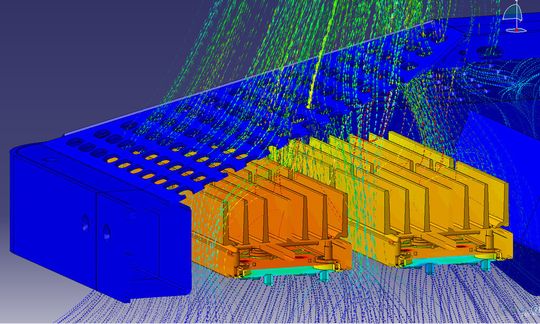
After the design optimization of the heatsink, they obtained data on the number, height, and thickness of the fins that would provide the best possible heat dissipation for the LED modules.
As part of the optimization process, they wanted to test the effect of dust accumulation over the top of the heatsink on cooling. Dust/dirt deposition reduces the available surface area for heat transfer, creates additional thermal resistance for heat to get to the ambient, and reduces the amount of airflow that can travel between the heatsink fins (and remove heat). In the simulation, they added a component to represent “dirt/dust” placed over the top of the heatsink.
The desired self-cleaning effect requires relatively high velocities (by natural convection standards) to minimize dirt deposition. This can be simulated using the FloEFD particle study feature. The particle study feature in the simulation software permits injection of virtual particles with a material diameter and mass into the fluid flow to determine where particles will accumulate and erode surfaces. This lets the engineers visualize where dirt will fall out of the flow (or not, which is preferable).
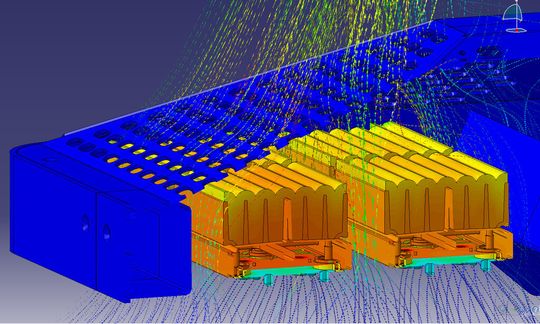
The self-cleaning heatsink has a similar mass as the extruded one, but it doesn’t need as much additional work and time on the milling machine. The simpler manufacturing process resulted in not only cost savings, but also significantly reduced maintenance, and longer product life.
With the addition of the new FloEFD LED module, they were able to obtain reliable results effortlessly. The values from the FloEFD simulations were within 3% of the results obtained by measurements on the physical model.
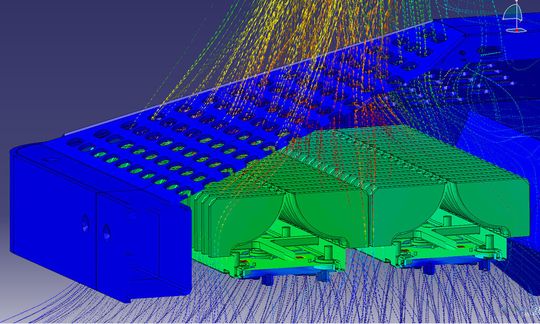
A company-specific LED model can also be input and simulated by specifying forward current for the LEDs; the software calculates the correct thermal heating power and a physically validated operating temperature. It allows building of an accurate thermal radiation analysis that is capable of simulating absorption of radiation in semi-transparent solids such as glass as well as taking into account effects as refraction, specular reflection, and wave-length dependency (spectrum properties of the radiation). Light quality from the LEDs can also be calculated to see whether they meet the design goals for light output and uniformity.
(ID:42896286)
:quality(80)/p7i.vogel.de/wcms/5a/7e/5a7ee70ac4705d535f7b9ba6dca2be8c/0133276633v2.jpeg "A planar transformer from Elytone for compact power supplies with high power density. Its flat design enables low-profile construction and can be adapted to high switching frequencies. (Bild: Elytone)")
:quality(80)/p7i.vogel.de/wcms/2f/0c/2f0cdaf3c1041b3592bd71e44edd4aea/0133352797v2.jpeg "Conquer’s 48MH series SMD fuses are designed for high-current applications in AI servers and data centers. Their compact form factor supports automated assembly. (Bild: Conquer)")