



:quality(80)/p7i.vogel.de/wcms/37/ec/37ece4c276f37114e8f40696ff5dcd66/0130537789v2.jpeg "Um die Entwicklung von High-TRL-Halbleiter-Qubits zu beschleunigen und damit in Europa produzierte Quantensysteme in größerem Maßstab zu ermöglichen wurde die vom belgischen Forschungsinstitut IMEC koordinierte Quanten-Pilotlinie SPINS ins Leben gerufen. (Bild: Imec)")
:quality(80)/p7i.vogel.de/wcms/46/7c/467c0afffbfd10c3553c2888a4a6289f/0130479810v3.jpeg "Spezielle Elektroden, die Forscher am Fraunhofer IFAM entwickeln, entfernen wertvolle Rohstoffe wie Lithium und Kobalt beim Recyceln von Batterien aus dem Prozesswasser. (Bild: Fraunhofer IFAM)")
:quality(80)/p7i.vogel.de/wcms/12/3d/123d9eb2c2e4ce13296371a2ad3718a4/0130412664v2.jpeg "In seiner PCIe-5.0-SSD „BM9K1“ setzt Samsung erstmals statt ARM auf RISC-V-Kerne für den Festplattencontroller. (Bild: Samsung / finance.biggo.jp)")
:quality(80)/p7i.vogel.de/wcms/b6/e7/b6e755d9e704319c0bb59dc1ac2d67e8/0130537290v2.jpeg "Menschliches Wissen, künstliche Intelligenz: Intelligente Datenverarbeitung direkt am Einsatzort verlangt nach dem Zusammenspiel von KI, Hardware-Know-how und konkreter Anwendungserfahrung. (Bild: Dall-E / KI-generiert)")
:quality(80)/p7i.vogel.de/wcms/8b/10/8b10d1edceb749de99c1df3ad97be01e/0130564619v2.jpeg "Infrastruktur für KI-Agenten: Intel und Sambanova teilen Rechenlast auf drei Prozessortypen auf (Bild: Gemini / KI-generiert)")
:quality(80)/p7i.vogel.de/wcms/ac/da/acda3bafe46d3bf8e104a2a7bc2ac557/0130535476v2.jpeg "Geschätzter Ansprechpartner für Journalisten: Alfred Eiblmayr koordiniert seit vielen Jahren beim Halbleiterhersteller STMicroelectronics die Presse- und Öffentlichkeitsarbeit. Als ehemaliger Redakteur weiß er, worauf es ankommt. (Bild: Alfred Eiblmayr)")
:quality(80)/p7i.vogel.de/wcms/ca/9b/ca9b681785123f9700518a46897f9779/0130428786v1.jpeg "Biometrische Systeme mit künstlicher Intelligenz sind darauf ausgelegt, Personen anhand ihrer physischen oder verhaltensbezogenen Merkmale zu erkennen. (Bild: © AlinStock - stock.adobe.com)")
:quality(80)/p7i.vogel.de/wcms/38/cb/38cbe19e814dd30b94780bc3946547ab/0130446533v2.jpeg "Zur Absicherung seines KI-Ökosystems geht Nvidia eine Strategische Partnerschaft mit Marvell ein und investiert hierfür 2 Mrd. US-$ in den ASIC-Spezialisten. Im Fokus stehen NVLink Fusion, optische Interconnects und Silicium Photonics. (Bild: Marvell)")
:quality(80)/p7i.vogel.de/wcms/c2/88/c28805ea7b2261235475146a5b0c61f8/0130313028v2.jpeg "x86 trifft adaptive Logik: Auf der Messe demonstriert AMD die industrielle Vernetzung eines Node-RED-Gateways (links) mit Zynq-UltraScale+-Controllern (Mitte) und einer Soft-SPS auf Basis der Ryzen AI P100 Serie (rechts). (Bild: Manuel Christa)")
:quality(80)/p7i.vogel.de/wcms/fa/8d/fa8dedee195f29c33c89d86311c258ee/0130104146v2.jpeg "Kompakte KI-Power: Die Smart-Module SIM8668 und SIM8666 von Simcom vereinen auf kleinstem Raum eine Quad-Core-CPU samt integrierter NPU für ressourcenschonende Industrie- und Robotikanwendungen. (Bild: Chip: Simcom/Hintergrund: KI-generiert)")
:quality(80)/p7i.vogel.de/wcms/69/7a/697a270ed7538378d1fbc0f0b240ed25/0130534691v3.jpeg "Die Wago Stromversorgung Pro 2 ist eine intelligente und zuverlässige Stromversorgung mit integrierter Redundanz und MOSFET-Technologie und gewährleisten dadurch eine höhere Zuverlässigkeit der Anwendung. (Bild: WAGO GmbH & Co. KG)")
:quality(80)/p7i.vogel.de/wcms/e7/a4/e7a4e048491e60cb30e22a860f5d68bc/0130519425v4.jpeg "Dynamisch:
Die Zuverlässigkeit der Stromversorgung hängt von mechanischen und thermischen Faktoren sowie zeitlichen Abfolgen ab. (Bild: inpotron Schaltnetzteile GmbH)")
:quality(80)/p7i.vogel.de/wcms/1b/f0/1bf02d41e3eac721823841a4c1228753/0130519149v2.jpeg "Der Wandler GQA2W024A050V-007-R ist in mehreren Gehäusekonfigurationen erhältlich, um Entwicklern maximale Flexibilität für ihr Gesamtgehäusedesign und die Kühlung des Wandlers zu bieten. (Bild: TDK-Lambda)")
:quality(80)/p7i.vogel.de/wcms/1a/53/1a539631c940d184689460600bd2b395/0130410666v2.jpeg "Das iG-G74M von iWave Global ist das erste erhältliche System-on-Module, das den neuen FPGA-Modulstandard oHFM.c der SGeT erfüllt. (Bild: iWave Global)")
:quality(80)/p7i.vogel.de/wcms/10/45/1045969e69a1db4aaa73d0f74f55cc02/0129962687v2.jpeg "Bosch Rexroth und AMD arbeiten gemeinsam an Software-Defined Automation: ctrlX OS unterstützt nun auch auf AMD Embedded x86-CPUs und adaptive SoCs und verspricht so noch größere Hardware-DesignFlexibilität, nahtlose Skalierbarkeit und eine sichere, modulare Betriebssystem-Grundlage. (Bild: Bosch Rexroth AG)")
:quality(80)/p7i.vogel.de/wcms/cd/32/cd3243e4a9a6476265ef6ea9463dfbd8/0129852659v2.jpeg "Die PIC64-Serie an Multicore-Mikroprozessoren setzt auf RISC-V-Kerne und eignen sich speziell für Anwendungen mit asynchronem Multipricessing (AMP) in intelligenten Embedded-Edge-Anwendungen. (Bild: Microchip)")
:quality(80)/p7i.vogel.de/wcms/ba/e4/bae4e54395e5a53088060531ef99b814/0130359274v2.jpeg "Mit dem Fuse EDA AI Agent verfolgt Siemens EDA ein umfassendes Programm, alle Aspekte des Chipdesigns mit KI-Coworkern zu erleichtern, auch in Questa One. (Bild: Siemens EDA)")
:quality(80)/p7i.vogel.de/wcms/35/af/35af7dd326d198475d06fbb69aa600b5/0130175971v2.jpeg "Diff GT kann in einer kostenlosen Probeversion ausprobiert werden. (Bild: CSci)")
:quality(80)/p7i.vogel.de/wcms/c0/2e/c02e7bf72bfc434888c37100e2511681/0130127767v3.jpeg "„Wegen seiner kompakten Bauweise, des modularen Aufbaus und der hohen Effizienz ist der Axialflussmotor eine attraktive Alternative zur etablierten Radialflussmotor-Topologie“, PEM-Leiter Professor Achim Kampker (Bild: RWTH Aachen University)")
:quality(80)/p7i.vogel.de/wcms/e1/0b/e10bc04827e33786548587e32bbae422/0130438700v2.jpeg "Optische Datenkommunikation: Um Bauteile auf Basis optischer Datenkommunikation umfassend testen zu können, sind neue Testfähigkeiten erforderlich. (Bild: © kudzik - stock.adobe.com / KI-generiert)")
:quality(80)/p7i.vogel.de/wcms/35/06/3506f2a8d33a696aaef12a30771bd8d8/0130496747v2.jpeg "Ein von Keysight entwickelter Empfänger-Test für 10BASE-T1S fördert den Test von funktionskritischen Empfängern, um die Zuverlässigkeit und Sicherheit künftiger Bordnetzwerke zu gewährleisten. (Bild: Keysight)")
:quality(80)/p7i.vogel.de/wcms/e5/ed/e5ed08c670c44565a9130e95a760dddc/0130494578v2.jpeg "PV-Anlage auf dem Dach der Elbfabrik, einer Forschungsfabrik des Fraunhofer IFF. Mit einem Sensorsystem lassen sich Fehler in PV-Großanlagen frühzeitig erkennen. (Bild: Fraunhofer IFF/Anne Bornkessel)")
:quality(80)/p7i.vogel.de/wcms/ce/33/ce336bc438b912829effe8d4704dc159/0130480307v2.jpeg "Die VNA-Plattform von Siglent unterstützen vollständige Zweitor-S-Parameter-Messungen von 9 kHz bis 3 GHz. (Bild: Siglent)")
:quality(80)/p7i.vogel.de/wcms/3a/72/3a722ed2ad6ac4894c352e6ce87b6560/0130567207v2.jpeg "Mit Seamless Automation macht Festo die Automatisierungstechnik so einfach, dass Technik ein Erlebnis wird. Das Konzept baut Komplexität ab und schafft Klarheit für intuitive Lösungen – zu erleben auf dem Festo Stand in Halle 13 auf der Hannover Messe 2026. (Bild: Festo)")
:quality(80)/p7i.vogel.de/wcms/e4/d1/e4d122a8ecce14b98c8298c1cc130194/0130561462v2.jpeg "(Bild: Spectra AG)")
:quality(80)/p7i.vogel.de/wcms/3c/55/3c5505dd3ca3971cddd09c583a4c907d/0130458429v2.jpeg "Fit für Extrembedingungen: Diese Illustration zeigt einen photonischen Chip, dessen Komponenten mit der neuen Verbindungstechnik hochstabil gebondet wurden. (Bild: NIST)")
:quality(80)/p7i.vogel.de/wcms/47/ce/47ce64bad7990f276f68cbb24505f6dd/0130472850v2.jpeg "Data Modul fokussiert sich auf die Integration kompletter Display-Systeme. (Bild: Data Modul)")
:quality(80)/p7i.vogel.de/wcms/2e/95/2e9597b5dc1873771c7fe9c32ac41e82/0130549010v2.jpeg "Deepsleep: 13 Stunden lang war Deepseek nicht verfügbar. Nutzer spürten die Auswirkungen teils deutlich. (Bild: Dall-E / KI-generiert)")
:quality(80)/p7i.vogel.de/wcms/15/56/15564dea31861c376a385658c3b961a3/0130465243v2.jpeg "Luftaufnahme von Intels Fab 34 in Leixlip, Irland, aus dem Jahr 2024. In dem Werk werden Chips nach den hauseigenen Verfahren Intel 3 und Intel 4 gefertigt. (Bild: Intel)")
:quality(80)/p7i.vogel.de/wcms/bf/2a/bf2aad428ab1a80e6738fdbdc2efeb7e/0130453420v2.jpeg "Unter Dach und Fach: Nach Freigabe aller zuständigen Behörden das das amerikanische Unternehmen Molex den britischen Verbindungstechnik-Anbieter Smiths Interconect übernommen. (Bild: Molex / Smiths Interconect)")
:quality(80)/p7i.vogel.de/wcms/d6/ea/d6eac438c362c545cab42ef0f30bcfc0/0130136975v2.jpeg "Die Bewerbungsphase für den James Dyson Award 2026 ist gestartet. (Bild: Dyson)")
:quality(80)/p7i.vogel.de/wcms/e5/6c/e56ceb935ba09cb66a4fd0f961b2d3e9/0129642888v2.jpeg "(Bild: Vogel Professional Education)")
:quality(80)/p7i.vogel.de/wcms/69/1f/691f39ba12be3cad90eb88bdabc456a6/0127321404v2.jpeg "Das Kreativteam Christian Göller, GreatScott! und Christopher Becht (v. l. n. r.): erfolgreiches Creator-Marketing im B2B-Sektor (Bild: Würth Elektronik)")
Adhesion to Aluminium of PUR Coating for LED encapsulation
Only a protection against "environmental influences" and disturbing electrical currents will allow a broad use of mobile electronic devices and sensors even under extreme conditions.
Anbieter zum Thema
:fill(fff,0)/images.vogel.de/vogelonline/companyimg/127300/127366/65.jpg "Logo SPEA.jpg ()")
:fill(fff,0)/images.vogel.de/vogelonline/companyimg/130400/130457/65.jpg "mev_logo-RGB-L.jpg ()")
:fill(fff,0)/p7i.vogel.de/companies/68/62/68621fc4f1d39/logo.png "logo (https://www.ymin.cn/)")
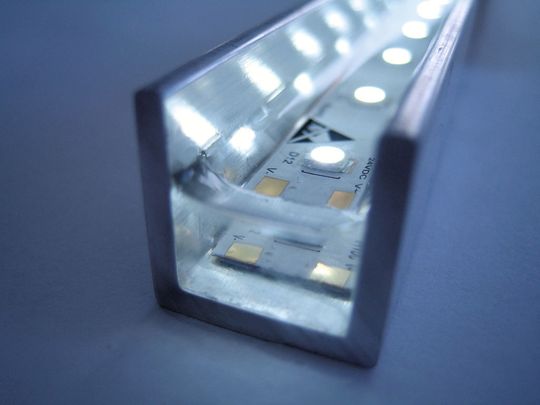
Casting compounds based on polyurethane resins are distinguished, on the one hand, by their low exothermic reaction when curing and the low reaction shrinkage related to this, and by their moderate elasticity modules on the other. The latter are a key size for the safe operation of electronic assemblies under changing temperature conditions. Due to this, PUR casting compounds enjoy a constantly expanding market presence when it comes to encapsulating electronic assemblies.
With LED technology constantly developing, a new promising field of application has been created for which PUR casting compounds are well-predestined. LEDs that were, at an early stage, mainly used in the fabrication of display elements such as status indicators, are nowadays not only more and more applied as lighting units in automotive engineering, but also tend to displace conventional light sources in the area of general indoor and outdoor lighting.
Thanks to the pointed encapsulation of complete LED circuits, PUR casting compounds, in view of a permanent resistance of the LED against environmental influences, are capable of performing protective functions that go far beyond a single light emitting diode encapsulation. Special PUR casting compounds developed for this application can, in particular, fulfill the optical requirements such as high transparency along with a fully colourless encapsulation that, in addition, ensure the optical properties under the influence of moisture and sunlight, thus not yellowing and/or chalking.
In architecture, most light strips used for the lighting technology consist of a plastics or aluminium U-profile with embedded LEDs where PUR casting compounds enclose complete LED circuits without significantly affecting their optical properties. In this context, aluminium is constantly gaining importance on account of its low density and the high elasticity module, being a very stretchy and easily processable metal.
PUR casting compounds must exhibit good adhesion
In co-operation with the Faculty of Chemistry of the Niederrhein University of Applied Sciences, the conditions of a good adhesion of 2-pack PUR casting compounds on aluminium alloy were examined as part of a bachelor thesis in the labs of Lackwerke Peter. Given the fact that the light emitting diode circuits are fully enclosed in the casting compound, the latter should not weaken or alter the luminescence or colour of the LED.
The adhesion of a coating material is a property that depends on cohesion, for example. Internal stress may be due to various causes - one may stem from reaction shrinkage - but they can also originate from ageing or degradation processes. Furthermore, diffusion processes and accumulations of the diffunding material on the interface may lead to a change in adhesion.
The wet grip is of major importance for the level of reliability
If water is the diffunding material, one would speak of wet grip. The wet grip can be determined by methods similar to those applied for adhesion in a normal climate, provided that the method used does not have an influence on the moisture level of the film. Especially in case of material combinations which are exposed to moisture at varying temperatures over long periods of time, the wet grip is of major importance for reliability.
The adhesion – meaning the grip of two materials – is an effective variable in molecular dimensions. The molecular adhesion is not directly measurable in general; therefore it is determined as an integral value through an area-related evaluation. For this purpose, a set of interacting forces is always determined along with a more or less unknown load distribution. Any deformation in the coating material and/or the substrate is likely to affect the distribution of loads and thus partially the result.
The direction of the load, either in parallel or vertically from the surface, has an influence on the result. The adhesive strength, being a measure of the resistance according to DIN EN ISO 55945 that is opposed by the coating to a mechanical separation from the substrate due to its grip, is used as a measurand to be determined through experiments. For examining the adhesion, different measuring principles are available that can be divided into three categories:
- sability testing
- direct measurement and test methods
- indirect test methods
How to evaluate the adhesive strength
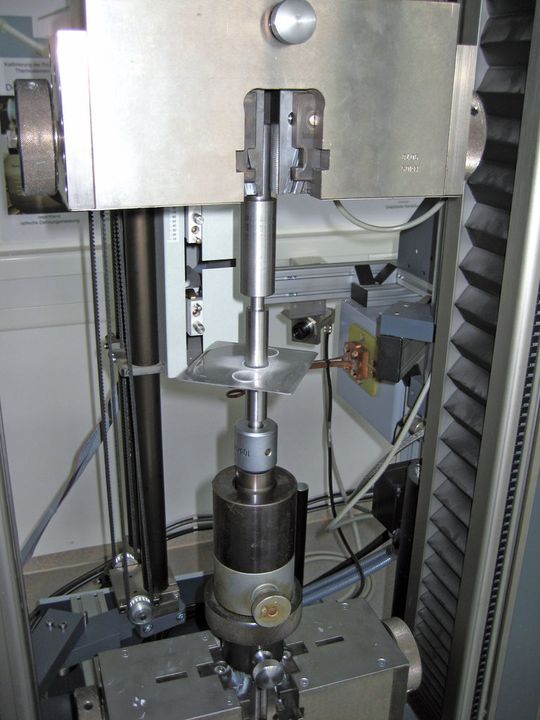
A test procedure based on the Z 050 tensile test machine by the German company Zwick and Roell was developed, in accordance with the pull-off test described in DIN EN ISO 4624. This procedure is also referred to as „butt-joint test“. Within this test, PUR casting compounds were casted on aluminium sheet in constant layer thicknesses, followed by the separating of a pre-defined area of casting compound from the surrounding coating material. This may produce various fracture points, due to the fact that the fracture will occur in the weakest point of the system.
Any conclusions on the adhesive strength between the casting compound and the aluminium sheet can only be drawn after an adhesion fracture has actually occurred. In all other cases, adhesion can only be defined by a value exceeding the one received. The pull-off strength required for calculating the adhesion (formula) is equivalent to the maximum load value in the diagram created for the respective measurement.
σ: adhesive strength [MPa]
F: pull-off strength [N]
A: pull-off area [mm²]
To begin with, the influence of the binding agent on the adhesion to pure aluminium substrates was determined by modifying the composition of the binding agent - based on various polyols and polyisocyanate classes. This revealed no systematic relationship between the chemical structure of the binding agent components and the adhesion. However, it was possible to improve the adhesion to the aluminium substantially through the choice of the binding agent. The adhesion values reached in these tests varied between 0.5 MPa and 15MPa.
With an adhesion of approx. 15 MPa, an outstanding result for casting compounds was finally achieved. For corrosion protection in structural steel engineering, butt-joint values of less than 1 MPa are considered a poor result while values of between 5 and 15MPa are midrange.
Sources
[1] Suppa, M: Schutzlacke für elektronische Baugruppen- Anwendungsgebiete- Anforderungsprofile- Merkmale- Verarbeitung, Stünings Medien GmbH, Krefeld, 2010
[2] DIN EN ISO 55945: 2007- 03, Beschichtungsstoffe und Beschichtungen- Ergänzende Begriffe zu DIN EN ISO 4618
[3] DIN EN ISO 4624:2002, Abreißversuch zur Beurteilung der Haftfestigkeit;
Deutsche Fassung
[4] DIN EN ISO 2409: 2007, Beschichtungsstoffe- GItterschnittprüfung
[5] Funke, W. / Fischer, E: Farbe und Lack 95 (1989) 403
* * Stefanie Schäfer Beng and Dr. Manfred Suppa ... are experts at Lackwerke Peters GmbH + Co KG in Kempen, Germany
(ID:29650030)
:quality(80)/p7i.vogel.de/wcms/da/e4/dae45caa7f4fa7125e17b07d9da016bb/0125786170v2.jpeg "Soft termination prevents cracks by absorbing mechanical stress through a resin layer. (Bild: TAIYO YUDEN CO., LTD.)")
:quality(80)/p7i.vogel.de/wcms/ab/73/ab73d241611c109a242a4e5f1b50d01e/0128483827v4.jpeg "Filter elements in various SMD designs. (Bild: TAIYO YUDEN)")