Modern vehicles are essentially computers on wheels. Smart car access, car sharing, and automated parking require not only computing power but also precise radio technologies. Ultra-Wideband (UWB) technology is regarded as a key enabler in this area. Many systems operate simultaneously and must not interfere with each other. Only specialized RF components make these technologies truly practical.
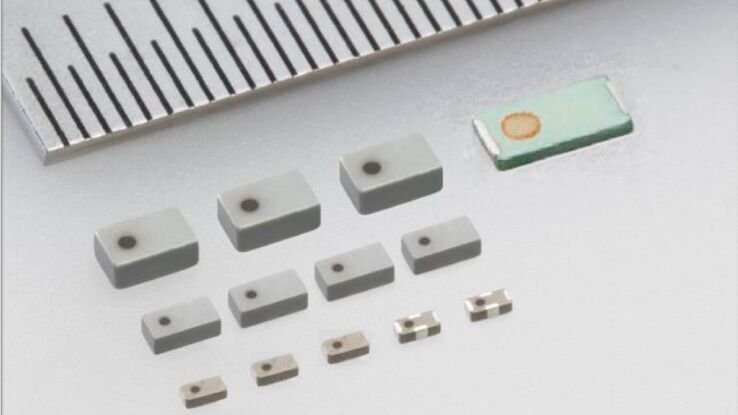
Filter elements in various SMD designs.
(Bild: TAIYO YUDEN)
Increasingly intelligent vehicles are fundamentally changing the requirements for vehicle communication. Early radio systems were primarily designed for convenience, whereas today they also serve safety purposes. This makes it essential to be able to precisely determine the location of objects in space. Systems must be able to determine positions with centimeter accuracy, authenticate them, and communicate in real time.
This aspect is particularly critical in modern access systems and driver assistance functions. Classic technologies such as Bluetooth ® or RFID are no longer up to date. They do not offer sufficient distance resolution and are susceptible to so-called relay attacks, in which signals are extended via intermediate stations in order to open vehicles without authorization.
UWB, or ultra-wideband, closes this gap. With bandwidths of several hundred megahertz and extremely short transit time measurements, it enables position determination in the centimeter range. It is independent of the environment and largely resistant to manipulation.
UWB as the basis for modern systems
Major automotive parts manufacturers provide a practical example of industrial application with its Smart Car Access System. The system uses UWB to precisely determine the location of the authorized key. Unlike conventional keyless systems, the vehicle not only detects whether the key is within range, but also its exact location. This includes whether it is outside or inside the vehicle.
The result is a significantly higher level of security. Doors only open when the driver actually approaches, not when the signal is extended via detours. At the same time, UWB increases convenience. The vehicle responds intuitively, without manual unlocking or starting. This makes UWB a basic technology for the next generation of connected mobility.
Feasible UWB integration therefore depends on RF components — particularly filters and antennas that adhere to stringent electrical performance and dimensional limits. Here, UWB leverages the ongoing miniaturization of LTCC-based RF filters, a trend primarily driven by general requirements in high-frequency system design (e.g., 5G, Wi-Fi 6/7), not by UWB itself.
This is where TAIYO YUDEN’s expertise becomes relevant: advanced LTCC processes enable tight tolerances, high Q-factors, and reduced insertion loss in a compact form factor — prerequisites for space-constrained UWB architectures or combined multi-band RF front-ends.
Technological response
TAIYO YUDEN focuses on advanced LTCC (Low Temperature Cofired Ceramic) filter technology to meet the demands of UWB and future high-frequency systems. LTCC enables the integration of multiple passive elements into a single multilayer structure, resulting in compact, stable, and low-loss RF components. This approach provides the required filter performance while significantly reducing footprint and module height.
Miniaturization impact and system benefits
Smaller LTCC filters allow UWB receivers and transmitters to be placed much closer to antennas, sensors, and control units without creating electromagnetic issues. This is especially important in constrained installation spaces such as door handles, interior panels, or compact TCU housing.
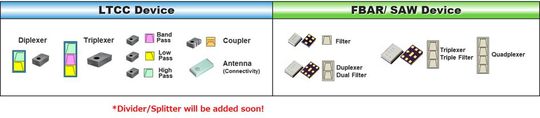
Figure 1: The diagram provides an overview of TAIYO YUDEN’s RF component portfolio, showing the different device types available in LTCC and FBAR/SAW technologies.
(Bild: TAIYO YUDEN)
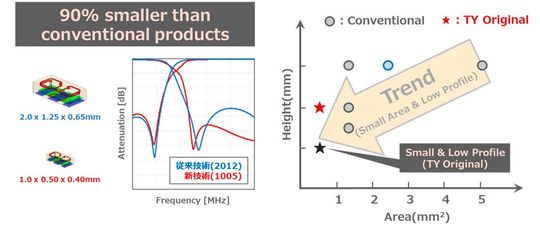
This results in components that are up to 90 % smaller than conventional solutions. This miniaturization is more than just a manufacturing advantage. It enables new system architecture. Vehicle manufacturers can place UWB radio modules closer to sensors and control units without generating thermal or electromagnetic interference.
Figure 2: The diagram illustrates how LTCC technology enables a volume reduction of up to 90 %, while maintaining stable attenuation characteristics across the operating band.
(Bild: TAIYO YUDEN)
RF components as enablers of system performance
The most important factor for the energy efficiency and reliability of UWB systems is signal quality, which depends heavily on the RF components used and the overall design. Using RF components helps eliminate interference signals and improve communication quality, ensuring stable operation even in dense or noisy environments. To prevent disturbances in adjacent frequency ranges and to guarantee clean signal evaluation, filter steepness remains a decisive parameter.
Miniaturization also plays a crucial role in more sustainable production. For TAIYO YUDEN, miniaturization is not only a design objective but also a contribution to resource efficiency and long-term component reliability.
From vehicles to a connected world
Vehicles are no longer isolated systems. They communicate with smartphones, other vehicles, and increasingly with the transport infrastructure. Terms such as Vehicle-to-Everything (V2X), Global Navigation Satellite Systems (GNSS), and Mobility as a Service (MaaS) represent the connectivity of the transport sector.
However, this also increases the demands on the communication architecture. It must not only be reliable in the vehicle, but also in mobile devices such as smartphones, wearables, and IoT systems. This creates a connected ecosystem. The car key can then be replaced by a smartphone, provided that the same RF structures, filters, and antenna technologies that are installed in the car are used.
This further highlights the role of RF components. They are no longer just part of a single module, but a link between different communication standards. TAIYO YUDEN therefore develops its RF devices across platforms.
The networked society
In Japan, this approach is described by the term “Society 5.0.” It is the fusion of the physical and digital worlds. Wireless technologies form the bridge here. They connect real objects with data-based services, enable autonomous processes, and increase safety in everyday life.
Innovation in detail
UWB will fundamentally change the architecture of future vehicles. It enables precise positioning, secure authentication, and seamless communication. But the real innovation lies deeper. It lies in the components that make this precision possible in the first place.
TAIYO YUDEN proves that progress is not always visible. Its RF components form the foundation for systems such as Digital Key Access and numerous upcoming mobility applications. Through technological combinations, miniaturization, and efficiency, the company is making a decisive contribution to ensuring that UWB does not remain just a concept, but becomes the cornerstone of a connected, safe automotive world.
(ID:50658598)
Stand: 08.12.2025
Es ist für uns eine Selbstverständlichkeit, dass wir verantwortungsvoll mit Ihren personenbezogenen Daten umgehen. Sofern wir personenbezogene Daten von Ihnen erheben, verarbeiten wir diese unter Beachtung der geltenden Datenschutzvorschriften. Detaillierte Informationen finden Sie in unserer Datenschutzerklärung.
Einwilligung in die Verwendung von Daten zu Werbezwecken
Ich bin damit einverstanden, dass die Vogel Communications Group GmbH & Co. KG, Max-Planckstr. 7-9, 97082 Würzburg einschließlich aller mit ihr im Sinne der §§ 15 ff. AktG verbundenen Unternehmen (im weiteren: Vogel Communications Group) meine E-Mail-Adresse für die Zusendung von redaktionellen Newslettern nutzt. Auflistungen der jeweils zugehörigen Unternehmen können hier abgerufen werden.
Der Newsletterinhalt erstreckt sich dabei auf Produkte und Dienstleistungen aller zuvor genannten Unternehmen, darunter beispielsweise Fachzeitschriften und Fachbücher, Veranstaltungen und Messen sowie veranstaltungsbezogene Produkte und Dienstleistungen, Print- und Digital-Mediaangebote und Services wie weitere (redaktionelle) Newsletter, Gewinnspiele, Lead-Kampagnen, Marktforschung im Online- und Offline-Bereich, fachspezifische Webportale und E-Learning-Angebote. Wenn auch meine persönliche Telefonnummer erhoben wurde, darf diese für die Unterbreitung von Angeboten der vorgenannten Produkte und Dienstleistungen der vorgenannten Unternehmen und Marktforschung genutzt werden.
Meine Einwilligung umfasst zudem die Verarbeitung meiner E-Mail-Adresse und Telefonnummer für den Datenabgleich zu Marketingzwecken mit ausgewählten Werbepartnern wie z.B. LinkedIN, Google und Meta. Hierfür darf die Vogel Communications Group die genannten Daten gehasht an Werbepartner übermitteln, die diese Daten dann nutzen, um feststellen zu können, ob ich ebenfalls Mitglied auf den besagten Werbepartnerportalen bin. Die Vogel Communications Group nutzt diese Funktion zu Zwecken des Retargeting (Upselling, Crossselling und Kundenbindung), der Generierung von sog. Lookalike Audiences zur Neukundengewinnung und als Ausschlussgrundlage für laufende Werbekampagnen. Weitere Informationen kann ich dem Abschnitt „Datenabgleich zu Marketingzwecken“ in der Datenschutzerklärung entnehmen.
Falls ich im Internet auf Portalen der Vogel Communications Group einschließlich deren mit ihr im Sinne der §§ 15 ff. AktG verbundenen Unternehmen geschützte Inhalte abrufe, muss ich mich mit weiteren Daten für den Zugang zu diesen Inhalten registrieren. Im Gegenzug für diesen gebührenlosen Zugang zu redaktionellen Inhalten dürfen meine Daten im Sinne dieser Einwilligung für die hier genannten Zwecke verwendet werden. Dies gilt nicht für den Datenabgleich zu Marketingzwecken.
Recht auf Widerruf
Mir ist bewusst, dass ich diese Einwilligung jederzeit für die Zukunft widerrufen kann. Durch meinen Widerruf wird die Rechtmäßigkeit der aufgrund meiner Einwilligung bis zum Widerruf erfolgten Verarbeitung nicht berührt. Um meinen Widerruf zu erklären, kann ich als eine Möglichkeit das unter https://contact.vogel.de abrufbare Kontaktformular nutzen. Sofern ich einzelne von mir abonnierte Newsletter nicht mehr erhalten möchte, kann ich darüber hinaus auch den am Ende eines Newsletters eingebundenen Abmeldelink anklicken. Weitere Informationen zu meinem Widerrufsrecht und dessen Ausübung sowie zu den Folgen meines Widerrufs finde ich in der Datenschutzerklärung, Abschnitt Redaktionelle Newsletter.





:quality(80)/p7i.vogel.de/wcms/68/46/684697b6eb687384e0d8c6803450401a/0130056395v2.jpeg "Das TUM RoboGym (powered by Neura) in der Planungsphase (Grafik). Die TU München und das Robotik Startup Neura Robotics planen, gemeinsam am Campus der TU München das weltgrößte Robotik-Trainingszentrum einzurichten. (Bild: Neura Robotics)")
:quality(80)/p7i.vogel.de/wcms/0f/c0/0fc0d93c99a5d9066e58c39f41fb1b10/0130046764v2.jpeg "Sicherheit im Schienenverkehr: Dank 5G-Funkverbindung wird eine stabile Übertragung unter schwankenden Netzbedingungen garantiert. (Bild: Smart Rail Connectivity Campus (SRCC))")
:quality(80)/p7i.vogel.de/wcms/40/eb/40ebe1b2905b863da8111cd0364ffcf1/0130027046v2.jpeg "Das belgische Forschingsinstitut hat ein europäisches Universitätskonsortium zum Thema CMOS 2.0 eins Leben gerufen. In ihm werden 26 Universitätsgruppen vereint, um Chiptechnologien zu erforschen, die über herkömmliche Transistorskalierungen hinausgehen. (Bild: Imec)")
:quality(80)/p7i.vogel.de/wcms/c0/92/c09252ae405f3d1fe4d606cfdef9376a/0130108881v2.jpeg "Jensen Huang, CEO von Nvidia (links) und Tae-won Chey, Chairman der SK Group (rechts) gemeinsam auf dem Nvidia-Event GTC 2026. (Bild: SK Group)")
:quality(80)/p7i.vogel.de/wcms/7d/76/7d76791a2abb881ce86b1fac7d081210/0130106077v2.jpeg "Ein Intel 4004 aus dem Jahr 1971:
Der im SGT-PMOS-Prozess gefertigte Chip hatte 2.300 Transistoren und war ursprünglich eine Auftragsarbeit für einen japanischen Tischrechner. (Bild: Intel)")
:quality(80)/p7i.vogel.de/wcms/9e/18/9e1862cf28b49e0623f973ca3f4ea4f2/0130102468v2.jpeg "Auf die Mischung kommt es an:
Metalldetektierbare Kabelbinder oder Teile davon lassen sich leicht im Herstellungsprozess identifizieren. (Bild: Panduit)")
:quality(80)/p7i.vogel.de/wcms/42/74/42747cd229a035fc573b62ca9a8985b6/0130029398v2.jpeg "Der Einsatz von KI ist bereits weit in der globalen Halbleiterindustrie verbreitet. Allerdings in einem sehr fragmentierten und unausgewogenem Ausmaß. (Bild: HTEC)")
:quality(80)/p7i.vogel.de/wcms/7b/57/7b5725dd2e7545ab4904a9b7a3735721/0129309389v2.jpeg "Die embedded world 2026 findet vom 10. bis zum 12. März 2026 statt. (Bild: NürnbergMesse / Thomas Geiger)")
:quality(80)/p7i.vogel.de/wcms/fa/8d/fa8dedee195f29c33c89d86311c258ee/0130104146v2.jpeg "Kompakte KI-Power: Die Smart-Module SIM8668 und SIM8666 von Simcom vereinen auf kleinstem Raum eine Quad-Core-CPU samt integrierter NPU für ressourcenschonende Industrie- und Robotikanwendungen. (Bild: Chip: Simcom/Hintergrund: KI-generiert)")
:quality(80)/p7i.vogel.de/wcms/cc/13/cc1378375499a26b5ddbb309d2155acb/0130085649v2.jpeg "Vom Hardware-Produzenten zum Software-Anbieter: Neocortec lizenziert seinen NeoMesh-Protokoll-Stack zunehmend direkt an OEMs und Dritthersteller, anstatt ausschließlich auf den Verkauf eigener Funkmodule zu setzen. (Bild: mc/VCG)")
:quality(80)/p7i.vogel.de/wcms/24/58/2458f1cae3100e375fbb8124f02c54af/0130111244v3.jpeg "Stromsparer für das IoT: Der Npzero-Baustein übernimmt die Sensorüberwachung und schickt den Hauptprozessor in den Tiefschlaf. (Bild: Manuel Christa)")
:quality(80)/p7i.vogel.de/wcms/d2/cd/d2cd33084ab732ff8a600bc55ade1f47/0130096831v1.jpeg "Die WE-MPSB-Familie. (Bild: Würth Elektronik eiSos)")
:quality(80)/p7i.vogel.de/wcms/3a/79/3a79504e38945985e7369fd2b971a8b9/0129690250v2.jpeg "Die Solid-State-Batterie wurde 2026 auf der CES in Las Vegas vorgestellt. (Bild: Donut Lab)")
:quality(80)/p7i.vogel.de/wcms/b4/9f/b49fe35971f6c2cfe4389ec90124c089/0129954153v2.jpeg "Ligna Energy möchte die Designdisziplin von Smartcards auf Gebäudesensoren anwenden. (Bild: Ligna Energy)")
:quality(80)/p7i.vogel.de/wcms/10/45/1045969e69a1db4aaa73d0f74f55cc02/0129962687v2.jpeg "Bosch Rexroth und AMD arbeiten gemeinsam an Software-Defined Automation: ctrlX OS unterstützt nun auch auf AMD Embedded x86-CPUs und adaptive SoCs und verspricht so noch größere Hardware-DesignFlexibilität, nahtlose Skalierbarkeit und eine sichere, modulare Betriebssystem-Grundlage. (Bild: Bosch Rexroth AG)")
:quality(80)/p7i.vogel.de/wcms/cd/32/cd3243e4a9a6476265ef6ea9463dfbd8/0129852659v2.jpeg "Die PIC64-Serie an Multicore-Mikroprozessoren setzt auf RISC-V-Kerne und eignen sich speziell für Anwendungen mit asynchronem Multipricessing (AMP) in intelligenten Embedded-Edge-Anwendungen. (Bild: Microchip)")
:quality(80)/p7i.vogel.de/wcms/c7/f6/c7f61d0437c7f8fca3c6ff947ba2ad62/0129322490v2.jpeg "AMD hat die zweite Generation der Kintex UltraScale+ Gen 2 FPGA-Familie vorgestellt, die mit PCIe Gen4 den 4K-AV-over-IP-Betrieb für 4K/8K-Medienanwendungen unterstützt. (Bild: AMD)")
:quality(80)/p7i.vogel.de/wcms/66/0c/660c31afa35398bac9be42f2be73fdc4/0129073529v2.jpeg "FPGAs lösen Performance-Engpässe, gelten aber in der Programmierung als schwer zugänglich. Die universelle Programmiersprache Livt soll die Hürde senken – korrekt, deterministisch und HDL-kompatibel. (Bild: Toby Giessen / VCG)")
:quality(80)/p7i.vogel.de/wcms/95/a1/95a197490145b7afcfd4dc176a1b5ef9/0130096114v2.jpeg "Der Einsatz amorpher Stähle im Stator ermöglicht eine deutliche Reduktion von Verlusten und steigert die Effizienz moderner Elektromotoren im Fahrzeugantrieb. (Bild: Horse Powertrain)")
:quality(80)/p7i.vogel.de/wcms/a5/05/a505dc663f37b797da7a2480fa2e90ba/0130076034v2.jpeg "Lösungsansatz: 3D‑ICs erhöhen die Flexibilität und die Herausforderungen beim elektronischen Systemdesign. (Bild: Siemens EDA)")
:quality(80)/p7i.vogel.de/wcms/65/d3/65d32f7e29fc034618475a64fb0c37b0/0123498946v2.jpeg "Reichen Sie Ihren Vortrag für den ESE Kongress ein. Jahr für Jahr trifft treffen sich über 1000 Teilnehmer aus der Embedded-Software-Community in Sindelfingen zu Deutschlands größtem Fachkongress rund um das Thema Software Engineering. (Bild: Nicolas Det)")
:quality(80)/p7i.vogel.de/wcms/74/96/74964a7715c738a9e8b17681445ceed3/0130103633v2.jpeg "Zusammen mit dem Vektor-Netzwerkanalysator PNA/PNA-X kann der Lightwave Component Analyzer N4378A von Keysight optische Transceiver-Komponenten mit 1,6 T und darüber hinaus charakterisieren. (Bild: Keysight)")
:quality(80)/p7i.vogel.de/wcms/0d/18/0d183ecb569b03285578762658d2def6/0130061201v2.jpeg "Rahman Jamal war 30 Jahre bei National Instruments und damit ein Teil der Messtechnik-Branche. Den VIP-Anwenderkongress hat er mit aus der Taufe gehoben. (Bild: ELEKTRONIKPRAXIS/privat)")
:quality(80)/p7i.vogel.de/wcms/72/19/7219e53d462877119eaf0bd98783a46d/0129953146v2.jpeg "Das GCAR 6283 unterstützt bei Test, Simulation und Analyse moderner Steuergeräte. (Bild: Göpel electronic)")
:quality(80)/p7i.vogel.de/wcms/aa/0a/aa0ac25ad5bfedac92cee283b06a75b1/0129968415v2.jpeg "USRP X420 von Emerson NI ist eine softwarebasierte Funkplattform. (Bild: Emerson NI)")
:quality(80)/p7i.vogel.de/wcms/6a/93/6a93991941467231d8798c8577882dfd/0130071573v2.jpeg "(Bild: Vision & Control GmbH)")
:quality(80)/p7i.vogel.de/wcms/d3/76/d3760874d137b2f4bae5954b46dd5900/0130101582v3.jpeg "Hardware hautnah: Ein Development-Board mit dem neuen SoC nRF54LM20, der dank integrierter NPU speziell für extrem stromsparende Edge-KI-Anwendungen entwickelt wurde. (Bild: mc/VCG)")
:quality(80)/p7i.vogel.de/wcms/77/5a/775adcba08e43dfa9f23929ef6acbd1f/0130126797v2.jpeg "Startschuss für „SPRINT“: Globalfoundries hat am Dienstag, dem 17. März, offiziell den Ausbau seiner Halbleiterfertigung in Dresden begonnen. (Bild: Globalfoundries)")
:quality(80)/p7i.vogel.de/wcms/85/ef/85ef671dd893a9f44f94cfffada66de3/0130027270v3.jpeg "Samir Sharma, Assistant Vice President der Mediatek IoT Business Group, zeigt auf der Pressekonferenz auf der Embedded World 2026 einen neuen Genio-Pro-Chip. (Bild: mc/VCG)")
:quality(80)/p7i.vogel.de/wcms/2f/d1/2fd1a1e60cea15b09ba0289aae5f781b/0130053098v2.jpeg "Hydropmeter mit App: Das Lesegerät ist in weniger als zwei Minuten installiert. Dann hat man seinen Wasserverbrauch jederzeit im Blick und wird bei Wasserschäden sofort gewarnt. (Bild: Hydrop Systems)")
:quality(80)/p7i.vogel.de/wcms/2b/78/2b7840e1e29d2649c24f62308ada4c63/0129857003v2.jpeg "KI treibt das Wachstum auf dem Halbleitermarkt auch im Jahr 2026 an. (Bild: Dall-E / KI-generiert)")
:quality(80)/p7i.vogel.de/wcms/e5/6c/e56ceb935ba09cb66a4fd0f961b2d3e9/0129642888v2.jpeg "(Bild: Vogel Professional Education)")
:quality(80)/p7i.vogel.de/wcms/69/1f/691f39ba12be3cad90eb88bdabc456a6/0127321404v2.jpeg "Das Kreativteam Christian Göller, GreatScott! und Christopher Becht (v. l. n. r.): erfolgreiches Creator-Marketing im B2B-Sektor (Bild: Würth Elektronik)")
:quality(80)/p7i.vogel.de/wcms/6a/cc/6acc4f803241cfe5b6d60560c0a2b4d9/0126684948v2.jpeg "In der Altersgruppe 25 bis 64 verfügen 34 Prozent der Deutschen über einen tertiären Abschluss im MINT-Bereich. (Bild: Dall-E / KI-generiert)")
:fill(fff,0)/p7i.vogel.de/companies/67/48/674821efc7bba/images.png "images (TAIYO YUDEN)")
:quality(80)/p7i.vogel.de/wcms/da/e4/dae45caa7f4fa7125e17b07d9da016bb/0125786170v2.jpeg "Soft termination prevents cracks by absorbing mechanical stress through a resin layer. (Bild: TAIYO YUDEN CO., LTD.)")
:quality(80)/p7i.vogel.de/wcms/3f/45/3f45b76aef06121a2016dd70cbecd5f3/0127037255v2.jpeg "Piezoelectric actuators turn flat car displays into responsive surfaces, providing tactile and acoustic feedback for safer, more intuitive interaction. (Bild: TAIYO YUDEN CO., LTD.)")