



:quality(80)/p7i.vogel.de/wcms/02/ac/02ac633824604507753bfbe704b4c9ac/0133739635v2.jpeg "Die Nobelpreisträger für Medizin 2026: Karl Deisseroth, Peter Hegemann und Georg Nagel. (Bild: Nobel Prize Outreach)")
:quality(80)/p7i.vogel.de/wcms/fd/f9/fdf9fb05837fb729c26c7e1fff63c44b/0133551695v3.jpeg "Schematische Darstellung: Ein kurzer Stromimpuls durchläuft einen Supraleiter. (Bild: Dall-E / KI-generiert)")
:quality(80)/p7i.vogel.de/wcms/38/4f/384f5a1ca48c8ca4666fd951ccab4e26/0133597121v4.jpeg "Mit rund 33 PetaFLOPS ermöglicht der neue Hochleistungsrechner Horeka 2 Berechnungen, die auf herkömmlichen Computersystemen Monate oder Jahre dauern würden. (Bild: Markus Breig, KIT)")
:quality(80)/p7i.vogel.de/wcms/ba/38/ba38cbd17cbb92dc521eec28ef876dc3/0133968557v2.jpeg "Impressionen von der 34. FED-Konferenz im spätsommerlichen Bamberg. (Bild: Pia Simon photography)")
:quality(80)/p7i.vogel.de/wcms/3e/e9/3ee9f88a0cb12dcc87edf18977088a77/0133862025v2.jpeg "Ein Chip, der
Geschichte schrieb:
Der Intel 4004 wurde ursprünglich als einer von vier Chips für eine Auftragsarbeit der japanischen Nippon Calculating Machine Corp. entworfen und in der Rechenmaschine Busicom 141-PF verbaut. Als das Gerät floppte, kaufte Intel das Design für den Prozessor für 60.000 US-Dollar wieder zurück. (Bild: Intel)")
:quality(80)/p7i.vogel.de/wcms/7d/f5/7df5936b73646e0da9090fe2b5ba649a/0133969262v2.jpeg "Das auf einer 28-nm-CMOS-Backplane gefertigte OLED-Mikrodisplay bietet RGBW-Pixel. Als vollfarbiges Display verfügt es über 720 x 540 Pixel. (Bild: Fraunhofer IPMS
)")
:quality(80)/p7i.vogel.de/wcms/44/8d/448d45b7cc329b9eca194fc6fd26e417/0133564128v2.jpeg "Auf der Computex 2026 demonstrierte IEI ein Edge-AI-System, das Robotersteuerung, lokale Datenverarbeitung und visuelle Überwachung auf einer industriellen Plattform verbindet. (Bild: IEI)")
:quality(80)/p7i.vogel.de/wcms/0e/b0/0eb048ece034e41de8ae33647377ff08/0133892190v2.jpeg "Von 30. November bis 04. Dezember 2026 findet der ESE-Kongress in Sindelfingen statt. Die alljährliche Entwicklerkonferenz lockt wieder zahlreiche Entwickler, Systemarchitekten, Designer und Embedded-Enthusiasten ins „Ländle“. Die Keynotes versprechen tiefe Einblicke in die aktuellen Chancen, Risiken und Herausforderungen, die der Einsatz agentischer KI mit sich bringt. (Bild: VCG / ESE Kongress)")
:quality(80)/p7i.vogel.de/wcms/ba/18/ba183500bea247c55c627d07eb4484d8/0133788141v5.jpeg "Simplicity AI SDK: Silicon Labs hat sein KI-gestütztes Entwickler-SDK in die öffentliche Beta überführt und bindet damit KI-Assistenten in den Embedded-Entwicklungsprozess ein. (Bild: Silicon Labs)")
:quality(80)/p7i.vogel.de/wcms/2c/75/2c754216ec80a9e0543cc06fa5529ec9/0133945175v2.jpeg "Raspberry Pi Desktop: Das neue, 64-Bit-Debian-Betriebssystem ist hier installiert auf einem Dell XPS aus dem Jahr 2020. (Bild: Raspberry Pi)")
:quality(80)/p7i.vogel.de/wcms/9f/8d/9f8df4cd9cceaba8ff9e49da50b36253/0133706714v3.jpeg "Vom Sensor bis zum Server: LwM2M strukturiert Geräte- und Sensordaten über ein einheitliches Object-/Resource-Modell und ermöglicht so die standardisierte Kommunikation zwischen Embedded-Client und Cloud-Infrastruktur. (Bild: Dall-E / KI-generiert)")
:quality(80)/p7i.vogel.de/wcms/ee/6c/ee6cd73e641e91caf0a7422c4a092bb6/0133889260v2.jpeg "Bild 1:
Eine tragbare Health Sensor Plattform. (Bild: ADI)")
:quality(80)/p7i.vogel.de/wcms/a3/5e/a35ede6c3ce263b04bc05fe668c92a61/0133698752v3.jpeg "BMW baut seine Elektrofahrzeugproduktion in Bayern aus: Das neue Batteriewerk Irlbach-Straßkirchen liefert Gen6-Hochvoltbatterien nach München, wo künftig auch der erste vollelektrische M3 entstehen soll. (Bild: Fabian Kirchbauer)")
:quality(80)/p7i.vogel.de/wcms/58/e4/58e4ca0123675b5fd23a395a0a513040/0133747059v2.jpeg "Schneider Electric will PTC für rund 22,6 Mrd. US-Dollar übernehmen. Dessen CAD- und Lifecycle-Technologien sollen Engineering-, Betriebs- und Energiedaten verbinden und das Softwareangebot des Stromversorgungsspezialisten mehr in Richtung Produktentwicklung bei Kunden des Unternehmens verschieben. (Bild: PTC)")
:quality(80)/p7i.vogel.de/wcms/3d/67/3d6777d7a99bdf88f86798cd73451538/0133004756v2.jpeg "Die AGI-CPU von Arm wurde im März 2026 angekündigt. Im Rahmen der Hot Chips 2026 sind die Entwickler ins Detail gegangen. (Bild: Arm)")
:quality(80)/p7i.vogel.de/wcms/8a/2e/8a2e7d2a89ffe55c545dd6c831ed154e/0132246788v2.jpeg "Über 500 Teilnehmer, 120 Referenten: Die FPGA Conference Europe platzte in diesem Jahr aus allen Nähten – und wurde ihrem Anspruch als Leitkongress der FPGA-Welt einmal mehr gerecht. (Bild: Tobi Giessen)")
:quality(80)/p7i.vogel.de/wcms/06/a1/06a158e32b18d99fcea65547cec5d4c7/0132069489v2.jpeg "Mit direkter Integration von Speicher ins Chip-Package verspricht AMD mit dem Versal Premium Gen 2 SoC eine schnellere Datenübertragung, verringerte Latenz und einem potentiell geringere Stromverbrauch. (Bild: AMD)")
:quality(80)/p7i.vogel.de/wcms/86/2a/862afb1de8423bb7401098a2fd268281/0131792672v2.jpeg "Bild 1: Ein Spannungsversorgungskonzept für Lasten, welche eine vorgegebene Ein- und Abschaltreihenfolge (Sequencing) benötigen. (Bild: ADI)")
:quality(80)/p7i.vogel.de/wcms/31/67/3167f8f4020d83c5bbaa8d1be0ed5171/0133898582v2.jpeg "Kühlbereich im Supermarkt (Symbolbild): Hacker haben in Frankreich, Belgien und den Niederlanden Kühlschränke über ungesicherte Fernwartungs-Zugänge Kühlschränkedes Herstellers Danfoss in hunderten französischen, belgischen und niederländischen Supermärkten lahmgelegt. Der Schaden geht in Millionenhöhe. (Bild: frei lizenziert)")
:quality(80)/p7i.vogel.de/wcms/21/ca/21ca81e40b1764b5049d5159d95e25f0/0133748071v2.jpeg "GPT-Synopsys: ChatGPT, bekannt für das Sprachmodell ChatGPT, und EDE-Softwarespezialist Synopsys entwickeln gemeinsam eine agentische KI, die Haardwareentwickjler bei Chipdesign-Workflows tatkräftig unterstützen soll. (Bild: Synopsys)")
:quality(80)/p7i.vogel.de/wcms/24/22/2422823c8106e5e0d2989446812f1166/0133923995v2.jpeg "Keysight vereinfacht gemeinsam mit Forschungsinstituten das Testen von Halbleiter-Bauelementen der nächsten Generation. (Bild: Keysight)")
:quality(80)/p7i.vogel.de/wcms/1b/ec/1becdb6cb11f50cb3b5af47fab320b1c/0133879502v2.jpeg "Das Forschungsteam bei der Installation seines Messsystems für Feldtests. Mit faseroptischen Stromsensoren lassen sich Gleichströme in einem Umspannwerk erfassen. (Bild: EMS - TU Graz)")
:quality(80)/p7i.vogel.de/wcms/09/54/0954666778f5471eaf43d45c71a714fe/0133841330v2.jpeg "Chip-on-Cell-Technik: Dukosis DK8102-Messchip erfasst Zellspannung und Temperatur direkt an der Batteriezelle und überträgt die Daten an das Batteriemanagementsystem. (Bild: Dukosi)")
:quality(80)/p7i.vogel.de/wcms/08/d3/08d30f0fe3f0cfc4ff7febcb7547eceb/0133744161v2.jpeg "Der SIS18-Tunnel am GSI Helmholtzzentrum für Schwerionenforschung in Darmstadt, Deutschland. (Bild: A. Zschau, GSI/FAIR)")
:quality(80)/p7i.vogel.de/wcms/37/2f/372f18f69870f520879a9b36ef80cccd/0133952056v2.jpeg "Multimodale Roboter-KI: Mit Neuron AI verbindet Neura Robotics Sehen, Tasten und Hören mit einem Gedächtnis, damit Roboter komplexe Aufgaben über mehrere Handlungsschritte hinweg autonom ausführen können. (Bild: Neura Robotics )")
:quality(80)/p7i.vogel.de/wcms/53/89/5389634e83d7c1f82daff9bf232f58aa/0133896104v2.jpeg "Trägheitsarme Robotik: AthenaZero kombiniert niedrig übersetzte Antriebe mit einer schnellen Regelung, um Bälle zu werfen, zu fangen und Schläge auszuführen. Die Konstruktion ermöglicht schnelle und zugleich nachgiebige Armbewegungen. (Bild: RAI (Robotics and AI Institute))")
:quality(80)/p7i.vogel.de/wcms/6d/38/6d38ad8702a1979c09e4684bf4e369dc/0133939086v2.jpeg "Die neun optischen Sensoren von Vishay kombinieren einen Infrarotemitter mit einer PIN-Fotodiode. Sie ermöglichen eine bidirektionale Datenübertragung mit bis zu 6 Mbit/s, beispielsweise im Batteriemanagement von Elektrofahrzeugen. (Bild: Vishay)")
:quality(80)/p7i.vogel.de/wcms/c8/8b/c88b552d2cd3a389a2a990ba13052e75/0133966079v2.jpeg "Die UltraFLEXplus-S-Serie von Teradyne erweitert die bestehende Testplattform um kompakte Systeme für die Prüfung unterschiedlicher Halbleitertypen bei wechselnden Produktionsvolumina. Ziel ist eine effizientere Nutzung der Fertigungsfläche. (Bild: Teradyne)")
:quality(80)/p7i.vogel.de/wcms/8a/86/8a863d73d5f4208e0d6ce09e884f6313/0133989644v2.jpeg "Infineon setzt bei der Fertigung von SiC-Leistungshalbleitern zunehmend auf 200-mm-Wafer. Eine erweiterte Liefervereinbarung mit Wolfspeed soll die Versorgung mit den größeren Substraten sichern. (Bild: Infineon Technologies)")
:quality(80)/p7i.vogel.de/wcms/de/9e/de9e5568cc6c7cf357e4d34d72084135/0133955532v2.jpeg "Im Beratungsgespräch klären dataTec-Mitarbeiter mit Kunden die Anforderungen an die passende Mess- und Prüftechnik. Der Distributor für Mess- und Prüftechnik will seine Aktivitäten in Österreich ausbauen. (Bild: dataTec)")
:quality(80)/p7i.vogel.de/wcms/db/dc/dbdcaa814dc3fc9e0119b879c2315f3e/0133987448v2.jpeg "Vor Gericht erzielte Qualcomm im Rechtsstreit mit Arm einen Teilerfolg, bekommt aber nur einen symbolischen Schadenswert von 2 Dollar zugesprochen – vorerst. (Bild: Dall-E / KI-generiert)")
:quality(80)/p7i.vogel.de/wcms/6b/1d/6b1dde86fdb120b4cf9b8bc8573c415a/0133056789v3.jpeg "Wir bezahlen für Systeme, die menschliche Arbeit übernehmen, ohne bislang geklärt zu haben, wie die dadurch entstehende Wertschöpfung künftig verteilt werden soll. (Bild: frei lizenziert)")
:quality(80)/p7i.vogel.de/wcms/47/20/47201c1ce3692dbdb4e7e62709de4e16/0132649717v3.jpeg "Ingenieurberufe verändern sich: Neben der aktuellen Konjunktur treiben Digitalisierung, KI und neue Technologien den Bedarf an kontinuierlicher Qualifizierung. (Bild: frei lizenziert)")
:quality(80)/p7i.vogel.de/wcms/4e/41/4e4159d1e93e67d47bd2f51a90691b23/0131548978v2.jpeg "Transformation im Engineering: KI-gestützte Systeme generieren zunehmend selbstständig Schaltschranklayouts und entlasten Konstrukteure von zeitraubenden Routineaufgaben. (Bild: WSCAD)")
Anbieter zum Thema
:fill(fff,0)/p7i.vogel.de/companies/63/88/63887b860cf66/me-logo-400px.jpeg "me-logo-400px (Micro-Epsilon)")
:fill(fff,0)/p7i.vogel.de/companies/67/8a/678a0c5c3e273/logo-caltest-instruments-signet.png "logo-caltest-instruments-signet (Caltest Instruments GmbH)")
3D magnetic field sensor system with low-cost SMD sensors
In this system three commercially available low-cost SMD magnetic field sensors are arranged perpendicularly, so that they build a three dimensional measuring system. The MID carrier is built in LPKF-LDS-technology. Therefore it is very easy to flexibly adjust the metallization layout at any time, e.g. to replace the SMD sensors by other magnet field sensors optimized for different field strength.
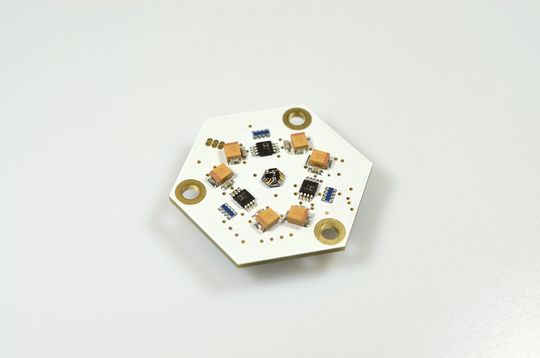
Today commercially available 3D magnetic field sensors usually do not have the same sensitivity in all three axes. This is different with the MID based system as there are three equal sensors with equal properties in use. The MID and the electrical layout is designed to position the SMD as close to each other as possible to detect the components of the field almost in one single spot.
A surrounding border underneath the SMD makes it possible for a vacuum tool of a state of the art assembly machine to handle the MID as an SMD itself. The MID is also designed with the highest amount of symmetry in order to minimize distortion or troublesome effects e.g. due to temperature changes. All this adds up to a very compact system with a volume of only 4 x 4 x 2.5 mm³.
A challenge for manufacturing this system is the 3D assembly. On one hand the three magnetic field sensors have to be positioned accurately in 90° to each other, on the other hand there is a need for an automated process with short cycle time in order to maintain the advantage of using low-cost SMD-sensors.
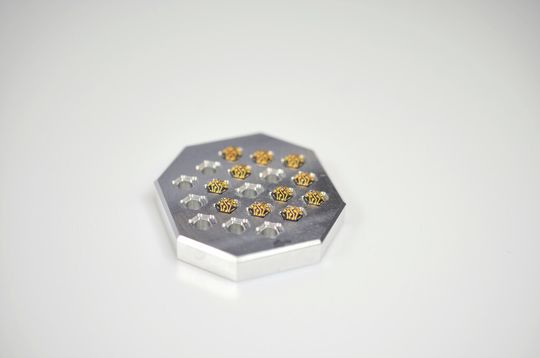
The key to achieve this goal is to use multiple work piece holders in a multi axis substrate manipulating device. Depending on the working area of the assembly machine the time needed for loading and unloading and for positioning the devices can be reduced highly. The multiple work piece holder in figure 4 can carry up to 19 MID modules and can be positioned in the correct angles in a very accurate way.
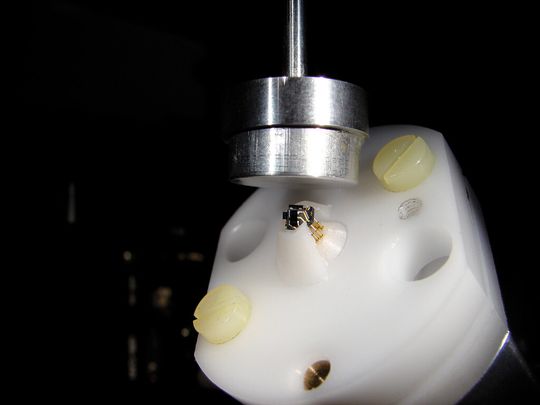
The same assembly machine can be used for characterizing the system. Therefore the MID is mounted onto a special interface for electrical connection and the interface can be assembled onto the multi axis substrate manipulating device instead of a multiple work piece carrier. A permanent magnet and the MID modules can now be arranged in relative position to each other with the same high accuracy like the previous assembly.
Measuring the gradient and eliminating interfering fields
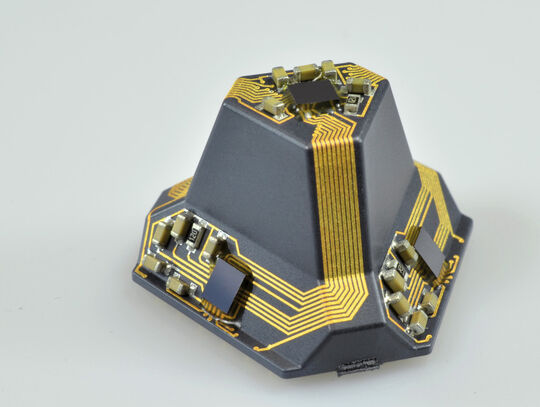
The second MID based magnetic field sensor system can detect the gradient of the field within a small volume. Therefore magnetic field sensor chips are used that are capable of measuring three dimensionally themselves. Four of them are positioned in a way that they lie on the edges of a virtual pyramid made of equilateral triangles. By differential calculation the field gradient for each axis can be detected.
A system like this is able to find out the position and direction of a known field even if other magnetic fields may interfere. That is a big benefit e.g. when using a permanent magnet as a positioning sensor in an electric motor. But also in this case the single sensor chips do not have equal sensitivity in all axes that is why they are positioned within defined angles in order to compensate this effect a bit.
Precision plays an important role for this system. That is why flip chip assembly using non conductive adhesive (NCA) is used. The NCA is dispensed to the substrate in the first step. The chips have Au studs as bumps and are pressed to the substrate with defined pressure and a heated tool. By that the NCA is cured within seconds creating a reliable electrical and mechanical connection. As the sensor chip is fixed in position through the curing process a very high accuracy even after assembly can be achieved. The necessary passive SMDs can be mounted by means of leadless soldering right next to the chip. A peripheral microcontroller unit on the PCB completes the system. The MID sensor system can be mounted as an SMD on the PCB as well. Molded MID bumps on the backside ensure reliable connections.
New applications with MID technology
The two magnetic field sensor systems introduced above are results of a funded research project and therefore no commercially available products. But they form the basis for a product development and what is more important; they demonstrate the possibilities of MID technology when complex requirements are met by creative and innovative ideas.
Today as well as in the future MID technology will especially be able to create a new solution, if miniaturized products are capable of using spatial design and 3D assembly of functional components. Current activities with focus on new and improved materials with increased thermal conductivity and robust mechanical properties will open MID for new applications, e.g. for LED lighting solutions.
For more than 15 years HSG-IMAT is doing R&D in the field of polymer based Microsystems. For almost 2 years the TransferFab also provides the infrastructure for accompanying our customers on the whole path from the idea to prototypes or even small series.
We gratefully thank the Federal Ministry of Economics and Technology for funding this project 17163N within the program for promotion of industrial collective research (IGF).
* Dr. Ulrich Keßler is head of micro assembly at the Hahn-Schickard institute für microassembly technology (HSG-IMAT)
(ID:42360897)
:quality(80)/p7i.vogel.de/wcms/2f/0c/2f0cdaf3c1041b3592bd71e44edd4aea/0133352797v2.jpeg "Conquer’s 48MH series SMD fuses are designed for high-current applications in AI servers and data centers. Their compact form factor supports automated assembly. (Bild: Conquer)")
:quality(80)/p7i.vogel.de/wcms/ee/38/ee38fbe5d1144fa0413c3e1f0119c2f0/0133245101v2.jpeg "Hitpoint’s PT-2728FPQ is an acoustic signaling device and one of the models the company also offers as a replacement for discontinued buzzers from other manufacturers. (Bild: Hitpoint)")