The technological preconditions—advancements in computing, sensing, motor control, and data systems—are now in place, enabling a new generation of surgical robots to emerge. These robots will perform with greater precision than human surgeons, reducing risk and enabling customised procedures.
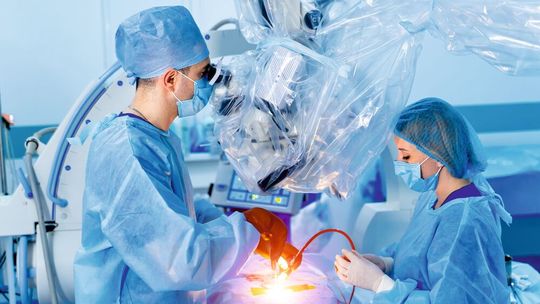
Surgeon and robot working together: Medical robots are necessary for many surgical procedures when it comes to precision, safety and efficiency.
About 500 million years ago, all major types of animals on earth appeared over a period of only 25 million years or so. This event, known as the Cambrian explosion, occurred because all the preconditions were right for animals to diversify. Simple organisms had many years to mature before the event. The explosion happened because multicellular structures, circulation systems, sensing, motor control and more were available for the first time.
A similar thing is going on in medical robotics today. The pioneering teleoperated robotic surgery system, Intuitive Surgical’s DaVinci, has been operating for over 20 years. It works with end effectors that look like sticks, and is used in only a few types of procedures, mostly in the urology and gynecology areas. But now, computing, sensing, motor control, data flow architecture, and more are finally capable of powering a new generation of medical robots. Operating rooms are transforming into digital surgery platforms. These systems will take on most every type of surgical procedure. This robotic explosion will change surgery more than anything in the last hundred years.
For instance, imagine you are an orthopedic surgeon specializing in knee replacements. The preconditions are there for robotic assistance. Compared to only a few years ago, prosthetic knees are commonplace these days. In fact, it’s become so common that efficiency is critical; surgeons handle almost 1 million operations in the U.S. each year. Robotic technology, including sensing, control, data flow, and intelligence, is ready for application. Specialized robotic systems will soon change both the process and economics of these procedures.
The Manual Process Looks Like This
Preparation:
Obtain X-ray or CT images of the knee.
Design how the new joint will function. This is complex and involves balancing positioning, alignment, laxity (joint play), and other factors. The biomechanics must be precise. You can use computer-aided design (CAD) tools to plan exactly how it will work.
Choose a prosthesis: metal and plastic components designed to function as a "new knee." Most modern prosthetics are standardized parts available in various sizes, with one component for each bone in the joint.
Plan where you will make the cuts and how you will install the new joint.
Surgery:
While the patient is under anesthesia, remove the damaged bone, shape the remaining bone to fit the prosthetic, and install the new joint.
This is not straightforward. It’s difficult to know exactly where to cut and how to shape the bone for the prosthetic. Sometimes, real-time imaging systems are used to guide the cuts, but often it’s a trial-and-error process—cutting, temporarily installing the prosthesis, testing motion, and making adjustments. Guides, alignment jigs, and test instruments may be used, but experience is key.
Since perfect cuts are hard to achieve, the prosthetic is cemented in place to close any gaps.
Then, restore the soft tissues (ligaments, tendons, etc.).
Finally, recovery: Additional images are taken to confirm proper function. The patient is then referred for physiotherapy.
Robots Are More Precise Than Surgeons
Of all these steps, making accurate cuts is by far the most difficult and important. Setting up the table and patient to ensure alignment of the cuts is the most expensive part. It can take 2-3 hours to get everything in the right position for the operation. Much of this must be done with the patient on the table. Together, setup and cut planning and evaluation drive much of the cost and risk. In the end, however, humans aren't very good at making precise angular cuts. Even trained surgeons can't make perfect cuts. And adapting the diversity of human bone to standard parts means that most patients don't get an optimal result.
Robots can follow extremely precise cut paths generated by the imaging and CAD plans. The resulting precision angles and ultra-smooth surfaces are so clean that many operations don’t require cement; the part is press fit and the bone grows into the part like your natural joint. With robotic accuracy and flexibility, custom joints become realistic to install. Instead of adapting the patient to a standard part, a custom part can be 3D printed from the imaging information. Manually adapting procedures to install these unique parts is impractical for humans. It’s entirely possible for a robot.
Of course, it’s not quite that simple. Importantly, the robot has to know exactly where the bone is, a process called “registration.” That’s done with an imaging system that can track something that looks like an antenna with reflective targets on it. This is attached (screwed into) the bone, and then another probe with targets on it is used to locate bone points exactly. After that, the vision system knows exactly where the bone is while it’s cutting.
Then, to make it all work, the right data has to get to the right place at the right time. The vision system communicates where the bone is, even if it’s moving. The surgeon controls when and how fast to cut. The robot uses those to execute a perfect cut along the pre-planned angle. This is all automated so it can even be done remotely, even with the surgeon thousands of miles away. It’s a bold new intelligent world. The knee-replacement robot essentially copies how surgeons work, but with better accuracy and precision. Increasing evidence shows that the results of robotic joint replacement are better. The robotic surgery in these studies improved implant positioning, alignment, and ligament balance. General-purpose robots can extend human capabilities in other ways. Robotic technology can enhance a surgeon’s environment with high-resolution 3D monitors, four robotic arms, and automatically-changeable tools. Connecting those through intelligent computing lets the surgeon measure anatomical structures to millimeter precision, generate “tags” for landmarks and training, and even monitor potential accidental injuries. The robot + surgeon system improves operating-room capability, communication, and outcomes.
Stand: 08.12.2025
Es ist für uns eine Selbstverständlichkeit, dass wir verantwortungsvoll mit Ihren personenbezogenen Daten umgehen. Sofern wir personenbezogene Daten von Ihnen erheben, verarbeiten wir diese unter Beachtung der geltenden Datenschutzvorschriften. Detaillierte Informationen finden Sie in unserer Datenschutzerklärung.
Einwilligung in die Verwendung von Daten zu Werbezwecken
Ich bin damit einverstanden, dass die Vogel Communications Group GmbH & Co. KG, Max-Planckstr. 7-9, 97082 Würzburg einschließlich aller mit ihr im Sinne der §§ 15 ff. AktG verbundenen Unternehmen (im weiteren: Vogel Communications Group) meine E-Mail-Adresse für die Zusendung von redaktionellen Newslettern nutzt. Auflistungen der jeweils zugehörigen Unternehmen können hier abgerufen werden.
Der Newsletterinhalt erstreckt sich dabei auf Produkte und Dienstleistungen aller zuvor genannten Unternehmen, darunter beispielsweise Fachzeitschriften und Fachbücher, Veranstaltungen und Messen sowie veranstaltungsbezogene Produkte und Dienstleistungen, Print- und Digital-Mediaangebote und Services wie weitere (redaktionelle) Newsletter, Gewinnspiele, Lead-Kampagnen, Marktforschung im Online- und Offline-Bereich, fachspezifische Webportale und E-Learning-Angebote. Wenn auch meine persönliche Telefonnummer erhoben wurde, darf diese für die Unterbreitung von Angeboten der vorgenannten Produkte und Dienstleistungen der vorgenannten Unternehmen und Marktforschung genutzt werden.
Meine Einwilligung umfasst zudem die Verarbeitung meiner E-Mail-Adresse und Telefonnummer für den Datenabgleich zu Marketingzwecken mit ausgewählten Werbepartnern wie z.B. LinkedIN, Google und Meta. Hierfür darf die Vogel Communications Group die genannten Daten gehasht an Werbepartner übermitteln, die diese Daten dann nutzen, um feststellen zu können, ob ich ebenfalls Mitglied auf den besagten Werbepartnerportalen bin. Die Vogel Communications Group nutzt diese Funktion zu Zwecken des Retargeting (Upselling, Crossselling und Kundenbindung), der Generierung von sog. Lookalike Audiences zur Neukundengewinnung und als Ausschlussgrundlage für laufende Werbekampagnen. Weitere Informationen kann ich dem Abschnitt „Datenabgleich zu Marketingzwecken“ in der Datenschutzerklärung entnehmen.
Falls ich im Internet auf Portalen der Vogel Communications Group einschließlich deren mit ihr im Sinne der §§ 15 ff. AktG verbundenen Unternehmen geschützte Inhalte abrufe, muss ich mich mit weiteren Daten für den Zugang zu diesen Inhalten registrieren. Im Gegenzug für diesen gebührenlosen Zugang zu redaktionellen Inhalten dürfen meine Daten im Sinne dieser Einwilligung für die hier genannten Zwecke verwendet werden. Dies gilt nicht für den Datenabgleich zu Marketingzwecken.
Recht auf Widerruf
Mir ist bewusst, dass ich diese Einwilligung jederzeit für die Zukunft widerrufen kann. Durch meinen Widerruf wird die Rechtmäßigkeit der aufgrund meiner Einwilligung bis zum Widerruf erfolgten Verarbeitung nicht berührt. Um meinen Widerruf zu erklären, kann ich als eine Möglichkeit das unter https://contact.vogel.de abrufbare Kontaktformular nutzen. Sofern ich einzelne von mir abonnierte Newsletter nicht mehr erhalten möchte, kann ich darüber hinaus auch den am Ende eines Newsletters eingebundenen Abmeldelink anklicken. Weitere Informationen zu meinem Widerrufsrecht und dessen Ausübung sowie zu den Folgen meines Widerrufs finde ich in der Datenschutzerklärung, Abschnitt Redaktionelle Newsletter.
A Wide Range of Medical Robots
Some robots can perform operations that a human cannot do. For instance, consider the problem of a lung biopsy. The current way to do a biopsy is to take a long needle, poke it through the chest into the lung and suck out a sample for analysis. But this has all sorts of problems. The needle goes through the skin into the lung, so bacteria can get in, risking infection. You have to puncture the lung, risking a pneumothorax (collapsed lung). It’s very hard to know where the needle actually is, so you need to run continuous X-rays (fluoroscope) and “poke around” a bit to find the right spot. It can work, but it’s messy, slow, risky, and expensive.
Now imagine instead that you have a robot that looks like a long thin tube about the thickness of a USB cable. It’s steerable with a simple controller. You can see through fiber optic video cable. When you get to the suspected tumor, a quick suction tube takes a sample. This tube robot makes no punctures, risks no infection or lung damage, and makes the procedure safer, faster, and more accurate. No human can match that. These are only a few of the hundreds of new-generation medical robots. The variety is incredible.
A laparoscope robot folds up to go through a hole the size of a dime, then unfolds into a praying-mantis-like device with eyes and hands. Another looks like two very dextrous snakes with gripper heads. Jointed arms, tiny grippers on sticks, human-like dual-armed systems, under-the-skin grippers, and more will soon populate operating rooms. Fletcher Spaght Inc. (FSI), an analyst in the industry, tracks over 200 robotic-assisted surgery products in various stages of development. Each is designed to perform precision motions in ways that humans cannot match. Medical robots will soon change nearly every procedure in the operating room.
Equally important, many of these systems will soon leverage AI. Applications include before (pre-op), during (intra-op), and after (post-op) the surgery. Pre-op, AI can help surgeons train for the specific challenge, model the patient, and develop custom process and implants. Closer to the surgery, AI can speed setup, making sure the patient and equipment are properly placed and calibrated. It can also help align images such as CT scans to the actual patient, ensuring accurate operation.
Robots During and After an Operation
During the procedure, AI can increase accuracy, enforce safety, and improve efficiency. For instance, smart robots can verify measurements, guide the robotic motion, and flag potential unsafe steps. Smart tools can automate some of the routine-but-slow steps like staple placement and suturing. Increasingly, the robot can also use AI to coordinate the operation with other devices in the operating theater like patient monitoring and anesthesiology. After the operation, AIs will improve both operations and patient outcomes. Automated systems can more closely monitor patients, analyze operational effectiveness, and even predict outcomes for early intervention.
In summary, surgical systems of tomorrow will teem with hundreds of types of robots. They won’t be just mechanical motion replicators, they will use AI to assist care teams in performing more accurate, faster, less invasive operations. They will fill every niche of surgery, adapting exactly to each procedure’s challenges and needs. Every operation can be customized to fit each patient’s unique condition and needs. The environment is incredibly fertile: Imaging, compute power, sensing, intelligence, software architecture, and mechanical design are all at inflection points, forming a truly unique junction.
The advent of these new applications is contingent upon the availability of data, or more accurately, upon the capacity for data flow. An approach to real-world software architecture, designated as "data centricity," ensures the delivery of pertinent data to the appropriate location at the optimal time. The data-centric approach facilitates the integration of sensor data into intelligent algorithms, which in turn are linked to the motors that perform the actions. In the context of artificial intelligence, data is the fundamental building block of intelligence. However, in the real-world context of sensors, motors, robots, instruments, and human interactions, data flow is the crucial element that enables the development of intelligent systems. Consequently, data flow is a pivotal aspect in the advancement of patient care. (heh)
* Stan Schneider is CEO at Real-Time Innovations (RTI).





:quality(80)/p7i.vogel.de/wcms/f1/2f/f12fcea90f39543f7eeb41528887fffd/0129774307v4.jpeg "Robotic Award Hannover Messe: Der Preis ging an goodBytz. Gründer Dr. Hendrik Susemihl (re) ist Ingenieur und promovierter Robotik-Experte. Er hatte die technische Vision und entwickelte den ersten Prototypen des Kochroboters. (Bild: Kristin Rinortner)")
:quality(80)/p7i.vogel.de/wcms/2f/bc/2fbc41c5140905b15698225ff58b203e/0129648135v2.jpeg "Das III-V-Germanium-PV-Modul mit einem Wirkungsgrad von 34,2 % ist das aktuell effizienteste Solarmodul der Welt. (Bild: Jacob Forster)")
:quality(80)/p7i.vogel.de/wcms/17/2c/172caa709bdbf17c495ef523f65663ad/0129630827v1.jpeg "Links: High Bandwith Flash (HBF) stapelt mehrere Schichten von NAND-Chips, um die Speicherkapazität deutlich zu erhöhen; Rechts: Konzept der in der IEEE-Studie vorgestellten „hybriden“ H³-Architektur. (Bild: Sandisk (links) / Sk hynix (rechts))")
:quality(80)/p7i.vogel.de/wcms/5c/42/5c4277b2a48f97332adfc485d6c7aee6/0129494885v2.jpeg "Bild 1: Einzelne Kupfersubstrate (a) sowie mit Lötpaste verbundene Kupfersubstrate in rohem (b), geschliffenem (c) und mit Polymerfolie beschichtetem (d) Zustand. (Bild: ZFW)")
:quality(80)/p7i.vogel.de/wcms/26/c7/26c7a8a41420adecc0864c3001233ac3/0129722027v2.jpeg "Der Meta-Konzern hat für den Ausbau seiner KI-Kapazitäten einen über fünf Jahre währenden Vertrag über GPU- und CPU-Lieferungen geschlossen. Vereinbart ist die Lieferung von bis zu 6 Gigawatt an GPU-Rechenleistung in einem Gesamtwert von etwa 60 Mrs. US-Dollar. (Bild: frei lizenziert)")
:quality(80)/p7i.vogel.de/wcms/7e/5f/7e5f325ff1bfc6b00cf7bbbd51eb8f4f/0129653700v2.jpeg "Ein WBA-Report zeigt auf, warum KI und Machine Learning zur Grundlage moderner Wi-Fi-Netze werden, und plädiert für offene Standards entscheidend, um Fragmentierung zu vermeiden. (Bild: frei lizenziert)")
:quality(80)/p7i.vogel.de/wcms/7b/57/7b5725dd2e7545ab4904a9b7a3735721/0129309389v2.jpeg "Die embedded world 2026 findet vom 10. bis zum 12. März 2026 statt. (Bild: NürnbergMesse / Thomas Geiger)")
:quality(80)/p7i.vogel.de/wcms/44/2c/442ca7930230eaeb8d27d0234a9ab8d3/0129693467v2.jpeg "Eine Karte mit Programmcode, wie sie in Unterrichtseinheiten für COBOL-Programmierung auf einem IBM System/360 Mainframe eingesetzt wurde. Die über 65 Jahre alte Programmiersprache COBOL ist vor allem bei Legacy-Anwendungen im Bank- und Versicherungswesen noch fest verankert, und deren Modernisierung aufwändig und teuer. Laut Anthropic lässt sich dieser Aufwand nun mit dem KI-Tool Claude Code leicht automatisieren. (Bild: frei lizenziert)")
:quality(80)/p7i.vogel.de/wcms/e1/78/e17860d5b42a0bc53e323868d2777d79/0129752421v2.jpeg "(Bild: concept electronic GmbH)")
:quality(80)/p7i.vogel.de/wcms/92/43/9243cfe82b7ab3448679ded83cb50204/0129762425v2.jpeg "PLS‘ UDE 2026 ermöglicht jetzt auch das Debuggen hocheffizienter embedded KI-Beschleuniger. (Bild: PLS)")
:quality(80)/p7i.vogel.de/wcms/30/1f/301fa3142221a2ee6ba3ef07e89a4ec8/0129690250v2.jpeg "Die Solid-State-Batterie wurde 2026 auf der CES in Las Vegas vorgestellt. (Bild: Donut Lab)")
:quality(80)/p7i.vogel.de/wcms/e1/2d/e12d843be72a9dc1cab04b68f1c39e4a/0129691802v3.jpeg "Aufbau einer Flüssigmetall-Batterie - Projekt Solstice. (Bild: HZDR / Blaurock)")
:quality(80)/p7i.vogel.de/wcms/8b/e8/8be874cadb88f7d40c58381cd26f0122/0129697493v3.jpeg "Universell: Motoren kommen überall zum Einsatz. (Bild: Microchip Technology)")
:quality(80)/p7i.vogel.de/wcms/c7/f6/c7f61d0437c7f8fca3c6ff947ba2ad62/0129322490v2.jpeg "AMD hat die zweite Generation der Kintex UltraScale+ Gen 2 FPGA-Familie vorgestellt, die mit PCIe Gen4 den 4K-AV-over-IP-Betrieb für 4K/8K-Medienanwendungen unterstützt. (Bild: AMD)")
:quality(80)/p7i.vogel.de/wcms/66/0c/660c31afa35398bac9be42f2be73fdc4/0129073529v2.jpeg "FPGAs lösen Performance-Engpässe, gelten aber in der Programmierung als schwer zugänglich. Die universelle Programmiersprache Livt soll die Hürde senken – korrekt, deterministisch und HDL-kompatibel. (Bild: Toby Giessen / VCG)")
:quality(80)/p7i.vogel.de/wcms/9c/35/9c35ed04fa562b190cbc496a695a6802/0128823288v1.jpeg "Optimiert auf Skalierung oder Geschwindigkeit: Die SGET hat den offenen Standard oHFM für FPGA-Module in zwei Varianten vorgestellt. (Bild: SGET (Screencast / Screenshot))")
:quality(80)/p7i.vogel.de/wcms/7b/70/7b700e93abd717e2feb5466810810af4/0127597143v2.jpeg "Shrike-lite: FPGA und ein Mikrocontroller für nur vier US-Dollar. (Bild: Vicharak)")
:quality(80)/p7i.vogel.de/wcms/93/ee/93ee5e88736974a1259c7427fc92f019/0129633555v2.jpeg "Eine vom MIT entwickelte Chip-Verarbeitungsmethode könnte Kryptografieverfahren dabei unterstützen, Daten sicher zu halten, indem zwei Chips sich innerhalb desselben Systems gegenseitig anhand eines gemeinsamen Fingerabdrucks authentifizieren können. (Bild: frei lizenziert)")
:quality(80)/p7i.vogel.de/wcms/23/37/2337c3956a8f3d1cb3552ad197f0d78b/0129723446v2.jpeg "Nigel von Emerson NI ist ein integraler Bestandteil der Software geworden. (Bild: Emerson NI )")
:quality(80)/p7i.vogel.de/wcms/17/9c/179c11641120399cf2e4cf0e5943b107/0129645476v2.jpeg "Auf der „embedded world 2026” präsentiert Rohde & Schwarz einen Auszug aus seinem Portfolio an Messtechnik und Testsystemen. (Bild: Rohde & Schwarz)")
:quality(80)/p7i.vogel.de/wcms/84/10/8410f7a52af344d1e5626d0610c9fa23/0129553240v2.jpeg "Joe Woodford ist als Group Director für Global Sales & Marketing bei Pickering Interfaces tätig. Seiner Meinung nach war das Jahr 2025 für das Unternehmen von „globaler Unsicherheit geprägt“, die er unter anderem auf die von US-Präsident Trump verhängten Zölle zurückführte.
(Bild: Pickering Interfaces)")
:quality(80)/p7i.vogel.de/wcms/6c/b2/6cb2f5a31e5d99bea02cfcac09fc6e53/0129765681v2.jpeg "Strategische Allianz: Die neue Plattform soll künstliche Intelligenz in großem Maßstab in die Rechenzentren bringen. (Bild: Red hat/Nvidia)")
:quality(80)/p7i.vogel.de/wcms/01/02/01020f25b00a35b8229bfc2ca18edb3a/0129748520v2.jpeg "Physical AI in der Praxis: TwinCAT CoAgent übersetzt natürliche Sprache in Maschinenbefehle und ermöglicht die intuitive Steuerung komplexer mechatronischer Systeme. (Bild: Beckhoff Automation)")
:quality(80)/p7i.vogel.de/wcms/68/95/6895bd4fbdb1e9c84f6ebac2e11b03b3/0129764984v2.jpeg "China Resources Microelectronics (CR Micro) hat angekündigt, die Preise für die eigenen Produkte erhöhen zu wollen. (Bild: China Resources Microelectronics)")
:quality(80)/p7i.vogel.de/wcms/9d/13/9d131190bf01a4a85b6d63178e2567b8/0129778339v2.jpeg "Die Software-Investments in die Fertigung haben in der Lacon-Fertigung für einen Zeitgewinn gesorgt. (Bild: Lacon)")
:quality(80)/p7i.vogel.de/wcms/06/bf/06bf3e15e9d8ebc4f77a148b3066a8b8/0129680605v2.jpeg "Der Z22198 ist ein extrem kompakter, dreiachsiger IEPE-Beschleunigungssensor für das Messen von Schwingungen (Vibrationen) und Stößen (Schocks) in anspruchsvollen Anwendungen. Mit nur 6 mm Kantenlänge und 0,9 g Gewicht eignet er sich ideal für leichte Strukturen und beengte Platzverhältnisse. (Bild: Copyright 2020 ScROGERS,All Rights Reserved)")
:quality(80)/p7i.vogel.de/wcms/fd/fb/fdfb374c9c6980af66089d250209d0aa/0129722035v2.jpeg "SMIC ist Vorreiter bei Chinas Vorstoß, Chips in fortschrittlichen Prozessen zu fertigen. Das Unternehmen hat bereits 7-nm-Chips mit weniger fortschrittlichen Anlagen hergestellt; laut Nikkei Asia arbeite es nun an einer Technologie, die als „5-Nanometer-ähnlich“ bezeichnet wird. (Bild: SMIC)")
:quality(80)/p7i.vogel.de/wcms/e5/6c/e56ceb935ba09cb66a4fd0f961b2d3e9/0129642888v2.jpeg "(Bild: Vogel Professional Education)")
:quality(80)/p7i.vogel.de/wcms/69/1f/691f39ba12be3cad90eb88bdabc456a6/0127321404v2.jpeg "Das Kreativteam Christian Göller, GreatScott! und Christopher Becht (v. l. n. r.): erfolgreiches Creator-Marketing im B2B-Sektor (Bild: Würth Elektronik)")
:quality(80)/p7i.vogel.de/wcms/6a/cc/6acc4f803241cfe5b6d60560c0a2b4d9/0126684948v2.jpeg "In der Altersgruppe 25 bis 64 verfügen 34 Prozent der Deutschen über einen tertiären Abschluss im MINT-Bereich. (Bild: Dall-E / KI-generiert)")
:quality(80)/p7i.vogel.de/wcms/da/e4/dae45caa7f4fa7125e17b07d9da016bb/0125786170v2.jpeg "Soft termination prevents cracks by absorbing mechanical stress through a resin layer. (Bild: TAIYO YUDEN CO., LTD.)")
:quality(80)/p7i.vogel.de/wcms/ab/73/ab73d241611c109a242a4e5f1b50d01e/0128483827v4.jpeg "Filter elements in various SMD designs. (Bild: TAIYO YUDEN)")