



:quality(80)/p7i.vogel.de/wcms/37/ec/37ece4c276f37114e8f40696ff5dcd66/0130537789v2.jpeg "Um die Entwicklung von High-TRL-Halbleiter-Qubits zu beschleunigen und damit in Europa produzierte Quantensysteme in größerem Maßstab zu ermöglichen wurde die vom belgischen Forschungsinstitut IMEC koordinierte Quanten-Pilotlinie SPINS ins Leben gerufen. (Bild: Imec)")
:quality(80)/p7i.vogel.de/wcms/46/7c/467c0afffbfd10c3553c2888a4a6289f/0130479810v3.jpeg "Spezielle Elektroden, die Forscher am Fraunhofer IFAM entwickeln, entfernen wertvolle Rohstoffe wie Lithium und Kobalt beim Recyceln von Batterien aus dem Prozesswasser. (Bild: Fraunhofer IFAM)")
:quality(80)/p7i.vogel.de/wcms/12/3d/123d9eb2c2e4ce13296371a2ad3718a4/0130412664v2.jpeg "In seiner PCIe-5.0-SSD „BM9K1“ setzt Samsung erstmals statt ARM auf RISC-V-Kerne für den Festplattencontroller. (Bild: Samsung / finance.biggo.jp)")
:quality(80)/p7i.vogel.de/wcms/b6/e7/b6e755d9e704319c0bb59dc1ac2d67e8/0130537290v2.jpeg "Menschliches Wissen, künstliche Intelligenz: Intelligente Datenverarbeitung direkt am Einsatzort verlangt nach dem Zusammenspiel von KI, Hardware-Know-how und konkreter Anwendungserfahrung. (Bild: Dall-E / KI-generiert)")
:quality(80)/p7i.vogel.de/wcms/8b/10/8b10d1edceb749de99c1df3ad97be01e/0130564619v2.jpeg "Infrastruktur für KI-Agenten: Intel und Sambanova teilen Rechenlast auf drei Prozessortypen auf (Bild: Gemini / KI-generiert)")
:quality(80)/p7i.vogel.de/wcms/ac/da/acda3bafe46d3bf8e104a2a7bc2ac557/0130535476v2.jpeg "Geschätzter Ansprechpartner für Journalisten: Alfred Eiblmayr koordiniert seit vielen Jahren beim Halbleiterhersteller STMicroelectronics die Presse- und Öffentlichkeitsarbeit. Als ehemaliger Redakteur weiß er, worauf es ankommt. (Bild: Alfred Eiblmayr)")
:quality(80)/p7i.vogel.de/wcms/ca/9b/ca9b681785123f9700518a46897f9779/0130428786v1.jpeg "Biometrische Systeme mit künstlicher Intelligenz sind darauf ausgelegt, Personen anhand ihrer physischen oder verhaltensbezogenen Merkmale zu erkennen. (Bild: © AlinStock - stock.adobe.com)")
:quality(80)/p7i.vogel.de/wcms/38/cb/38cbe19e814dd30b94780bc3946547ab/0130446533v2.jpeg "Zur Absicherung seines KI-Ökosystems geht Nvidia eine Strategische Partnerschaft mit Marvell ein und investiert hierfür 2 Mrd. US-$ in den ASIC-Spezialisten. Im Fokus stehen NVLink Fusion, optische Interconnects und Silicium Photonics. (Bild: Marvell)")
:quality(80)/p7i.vogel.de/wcms/c2/88/c28805ea7b2261235475146a5b0c61f8/0130313028v2.jpeg "x86 trifft adaptive Logik: Auf der Messe demonstriert AMD die industrielle Vernetzung eines Node-RED-Gateways (links) mit Zynq-UltraScale+-Controllern (Mitte) und einer Soft-SPS auf Basis der Ryzen AI P100 Serie (rechts). (Bild: Manuel Christa)")
:quality(80)/p7i.vogel.de/wcms/fa/8d/fa8dedee195f29c33c89d86311c258ee/0130104146v2.jpeg "Kompakte KI-Power: Die Smart-Module SIM8668 und SIM8666 von Simcom vereinen auf kleinstem Raum eine Quad-Core-CPU samt integrierter NPU für ressourcenschonende Industrie- und Robotikanwendungen. (Bild: Chip: Simcom/Hintergrund: KI-generiert)")
:quality(80)/p7i.vogel.de/wcms/69/7a/697a270ed7538378d1fbc0f0b240ed25/0130534691v3.jpeg "Die Wago Stromversorgung Pro 2 ist eine intelligente und zuverlässige Stromversorgung mit integrierter Redundanz und MOSFET-Technologie und gewährleisten dadurch eine höhere Zuverlässigkeit der Anwendung. (Bild: WAGO GmbH & Co. KG)")
:quality(80)/p7i.vogel.de/wcms/e7/a4/e7a4e048491e60cb30e22a860f5d68bc/0130519425v4.jpeg "Dynamisch:
Die Zuverlässigkeit der Stromversorgung hängt von mechanischen und thermischen Faktoren sowie zeitlichen Abfolgen ab. (Bild: inpotron Schaltnetzteile GmbH)")
:quality(80)/p7i.vogel.de/wcms/1b/f0/1bf02d41e3eac721823841a4c1228753/0130519149v2.jpeg "Der Wandler GQA2W024A050V-007-R ist in mehreren Gehäusekonfigurationen erhältlich, um Entwicklern maximale Flexibilität für ihr Gesamtgehäusedesign und die Kühlung des Wandlers zu bieten. (Bild: TDK-Lambda)")
:quality(80)/p7i.vogel.de/wcms/1a/53/1a539631c940d184689460600bd2b395/0130410666v2.jpeg "Das iG-G74M von iWave Global ist das erste erhältliche System-on-Module, das den neuen FPGA-Modulstandard oHFM.c der SGeT erfüllt. (Bild: iWave Global)")
:quality(80)/p7i.vogel.de/wcms/10/45/1045969e69a1db4aaa73d0f74f55cc02/0129962687v2.jpeg "Bosch Rexroth und AMD arbeiten gemeinsam an Software-Defined Automation: ctrlX OS unterstützt nun auch auf AMD Embedded x86-CPUs und adaptive SoCs und verspricht so noch größere Hardware-DesignFlexibilität, nahtlose Skalierbarkeit und eine sichere, modulare Betriebssystem-Grundlage. (Bild: Bosch Rexroth AG)")
:quality(80)/p7i.vogel.de/wcms/cd/32/cd3243e4a9a6476265ef6ea9463dfbd8/0129852659v2.jpeg "Die PIC64-Serie an Multicore-Mikroprozessoren setzt auf RISC-V-Kerne und eignen sich speziell für Anwendungen mit asynchronem Multipricessing (AMP) in intelligenten Embedded-Edge-Anwendungen. (Bild: Microchip)")
:quality(80)/p7i.vogel.de/wcms/ba/e4/bae4e54395e5a53088060531ef99b814/0130359274v2.jpeg "Mit dem Fuse EDA AI Agent verfolgt Siemens EDA ein umfassendes Programm, alle Aspekte des Chipdesigns mit KI-Coworkern zu erleichtern, auch in Questa One. (Bild: Siemens EDA)")
:quality(80)/p7i.vogel.de/wcms/35/af/35af7dd326d198475d06fbb69aa600b5/0130175971v2.jpeg "Diff GT kann in einer kostenlosen Probeversion ausprobiert werden. (Bild: CSci)")
:quality(80)/p7i.vogel.de/wcms/c0/2e/c02e7bf72bfc434888c37100e2511681/0130127767v3.jpeg "„Wegen seiner kompakten Bauweise, des modularen Aufbaus und der hohen Effizienz ist der Axialflussmotor eine attraktive Alternative zur etablierten Radialflussmotor-Topologie“, PEM-Leiter Professor Achim Kampker (Bild: RWTH Aachen University)")
:quality(80)/p7i.vogel.de/wcms/8c/42/8c4211320be4a5ef78ca36d37b2406f2/0130561321v2.jpeg "Auf dem Weg zum Mond: Um einen reibungslosen Start der Artemis-II-Mission zu gewährleisten, validierte die NASA Rakete und Startplattform vorab mithilfe dezentraler DAQ-Systeme von Dewetron. (Bild: NASA/Bill Ingalls)")
:quality(80)/p7i.vogel.de/wcms/e1/0b/e10bc04827e33786548587e32bbae422/0130438700v2.jpeg "Optische Datenkommunikation: Um Bauteile auf Basis optischer Datenkommunikation umfassend testen zu können, sind neue Testfähigkeiten erforderlich. (Bild: © kudzik - stock.adobe.com / KI-generiert)")
:quality(80)/p7i.vogel.de/wcms/35/06/3506f2a8d33a696aaef12a30771bd8d8/0130496747v2.jpeg "Ein von Keysight entwickelter Empfänger-Test für 10BASE-T1S fördert den Test von funktionskritischen Empfängern, um die Zuverlässigkeit und Sicherheit künftiger Bordnetzwerke zu gewährleisten. (Bild: Keysight)")
:quality(80)/p7i.vogel.de/wcms/e5/ed/e5ed08c670c44565a9130e95a760dddc/0130494578v2.jpeg "PV-Anlage auf dem Dach der Elbfabrik, einer Forschungsfabrik des Fraunhofer IFF. Mit einem Sensorsystem lassen sich Fehler in PV-Großanlagen frühzeitig erkennen. (Bild: Fraunhofer IFF/Anne Bornkessel)")
:quality(80)/p7i.vogel.de/wcms/34/6d/346d110316228e54143f67e9f273972b/0130589338v2.jpeg "Hannover Messe 2026: Egal ob Humanoide oder Cobots, die Robotik ist auf der diesjährigen Messe groß vertreten. (Bild: Rainer Jensen/Deutsche Messe AG)")
:quality(80)/p7i.vogel.de/wcms/c0/7a/c07aaa9f6122aeb6faed4f2a74dcb77f/0130542642v2.jpeg "Symbolbild: Robotikhersteller befinden sich auf dem Weg zum massentauglichen Humanoiden. (Bild: Dall-E / KI-generiert)")
:quality(80)/p7i.vogel.de/wcms/3a/72/3a722ed2ad6ac4894c352e6ce87b6560/0130567207v2.jpeg "Mit Seamless Automation macht Festo die Automatisierungstechnik so einfach, dass Technik ein Erlebnis wird. Das Konzept baut Komplexität ab und schafft Klarheit für intuitive Lösungen – zu erleben auf dem Festo Stand in Halle 13 auf der Hannover Messe 2026. (Bild: Festo)")
:quality(80)/p7i.vogel.de/wcms/e9/19/e919aaa1fb20114acd7f56479d9d6c0d/0130599660v2.jpeg "Erfolgreiche Vertriebs- und Marketingstrategien für EMS-Unternehmen (Bild: Dall-E / KI-generiert)")
:quality(80)/p7i.vogel.de/wcms/1c/33/1c3399d0f7fb55bda7808310088accaf/0130565746v1.jpeg "Hand in Hand: Intel-CEO Lip-Bu Tan geht mit seinem Unternehmen eine strategische Partnerschaft im großspurigen Terafab-Projekt ein. Aber Umfang, Zeitrahmen und Zweck bleiben weiterhin schwammig. (Bild: SemWiki/X)")
:quality(80)/p7i.vogel.de/wcms/2e/95/2e9597b5dc1873771c7fe9c32ac41e82/0130549010v2.jpeg "Deepsleep: 13 Stunden lang war Deepseek nicht verfügbar. Nutzer spürten die Auswirkungen teils deutlich. (Bild: Dall-E / KI-generiert)")
:quality(80)/p7i.vogel.de/wcms/15/56/15564dea31861c376a385658c3b961a3/0130465243v2.jpeg "Luftaufnahme von Intels Fab 34 in Leixlip, Irland, aus dem Jahr 2024. In dem Werk werden Chips nach den hauseigenen Verfahren Intel 3 und Intel 4 gefertigt. (Bild: Intel)")
:quality(80)/p7i.vogel.de/wcms/d6/ea/d6eac438c362c545cab42ef0f30bcfc0/0130136975v2.jpeg "Die Bewerbungsphase für den James Dyson Award 2026 ist gestartet. (Bild: Dyson)")
:quality(80)/p7i.vogel.de/wcms/e5/6c/e56ceb935ba09cb66a4fd0f961b2d3e9/0129642888v2.jpeg "(Bild: Vogel Professional Education)")
:quality(80)/p7i.vogel.de/wcms/69/1f/691f39ba12be3cad90eb88bdabc456a6/0127321404v2.jpeg "Das Kreativteam Christian Göller, GreatScott! und Christopher Becht (v. l. n. r.): erfolgreiches Creator-Marketing im B2B-Sektor (Bild: Würth Elektronik)")
Strategy Lean processes in development: risks and costs under control
Unstructured projects, incalculable expenses and long lead times in development are the woes of many electronics manufacturers. The frontloading strategy keeps those problems in check.
Anbieter zum Thema
:fill(fff,0)/images.vogel.de/vogelonline/companyimg/130400/130457/65.jpg "mev_logo-RGB-L.jpg ()")
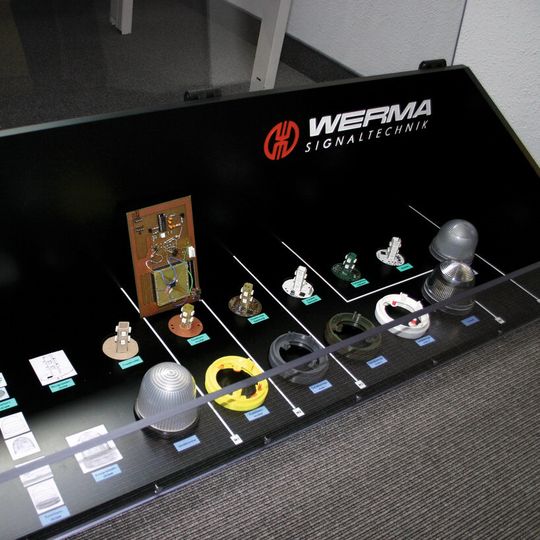
At Werma Signaltechnik, unstructured projects, incalculable expenses and excessively long lead times in development are part of the past thanks to clearly defined management, precise project prioritisation and, above all, consistent front-loading. The company consciously took the time to deliberate on the reorganisation and on sustainable learning processes. Supported by Staufen AG, Werma Signaltechnik developed the "Werma Development System". As a result, Werma was awarded the Top 100 Innovation Award in 2012.
The focus of Matthias Marquardt, Managing Partner of Werma Signaltechnik, is firmly on the number 2 spot on the global market behind the domineering Japanese leader and thus a successful future of his mid-size business. The son of the business founder who took over management of the business in 2009 knew all along that development is the foundation for achieving this goal. "I had been dealing with lean management, i.e. lean processes for quite a while and after the Best Practice Day 2009 hosted by Staufen AG it was clear to me that it would be the right approach for us as well given that we are a catalogue merchant with high vertical integration."
With the help of consultants, the pilot programme got off the ground as early as 2010. "It was mainly organisation and prioritisation of projects that were in dire need of improvement," says Marquardt. Lead times were high as a result. In addition, according to him it was nearly impossible to calculate actual expenses. "Frequently, just before the development phase was completed, some party had yet another new requirement for the product. Therefore, the entire concept had to be revised again."
Consistent project management required
After analysing the company and processes, the consultants with Staufen AG proposed to designate employees for project management only. Werma followed this recommendation by consistently making a motivated developer available. Furthermore, we posted additional project manager jobs internally. In addition, we promptly began the process of prioritisation, using the current project list. "We had many projects in the queue that were all rated the same more or less," says Marquardt. "Today, we have clearly defined criteria we use to stagger." In a room conceived especially for this purpose, now our project landscape is clearly visualised, altogether without computer and Powerpoint.
Each project receives its own DIN A4 sheet used to document the current status in hand writing. Depending on the product group, this sheet is hung on one of three clothes lines in the project room. The position of the sheet indicates the phase in which the project is at any time. The colour of the clothes pin indicates whether there are problems or everything is in keeping with the plan. "This way, we only have to look once and know what our status is," Marquardt clarifies. Now our development projects are clearly scheduled and structured, responsibilities are unambiguous and nothing is left behind any more. The method is simple and precisely for this reason it is efficient."
Weekly meetings of specialist teams also contribute to these improvements. This is where the previous week's progress as well as pending topics for the upcoming week are discussed briefly and concisely. According to Marquardt the point is not in attributing mistakes to an individual. On the contrary, he says, it is desirable to obtain diverse feedback that supports finding a solution. "Werma has always supported the idea of permitting mistakes and learning from them – as long as they are not repeated too often, of course."
Designated project managers as well as participants in all roles – product management, purchasing, sales and distribution, marketing, production, resource production, etc. – formed the core team for the pilot project with the consultants: development of a brand new family of optical-acoustic signal devices.
The goal was to reorganise the development processes so that consistent front-loading would take place. The intention was to reposition main expenditures, which so far accumulated at the end of the projects, further to the front in order to ensure more planning security and reduce financial risks.
At the same time, it was important to minimise buffer times and have processes run in parallel. "That was a big adjustment for us. For this reason, we deliberately took out time to set up the process sustainably by working with Staufen," Marquardt explains the method. In a joint effort with the team of consultants the process of front-loading was customised to Werma and the existing milestone structure and immediately tested in its practical application.
(ID:42360932)
:quality(80)/p7i.vogel.de/wcms/22/13/22139dbc66e329989c7888100bd9762a/0127351267v2.jpeg "EasyLogix Part Library (Bild: EasyLogix)")
:quality(80)/p7i.vogel.de/wcms/3f/45/3f45b76aef06121a2016dd70cbecd5f3/0127037255v2.jpeg "Piezoelectric actuators turn flat car displays into responsive surfaces, providing tactile and acoustic feedback for safer, more intuitive interaction. (Bild: TAIYO YUDEN CO., LTD.)")