This article provides a short description of chopping, auto-zeroing, and the sources of zero-drift artifacts, including a summary of some techniques that amplifier designers can use to reduce their impact. It also explains how to minimize the impact of these residual AC artifacts in a precision signal chain, including matching input source impedance, filtering, and frequency planning.
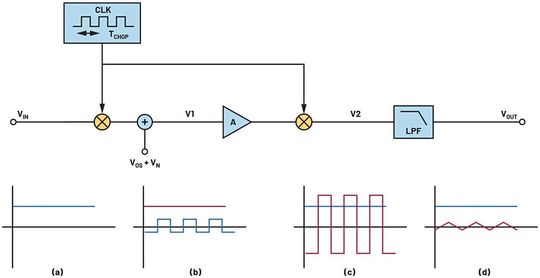
Figure 1: Time domain waveforms of the signal (blue) and errors (red) at (a) input, (b) V1, (c) V2, and (d) VOUT.
(Source: ADI)
Zero-Drift Techniques
Chopping Background: The first zero-drift technique, chopping, uses modulation to separate offset and low frequency noise from the signal content by modulating the errors to higher frequencies.
Figure 1 shows (b) how chopping modulates the input signal (blue waveform) to a square wave, processes that signal in the amplifier, then (c) demodulates the signal at the output back to DC. At the same time, the low frequency errors (red waveform) in the amplifier are (c) modulated at the output to a square wave, which is then (d) filtered by the low-pass filter (LPF).
Similarly, in the frequency domain, the input signal (Figure 2, blue signal) is (b) modulated to the chopping frequency, processed by the gain stage at fCHOP, (c) demodulated at the output back to DC, and finally (d) passed through the LPF. The offset and noise sources (Figure 2, red signal) of the amplifier are processed at DC through the gain stage, (c) modulated to fCHOP by the output chop switches, and finally (d) filtered by the LPF. Since square wave modulation is employed, the modulation occurs around odd multiples of the modulation frequency.
As can been seen in both the frequency and time domain illustrations, there will be some residual error due to the modulated noise and offset since the LPF is not an ideal brick wall.
Auto-Zero Background: A second zero-drift technique, auto-zeroing, is also a dynamic correction technique that works by sampling and subtracting low frequency error sources in an amplifier. Figure 3 shows an example of a basic auto-zero amplifier. It consists of an amplifier with offset and noise, switches to reconfigure the input and output, and an auto-zero sampling capacitor.
During the auto-zero phase, ϕ1, the circuit’s input is shorted to a common voltage and the auto-zero capacitor samples the input offset voltage and noise. Note that the amplifier is unavailable for signal amplification during this phase. For an auto-zeroed amplifier to operate in a continuous manner, two identical channels must be interleaved. This is called ping-pong auto-zeroing.
During the amplification phase, ϕ2, the input is connected back to the signal path and the amplifier is again available for amplifying the signal. The low frequency noise, offset, and drift are cancelled by auto-zeroing, and the remaining error is the difference between the current value and previous sample of the errors. Because low frequency error sources do not change much from ϕ1 to ϕ2, this subtraction works well. High frequency noise, on the other hand, is aliased down to baseband and results in an increased white noise floor as shown in Figure 4.
Due to the noise folding and the need for an additional channel for continuous operation, chopping can be a more power efficient zero-drift technique for standalone op amps.2
Although chopping works well to remove unwanted offset, drift, and 1/f noise, it produces unwanted AC artifacts such as output ripple and glitches. Analog Devices’ recent zero-drift products have taken steps to make the magnitude of these artifacts smaller and located at higher frequencies, which makes filtering easier at the system level.
Ripple Artifact
Ripple is a basic consequence of the chopping modulation technique that moves these low frequency errors to odd harmonics of the chopping frequency. Amplifier designers employ many methods to reduce the effects of ripple, including:
Production offset trimming: The nominal offset can be significantly reduced by performing a one-time initial trim, but the offset drift and 1/f noise remain.
Combining chopping and auto-zeroing: The amplifier is first auto-zeroed then chopped to upmodulate the increased noise spectral density (NSD) to a higher frequency. Figure 4 shows the resulting noise spectrum after chopping and auto-zeroing.
Autocorrection feedback (ACFB): A local feedback loop can be used to sense the modulated ripple at the output and null out the low frequency errors at their source.
Glitch Artifact: Glitches are transient spikes that are caused by charge injection mismatch from the chopping switches. The magnitude of these glitches depends on many factors including source impedance and the amount of charge mismatch.1 The glitch spikes not only cause artifacts at the even harmonics of the chop frequency but also create a residual DC offset, which is proportional to the chopping frequency. Figure 5 (left) illustrates what these spikes look like at V1 (inside the chop switches) and V2 (after the output chop switches) in Figure 1. Additional glitch artifacts at even harmonics of the chop frequency are caused by finite amplifier bandwidth as shown in Figure 5 (right).
Like with ripple, amplifier designers have techniques to reduce the impact of glitches in zero-drift amplifiers:
Charge injection trim: A trimmable charge can be injected into the inputs of a chopped amplifier to compensate for charge mismatch, which reduces the amount of input current at the op amp’s inputs.
Multichannel chopping: This not only reduces glitch magnitude but also moves it to a higher frequency making filtering easier. This technique results in more frequent glitches but with smaller magnitudes than simply chopping at a higher frequency. Figure 6 compares a typical zero-drift amplifier to the ADA4522, which uses this technique to significantly reduce the impact of glitches.
In summary, Figure 7 shows the output voltage of a chopper amplifier, which contains:
Ripple caused by upmodulated offset and 1/f noise at odd multiples of the chopping frequency
Glitches caused by charge injection mismatch of the chopping switches and finite amplifier bandwidth at even multiples of the chopping frequency.
System-Level Considerations
When using a zero-drift amplifier in a data acquisition solution, it is important to understand where the frequency artifacts are and plan for them accordingly.
Finding the Chopping Frequency in the Data Sheet: The chopping frequency is usually explicitly stated in the data sheet, but it can also be determined by looking at the noise spectrum plots. A couple of ADI’s latest zero-drift amplifier data sheets show where in the spectrum artifacts occur.
The ADA4528 data sheet not only explicitly states a chopping frequency of 200 kHz in the Applications Information section of the data sheet, but this can also clearly be seen in the noise density plot in Figure 8.
In the Theory of Operation section of the ADA4522’s data sheet, the chopping frequency is stated to be 4.8 MHz with an offset and ripple correction loop operating at 800 kHz. Figure 9 shows the noise density of the ADA4522 where these noise peaks are visible. There is also a noise bump at 6 MHz due to the reduced phase margin of the loop when in unity gain, which is not unique to zero-drift amplifiers.
It is important to keep in mind that the frequency described in the data sheet is a typical number and can vary from part to part. For this reason, if the system requires two chopped amplifiers for differential signal conditioning, use a dual amplifier because two single amplifiers could have slightly different chopping frequencies that can interact and cause additional IMD.
Matching Input Source Impedance
Transient current glitches interacting with input source impedance can cause differential voltage errors, potentially resulting in additional artifacts at multiples of the chopping frequency. Figure 10 shows spikes in the noise density plot of the ADA4522 with mismatched source resistance (bottom). To mitigate this potential source of error, the system designer should ensure that each input of a chopped amplifier sees the same impedance (top).
IMD and Aliasing Artifacts
When using a chopping amplifier, the input signal can mix with the chopping frequency, fCHOP, to create IMD at fIN ± fCHOP, fIN ± 2fCHOP, 2fIN ± fCHOP, … These IMD products can appear in the band of interest especially as fIN approaches the chopping frequency. To eliminate this issue, select a zero-drift amplifier that has a chopping frequency much greater than the input signal bandwidth and ensure that interferers at frequencies close to fCHOP are filtered before this amplifier stage.
Chopping artifacts can also be aliased when sampling an amplifier output with an ADC. Figure 11 shows an example IMD product resulting from the aliasing of the glitch frequency when the ADC takes a sample. These IMD products depend on glitch and ripple magnitudes and can vary from part to part. When designing a signal chain, it is necessary to include antialiasing filters before the ADC to reduce this IMD.
Filtering the Chopping Artifacts: At the system level, the single most effective way to deal with these high frequency artifacts is by filtering. An LPF between the zero-drift amplifier and the ADC reduces chopping artifacts and avoids aliasing. For this reason, amplifiers with a higher chopping frequency relax the requirements of an LPF and allow for wider signal bandwidth.
As an example, Figure 13 shows the effects of mitigating chopping artifacts with the ADA4522 using various techniques shown in Figure 12: increasing the closed-loop gain, postfiltering, and using a capacitor in parallel with the feedback resistor.
Depending on how much out of band rejection your system needs, a higher order active filter may be required. ADI has many resources to help with filter design including the multiple feedback filter tutorial and the online filter design tool.
Knowing the frequencies where chopping artifacts occur can help to create the required filter. The locations of AC artifacts caused by zero-drift amplifiers are listed below: Ripple – fCHOP, 3fCHOP, 5fCHOP, …; Glitch – 2fCHOP, 4fCHOP, 6fCHOP, …; Amplifier IMD – fIN ± fCHOP, fIN ± 2fCHOP, 2fIN ± fCHOP, …; Aliasing – fARTIFACT ± fSAMPLE, fARTIFACT ± 2fSAMPLE, fARTIFACT ± 3fSAMPLE, ….
Conclusion: By understanding high frequency artifacts in zero-drift amplifiers, system designers can be more confident in using zero-drift op amps for their wider bandwidth applications. These system design considerations include:
Matching source input impedance seen by a zero-drift amplifier’s inputs
Using a dual amplifier for differential signal conditioning
Finding the frequency of artifacts in the data sheet noise spectrum
Designing a filter such that it reduces the impact of high frequency artifacts caused by dynamic offset reduction techniques
Understanding and planning for high frequency artifacts in the frequency domain.
Es ist für uns eine Selbstverständlichkeit, dass wir verantwortungsvoll mit Ihren personenbezogenen Daten umgehen. Sofern wir personenbezogene Daten von Ihnen erheben, verarbeiten wir diese unter Beachtung der geltenden Datenschutzvorschriften. Detaillierte Informationen finden Sie in unserer Datenschutzerklärung.
Einwilligung in die Verwendung von Daten zu Werbezwecken
Ich bin damit einverstanden, dass die Vogel Communications Group GmbH & Co. KG, Max-Planckstr. 7-9, 97082 Würzburg einschließlich aller mit ihr im Sinne der §§ 15 ff. AktG verbundenen Unternehmen (im weiteren: Vogel Communications Group) meine E-Mail-Adresse für die Zusendung von redaktionellen Newslettern nutzt. Auflistungen der jeweils zugehörigen Unternehmen können hier abgerufen werden.
Der Newsletterinhalt erstreckt sich dabei auf Produkte und Dienstleistungen aller zuvor genannten Unternehmen, darunter beispielsweise Fachzeitschriften und Fachbücher, Veranstaltungen und Messen sowie veranstaltungsbezogene Produkte und Dienstleistungen, Print- und Digital-Mediaangebote und Services wie weitere (redaktionelle) Newsletter, Gewinnspiele, Lead-Kampagnen, Marktforschung im Online- und Offline-Bereich, fachspezifische Webportale und E-Learning-Angebote. Wenn auch meine persönliche Telefonnummer erhoben wurde, darf diese für die Unterbreitung von Angeboten der vorgenannten Produkte und Dienstleistungen der vorgenannten Unternehmen und Marktforschung genutzt werden.
Meine Einwilligung umfasst zudem die Verarbeitung meiner E-Mail-Adresse und Telefonnummer für den Datenabgleich zu Marketingzwecken mit ausgewählten Werbepartnern wie z.B. LinkedIN, Google und Meta. Hierfür darf die Vogel Communications Group die genannten Daten gehasht an Werbepartner übermitteln, die diese Daten dann nutzen, um feststellen zu können, ob ich ebenfalls Mitglied auf den besagten Werbepartnerportalen bin. Die Vogel Communications Group nutzt diese Funktion zu Zwecken des Retargeting (Upselling, Crossselling und Kundenbindung), der Generierung von sog. Lookalike Audiences zur Neukundengewinnung und als Ausschlussgrundlage für laufende Werbekampagnen. Weitere Informationen kann ich dem Abschnitt „Datenabgleich zu Marketingzwecken“ in der Datenschutzerklärung entnehmen.
Falls ich im Internet auf Portalen der Vogel Communications Group einschließlich deren mit ihr im Sinne der §§ 15 ff. AktG verbundenen Unternehmen geschützte Inhalte abrufe, muss ich mich mit weiteren Daten für den Zugang zu diesen Inhalten registrieren. Im Gegenzug für diesen gebührenlosen Zugang zu redaktionellen Inhalten dürfen meine Daten im Sinne dieser Einwilligung für die hier genannten Zwecke verwendet werden. Dies gilt nicht für den Datenabgleich zu Marketingzwecken.
Recht auf Widerruf
Mir ist bewusst, dass ich diese Einwilligung jederzeit für die Zukunft widerrufen kann. Durch meinen Widerruf wird die Rechtmäßigkeit der aufgrund meiner Einwilligung bis zum Widerruf erfolgten Verarbeitung nicht berührt. Um meinen Widerruf zu erklären, kann ich als eine Möglichkeit das unter https://contact.vogel.de abrufbare Kontaktformular nutzen. Sofern ich einzelne von mir abonnierte Newsletter nicht mehr erhalten möchte, kann ich darüber hinaus auch den am Ende eines Newsletters eingebundenen Abmeldelink anklicken. Weitere Informationen zu meinem Widerrufsrecht und dessen Ausübung sowie zu den Folgen meines Widerrufs finde ich in der Datenschutzerklärung, Abschnitt Redaktionelle Newsletter.





:quality(80)/p7i.vogel.de/wcms/d8/78/d878b7bfc23826e6ddfce42443836d28/0130384280v2.jpeg "Jensen Huang bei einer Präsentation der GB200-Grace Blackwell Plattform: Der Gründer und CEO von Nvidia wurde für seinen Beitrag zum Vorantreiben von KI-Technologien mit dem Imec Lifetime Achievement Award 2026 ausgezeichnet. (Bild: Nvidia)")
:quality(80)/p7i.vogel.de/wcms/e9/ce/e9ce137e87eccac328ec5504c586c477/0129711019v3.jpeg "Im Rahmen eines Entwicklungsprojekts wurden verschiedene bleireduzierte und bleifreie Kupfer-Beryllium-basierte Legierungskonzepte untersucht, die die Anforderungen an hohe Festigkeiten als auch eine hohe elektrische Leitfähigkeit erfüllen. (Bild: Materion)")
:quality(80)/p7i.vogel.de/wcms/68/46/684697b6eb687384e0d8c6803450401a/0130056395v2.jpeg "Das TUM RoboGym (powered by Neura) in der Planungsphase (Grafik). Die TU München und das Robotik Startup Neura Robotics planen, gemeinsam am Campus der TU München das weltgrößte Robotik-Trainingszentrum einzurichten. (Bild: Neura Robotics)")
:quality(80)/p7i.vogel.de/wcms/88/a1/88a15070daae8c090f4256580cf8a61c/0130329906v2.jpeg "Hybride Netzwerke: Mit dem LiveLink Bluetooth NLC Gateway lassen sich Funk- und DALI-Komponenten in einem Netzwerk vereinen. (Bild: Trilux)")
:quality(80)/p7i.vogel.de/wcms/f7/90/f79070d95e48c6d1a5c77c5d05a7e4da/0130344018v1.jpeg "Auch große Player im Speichermarkt investieren nun Stark, um sich langfristig die Versorgung mit DRAM-Bausteinen zu sichern: Der taiwanesische Speicherhersteller Nanya Technology hat über eine Privatplatzierung von Aktien etwa 2,5 Mrd. US-$ eingefahren. Zu den Investoren zählen unter anderem Sandisk, Kioxia und Sk hynix, die sich hierüber eine langfristig garantierte Versorgung mit DRAM erhoffen. (Bild: Nanya Technology)")
:quality(80)/p7i.vogel.de/wcms/1b/bb/1bbb096db776f5ab19ff87fc7f86392f/0130318021v2.jpeg "Prototyp des neuartigen Sensorchips: ETH-Forschende haben ein Sensorsystem entwickelt, das produzierte Daten direkt im Chip fälschungssicher signiert und das unbemerkte Fälschen von Daten praktisch unmöglich machen soll. (Bild: Caroline Arndt Foppa / ETH Zürich)")
:quality(80)/p7i.vogel.de/wcms/6a/42/6a423ced6604acf7d3eef8e4c0c2bd39/0130317237v4.jpeg "Mit der AGI-CPU wagt Arm nach eigenen Angaben einen \"historischen Schritt\": Das Unternehmen präsentiert sich mit dem auf KI in Rechenzentren abzielenden Prozesser erstmals als Anbieter eigener Chips, nicht nur als reiner IP-Lizenzgeber. (Bild: Arm)")
:quality(80)/p7i.vogel.de/wcms/a2/31/a2319b6d6b473424b275f6489bbce348/0130213768v2.jpeg "KI kann in China günstig arbeiten und die Ergebnisse rasant in alle Welt liefern. (Bild: Dall-E / KI-generiert)")
:quality(80)/p7i.vogel.de/wcms/c2/88/c28805ea7b2261235475146a5b0c61f8/0130313028v2.jpeg "x86 trifft adaptive Logik: Auf der Messe demonstriert AMD die industrielle Vernetzung eines Node-RED-Gateways (links) mit Zynq-UltraScale+-Controllern (Mitte) und einer Soft-SPS auf Basis der Ryzen AI P100 Serie (rechts). (Bild: Manuel Christa)")
:quality(80)/p7i.vogel.de/wcms/fa/8d/fa8dedee195f29c33c89d86311c258ee/0130104146v2.jpeg "Kompakte KI-Power: Die Smart-Module SIM8668 und SIM8666 von Simcom vereinen auf kleinstem Raum eine Quad-Core-CPU samt integrierter NPU für ressourcenschonende Industrie- und Robotikanwendungen. (Bild: Chip: Simcom/Hintergrund: KI-generiert)")
:quality(80)/p7i.vogel.de/wcms/cc/13/cc1378375499a26b5ddbb309d2155acb/0130085649v2.jpeg "Vom Hardware-Produzenten zum Software-Anbieter: Neocortec lizenziert seinen NeoMesh-Protokoll-Stack zunehmend direkt an OEMs und Dritthersteller, anstatt ausschließlich auf den Verkauf eigener Funkmodule zu setzen. (Bild: mc/VCG)")
:quality(80)/p7i.vogel.de/wcms/85/b0/85b0b32128f6d1968e975043f1e0b67b/0130342166v3.jpeg "Nahe am Versagen: Vier Aufnahmen derselben Messung, unterschiedlich eingefärbt – je heller, desto höher die mechanische Spannung im Material. An der Spitze des wachsenden Dendriten zeigt sich ein charakteristisches Fliegen-Muster. (Bild: Courtesy of Cole Fincher and Yet-Ming Chiang)")
:quality(80)/p7i.vogel.de/wcms/81/c0/81c03683c33cf69903df78a57145bcca/0130328599v2.jpeg "Solid-State-Transformatoren: Die Siliziumkarbid-Leistungshalbleiter von Infineon sollen den Wirkungsgrad, die Leistungsdichte und die Zuverlässigkeit der Halbleitertransformator-Plattform von DG Matrix verbessern. (Bild: Infineon Technologies AG)")
:quality(80)/p7i.vogel.de/wcms/6d/f0/6df06a1488ceb6357c287fee993fad65/0130161592v3.jpeg "Die weltweit erste voll funktionsfähige Quantenbatterie als Proof-of-Concept, entwickelt von CSIRO und seinen Kooperationspartnern, der University of Melbourne und dem RMIT. (Bild: CSIRO and collaborators, The University of Melbourne and RMIT)")
:quality(80)/p7i.vogel.de/wcms/10/45/1045969e69a1db4aaa73d0f74f55cc02/0129962687v2.jpeg "Bosch Rexroth und AMD arbeiten gemeinsam an Software-Defined Automation: ctrlX OS unterstützt nun auch auf AMD Embedded x86-CPUs und adaptive SoCs und verspricht so noch größere Hardware-DesignFlexibilität, nahtlose Skalierbarkeit und eine sichere, modulare Betriebssystem-Grundlage. (Bild: Bosch Rexroth AG)")
:quality(80)/p7i.vogel.de/wcms/cd/32/cd3243e4a9a6476265ef6ea9463dfbd8/0129852659v2.jpeg "Die PIC64-Serie an Multicore-Mikroprozessoren setzt auf RISC-V-Kerne und eignen sich speziell für Anwendungen mit asynchronem Multipricessing (AMP) in intelligenten Embedded-Edge-Anwendungen. (Bild: Microchip)")
:quality(80)/p7i.vogel.de/wcms/c7/f6/c7f61d0437c7f8fca3c6ff947ba2ad62/0129322490v2.jpeg "AMD hat die zweite Generation der Kintex UltraScale+ Gen 2 FPGA-Familie vorgestellt, die mit PCIe Gen4 den 4K-AV-over-IP-Betrieb für 4K/8K-Medienanwendungen unterstützt. (Bild: AMD)")
:quality(80)/p7i.vogel.de/wcms/66/0c/660c31afa35398bac9be42f2be73fdc4/0129073529v2.jpeg "FPGAs lösen Performance-Engpässe, gelten aber in der Programmierung als schwer zugänglich. Die universelle Programmiersprache Livt soll die Hürde senken – korrekt, deterministisch und HDL-kompatibel. (Bild: Toby Giessen / VCG)")
:quality(80)/p7i.vogel.de/wcms/ba/e4/bae4e54395e5a53088060531ef99b814/0130359274v2.jpeg "Mit dem Fuse EDA AI Agent verfolgt Siemens EDA ein umfassendes Programm, alle Aspekte des Chipdesigns mit KI-Coworkern zu erleichtern, auch in Questa One. (Bild: Siemens EDA)")
:quality(80)/p7i.vogel.de/wcms/35/af/35af7dd326d198475d06fbb69aa600b5/0130175971v2.jpeg "Diff GT kann in einer kostenlosen Probeversion ausprobiert werden. (Bild: CSci)")
:quality(80)/p7i.vogel.de/wcms/c0/2e/c02e7bf72bfc434888c37100e2511681/0130127767v3.jpeg "„Wegen seiner kompakten Bauweise, des modularen Aufbaus und der hohen Effizienz ist der Axialflussmotor eine attraktive Alternative zur etablierten Radialflussmotor-Topologie“, PEM-Leiter Professor Achim Kampker (Bild: RWTH Aachen University)")
:quality(80)/p7i.vogel.de/wcms/ac/31/ac31fbd47f85c24ae7d13a73555c85e6/0130236430v2.jpeg "Mess- Module: Das Modul 720301 in Kombination mit dem SL2000 ermöglicht unter anderem RMS- und Leistungsberechnungen. (Bild: Yokogawa)")
:quality(80)/p7i.vogel.de/wcms/ef/a0/efa0d8af7bcf1d64636b877a04b853d9/0130136738v2.jpeg "Nigel unterstützt Ingenieure und Entwickler bei ihrer täglichen Arbeit. (Bild: Emerson NI)")
:quality(80)/p7i.vogel.de/wcms/bf/82/bf82f81061b759c454e15ec4c2e7560b/0130110139v2.jpeg "48 Volt im Fahrzeug: Ziel ist eine effiziente Energienutzung, einfache Integration sowie eine zuverlässige Leistung. Doch mit den Möglichkeiten kommen auch Probleme. (Bild: Leoni)")
:quality(80)/p7i.vogel.de/wcms/74/96/74964a7715c738a9e8b17681445ceed3/0130103633v2.jpeg "Zusammen mit dem Vektor-Netzwerkanalysator PNA/PNA-X kann der Lightwave Component Analyzer N4378A von Keysight optische Transceiver-Komponenten mit 1,6 T und darüber hinaus charakterisieren. (Bild: Keysight)")
:quality(80)/p7i.vogel.de/wcms/2f/b5/2fb51bc9f8702faa2195070c97fe7754/0130349161v2.jpeg "Edge-KI für den Shopfloor: Siemens-CEO Roland Busch präsentiert einen Industrial Edge PC mit integrierter Nvidia-GPU, der als Echtzeit-Orchestrator für Flotten von SPSen dient. (Bild: Siemens)")
:quality(80)/p7i.vogel.de/wcms/78/ab/78abfaed29756f96d23ae135f707026a/0130332461v2.jpeg "Zentrale in Ankara: Der Hauptsitz von NGX Storage befindet sich in der türkischen Hauptstadt. (Bild: NGX Storage)")
:quality(80)/p7i.vogel.de/wcms/b9/e5/b9e56a5eba2fbf56a6e3efac57f96dbb/0130345302v2.jpeg "Made in India: Angaben der India Electronics and Semiconductor Association (IESA) dürfte das Land in der Lage sein, bis Anfang 2027 zwischen 75 und 80 Millionen Chips produzieren zu können, sobald die derzeit im Bau befindlichen Anlagen ihren Betrieb aufnehmen. (Bild: Pixabay (Montage: Sebastian Gerstl))")
:quality(80)/p7i.vogel.de/wcms/9c/06/9c0651d3c2cec436277af3f698a6cf3f/0130342944v2.jpeg "Samsung-Standort im texanischen Taylor: Samsung Foundry plant Analystenmeldungen zufolge den Bau einer zweiten Wafer-Fab im US-Bundesstaat. (Bild: Samsung)")
:quality(80)/p7i.vogel.de/wcms/02/f8/02f84dfb1ad4ccfe94f3b4045bcee023/0130316909v2.jpeg "Der anhaltende Irankrieg und die Blockade der Straße von Hormus droht die bestehende Krise im Chipmarkt zu verschärfen: Der für die Fertigung wichtige Rohstoff Helium kann derzeit nicht aus Katar ausgeliefert werden. Vor allem südkoreanische Hersteller wie Samsung und SK Hynix, aber auch Hersteller in Taiwan sind dadurch betroffen. (Bild: Dall-E / KI-generiert)")
:quality(80)/p7i.vogel.de/wcms/a2/b5/a2b54e377a6050b54acf8ac938b63ef8/0130318106v2.jpeg "NIS2: Die Richtlinie zwingt Unternehmen, ihre Produktionslandschaften systematisch zu erfassen und Risiken auf Basis realer Daten zu bewerten. (Bild: AMDT)")
:quality(80)/p7i.vogel.de/wcms/00/08/0008cc4b713f15ab39492f6c66b0485f/0130362942v2.jpeg "Wafer: Ein Symbolbild (Bild: Dall-E / KI-generiert)")
:quality(80)/p7i.vogel.de/wcms/d6/ea/d6eac438c362c545cab42ef0f30bcfc0/0130136975v2.jpeg "Die Bewerbungsphase für den James Dyson Award 2026 ist gestartet. (Bild: Dyson)")
:quality(80)/p7i.vogel.de/wcms/e5/6c/e56ceb935ba09cb66a4fd0f961b2d3e9/0129642888v2.jpeg "(Bild: Vogel Professional Education)")
:quality(80)/p7i.vogel.de/wcms/69/1f/691f39ba12be3cad90eb88bdabc456a6/0127321404v2.jpeg "Das Kreativteam Christian Göller, GreatScott! und Christopher Becht (v. l. n. r.): erfolgreiches Creator-Marketing im B2B-Sektor (Bild: Würth Elektronik)")
:fill(fff,0)/images.vogel.de/vogelonline/companyimg/92100/92124/65.jpg "AnalogDevices.jpg ()")
:quality(80)/p7i.vogel.de/wcms/b9/ee/b9ee66e9d1434aa24560409a13ada8d9/0107754445.jpeg "Figure 2: Frequency domain spectrum of the signal (blue) and errors (red) at (a) input, (b) V1, (c) V2, and (d) VOUT.(Source: ADI)")
:quality(80)/p7i.vogel.de/wcms/61/3d/613de52b3cd6e3c3931656b8ff3e07d4/0107761840.jpeg "Figure 3: A basic auto-zero amplifier.(Source: ADI)")
:quality(80)/p7i.vogel.de/wcms/fd/06/fd06fdb0ae100a94814039eef5ad7af5/0107754606.jpeg "Figure 4: Noise PSD: before chop or AZ, after AZ, after chop, and after chop and AZ.(Source: ADI)")
:quality(80)/p7i.vogel.de/wcms/e1/23/e12392a07ab4cb0642770a249446a7a5/0107754611.jpeg "Figure 5: (L) Glitch voltage from charge injection at V1 (inside the chopping switches) and V2 (outside the chopping switches) in Figure 1; (R) glitches caused by finite amplifier bandwidth at V1 and V2 in Figure 1.(Source: ADI)")
:quality(80)/p7i.vogel.de/wcms/ab/73/ab73d241611c109a242a4e5f1b50d01e/0128483827v4.jpeg "Filter elements in various SMD designs. (Bild: TAIYO YUDEN)")
:quality(80)/p7i.vogel.de/wcms/da/e4/dae45caa7f4fa7125e17b07d9da016bb/0125786170v2.jpeg "Soft termination prevents cracks by absorbing mechanical stress through a resin layer. (Bild: TAIYO YUDEN CO., LTD.)")