



:quality(80)/p7i.vogel.de/wcms/d7/05/d7050b29ea044c2d42f326a2461dab62/0133138830v2.jpeg "David Walther (links) und Carlos Rincon, wissenschaftliche Mitarbeiter am Lehrstuhl für Werkstoffe und Zuverlässigkeit mikrotechnischer Systeme der Technischen Universität Chemnitz, installieren einen neuen Prüfstand im Inneren der Kammer eines Helium-Kryostaten. (Bild: TU Chemnitz)")
:quality(80)/p7i.vogel.de/wcms/68/82/688233aa2cd9e89a6f042a1f3f7332d7/0133122313v2.jpeg "Vom physischen Chip zum stabilen Rechenraum: Die industrielle Nutzbarkeit von Quantenprozessoren bemisst sich an der Circuit-Level-Performance – nicht an reinen Qubit-Zahlen. (Bild: Gemini / KI-generiert)")
:quality(80)/p7i.vogel.de/wcms/40/77/40770331c5b4af5e59516bb8bb76a866/0133084281v2.jpeg "Der extraleichte R1 von Unitree. (Bild: Unitree)")
:quality(80)/p7i.vogel.de/wcms/37/b7/37b756f3da1537fc72521e7de20a54ce/0133191981v2.jpeg "Symbolbild: Der KI-Rechencenter-Boom wirkt sich auch auf die Verfügbarkeit von passiven Bauelementen aus. (Bild: Dall-E / KI-generiert)")
:quality(80)/p7i.vogel.de/wcms/07/ea/07ea8079334f970dc47e1c66f288042d/0133178779v2.jpeg "Marcus Ossiander, Associate Professor am Institut für Experimentalphysik der TU Graz, war an der Entwicklung der Quantenwell-Struktur mit Metaoberfläche beteiligt. (Bild: Lunghammer - TU Graz )")
:quality(80)/p7i.vogel.de/wcms/04/99/04995f62f22bc0ad601344e9df68ae8e/0133152766v2.jpeg "Marcus Ossiander vom Institut für Experimentalphysik der TU Graz war an der Entwicklung der Quantenwell-Metasurface beteiligt. (Bild: Lunghammer/TU Graz)")
:quality(80)/p7i.vogel.de/wcms/55/4a/554ae759b37bf6f75ae0a015b8ab1534/0133183641v2.jpeg "Edge-AI-Security: Je autonomer KI-Systeme am Netzrand agieren, desto wichtiger wird eine durchgängige Vertrauenskette – vom sicheren Boot bis zum geschützten Modell. (Bild: NXP)")
:quality(80)/p7i.vogel.de/wcms/63/9f/639fcf9a3405afeb5b40ff010966d74b/0133127211v2.jpeg "Einheitliche Schnittstelle: Mit dem Model Hardware Standard will Anthropic erreichen, dass KI-Agenten programmierbare Laborgeräte und Roboterarme über eine einheitliche Treiberschicht ansprechen können. (Bild: Dall-E / KI-generiert)")
:quality(80)/p7i.vogel.de/wcms/da/1b/da1bc353f79ddc2b27c44c100b715c99/0133127761v2.jpeg "(Bild: Innodisk)")
:quality(80)/p7i.vogel.de/wcms/7f/2f/7f2f8fdc44bb9a8eb10c91d4ed89950f/0132825173v2.jpeg "Immer im Überblick: Das volle Programm des ESE Kongress 2026 mit über 100 Beiträgen - Keynotes, Vorträge und Seminare - ist nun auf www.ese-kongress.de online. (Bild: Elisabeth Wiesner)")
:quality(80)/p7i.vogel.de/wcms/de/4f/de4f4d6ff4eca78d95a5082b9028e120/0132945424v2.jpeg "Das BrainBoard 1500 bringt den KI-Beschleuniger AKD1500 auf ein Entwicklerboard. (Bild: Brainchip)")
:quality(80)/p7i.vogel.de/wcms/7b/8a/7b8a66fdd13fe9fdb60be36890abfc99/0133086566v2.jpeg "Vantys kombiniert eine hochpräzise DC-Hochspannungsversorgung mit einer besonders schnellen Regelung, flexiblen Schnittstellen und einer wartungsfreien Systemarchitektur (Bild: DBK)")
:quality(80)/p7i.vogel.de/wcms/64/94/64946fe89c716c313dfb32bec5b30a0a/0133056967v2.jpeg "Unverzichtbar: Schaltnetzteile haben sich über Jahrzehnte kontinuierlich weiterentwickelt. Fortschritte bei Leistungshalbleitern, magnetischen Bauelementen, Regelungstechnik und Wandlertopologien ermöglichen heute hohe Wirkungsgrade und Leistungsdichten bei kompakter Bauform. (Bild: Stefan Bausewein)")
:quality(80)/p7i.vogel.de/wcms/a4/07/a4075a688c12316dad6007f9a649ec44/0133085979v2.jpeg "Vishay erweitert sein Portfolio um die RPWA‑650‑Serie. (Bild: Vishay)")
:quality(80)/p7i.vogel.de/wcms/3d/67/3d6777d7a99bdf88f86798cd73451538/0133004756v2.jpeg "Die AGI-CPU von Arm wurde im März 2026 angekündigt. Im Rahmen der Hot Chips 2026 sind die Entwickler ins Detail gegangen. (Bild: Arm)")
:quality(80)/p7i.vogel.de/wcms/8a/2e/8a2e7d2a89ffe55c545dd6c831ed154e/0132246788v2.jpeg "Über 500 Teilnehmer, 120 Referenten: Die FPGA Conference Europe platzte in diesem Jahr aus allen Nähten – und wurde ihrem Anspruch als Leitkongress der FPGA-Welt einmal mehr gerecht. (Bild: Tobi Giessen)")
:quality(80)/p7i.vogel.de/wcms/06/a1/06a158e32b18d99fcea65547cec5d4c7/0132069489v2.jpeg "Mit direkter Integration von Speicher ins Chip-Package verspricht AMD mit dem Versal Premium Gen 2 SoC eine schnellere Datenübertragung, verringerte Latenz und einem potentiell geringere Stromverbrauch. (Bild: AMD)")
:quality(80)/p7i.vogel.de/wcms/86/2a/862afb1de8423bb7401098a2fd268281/0131792672v2.jpeg "Bild 1: Ein Spannungsversorgungskonzept für Lasten, welche eine vorgegebene Ein- und Abschaltreihenfolge (Sequencing) benötigen. (Bild: ADI)")
:quality(80)/p7i.vogel.de/wcms/91/de/91de4610a7ffe43924e12da2981b3e28/0133086550v2.jpeg "Die neuen AEVA- und AEVB-Serien von Kyocera AVX sind für bis zu 30 g Beschleunigung ausgelegt und lassen sich automatisiert bestücken. (Bild: Kyocera AVX)")
:quality(80)/p7i.vogel.de/wcms/a6/c0/a6c06a22bea85ff7f6c13ce4d6c8b06a/0133021608v2.jpeg "Ein kernloser Hall-Effekt-Stromsensor erfasst mehrere räumliche Komponenten des Magnetfelds und soll dadurch Messfehler infolge von Vibrationen und Montageabweichungen reduzieren. (Bild: Texas Instruments)")
:quality(80)/p7i.vogel.de/wcms/4e/9f/4e9fdabefc243effcbc732982d6c6044/0133184134v2.jpeg "5G-Netzwerke und Endgeräte müssen Steuerinformationen regelmäßig überwachen. Die 3GPP-Release-17-Funktion SSSG soll diesen Aufwand reduzieren (Symbolbild). (Bild: frei lizenziert)")
:quality(80)/p7i.vogel.de/wcms/52/9b/529b7bc41f8c6f43d6ef52d93fa7523e/0133110886v2.jpeg "Ein Mitarbeiter von NMi Testlab entnimmt eine elektrische Baugruppe aus einer thermischen Prüfkammer. Der Hitzeschutzanzug schützt ihn beim Umgang mit dem Prüfling unter hohen Temperaturen. (Bild: NMI Testlab)")
:quality(80)/p7i.vogel.de/wcms/45/32/45329f4e0d2749bcf0adebfc89eff3a4/0133165310v2.jpeg "Messtechnik gehört zur Validierung elektronischer Systeme. Bei schnellen Datenschnittstellen prüfen Entwickler unter anderem Signalqualität, Jitter und Übertragungsverluste. (Bild: frei lizenziert)")
:quality(80)/p7i.vogel.de/wcms/34/99/3499ee98b0439dde12ec3ef9ed421003/0133126924v2.jpeg "Linearverstärker mit integriertem Bias-Tee gleicht Signalverluste im Testpfad aus. (Bild: Anritsu)")
:quality(80)/p7i.vogel.de/wcms/cf/56/cf565dd8e45c688918f906980e9d5d6c/0133164470v2.jpeg "KI-basierende Robotik hat das Potenzial sich in zehn bis fünfzehn Jahren zu einem Industriezweig in Europa hin zu entwickeln, der in der Größe und Bedeutung der heutigen Automobilindustrie entspricht. Hier ist zu sehen, wie DLR-Roboter Rollin‘ Justin eigenständig eine Alltagsaufgabe übernimmt und die Küchenpflanze wässert. (Bild: DLR (CC BY-NC-ND 3.0))")
:quality(80)/p7i.vogel.de/wcms/76/23/7623ef5cda48852baabdae0fb68295e3/0133127938v2.jpeg "Das Wachstum der Nachfrage nach Elektronik- und Halbleiterprodukten wird voraussichtlich anhalten, was Hersteller dazu drängt, zu innovieren und schneller zu produzieren, während Herausforderungen bewältigt werden. (Bild: Siemens)")
:quality(80)/p7i.vogel.de/wcms/c0/86/c086239f80e454b7b759d972c14506f2/0133137734v2.jpeg "Offene und rekonfigurierbare, also für unterschiedliche Anwendungen anpassbare, Hard- und Softwareplattformen könnten eine deutlich größere Rolle bei der Entwicklung neuer Ultraschall-Wearables übernehmen.
(Bild: TU Bergakademie Freiberg )")
:quality(80)/p7i.vogel.de/wcms/9b/7a/9b7a862b6a4041366b45b37472dacac1/0133147099v2.jpeg "Die Leistung des EMS-Dienstleisters steht im Vordergrund, doch die lässt sich nur schlecht fotografieren und in Sichtbarkeit verwandeln. Beim EMS-Tag wollen wir Ihnen im Rahmen eines Workshops helfen. (Bild: Dall-E / KI-generiert)")
:quality(80)/p7i.vogel.de/wcms/28/02/2802d3016d447b3034dbedf878deee19/0133155599v2.jpeg "Perzeptron zeig auf der EFX mit Partnern zwei Live-Use-Cases. (Bild: Perzeptron)")
:quality(80)/p7i.vogel.de/wcms/17/40/17408075954df78831c35e7576884ba2/0133153751v2.jpeg "Die steigt Nachfrage nach KI-Infrastruktur wirkt sich direkt auf die Lieferkette aus und entlarvt Flaschenhälse in der Produktion. (Bild: Broadcom)")
:quality(80)/p7i.vogel.de/wcms/7e/1f/7e1f6804ac4b005ac165d39f2c0eab34/0133164888v2.jpeg "Z.ai hat ChatGPT gesagt, wie es gerne dargestellt werden möchte. (Bild: Dall-E / KI-generiert)")
:quality(80)/p7i.vogel.de/wcms/c1/f4/c1f479f73f54a5ba9a2698314a3d2517/0133155134v2.jpeg "Der Reinraum Klasse 8 von Beflex in Frickenhausen. (Bild: Kontron / Eberl Photo)")
:quality(80)/p7i.vogel.de/wcms/08/ff/08ffb0090e03aed8af0efea86bdaa375/0133122730v2.jpeg "Jan Krott (links) und Michael Blass (rechts) bei der Vertragsunterzeichnung zur Übernahme der Krott Electronic GmbH durch Igus. Durch die Bündelung der Kompetenzen soll das Angebot an individuellen Systemlösungen weiter ausgebaut werden (Bild: Igus SE & Co. KG)")
:quality(80)/p7i.vogel.de/wcms/6b/1d/6b1dde86fdb120b4cf9b8bc8573c415a/0133056789v3.jpeg "Wir bezahlen für Systeme, die menschliche Arbeit übernehmen, ohne bislang geklärt zu haben, wie die dadurch entstehende Wertschöpfung künftig verteilt werden soll. (Bild: frei lizenziert)")
:quality(80)/p7i.vogel.de/wcms/47/20/47201c1ce3692dbdb4e7e62709de4e16/0132649717v3.jpeg "Ingenieurberufe verändern sich: Neben der aktuellen Konjunktur treiben Digitalisierung, KI und neue Technologien den Bedarf an kontinuierlicher Qualifizierung. (Bild: frei lizenziert)")
:quality(80)/p7i.vogel.de/wcms/4e/41/4e4159d1e93e67d47bd2f51a90691b23/0131548978v2.jpeg "Transformation im Engineering: KI-gestützte Systeme generieren zunehmend selbstständig Schaltschranklayouts und entlasten Konstrukteure von zeitraubenden Routineaufgaben. (Bild: WSCAD)")
Anbieter zum Thema
:fill(fff,0)/p7i.vogel.de/companies/66/f6/66f673630a98a/logo-mc-rgb-300x300.png "logo-mc-rgb-300x300 (MicroConsult)")
:fill(fff,0)/p7i.vogel.de/companies/5f/f7/5ff7108437e0a/logo-20190211-02.jpg "LOGO_20190211-02.jpg (http://www.apacereu.com/Downloads/ApacerLOGO.jpg)")
:fill(fff,0)/p7i.vogel.de/companies/67/8a/678a0c5c3e273/logo-caltest-instruments-signet.png "logo-caltest-instruments-signet (Caltest Instruments GmbH)")
Test Automation @ iSYSTEM
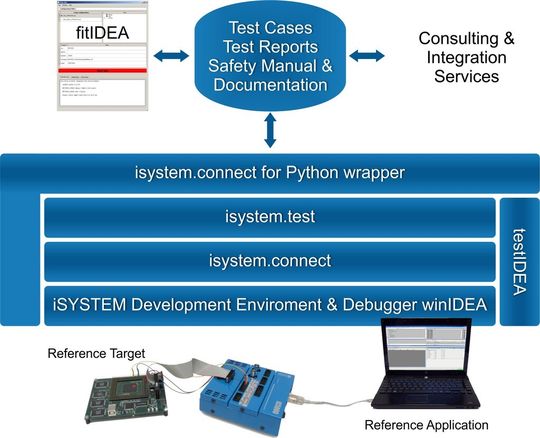
fitIDEA is an automated test tool that was initially developed for iSYSTEM internal purposes. It uses a generic API (application programming interface) of the iSYSTEM development environment named winIDEA (isystem.connect) and the public scripting language Python.
As a tool manufacturer iSYSTEM faces almost the same challenges as their customers: Lots of different hardware variants, historically grown code base plus legacy code, and extended functionality according to higher requirements of customers, increase the complexity of development and test tools as well and makes it evident to introduce test automation.
All critical aspects of the embedded software debugger and integrated unit test tool suite are tested. Amongst others, the following functions are checked:
- Standard debugging and IDE functions like download to flash memory, target system memory access (read, write, real-time access), breakpoint functions (execution and access)
- Specific time measurements to test advanced debugging, like trace and profiler functionality
- Software test with code coverage and unit test
- API functionality
The fitIDEA concept is based on the deterministic behavior of the test environment comprising the following components:
- Reference system (standard board of the semiconductor manufacturer, iSYSTEM board, customer-specific system)
- Reference application for such a board/system
- iSYSTEM debugging hardware (blue box)
- iSYSTEM software (winIDEA and testIDEA on PC side)
- Compiler
The reference application for the respective target system is the key element. It is programmed thus that a deterministic (defined and reproducible) behavior is exhibited:
Example:
char g_c;void Increment(){ g_c++;}The execution of this function obviously increments the variable g_c by one. fitIDEA now carries out the following steps:
- Execute the code until Increment() is requested
- Read the value of variable g_c
- Execute the function through to the end
- Read the value of variable g_c
The test was passed if the second read-out of variable g_c shows that the value was incremented by one. This test covers the following functions:
- Identification of code and data symbols from the download file (set breakpoints to symbolic values, read variable values through symbolic names)
- Interrupt of execution (a breakpoint was set on function entry and exit)
- Execution of code and CPU status verification (run until, wait until CPU stops)
- Read access to memory (read-out of variable values)
- C compiler: code and debug information was generated
Even if a component of the test environment changes (iSYSTEM tool, compiler, target, ...), the application has to maintain its behavior, and fitIDEA, as the test tool, still has to deliver the same result. The Python test scripts are created by dedicated test engineers. The iSYSTEM reference application uses reference commands (//rt) to save expected results of a test. These references are stored in the source code of the references application (see image above) and are thus independent of the compiler used.
char g_c;void Increment(){ g_c++; //rt step_and_evaluate: value[+1]}So far, more than 60 hardware configurations in the tests benches are actively running tests, and each configuration has about 100 test cases. Each developer can access all configurations and can also run tests locally before taking over the modified program code. Automatic testing with fitIDEA is executed overnight, and test results are available the next morning, thus facilitating seamless integration. New test cases are continuously added based on new functionalities, customer applications or resolved support cases.
(ID:38231760)
:quality(80)/p7i.vogel.de/wcms/22/13/22139dbc66e329989c7888100bd9762a/0127351267v2.jpeg "EasyLogix Part Library (Bild: EasyLogix)")
:quality(80)/p7i.vogel.de/wcms/ab/73/ab73d241611c109a242a4e5f1b50d01e/0128483827v4.jpeg "Filter elements in various SMD designs. (Bild: TAIYO YUDEN)")