GaN Reliability Testing Beyond AEC Proves Robustness for Lidar
Von
Alex Lidow, Robert Strittmatter, Shengke Zhang and Alejandro Pozo*
The superior performance of GaN power transistors and integrated circuits enable groundbreaking laser driver performance. provide the accuracy and robustness needed to ensure the performance and safety required for autonomous navigation.
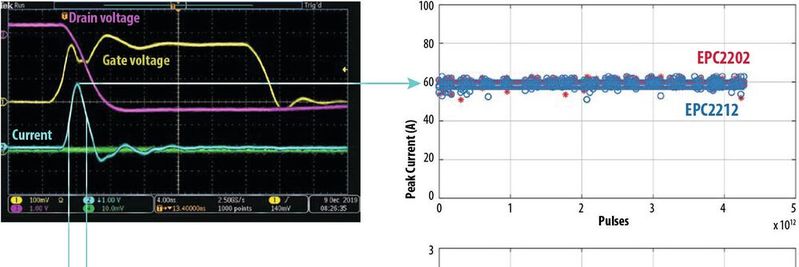
Figure 1: Long-term stability of pulse width (bottom right) and pulse height (top right) over 4.2 trillion lidar pulses. Data for 4 EPC2202 (red) devices and 4 EPC2212 (blue) devices are overlaid in the plots. Note the excellent stability of these key parameters over total number of pulses corresponding to a typical automotive lifetime.
(Source: EPC)
Gallium nitride (GaN) power devices have been in volume production since March 2010 and have established a remarkable field reliability record. An automotive application using GaN power devices in high volume is lidar (light detection and ranging) for autonomous vehicles. Lidar technology provides information about a vehicle’s surroundings, thus requiring high accuracy and reliability to ensure safety and performance. This article will discuss a novel testing mechanism developed by Efficient Power Conversion (EPC) to test eGaN devices beyond the qualification requirements of the Automotive Electronics Council (AEC) for the specific use case of lidar.
Gallium Nitride for Lidar Applications
eGaN FETs and ICs are widely implemented in lidar circuits for autonomous vehicles, where they offer several key benefits:
Faster switching for shorter pulses and better range resolution,
Smaller footprint which enables high power density, low inductance, and compact solutions,
Higher efficiency at higher pulse repetition rates.
In a lidar application, the GaN device delivers short, high-current pulses, on the order of 1−5 ns, which drive a laser diode to generate narrow optical pulses. The peak currents are usually substantially greater than 50% of the FET pulse-current rating. The pulse duty cycle is typically low, and the pulse repetition frequency is in the range of 10 to 100 kHz. When not being pulsed, the GaN device is in the OFF state, exposed to a certain drain bias.
This stress condition is somewhat unusual for a power device, making it difficult to predict lifetime in operation by projecting conventional DC reliability tests such as HTGB or HTRB. Even GaN-specific tests, like the hard-switching reliability testing employed by EPC, do not effectively emulate the stress conditions in a lidar circuit.
Long-Term Stability Under High Current Pulses
From the standpoint of physics of failure, the simultaneous high current and voltage during a pulse raises concerns about hot-carrier effects, potentially leading to VTH or RDS(on) shifting within the device. In addition, the cumulative effect of repetitive high current pulses raises the specter of electro-migration leading to degradation of the solder joints.
To address these concerns in lidar applications, EPC initiated a novel test method in collaboration with key customers. This lidar reliability testing is part of EPC’s Beyond AEC Initiative, a series of GaN specific stress tests that go beyond the conventional reliability tests developed for MOSFETs as part of AEC-Q101 standard.
The concept of this test method is to stress parts in an actual lidar circuit for a total number of pulses commensurate with their ultimate mission profile. The mission profiles for automotive lidar vary from customer to customer. A typical automotive profile would call for a 15-year life, with two hours operation per day, at 100 kHz pulse repetition frequency (PRF). This corresponds to approximately four trillion total lidar pulses. Some worst-case scenarios might call for ten to twelve trillion pulses in service life. By testing a population of devices well beyond the end of their full mission profile while verifying the stability of the system performance and the device characteristics, this test method directly demonstrates the lifetime of eGaN devices in a lidar mission. Note that this direct approach eliminates the need for an acceleration factor or activation energy of dubious validity. It also removes the need to somehow project lifetime estimates from standard reliability tests to the unique stress conditions of lidar.
The Test Methodology and The Results
To achieve the large number of pulses, parts are stressed continuously at a pulse repetition frequency (PRF) much higher than in typical lidar circuits. The test circuit is based on EPC’s popular EPC9126 lidar application board. Experimental details of the testing procedures are provided in Appendix B of EPC’s Phase 11 Reliability Report.
For this study, two popular AEC grade parts were put under test: EPC2202 (80V) and EPC2212 (100V). Four parts of each type were tested simultaneously. During the stress, two key parameters were continuously monitored on every device: (i) peak pulse current and (ii) pulse width. These parameters are both critical to the range and resolution of a lidar system. Figure 1 shows the results of this test over the first 4.2 trillion pulses. Note that there is no observed degradation or drift in either the pulse width or height. The cumulative number of pulses corresponds to a typical automotive lifetime. While this is an indirect monitor of the health of the eGaN device, it indicates that no degradation mechanisms have occurred that would adversely impact circuit performance.
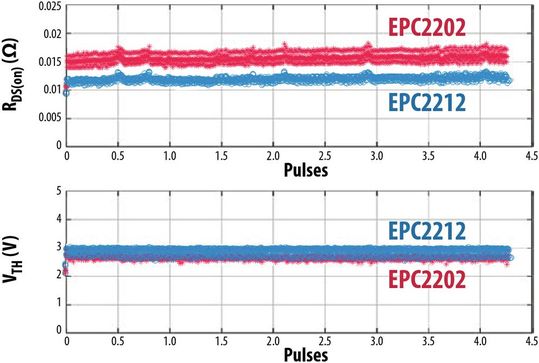
Figure 2: Long-term stability of RDS(on) and VTH during lidar reliability testing. These parameters are measured at six-hour intervals on every part by briefly interrupting the lidar stress. Note that VTH is inferred by measuring RDS(on) at a series of gate voltages. Data for four EPC2202 (red) devices and four EPC2212 (blue) devices are overlaid in the plots. Note the excellent stability of these key parameters over total number of pulses corresponding to a typical automotive lifetime.
(Source: EPC)
To gain better visibility into the eGaN device parametric stability over time, the test system interrupts lidar stress every six hours to measure the RDS(on) and device threshold VTH. After this brief parametric measurement, the parts are returned quickly to lidar stress mode. The results are shown in Figure 2. Both parameters show excellent stability over the duration of the test. The stability indicates that lidar stress is relatively benign to eGaN devices.
Stand: 08.12.2025
Es ist für uns eine Selbstverständlichkeit, dass wir verantwortungsvoll mit Ihren personenbezogenen Daten umgehen. Sofern wir personenbezogene Daten von Ihnen erheben, verarbeiten wir diese unter Beachtung der geltenden Datenschutzvorschriften. Detaillierte Informationen finden Sie in unserer Datenschutzerklärung.
Einwilligung in die Verwendung von Daten zu Werbezwecken
Ich bin damit einverstanden, dass die Vogel Communications Group GmbH & Co. KG, Max-Planckstr. 7-9, 97082 Würzburg einschließlich aller mit ihr im Sinne der §§ 15 ff. AktG verbundenen Unternehmen (im weiteren: Vogel Communications Group) meine E-Mail-Adresse für die Zusendung von redaktionellen Newslettern nutzt. Auflistungen der jeweils zugehörigen Unternehmen können hier abgerufen werden.
Der Newsletterinhalt erstreckt sich dabei auf Produkte und Dienstleistungen aller zuvor genannten Unternehmen, darunter beispielsweise Fachzeitschriften und Fachbücher, Veranstaltungen und Messen sowie veranstaltungsbezogene Produkte und Dienstleistungen, Print- und Digital-Mediaangebote und Services wie weitere (redaktionelle) Newsletter, Gewinnspiele, Lead-Kampagnen, Marktforschung im Online- und Offline-Bereich, fachspezifische Webportale und E-Learning-Angebote. Wenn auch meine persönliche Telefonnummer erhoben wurde, darf diese für die Unterbreitung von Angeboten der vorgenannten Produkte und Dienstleistungen der vorgenannten Unternehmen und Marktforschung genutzt werden.
Meine Einwilligung umfasst zudem die Verarbeitung meiner E-Mail-Adresse und Telefonnummer für den Datenabgleich zu Marketingzwecken mit ausgewählten Werbepartnern wie z.B. LinkedIN, Google und Meta. Hierfür darf die Vogel Communications Group die genannten Daten gehasht an Werbepartner übermitteln, die diese Daten dann nutzen, um feststellen zu können, ob ich ebenfalls Mitglied auf den besagten Werbepartnerportalen bin. Die Vogel Communications Group nutzt diese Funktion zu Zwecken des Retargeting (Upselling, Crossselling und Kundenbindung), der Generierung von sog. Lookalike Audiences zur Neukundengewinnung und als Ausschlussgrundlage für laufende Werbekampagnen. Weitere Informationen kann ich dem Abschnitt „Datenabgleich zu Marketingzwecken“ in der Datenschutzerklärung entnehmen.
Falls ich im Internet auf Portalen der Vogel Communications Group einschließlich deren mit ihr im Sinne der §§ 15 ff. AktG verbundenen Unternehmen geschützte Inhalte abrufe, muss ich mich mit weiteren Daten für den Zugang zu diesen Inhalten registrieren. Im Gegenzug für diesen gebührenlosen Zugang zu redaktionellen Inhalten dürfen meine Daten im Sinne dieser Einwilligung für die hier genannten Zwecke verwendet werden. Dies gilt nicht für den Datenabgleich zu Marketingzwecken.
Recht auf Widerruf
Mir ist bewusst, dass ich diese Einwilligung jederzeit für die Zukunft widerrufen kann. Durch meinen Widerruf wird die Rechtmäßigkeit der aufgrund meiner Einwilligung bis zum Widerruf erfolgten Verarbeitung nicht berührt. Um meinen Widerruf zu erklären, kann ich als eine Möglichkeit das unter https://contact.vogel.de abrufbare Kontaktformular nutzen. Sofern ich einzelne von mir abonnierte Newsletter nicht mehr erhalten möchte, kann ich darüber hinaus auch den am Ende eines Newsletters eingebundenen Abmeldelink anklicken. Weitere Informationen zu meinem Widerrufsrecht und dessen Ausübung sowie zu den Folgen meines Widerrufs finde ich in der Datenschutzerklärung, Abschnitt Redaktionelle Newsletter.
Summary: Short, high-current pulse (lidar) testing of eGaN devices shows they are very reliable in a lidar application over a typical automotive lifetime. As of the publishing of the EPC’s Phase 11 Reliability Report in March of 2020, no failure modes or parametric degradation have been observed. GaN power devices, already in volume production in lidar applications, provide the accuracy and robustness needed to ensure the performance and safety required for autonomous navigation.
* Ph.D. Alex Lidow, Ph.D. Robert Strittmatter, Ph.D. Shengke Zhang and Ph.D. Alejandro Pozo work at Efficient Power Conversion, El Segundo/California.




:quality(80)/p7i.vogel.de/wcms/37/ec/37ece4c276f37114e8f40696ff5dcd66/0130537789v2.jpeg "Um die Entwicklung von High-TRL-Halbleiter-Qubits zu beschleunigen und damit in Europa produzierte Quantensysteme in größerem Maßstab zu ermöglichen wurde die vom belgischen Forschungsinstitut IMEC koordinierte Quanten-Pilotlinie SPINS ins Leben gerufen. (Bild: Imec)")
:quality(80)/p7i.vogel.de/wcms/46/7c/467c0afffbfd10c3553c2888a4a6289f/0130479810v3.jpeg "Spezielle Elektroden, die Forscher am Fraunhofer IFAM entwickeln, entfernen wertvolle Rohstoffe wie Lithium und Kobalt beim Recyceln von Batterien aus dem Prozesswasser. (Bild: Fraunhofer IFAM)")
:quality(80)/p7i.vogel.de/wcms/12/3d/123d9eb2c2e4ce13296371a2ad3718a4/0130412664v2.jpeg "In seiner PCIe-5.0-SSD „BM9K1“ setzt Samsung erstmals statt ARM auf RISC-V-Kerne für den Festplattencontroller. (Bild: Samsung / finance.biggo.jp)")
:quality(80)/p7i.vogel.de/wcms/b6/e7/b6e755d9e704319c0bb59dc1ac2d67e8/0130537290v2.jpeg "Menschliches Wissen, künstliche Intelligenz: Intelligente Datenverarbeitung direkt am Einsatzort verlangt nach dem Zusammenspiel von KI, Hardware-Know-how und konkreter Anwendungserfahrung. (Bild: Dall-E / KI-generiert)")
:quality(80)/p7i.vogel.de/wcms/8b/10/8b10d1edceb749de99c1df3ad97be01e/0130564619v2.jpeg "Infrastruktur für KI-Agenten: Intel und Sambanova teilen Rechenlast auf drei Prozessortypen auf (Bild: Gemini / KI-generiert)")
:quality(80)/p7i.vogel.de/wcms/ac/da/acda3bafe46d3bf8e104a2a7bc2ac557/0130535476v2.jpeg "Geschätzter Ansprechpartner für Journalisten: Alfred Eiblmayr koordiniert seit vielen Jahren beim Halbleiterhersteller STMicroelectronics die Presse- und Öffentlichkeitsarbeit. Als ehemaliger Redakteur weiß er, worauf es ankommt. (Bild: Alfred Eiblmayr)")
:quality(80)/p7i.vogel.de/wcms/ca/9b/ca9b681785123f9700518a46897f9779/0130428786v1.jpeg "Biometrische Systeme mit künstlicher Intelligenz sind darauf ausgelegt, Personen anhand ihrer physischen oder verhaltensbezogenen Merkmale zu erkennen. (Bild: © AlinStock - stock.adobe.com)")
:quality(80)/p7i.vogel.de/wcms/38/cb/38cbe19e814dd30b94780bc3946547ab/0130446533v2.jpeg "Zur Absicherung seines KI-Ökosystems geht Nvidia eine Strategische Partnerschaft mit Marvell ein und investiert hierfür 2 Mrd. US-$ in den ASIC-Spezialisten. Im Fokus stehen NVLink Fusion, optische Interconnects und Silicium Photonics. (Bild: Marvell)")
:quality(80)/p7i.vogel.de/wcms/c2/88/c28805ea7b2261235475146a5b0c61f8/0130313028v2.jpeg "x86 trifft adaptive Logik: Auf der Messe demonstriert AMD die industrielle Vernetzung eines Node-RED-Gateways (links) mit Zynq-UltraScale+-Controllern (Mitte) und einer Soft-SPS auf Basis der Ryzen AI P100 Serie (rechts). (Bild: Manuel Christa)")
:quality(80)/p7i.vogel.de/wcms/fa/8d/fa8dedee195f29c33c89d86311c258ee/0130104146v2.jpeg "Kompakte KI-Power: Die Smart-Module SIM8668 und SIM8666 von Simcom vereinen auf kleinstem Raum eine Quad-Core-CPU samt integrierter NPU für ressourcenschonende Industrie- und Robotikanwendungen. (Bild: Chip: Simcom/Hintergrund: KI-generiert)")
:quality(80)/p7i.vogel.de/wcms/69/7a/697a270ed7538378d1fbc0f0b240ed25/0130534691v3.jpeg "Die Wago Stromversorgung Pro 2 ist eine intelligente und zuverlässige Stromversorgung mit integrierter Redundanz und MOSFET-Technologie und gewährleisten dadurch eine höhere Zuverlässigkeit der Anwendung. (Bild: WAGO GmbH & Co. KG)")
:quality(80)/p7i.vogel.de/wcms/e7/a4/e7a4e048491e60cb30e22a860f5d68bc/0130519425v4.jpeg "Dynamisch:
Die Zuverlässigkeit der Stromversorgung hängt von mechanischen und thermischen Faktoren sowie zeitlichen Abfolgen ab. (Bild: inpotron Schaltnetzteile GmbH)")
:quality(80)/p7i.vogel.de/wcms/1b/f0/1bf02d41e3eac721823841a4c1228753/0130519149v2.jpeg "Der Wandler GQA2W024A050V-007-R ist in mehreren Gehäusekonfigurationen erhältlich, um Entwicklern maximale Flexibilität für ihr Gesamtgehäusedesign und die Kühlung des Wandlers zu bieten. (Bild: TDK-Lambda)")
:quality(80)/p7i.vogel.de/wcms/1a/53/1a539631c940d184689460600bd2b395/0130410666v2.jpeg "Das iG-G74M von iWave Global ist das erste erhältliche System-on-Module, das den neuen FPGA-Modulstandard oHFM.c der SGeT erfüllt. (Bild: iWave Global)")
:quality(80)/p7i.vogel.de/wcms/10/45/1045969e69a1db4aaa73d0f74f55cc02/0129962687v2.jpeg "Bosch Rexroth und AMD arbeiten gemeinsam an Software-Defined Automation: ctrlX OS unterstützt nun auch auf AMD Embedded x86-CPUs und adaptive SoCs und verspricht so noch größere Hardware-DesignFlexibilität, nahtlose Skalierbarkeit und eine sichere, modulare Betriebssystem-Grundlage. (Bild: Bosch Rexroth AG)")
:quality(80)/p7i.vogel.de/wcms/cd/32/cd3243e4a9a6476265ef6ea9463dfbd8/0129852659v2.jpeg "Die PIC64-Serie an Multicore-Mikroprozessoren setzt auf RISC-V-Kerne und eignen sich speziell für Anwendungen mit asynchronem Multipricessing (AMP) in intelligenten Embedded-Edge-Anwendungen. (Bild: Microchip)")
:quality(80)/p7i.vogel.de/wcms/ba/e4/bae4e54395e5a53088060531ef99b814/0130359274v2.jpeg "Mit dem Fuse EDA AI Agent verfolgt Siemens EDA ein umfassendes Programm, alle Aspekte des Chipdesigns mit KI-Coworkern zu erleichtern, auch in Questa One. (Bild: Siemens EDA)")
:quality(80)/p7i.vogel.de/wcms/35/af/35af7dd326d198475d06fbb69aa600b5/0130175971v2.jpeg "Diff GT kann in einer kostenlosen Probeversion ausprobiert werden. (Bild: CSci)")
:quality(80)/p7i.vogel.de/wcms/c0/2e/c02e7bf72bfc434888c37100e2511681/0130127767v3.jpeg "„Wegen seiner kompakten Bauweise, des modularen Aufbaus und der hohen Effizienz ist der Axialflussmotor eine attraktive Alternative zur etablierten Radialflussmotor-Topologie“, PEM-Leiter Professor Achim Kampker (Bild: RWTH Aachen University)")
:quality(80)/p7i.vogel.de/wcms/e1/0b/e10bc04827e33786548587e32bbae422/0130438700v2.jpeg "Optische Datenkommunikation: Um Bauteile auf Basis optischer Datenkommunikation umfassend testen zu können, sind neue Testfähigkeiten erforderlich. (Bild: © kudzik - stock.adobe.com / KI-generiert)")
:quality(80)/p7i.vogel.de/wcms/35/06/3506f2a8d33a696aaef12a30771bd8d8/0130496747v2.jpeg "Ein von Keysight entwickelter Empfänger-Test für 10BASE-T1S fördert den Test von funktionskritischen Empfängern, um die Zuverlässigkeit und Sicherheit künftiger Bordnetzwerke zu gewährleisten. (Bild: Keysight)")
:quality(80)/p7i.vogel.de/wcms/e5/ed/e5ed08c670c44565a9130e95a760dddc/0130494578v2.jpeg "PV-Anlage auf dem Dach der Elbfabrik, einer Forschungsfabrik des Fraunhofer IFF. Mit einem Sensorsystem lassen sich Fehler in PV-Großanlagen frühzeitig erkennen. (Bild: Fraunhofer IFF/Anne Bornkessel)")
:quality(80)/p7i.vogel.de/wcms/ce/33/ce336bc438b912829effe8d4704dc159/0130480307v2.jpeg "Die VNA-Plattform von Siglent unterstützen vollständige Zweitor-S-Parameter-Messungen von 9 kHz bis 3 GHz. (Bild: Siglent)")
:quality(80)/p7i.vogel.de/wcms/3a/72/3a722ed2ad6ac4894c352e6ce87b6560/0130567207v2.jpeg "Mit Seamless Automation macht Festo die Automatisierungstechnik so einfach, dass Technik ein Erlebnis wird. Das Konzept baut Komplexität ab und schafft Klarheit für intuitive Lösungen – zu erleben auf dem Festo Stand in Halle 13 auf der Hannover Messe 2026. (Bild: Festo)")
:quality(80)/p7i.vogel.de/wcms/e4/d1/e4d122a8ecce14b98c8298c1cc130194/0130561462v2.jpeg "(Bild: Spectra AG)")
:quality(80)/p7i.vogel.de/wcms/3c/55/3c5505dd3ca3971cddd09c583a4c907d/0130458429v2.jpeg "Fit für Extrembedingungen: Diese Illustration zeigt einen photonischen Chip, dessen Komponenten mit der neuen Verbindungstechnik hochstabil gebondet wurden. (Bild: NIST)")
:quality(80)/p7i.vogel.de/wcms/47/ce/47ce64bad7990f276f68cbb24505f6dd/0130472850v2.jpeg "Data Modul fokussiert sich auf die Integration kompletter Display-Systeme. (Bild: Data Modul)")
:quality(80)/p7i.vogel.de/wcms/2e/95/2e9597b5dc1873771c7fe9c32ac41e82/0130549010v2.jpeg "Deepsleep: 13 Stunden lang war Deepseek nicht verfügbar. Nutzer spürten die Auswirkungen teils deutlich. (Bild: Dall-E / KI-generiert)")
:quality(80)/p7i.vogel.de/wcms/15/56/15564dea31861c376a385658c3b961a3/0130465243v2.jpeg "Luftaufnahme von Intels Fab 34 in Leixlip, Irland, aus dem Jahr 2024. In dem Werk werden Chips nach den hauseigenen Verfahren Intel 3 und Intel 4 gefertigt. (Bild: Intel)")
:quality(80)/p7i.vogel.de/wcms/bf/2a/bf2aad428ab1a80e6738fdbdc2efeb7e/0130453420v2.jpeg "Unter Dach und Fach: Nach Freigabe aller zuständigen Behörden das das amerikanische Unternehmen Molex den britischen Verbindungstechnik-Anbieter Smiths Interconect übernommen. (Bild: Molex / Smiths Interconect)")
:quality(80)/p7i.vogel.de/wcms/d6/ea/d6eac438c362c545cab42ef0f30bcfc0/0130136975v2.jpeg "Die Bewerbungsphase für den James Dyson Award 2026 ist gestartet. (Bild: Dyson)")
:quality(80)/p7i.vogel.de/wcms/e5/6c/e56ceb935ba09cb66a4fd0f961b2d3e9/0129642888v2.jpeg "(Bild: Vogel Professional Education)")
:quality(80)/p7i.vogel.de/wcms/69/1f/691f39ba12be3cad90eb88bdabc456a6/0127321404v2.jpeg "Das Kreativteam Christian Göller, GreatScott! und Christopher Becht (v. l. n. r.): erfolgreiches Creator-Marketing im B2B-Sektor (Bild: Würth Elektronik)")
:quality(80)/p7i.vogel.de/wcms/da/e4/dae45caa7f4fa7125e17b07d9da016bb/0125786170v2.jpeg "Soft termination prevents cracks by absorbing mechanical stress through a resin layer. (Bild: TAIYO YUDEN CO., LTD.)")
:quality(80)/p7i.vogel.de/wcms/ab/73/ab73d241611c109a242a4e5f1b50d01e/0128483827v4.jpeg "Filter elements in various SMD designs. (Bild: TAIYO YUDEN)")