Modern vehicles are packed with electronics, control units and sensors and cameras. They all need to communicate with each other. Data traffic on the buses is increasing.
Car communications: From a distributed to a zonal E/E architecture.
Three major trends are currently revolutionizing vehicle design: automated, electric, and connected driving. To enable these huge advances, a redesign of the E/E architecture is needed. Today's vehicles and their common E/E architectures consist of up to 150 separate ECUs and complex, weight-intensive wiring. Future technologies such as automated driving (ADAS) require more functions and therefore more sensor data and ECUs to implement each function.
Many electronic control units (ECUs) currently process the majority of sensor information locally. To cope with the growing complexity of vehicle functions, increasing data volumes, and increasing computing power, automotive manufacturers and suppliers are striving to transition from a distributed to a zonal E/E architecture. This new concept results in new network requirements.
Zonal modules are optimally placed in the vehicle and take over communication into and out of a zone. This requires a backbone system that distributes and collects data in the vehicle system. The sensors in the vehicle generate hundreds of megabytes of data per second that must be exchanged between the electronic control units with predictably low latencies (in the range of microseconds to milliseconds).
Automotive Ethernet Time Sensitive Networking
Traditional in-vehicle communication networks allow low-latency communication, but do not meet the high-bandwidth requirements. Due to this limitation, a high-bandwidth, low-latency network protocol is needed to support backbone communications in modern vehicles. Ethernet has been used for quite some time for diagnostic purposes, for feeding data from image sensors and for vehicle infotainment systems within vehicles.
By adding deterministic timing functions, the range of applications for Ethernet can be expanded considerably. The IEEE Time Sensitive Networking (TSN) working group has developed a set of standards to meet the requirements for in-vehicle communications with high bandwidth and low latency.
Advances in TSN standards include support for clock synchronization, resource reservation for different types of traffic, various traffic shapers, support for scheduled traffic, frame preemption, and network management mechanisms. In the future, the network technology Automotive Ethernet and the protocol extension TSN (Time Sensitive Networking) could further bring about significant changes if the vehicle network is divided into subnetworks of spatial zones in which special control units, so-called gateways, realize the connection of local control units.
Traditional automotive bus systems transition
The classic CAN variants have proven their worth for over three decades in various applications, especially in vehicles. With CAN XL, a new variant of the data bus is in the starting blocks, which is intended to close the gap in transmission rates between signal-based communication and automotive Ethernet technology. Not only because of the hardware costs and high transmission reliability, CAN XL is interesting for all users who want to continue their developments based on existing architectures.
In 2018, initial work on the development of the third generation of CAN-based data link layer protocols was started within the framework of CiA with the active participation of Fraunhofer IPMS. CAN XL offers a maximum payload of 2,048 bytes per frame. By means of an "acceptance field" it is now possible to separate the priority function (11-bit priority field) from the address & content function (32-bit acceptance field), which is significant for use in automotive applications, for example.
With a targeted data rate of up to 20 Mbit/s and a maximum payload of 2048 bytes, CAN XL allows the tunneling of TCP/IP packets, thus achieving significantly better interoperability, and opening up for new types of applications. Nevertheless, users can still benefit from the advantages of the classic CAN protocol when using CAN XL:
Fraunhofer IPMS IP Core Solutions for the Automotive Industry
Different components in vehicles require different bandwidths and latency, and the complexity of networking continues to increase as the number of ECUs used in vehicles grows. Different approaches in the automotive industry with regard to cost efficiency and flexibility require different network technologies in the vehicle in order to optimally adapt to the increasing requirements of the coming years, both technically and economically.
Stand: 08.12.2025
Es ist für uns eine Selbstverständlichkeit, dass wir verantwortungsvoll mit Ihren personenbezogenen Daten umgehen. Sofern wir personenbezogene Daten von Ihnen erheben, verarbeiten wir diese unter Beachtung der geltenden Datenschutzvorschriften. Detaillierte Informationen finden Sie in unserer Datenschutzerklärung.
Einwilligung in die Verwendung von Daten zu Werbezwecken
Ich bin damit einverstanden, dass die Vogel Communications Group GmbH & Co. KG, Max-Planckstr. 7-9, 97082 Würzburg einschließlich aller mit ihr im Sinne der §§ 15 ff. AktG verbundenen Unternehmen (im weiteren: Vogel Communications Group) meine E-Mail-Adresse für die Zusendung von redaktionellen Newslettern nutzt. Auflistungen der jeweils zugehörigen Unternehmen können hier abgerufen werden.
Der Newsletterinhalt erstreckt sich dabei auf Produkte und Dienstleistungen aller zuvor genannten Unternehmen, darunter beispielsweise Fachzeitschriften und Fachbücher, Veranstaltungen und Messen sowie veranstaltungsbezogene Produkte und Dienstleistungen, Print- und Digital-Mediaangebote und Services wie weitere (redaktionelle) Newsletter, Gewinnspiele, Lead-Kampagnen, Marktforschung im Online- und Offline-Bereich, fachspezifische Webportale und E-Learning-Angebote. Wenn auch meine persönliche Telefonnummer erhoben wurde, darf diese für die Unterbreitung von Angeboten der vorgenannten Produkte und Dienstleistungen der vorgenannten Unternehmen und Marktforschung genutzt werden.
Meine Einwilligung umfasst zudem die Verarbeitung meiner E-Mail-Adresse und Telefonnummer für den Datenabgleich zu Marketingzwecken mit ausgewählten Werbepartnern wie z.B. LinkedIN, Google und Meta. Hierfür darf die Vogel Communications Group die genannten Daten gehasht an Werbepartner übermitteln, die diese Daten dann nutzen, um feststellen zu können, ob ich ebenfalls Mitglied auf den besagten Werbepartnerportalen bin. Die Vogel Communications Group nutzt diese Funktion zu Zwecken des Retargeting (Upselling, Crossselling und Kundenbindung), der Generierung von sog. Lookalike Audiences zur Neukundengewinnung und als Ausschlussgrundlage für laufende Werbekampagnen. Weitere Informationen kann ich dem Abschnitt „Datenabgleich zu Marketingzwecken“ in der Datenschutzerklärung entnehmen.
Falls ich im Internet auf Portalen der Vogel Communications Group einschließlich deren mit ihr im Sinne der §§ 15 ff. AktG verbundenen Unternehmen geschützte Inhalte abrufe, muss ich mich mit weiteren Daten für den Zugang zu diesen Inhalten registrieren. Im Gegenzug für diesen gebührenlosen Zugang zu redaktionellen Inhalten dürfen meine Daten im Sinne dieser Einwilligung für die hier genannten Zwecke verwendet werden. Dies gilt nicht für den Datenabgleich zu Marketingzwecken.
Recht auf Widerruf
Mir ist bewusst, dass ich diese Einwilligung jederzeit für die Zukunft widerrufen kann. Durch meinen Widerruf wird die Rechtmäßigkeit der aufgrund meiner Einwilligung bis zum Widerruf erfolgten Verarbeitung nicht berührt. Um meinen Widerruf zu erklären, kann ich als eine Möglichkeit das unter https://contact.vogel.de abrufbare Kontaktformular nutzen. Sofern ich einzelne von mir abonnierte Newsletter nicht mehr erhalten möchte, kann ich darüber hinaus auch den am Ende eines Newsletters eingebundenen Abmeldelink anklicken. Weitere Informationen zu meinem Widerrufsrecht und dessen Ausübung sowie zu den Folgen meines Widerrufs finde ich in der Datenschutzerklärung, Abschnitt Redaktionelle Newsletter.
With a CAN and LIN controller IP cores, an IP core family for Time Sensitive Networking (TSN), Low Latency Ethernet MAC core and a 32-bit RISC-V IP processor core, Fraunhofer IPMS offers a comprehensive range of IP cores to meet the challenges of the new network architectures.
These automotive IP designs are offered platform independent and are suitable for integration into FPGAs as well as ASICs. Fraunhofer IPMS provides comprehensive manufacturer- and technology-independent consultancy on all development issues and adapts and continuously develops the IP cores according to the customers' needs. The multidisciplinary IP design team is available as a competent development partner in every development phase. A special focus is on safety-critical applications.
The use of ASIL-D
The ISO 26262 standard specifies the requirements for safety-critical electronic systems in the automotive sector so that hardware failures can be prevented and brought under control. The use of ASIL-D ready pre-certified IP cores from Fraunhofer IPMS significantly simplifies the approval process of the overall system, as relevant documents such as the FMEDA (Failure Mode and Effects Analysis) and the safety manual are already available and necessary safety functions are fully implemented and tested.
This guarantees the minimization of costs and time required for system development. SGS TÜV Saar is a certification partner for Fraunhofer IPMS IP Cores in the automotive sector.
Demonstration Multiprotocol Automotive Subsystem
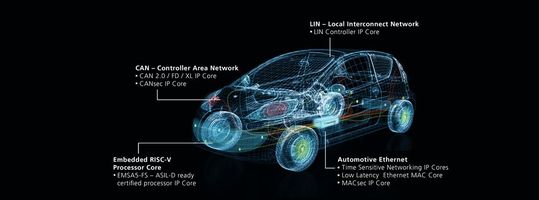
Figure 1: Demonstrates the type of customer-specific automotive networking subsystem, which combines CAN, LIN, TSN and the EMSA5-FS controller.
(source: Fraunhofer IPMS)
The advantages of CAN bus systems in combination with other protocols offer a wide range of applications. As an example, an automotive networking solution is outlined below — a Fraunhofer IPMS Automotive Networking Subsystem. The Fraunhofer IPMS EMSA5-FS uses among others the CAN-CTRL IP Core as peripheral device. The EMSA5-FS is a RISC-V processor core for functional safety and is designed as a 32-bit processor with a five-stage pipeline according to the open RISC-V instruction set architecture (ISA). The EMSA5-FS IP Core is available as a stand-alone processor or as a pre-configured subsystem.
Automotive bus systems require guaranteed low latencies and sometimes high bandwidths for the transmission of user data. New communication protocols such as CAN-XL or Ethernet-TSN are used in the context of automotive Ethernet in parallel to classic protocols such as CAN-FD, CAN2.0 or LIN. Bridging and Interbus switching is also integrated so that all the advantages of various bus systems can be used in automotive application scenarios.
Data packet between CAN XL, Ethernet and TSN
Gateways allow, for example, the bridging of data packets between CAN XL and Ethernet and vice versa, as well as the integration of real-time standards such as TSN. This allows real-time data streams from powertrain, chassis, cabin and infotainment, each of which has different specific requirements, to be combined in efficient E/E architectures.
The targeted combination of diverse protocols thus enables a tailored, application-oriented solution. Figure 1 demonstrates this type of customer-specific automotive networking subsystem, which combines not only CAN but also LIN, TSN and the EMSA5-FS controller for management tasks in one system.
* Monika Beck is Research and Development at Fraunhofer IPMS, Dresden.





:quality(80)/p7i.vogel.de/wcms/f1/2f/f12fcea90f39543f7eeb41528887fffd/0129774307v4.jpeg "Robotic Award Hannover Messe: Der Preis ging an goodBytz. Gründer Dr. Hendrik Susemihl (re) ist Ingenieur und promovierter Robotik-Experte. Er hatte die technische Vision und entwickelte den ersten Prototypen des Kochroboters. (Bild: Kristin Rinortner)")
:quality(80)/p7i.vogel.de/wcms/2f/bc/2fbc41c5140905b15698225ff58b203e/0129648135v2.jpeg "Das III-V-Germanium-PV-Modul mit einem Wirkungsgrad von 34,2 % ist das aktuell effizienteste Solarmodul der Welt. (Bild: Jacob Forster)")
:quality(80)/p7i.vogel.de/wcms/17/2c/172caa709bdbf17c495ef523f65663ad/0129630827v1.jpeg "Links: High Bandwith Flash (HBF) stapelt mehrere Schichten von NAND-Chips, um die Speicherkapazität deutlich zu erhöhen; Rechts: Konzept der in der IEEE-Studie vorgestellten „hybriden“ H³-Architektur. (Bild: Sandisk (links) / Sk hynix (rechts))")
:quality(80)/p7i.vogel.de/wcms/5c/42/5c4277b2a48f97332adfc485d6c7aee6/0129494885v2.jpeg "Bild 1: Einzelne Kupfersubstrate (a) sowie mit Lötpaste verbundene Kupfersubstrate in rohem (b), geschliffenem (c) und mit Polymerfolie beschichtetem (d) Zustand. (Bild: ZFW)")
:quality(80)/p7i.vogel.de/wcms/26/c7/26c7a8a41420adecc0864c3001233ac3/0129722027v2.jpeg "Der Meta-Konzern hat für den Ausbau seiner KI-Kapazitäten einen über fünf Jahre währenden Vertrag über GPU- und CPU-Lieferungen geschlossen. Vereinbart ist die Lieferung von bis zu 6 Gigawatt an GPU-Rechenleistung in einem Gesamtwert von etwa 60 Mrs. US-Dollar. (Bild: frei lizenziert)")
:quality(80)/p7i.vogel.de/wcms/7e/5f/7e5f325ff1bfc6b00cf7bbbd51eb8f4f/0129653700v2.jpeg "Ein WBA-Report zeigt auf, warum KI und Machine Learning zur Grundlage moderner Wi-Fi-Netze werden, und plädiert für offene Standards entscheidend, um Fragmentierung zu vermeiden. (Bild: frei lizenziert)")
:quality(80)/p7i.vogel.de/wcms/7b/57/7b5725dd2e7545ab4904a9b7a3735721/0129309389v2.jpeg "Die embedded world 2026 findet vom 10. bis zum 12. März 2026 statt. (Bild: NürnbergMesse / Thomas Geiger)")
:quality(80)/p7i.vogel.de/wcms/44/2c/442ca7930230eaeb8d27d0234a9ab8d3/0129693467v2.jpeg "Eine Karte mit Programmcode, wie sie in Unterrichtseinheiten für COBOL-Programmierung auf einem IBM System/360 Mainframe eingesetzt wurde. Die über 65 Jahre alte Programmiersprache COBOL ist vor allem bei Legacy-Anwendungen im Bank- und Versicherungswesen noch fest verankert, und deren Modernisierung aufwändig und teuer. Laut Anthropic lässt sich dieser Aufwand nun mit dem KI-Tool Claude Code leicht automatisieren. (Bild: frei lizenziert)")
:quality(80)/p7i.vogel.de/wcms/e1/78/e17860d5b42a0bc53e323868d2777d79/0129752421v2.jpeg "(Bild: concept electronic GmbH)")
:quality(80)/p7i.vogel.de/wcms/92/43/9243cfe82b7ab3448679ded83cb50204/0129762425v2.jpeg "PLS‘ UDE 2026 ermöglicht jetzt auch das Debuggen hocheffizienter embedded KI-Beschleuniger. (Bild: PLS)")
:quality(80)/p7i.vogel.de/wcms/30/1f/301fa3142221a2ee6ba3ef07e89a4ec8/0129690250v2.jpeg "Die Solid-State-Batterie wurde 2026 auf der CES in Las Vegas vorgestellt. (Bild: Donut Lab)")
:quality(80)/p7i.vogel.de/wcms/e1/2d/e12d843be72a9dc1cab04b68f1c39e4a/0129691802v3.jpeg "Aufbau einer Flüssigmetall-Batterie - Projekt Solstice. (Bild: HZDR / Blaurock)")
:quality(80)/p7i.vogel.de/wcms/8b/e8/8be874cadb88f7d40c58381cd26f0122/0129697493v3.jpeg "Universell: Motoren kommen überall zum Einsatz. (Bild: Microchip Technology)")
:quality(80)/p7i.vogel.de/wcms/c7/f6/c7f61d0437c7f8fca3c6ff947ba2ad62/0129322490v2.jpeg "AMD hat die zweite Generation der Kintex UltraScale+ Gen 2 FPGA-Familie vorgestellt, die mit PCIe Gen4 den 4K-AV-over-IP-Betrieb für 4K/8K-Medienanwendungen unterstützt. (Bild: AMD)")
:quality(80)/p7i.vogel.de/wcms/66/0c/660c31afa35398bac9be42f2be73fdc4/0129073529v2.jpeg "FPGAs lösen Performance-Engpässe, gelten aber in der Programmierung als schwer zugänglich. Die universelle Programmiersprache Livt soll die Hürde senken – korrekt, deterministisch und HDL-kompatibel. (Bild: Toby Giessen / VCG)")
:quality(80)/p7i.vogel.de/wcms/9c/35/9c35ed04fa562b190cbc496a695a6802/0128823288v1.jpeg "Optimiert auf Skalierung oder Geschwindigkeit: Die SGET hat den offenen Standard oHFM für FPGA-Module in zwei Varianten vorgestellt. (Bild: SGET (Screencast / Screenshot))")
:quality(80)/p7i.vogel.de/wcms/7b/70/7b700e93abd717e2feb5466810810af4/0127597143v2.jpeg "Shrike-lite: FPGA und ein Mikrocontroller für nur vier US-Dollar. (Bild: Vicharak)")
:quality(80)/p7i.vogel.de/wcms/93/ee/93ee5e88736974a1259c7427fc92f019/0129633555v2.jpeg "Eine vom MIT entwickelte Chip-Verarbeitungsmethode könnte Kryptografieverfahren dabei unterstützen, Daten sicher zu halten, indem zwei Chips sich innerhalb desselben Systems gegenseitig anhand eines gemeinsamen Fingerabdrucks authentifizieren können. (Bild: frei lizenziert)")
:quality(80)/p7i.vogel.de/wcms/23/37/2337c3956a8f3d1cb3552ad197f0d78b/0129723446v2.jpeg "Nigel von Emerson NI ist ein integraler Bestandteil der Software geworden. (Bild: Emerson NI )")
:quality(80)/p7i.vogel.de/wcms/17/9c/179c11641120399cf2e4cf0e5943b107/0129645476v2.jpeg "Auf der „embedded world 2026” präsentiert Rohde & Schwarz einen Auszug aus seinem Portfolio an Messtechnik und Testsystemen. (Bild: Rohde & Schwarz)")
:quality(80)/p7i.vogel.de/wcms/84/10/8410f7a52af344d1e5626d0610c9fa23/0129553240v2.jpeg "Joe Woodford ist als Group Director für Global Sales & Marketing bei Pickering Interfaces tätig. Seiner Meinung nach war das Jahr 2025 für das Unternehmen von „globaler Unsicherheit geprägt“, die er unter anderem auf die von US-Präsident Trump verhängten Zölle zurückführte.
(Bild: Pickering Interfaces)")
:quality(80)/p7i.vogel.de/wcms/6c/b2/6cb2f5a31e5d99bea02cfcac09fc6e53/0129765681v2.jpeg "Strategische Allianz: Die neue Plattform soll künstliche Intelligenz in großem Maßstab in die Rechenzentren bringen. (Bild: Red hat/Nvidia)")
:quality(80)/p7i.vogel.de/wcms/01/02/01020f25b00a35b8229bfc2ca18edb3a/0129748520v2.jpeg "Physical AI in der Praxis: TwinCAT CoAgent übersetzt natürliche Sprache in Maschinenbefehle und ermöglicht die intuitive Steuerung komplexer mechatronischer Systeme. (Bild: Beckhoff Automation)")
:quality(80)/p7i.vogel.de/wcms/68/95/6895bd4fbdb1e9c84f6ebac2e11b03b3/0129764984v2.jpeg "China Resources Microelectronics (CR Micro) hat angekündigt, die Preise für die eigenen Produkte erhöhen zu wollen. (Bild: China Resources Microelectronics)")
:quality(80)/p7i.vogel.de/wcms/9d/13/9d131190bf01a4a85b6d63178e2567b8/0129778339v2.jpeg "Die Software-Investments in die Fertigung haben in der Lacon-Fertigung für einen Zeitgewinn gesorgt. (Bild: Lacon)")
:quality(80)/p7i.vogel.de/wcms/06/bf/06bf3e15e9d8ebc4f77a148b3066a8b8/0129680605v2.jpeg "Der Z22198 ist ein extrem kompakter, dreiachsiger IEPE-Beschleunigungssensor für das Messen von Schwingungen (Vibrationen) und Stößen (Schocks) in anspruchsvollen Anwendungen. Mit nur 6 mm Kantenlänge und 0,9 g Gewicht eignet er sich ideal für leichte Strukturen und beengte Platzverhältnisse. (Bild: Copyright 2020 ScROGERS,All Rights Reserved)")
:quality(80)/p7i.vogel.de/wcms/fd/fb/fdfb374c9c6980af66089d250209d0aa/0129722035v2.jpeg "SMIC ist Vorreiter bei Chinas Vorstoß, Chips in fortschrittlichen Prozessen zu fertigen. Das Unternehmen hat bereits 7-nm-Chips mit weniger fortschrittlichen Anlagen hergestellt; laut Nikkei Asia arbeite es nun an einer Technologie, die als „5-Nanometer-ähnlich“ bezeichnet wird. (Bild: SMIC)")
:quality(80)/p7i.vogel.de/wcms/e5/6c/e56ceb935ba09cb66a4fd0f961b2d3e9/0129642888v2.jpeg "(Bild: Vogel Professional Education)")
:quality(80)/p7i.vogel.de/wcms/69/1f/691f39ba12be3cad90eb88bdabc456a6/0127321404v2.jpeg "Das Kreativteam Christian Göller, GreatScott! und Christopher Becht (v. l. n. r.): erfolgreiches Creator-Marketing im B2B-Sektor (Bild: Würth Elektronik)")
:quality(80)/p7i.vogel.de/wcms/6a/cc/6acc4f803241cfe5b6d60560c0a2b4d9/0126684948v2.jpeg "In der Altersgruppe 25 bis 64 verfügen 34 Prozent der Deutschen über einen tertiären Abschluss im MINT-Bereich. (Bild: Dall-E / KI-generiert)")
:quality(80)/p7i.vogel.de/wcms/7d/27/7d277a20a9ea7e17c226372c4d951316/0124246561v2.jpeg "0124246561v2 (Source: Analog Devices)")
:quality(80)/p7i.vogel.de/wcms/ab/73/ab73d241611c109a242a4e5f1b50d01e/0128483827v4.jpeg "Filter elements in various SMD designs. (Bild: TAIYO YUDEN)")